Here is a number that should keep you up at night. Across 156,000 DTC customers, only 18.8% ever placed a second order within a year. That means for most Aussie Shopify stores, more than four in five customers buy once and vanish. You paid the ad cost, the shipping, the packaging and the support to win them, and they walked out the door for good.
What’s in This Article
Most founders respond to that by spending more on acquisition. Bigger Meta budget, another creative, a new influencer. It is the most expensive way to grow a store, and it ignores the cheapest revenue you own: the customers already sitting in your database who bought once, loved the product, and simply drifted.
You have a 60 to 70% chance of selling to an existing customer, versus 5 to 20% for a cold prospect. Reactivating a lapsed buyer costs 5 to 10 times less than acquiring a new one. A proper win-back flow is not a nice-to-have email. It is the highest-return marketing asset most Shopify stores never build. This playbook shows you the exact 5-part system we run with members inside eCommerce Circle.
Stage 1: Define “Lapsed” Around Your Buying Cycle, Not a Guess
The single biggest mistake in win-back is triggering the flow on the wrong day. Send too early and you are nagging a customer who was always going to reorder next week. Send too late and they have already found a competitor. Both leak money.
Your lapsed threshold should sit a little longer than your average time between orders. That number is different for every category, so pull your own data before you copy anyone. As a starting frame:
- Consumables (supplements, coffee, pet, skincare refills). A 30-day supply that has not repurchased by day 90 is dormant. That is three missed cycles.
- Apparel and seasonal. Buying is lumpy, so 150 to 180 days without a purchase is a fair lapse point.
- Home, electronics, durables. Replacement cycles are long. Twelve months of silence is your trigger.
In Shopify, find your real number by exporting order data and calculating the median gap between first and second orders for repeat buyers. Repeat categories like supplements and pet run a 35 to 45% repeat rate, beauty 30 to 40%, apparel 25 to 32%, and home or electronics as low as 12 to 25%. Your win-back timing should reflect where you actually sit, not a blog default. If you have not mapped your buying cycle yet, our Shopify LTV playbook walks through the exact calculation.
Stage 2: Segment Before You Send (Not Everyone Deserves a Discount)
Blasting one generic “we miss you, here is 20% off” to your entire lapsed list is lazy and expensive. It trains your best customers to wait for discounts and it torches margin on people who would have come back anyway. Segment first.
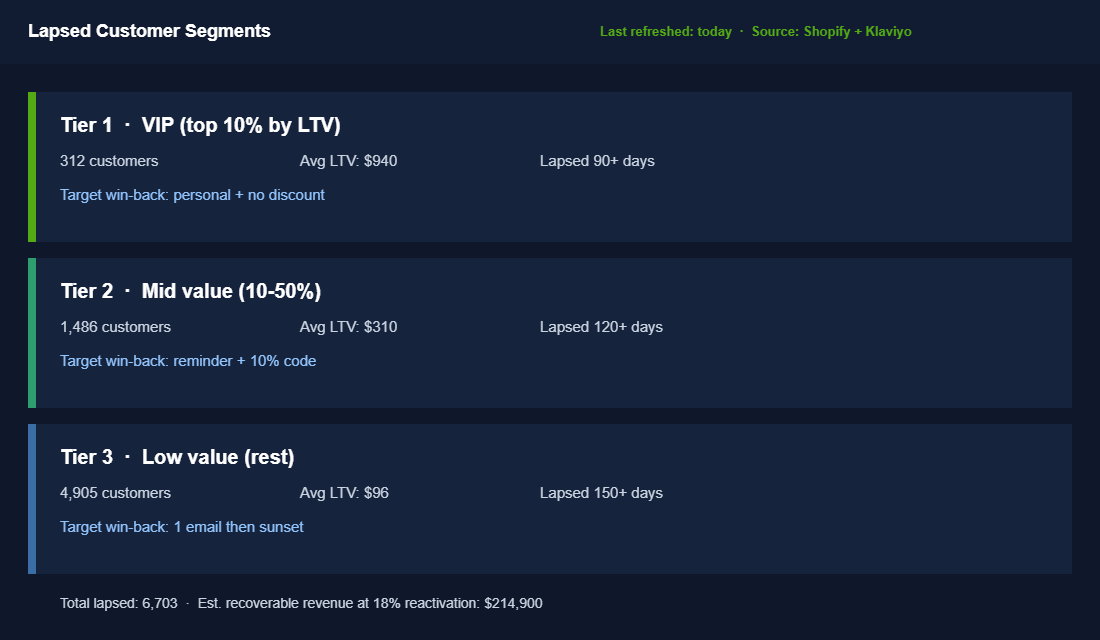
Split your lapsed audience into three value tiers based on lifetime spend, then treat each differently:
- Tier 1, your VIPs (top 10% by lifetime value). A dormant VIP is a red alert. These get a personal, no-discount touch first. A plain-text note from the founder outperforms a coupon here. If a customer has spent $900 with you, the problem is rarely price.
- Tier 2, mid value (the next 40%). These respond well to a reminder plus a modest incentive, a 10% code or free shipping, ideally tied to a minimum order value so you protect margin.
- Tier 3, low value (everyone else). One well-written email, then sunset. Do not spend margin or sender reputation chasing one-time bargain hunters who were never going to be loyal.
Fixed dollar discounts on a minimum spend (“$20 off orders over $100”) tend to convert higher-value customers better than a flat percentage, because the maths feels concrete. Build these tiers as saved segments so the flow can branch automatically. For the deeper mechanics of cutting your list this way, see our customer segmentation playbook.
Stage 3: The Three-Email Sequence That Does the Heavy Lifting
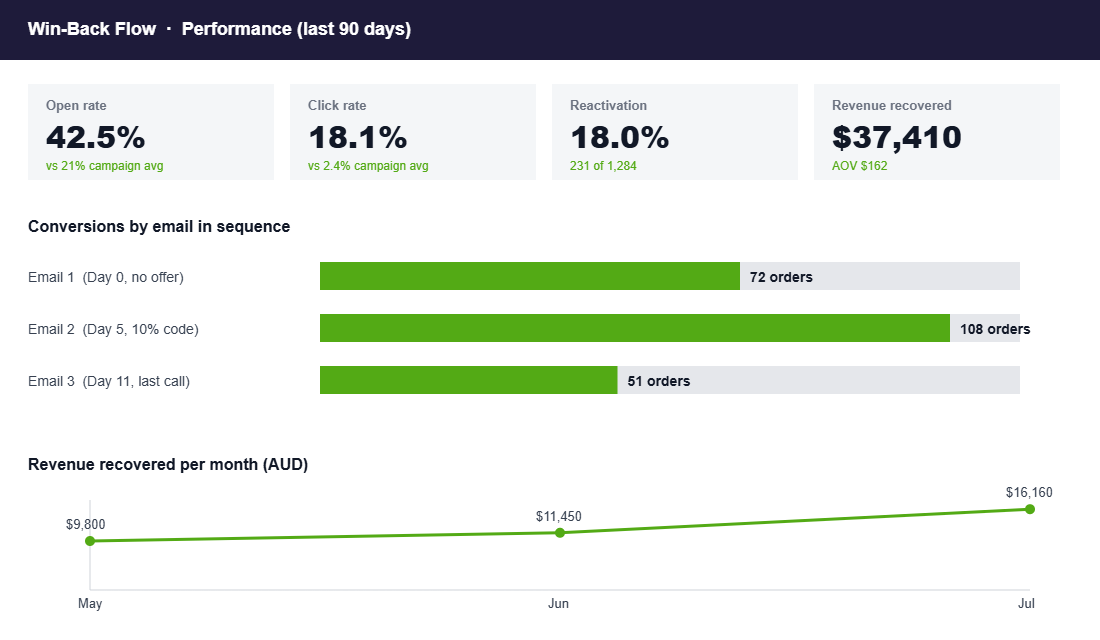
Klaviyo’s own guidance, backed by thousands of stores, is a three-email win-back: a light first touch, then two escalating follow-ups. A multi-touch series of three to five messages massively outperforms a single “come back” blast. Automated win-back flows pull a 42.5% open rate and around 18% click-through, several times higher than a standard campaign, because the intent is real: these people already trusted you once.
Here is the structure that works, and the timing to use:
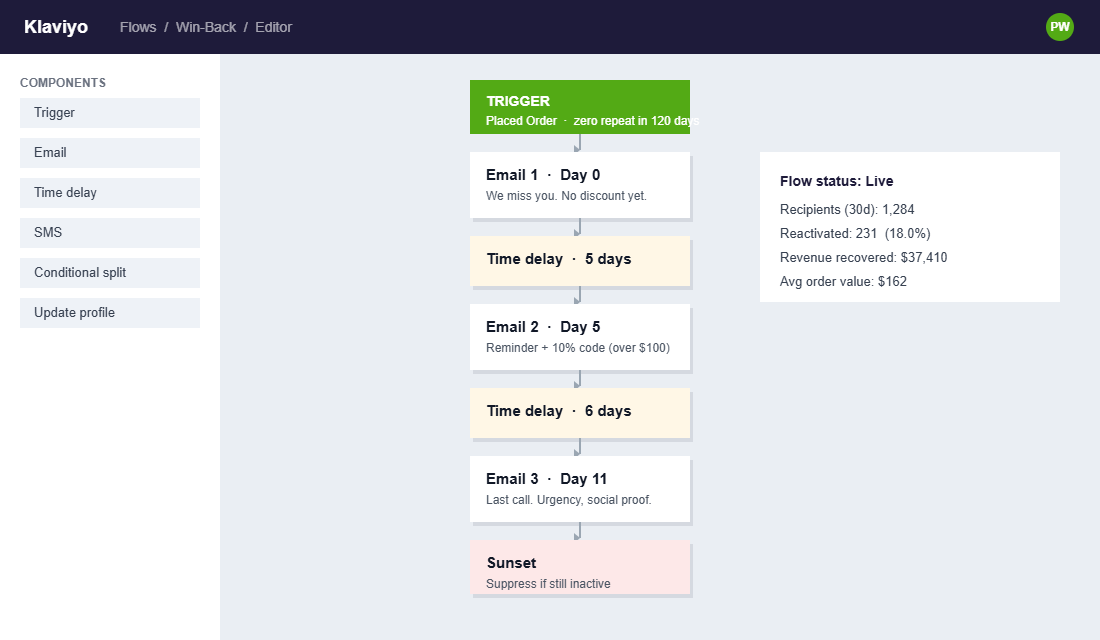
- Email 1, Day 0. No discount. Lead with the relationship, not a coupon. “We noticed you have been away” plus a reminder of why they bought and what is new. Give the discount-free version a real chance to convert. You will be surprised how many come back without you spending a cent of margin.
- Email 2, Day 5. The incentive. Now introduce the offer, matched to the customer’s tier. Reintroduce your hero product and stack in social proof: reviews, a best-seller badge, a real customer result. This is usually your highest-converting message in the sequence.
- Email 3, Day 11. Last call. Honest urgency. The code is expiring, the offer is closing. Keep it short. This email catches the procrastinators who meant to act on email 2 and forgot.
A well-run flow reactivates 2 to 5% of lapsed recipients per send, and top-quartile programs hit 5 to 10%. At the program level, good stores win back 12 to 20% of their inactive base over time, and the best push 20 to 35%. On a list of a few thousand lapsed buyers with a $150 average order, that is real money you are currently leaving on the table every single month.
One discipline: write like a human. Skip the corporate “we value your patronage” tone. Aussie customers can smell a template. The founder-voice email that says “genuinely wondering if the product missed the mark, hit reply and tell me” does double duty. It wins back the customer and it hands you product feedback money cannot buy.
Stage 4: Layer in SMS and Get the Offer Right
Email is the backbone, but the win-back is where SMS earns its keep. Combining SMS with email lifts conversion by around 54% versus email alone, because a text lands in a channel your customer actually checks within minutes. You are not replacing the emails, you are adding a single, well-timed nudge.
The pattern we use: keep the three emails, then drop one SMS between email 2 and email 3, aimed only at Tier 1 and Tier 2 customers who opened but did not buy. Something like “Hi Sarah, your 10% code closes tomorrow, here is the link.” Short, personal, and only to people who have shown a flicker of interest. If SMS is new to you, our Shopify SMS marketing playbook covers compliance and consent for Australian senders.
On the offer itself, three rules keep you out of trouble:
- Protect margin with a minimum spend. “$20 off orders over $100” recovers the customer without gutting your unit economics. A naked 25% off does the opposite.
- Never discount your VIPs by default. Your best customers left for a reason that is almost never price. A discount there is pure margin you did not need to give away.
- Make urgency honest. If the code expires in 72 hours, it must actually expire. Fake countdowns train customers to distrust you, and that costs far more than one lost sale.
Stage 5: Sunset the Truly Dead to Protect Deliverability
The unglamorous stage that separates pros from amateurs. If a customer ignores the entire win-back sequence, stop emailing them on the regular schedule. Continuing to hit unengaged addresses drags down your sender reputation, which quietly lowers deliverability for your whole list, including the customers who do want to hear from you.
Add a sunset step at the end of the flow: anyone who has not opened or clicked across the sequence gets suppressed from broadcast campaigns. They are not deleted, just parked. You can attempt a fresh win-back at the next big seasonal moment. This keeps your active list clean, your open rates high, and your Klaviyo bill honest, since you are not paying to email people who ghosted you months ago.
Two Aussie Brands That Treat Retention as a System
Who Gives A Crap, the Melbourne-born toilet paper brand, is a masterclass in staying wanted rather than chasing the lapsed. They email roughly twice a month with a genuine reason to open, mixing subscription reminders and product news with the ethical mission that made customers buy in the first place. The lesson for your win-back: people come back to brands they feel part of, so your reactivation copy should reconnect them to the “why”, not just wave a coupon.
Frank Body, the Melbourne skincare brand, built a repeat engine on a consumable product plus a rewards program and replenishment reminders that nudge customers right as their scrub runs low. That timing discipline is the whole game. They message when the product is about to run out, not on a random calendar date. Copy their instinct: anchor your win-back trigger to the moment of genuine need in your own category.
Build It in Klaviyo: The Setup, Step by Step
Klaviyo is the default for Shopify win-back because it reads your order data natively. Here is the build, start to finish:
- Create the flow. Flows, Create Flow, choose “Win-back” from the library or start blank.
- Set the trigger. Use a metric trigger on “Placed Order”, then add flow filters so it only enters customers whose last order was more than your lapse threshold ago (for example 120 days) and who have not placed an order since. This stops active customers ever entering.
- Add your tier branch. Insert a conditional split on lifetime value or “historic customer value” to route VIP, mid and low tiers down different paths.
- Space the emails. Email 1 sends on entry, a 5-day time delay, Email 2, a 6-day delay, then Email 3. For consumables, tighten the delays; for durables, widen them.
- Attach the discount. Generate a Shopify discount code (or use Klaviyo’s dynamic codes) for Email 2 and 3 only, with a minimum order value.
- Add the sunset. Close with a conditional split on engagement; the unengaged branch updates a profile property that excludes them from campaigns.
- Turn it live and watch Email 2. Give it 30 days, then compare conversions per email and refine the offer.
That is a half-day build for revenue that compounds every month afterward. Most stores recoup the setup time in the first fortnight.
The Three Win-Back Mistakes That Quietly Kill the Flow
Most win-back flows underperform for the same handful of reasons. Fix these before you obsess over subject lines.
- Leading with the discount. When email 1 opens with a coupon, you teach customers that lapsing is how you earn a deal. Give the relationship-first email a real run. A meaningful share of your reactivations should come before any offer, and every one of those is full-margin revenue.
- One message and done. A single “we miss you” email leaves most of the money on the table. The sequence is where the value sits, because email 2 and email 3 catch the people who were interested but distracted the first time. If you only build one email, you have built a fraction of the asset.
- Never turning it off for the dead. Flows that keep hammering unengaged contacts slowly poison deliverability for the whole database. The sunset step is not optional housekeeping, it is what keeps your good emails landing in the inbox instead of the promotions tab.
None of these are hard to fix. They are just easy to skip when you are busy, which is exactly why so few Aussie stores get the full return from win-back.
The Numbers to Watch After 30 Days
A win-back flow is not “set and forget”, it is “set and refine”. After the first 30 days live, pull these four numbers and let them tell you what to change:
- Reactivation rate. Reactivated customers divided by flow recipients. If you are under 10%, your lapse threshold or your offer is probably off. Healthy flows sit in the 12 to 20% band over time.
- Revenue per recipient. Total recovered revenue divided by everyone who entered. This is the honest measure of whether the flow is worth the discount you are giving away.
- Conversions by email. If email 1 (no offer) is pulling real orders, hold your margin and resist deepening the discount. If everything clusters on email 3, your urgency is doing the work and your earlier copy needs tightening.
- Unsubscribe and spam rate. A creeping complaint rate means you are triggering too soon or hitting people too hard. Ease the timing before it dents your whole list.
Change one variable at a time, give it another 30 days, and compare. Small, patient refinements to an automated flow compound into a materially bigger recovered-revenue line by the end of the quarter.
The Compound Effect: Why Win-Back Funds Everything Else
Here is where the five stages stop being a flow and start being a growth lever. Every customer you reactivate does three things at once. They add revenue this month. They lift your repeat purchase rate, and repeat customers spend around 67% more per order than first-timers. And they push up your average customer lifetime value, which is the number that decides how much you can afford to spend on acquisition.
Roughly 65% of revenue in a healthy store comes from existing customers. When your win-back reliably recovers a slice of the lapsed base, your whole economic model loosens up. Higher LTV means you can outbid competitors on Meta and Google, because you know each customer is worth more over time. Retention does not just save money, it becomes the engine that lets you spend more aggressively to acquire. The stores that win in a tight Australian market in 2026 are not the ones with the biggest ad budgets. They are the ones that stop leaking the customers they already paid for.
Your Win-Back Ladder: The One-Page Framework
Run your store through this checklist. If you cannot tick every rung, that is your revenue leak.
- Rung 1, Define. Lapse threshold set to just past your real median repurchase gap, calculated from Shopify data.
- Rung 2, Segment. Lapsed list split into VIP, mid and low value tiers with different offers.
- Rung 3, Sequence. Three emails: no-offer Day 0, incentive Day 5, last call Day 11.
- Rung 4, Layer. One SMS between email 2 and 3 for engaged Tier 1 and 2, with a margin-safe minimum-spend offer.
- Rung 5, Sunset. Unengaged profiles suppressed from broadcasts to protect deliverability.
- Rung 6, Review. Conversions tracked per email, offer refined after 30 days.
Six rungs. Half a day to build. It quietly becomes one of the best-performing assets in your store, working every day whether you show up or not.
Inside eCommerce Circle, retention and win-back is one of the core pillars we work on with every member, because it is where the fastest margin gains usually hide. If you want a second opinion on yours, let’s talk.