Most Aussie Shopify founders treat SMS like a fire alarm. They pull it once a year on Black Friday, blast the entire list a 20% code, get a spike, then go quiet for another eleven months. The channel that should be your most profitable owned asset ends up being the one you are slightly scared of.
What’s in This Article
Here is what that fear costs you. SMS open rates sit between 90% and 98%, while your best email campaign is lucky to crack 30%. When a message gets read almost every time, the question stops being “will they see it” and becomes “was it worth sending”. That is a far better problem to have.
The brands winning with SMS in Australia are not sending more messages. They send fewer, to the right people, at the right moment, with consent locked down so tightly that ACMA never has a reason to call. This playbook builds that channel from scratch: the compliance guard rails first, then the list, then the three flows that quietly pay for the whole thing.
Why SMS is the highest-return channel most stores underuse
Start with attention, because attention is the whole game. SMS open rates of 90% to 98% dwarf the 20% to 28% you see on email. Your customer carries the channel in their pocket and glances at it within minutes, not hours.
Speed compounds that advantage. Send a text within five minutes of a customer action like a sign-up or an abandoned cart and click-through rates jump to around 36%, against a 9.2% average for slower sends. The moment of intent is short, and SMS is the only channel fast enough to catch it.
Automation is where the real money hides. Automated SMS flows convert at roughly 3.81% click-to-order, compared with 0.97% for one-off broadcast blasts. Revenue per recipient on SMS runs higher than email, and the top 10% of messages drive around 11 times the revenue per recipient of the average send. The lesson is not “text more”. It is “build the machine, then feed it the right people”.
The economics are hard to argue with. At a few cents per message, an SMS flow that recovers even a handful of carts a day pays for itself many times over. Retailers using SMS reported an average 23% lift in revenue in a recent year, and unlike paid media, that lift does not vanish the moment you stop spending. You own the list, so you own the channel.
Get consent right before you send a single text
This is the part most founders skip, and it is the part that can end the channel before it starts. In Australia, SMS marketing is governed by the Spam Act 2003 and enforced by ACMA. The rules are not vague, and the penalties are not small.
Three things matter more than anything else:
- Express consent, not assumed consent. A one-off purchase does not give you permission to text someone, even if they handed over a mobile number for the receipt. You need a clear, deliberate opt-in for SMS specifically.
- Consent is channel-specific. Permission to email someone is not permission to text them. If you collected an email opt-in, you cannot quietly start sending SMS to the same person. Ask again, for the right channel.
- Identify yourself and make leaving easy. Every message must identify your business by legal name or name plus ABN, and every message needs an unsubscribe option that does not force the person to log in or hand over more details. Action opt-outs within five business days.
Why be this careful? Breaches of the Spam Act can attract penalties reported at up to $220,000 for a single day of contraventions and as much as $2.1 million a day for repeat corporate offenders. No promotional spike is worth that exposure. The good news is that platforms like Klaviyo handle STOP replies, sender identification and unsubscribe mechanics automatically once you configure them. Your job is to collect consent the right way and let the tool enforce the rest.
Stage 1: Build a list you are actually allowed to text
A small, consented SMS list beats a big, borrowed one every time. Your goal is a steady flow of people who chose to hear from you, captured through a handful of reliable sources.
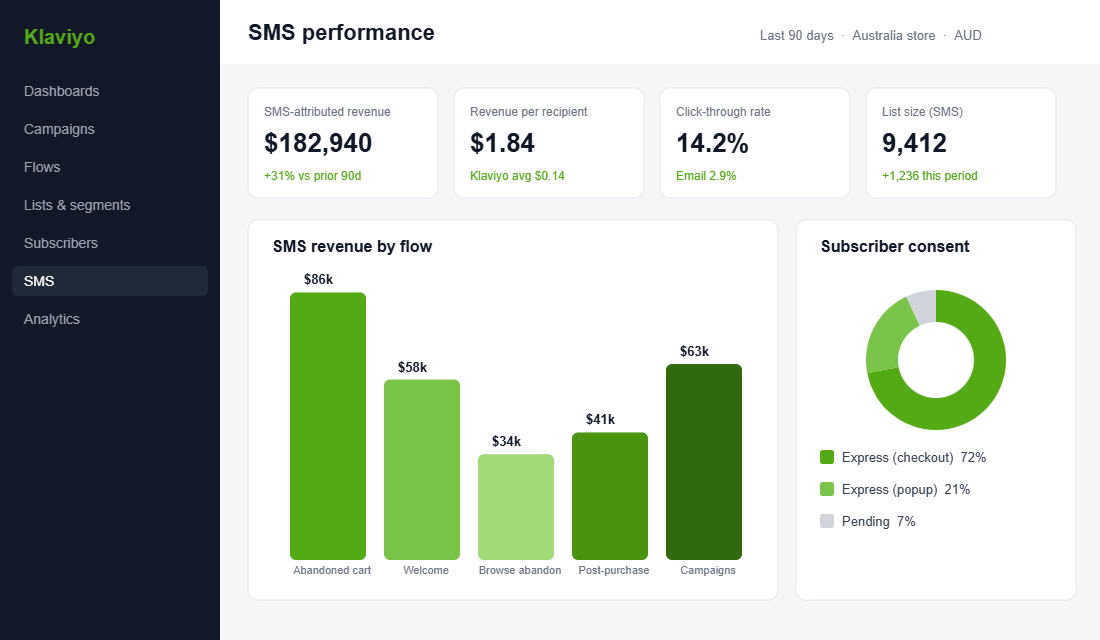
- Checkout consent. This is your biggest source, often around 70% of new subscribers. Add an SMS opt-in at checkout, unticked by default, with clear wording like “Text me order updates and offers”. It captures buyers at their highest point of trust.
- The pop-up with a phone step. Extend your email pop-up into a two-step form: email first, then mobile with a small incentive. Done well this can drive a fifth of your list. If you have not tuned your pop-up yet, our Shopify email pop-up playbook covers the mechanics.
- Keyword opt-in. “Text JOIN to 0488 xxx xxx for 10% off” works brilliantly on packaging, in the post-purchase thank-you page and in your Instagram bio. It is explicit, it is clean, and it self-documents consent.
- Quiz or preference flow. If you run a product quiz, add a mobile field at the end. These subscribers arrive already segmented by what they told you.
One hard rule for Australian stores: never pre-tick the consent box, and never bundle SMS consent inside a broader “I agree to marketing” checkbox. Separate, deliberate, and specific. It protects you legally and it keeps your list full of people who genuinely want to be there, which is what keeps opt-out rates under 1%.
Stage 2: The three flows that pay for the whole channel
If you only ever build three SMS automations, build these. They run in the background, they trigger on behaviour, and together they typically produce the majority of SMS revenue while you sleep.
1. The welcome text
Fire it within a minute of opt-in, while intent is hot. Deliver the incentive you promised, set expectations for how often you will text, and add a soft first-purchase nudge. Keep it to one or two messages. This is the flow with the highest engagement you will ever see, so do not waste it.
2. The abandoned cart and checkout flow
This is the single most profitable SMS flow for almost every store, and for good reason. Around 70% of carts are abandoned before purchase, so the recovery opportunity is enormous. Cart-abandonment texts have been shown to generate anywhere from $3.07 to $10.78 in revenue per message sent.
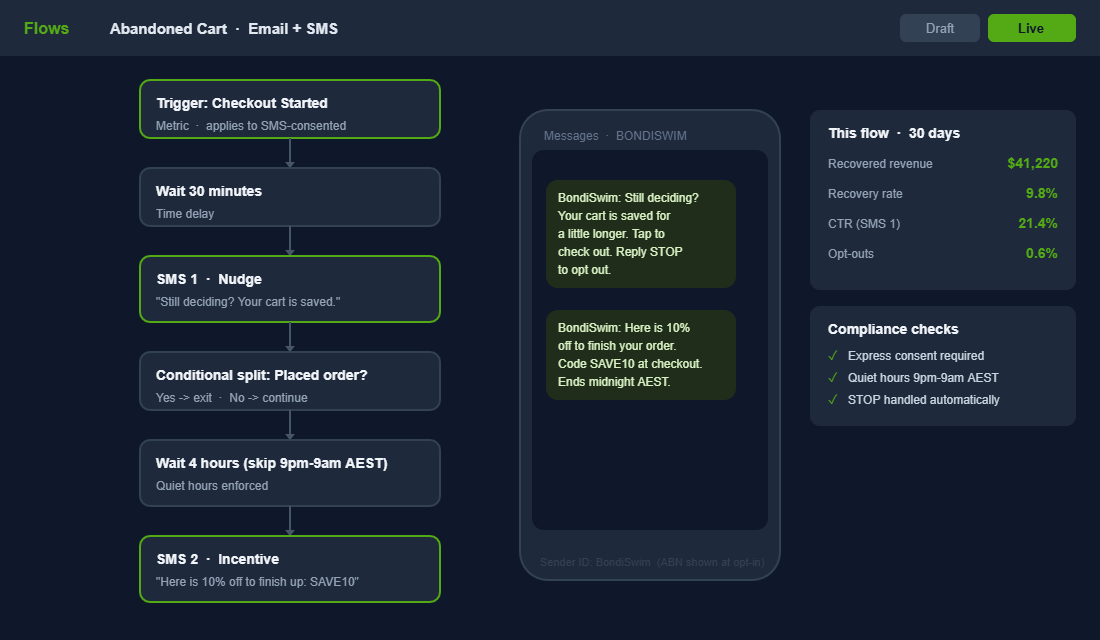
Structure it as a two-touch sequence. Wait 30 minutes, then send a gentle nudge with no discount. If they still have not converted after a few hours, send a second message with a small, time-limited incentive. Only text people who gave SMS consent, and enforce quiet hours so nothing lands at 2am.
3. The post-purchase flow
SMS is superb for the delivery moment. A shipping-confirmation text, a “how did it go” check-in a week after delivery, and a well-timed replenishment reminder turn one-time buyers into repeat customers. This is where SMS quietly lifts customer lifetime value rather than just chasing the next sale.
Pair these flows with your email programme rather than duplicating it. SMS carries the urgent, time-sensitive moment; email carries the story and the detail. If deliverability on the email side is shaky, fix that in parallel using our email deliverability playbook so the two channels reinforce each other.
Stage 3: Run campaigns without burning the list
Flows run themselves. Campaigns are where founders get into trouble, because it is tempting to blast the whole list every time you have news. Do that and your opt-out rate climbs, your engagement falls, and the channel slowly dies.
Three disciplines keep a campaign programme healthy:
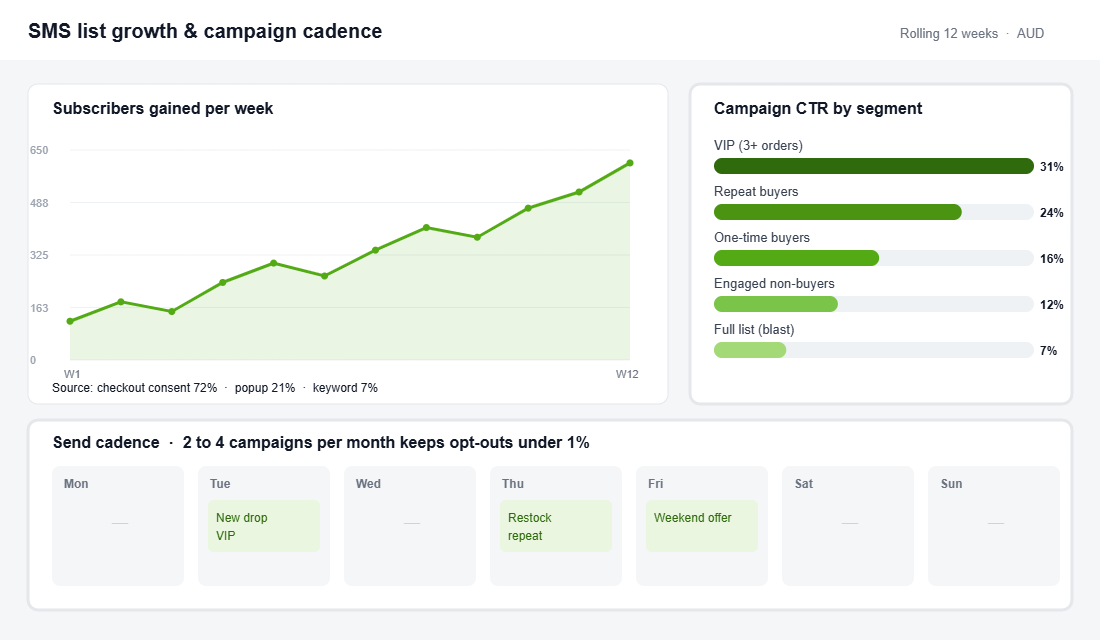
- Cadence. Two to four campaigns a month is the sweet spot for most Aussie DTC stores. Enough to stay present, not so much that people reach for STOP. Consistency beats volume.
- Quiet hours. Respect a 9pm to 9am window in the recipient’s timezone. A text at the wrong hour feels invasive and drives opt-outs faster than any bad offer. For a national list, set quiet hours to AEST and accept the trade-off, or split by state if your volume justifies it.
- Segmentation. This is the difference between a good channel and a great one. A blast to your full list might click at 7%. The same message sent only to repeat buyers or VIPs can click at 25% to 45%. Text fewer people more relevantly and your revenue per send climbs while your opt-outs fall.
If your segments are still just “everyone”, start there before you touch cadence. Our customer segmentation playbook walks through the exact segments worth building, and every one of them applies directly to SMS.
The tool: setting up Klaviyo SMS on Shopify
Klaviyo is the practical default for Aussie Shopify stores because it unifies email and SMS in one platform, so your segments and flows share the same data. Postscript and Attentive are strong SMS-first alternatives, but if you already run Klaviyo for email, adding SMS is the fastest path. Here is the setup, start to finish:
- Enable SMS and register your sender. In Klaviyo, open Settings and turn on the SMS channel for Australia. You will provision a sender number and complete sender registration. Add your business legal name and ABN so every message is compliant by default.
- Set your quiet hours. Configure smart sending and quiet hours to 9pm to 9am so no automation or campaign can send outside that window.
- Collect consent in two places. Add the SMS consent checkbox to your Shopify checkout, and add a phone step to your sign-up form. Make sure both are unticked by default and worded clearly.
- Build the abandoned cart flow first. Clone Klaviyo’s abandoned cart flow, add an SMS message at the 30-minute mark and a second at four hours, and gate both on SMS consent. This one flow usually pays for the platform.
- Add the welcome and post-purchase flows. Trigger the welcome on list join, and the post-purchase on fulfilment events from Shopify.
- Create your core segments. VIPs, repeat buyers, one-time buyers and engaged non-buyers. Send campaigns to segments, never to the raw list.
Budget a couple of hours for setup and a few days for sender registration to clear. Once it is live, the channel largely runs itself.
What good looks like
Numbers make this concrete. Australian kidswear brand Cheeky Chickadee moved its SMS programme onto Klaviyo and, during a Summer Collection launch, saw loyalty segments blow past benchmarks: 45.7% click rate for its top tier, 44.6% for its family segment and 31.3% for its base tier. That is segmentation and consent doing the heavy lifting, not clever copy alone.
Voice matters too. Frank Body built a cult following partly on a cheeky, unmistakable brand voice that carries straight into short-form channels like SMS. A text has no design, no images, no header. The words are the entire experience, so a distinct voice is a genuine advantage. When your brand has a personality, 160 characters is plenty.
SMS versus email: which moment belongs to which channel
SMS does not replace email. It takes the jobs email is bad at. The fastest way to decide what goes where is to sort every message by how time-sensitive and how short it is.
- Send by SMS: abandoned cart nudges, back-in-stock alerts, flash sale last-chance reminders, shipping and delivery updates, VIP early access. Anything where minutes matter and the message fits in a sentence.
- Send by email: the brand story, new collection lookbooks, detailed education, long-form newsletters, receipts and anything that needs images or layout to land.
- Use both, in sequence: a product launch might open with an email that tells the story, then a same-day SMS to your most engaged segment when stock is live. The email builds desire, the text captures the moment.
Because flows drive around 41% of email revenue from just over 5% of sends, the same automation-first logic applies to SMS. Build the flows once, let them run, and reserve your active effort for a small number of well-targeted campaigns.
Three mistakes that quietly kill an SMS channel
Most failed SMS programmes do not fail loudly. They erode. Watch for these three:
- Treating SMS as a discount channel. If every text carries a code, you train customers to wait for one and you shred your margin. Mix in genuine value: early access, restock alerts, useful order updates. The discount should be the exception, not the format.
- Blasting the full list. The lazy send feels productive and quietly poisons the channel. Every irrelevant message pushes engaged subscribers a little closer to STOP. Segment first, every time, even when it feels like extra work.
- Ignoring the opt-out rate. List size flatters you; opt-out rate tells the truth. A rising STOP rate is the channel warning you that cadence or relevance is off. Keep it under 1% and treat any spike as a signal to slow down, not push harder.
None of these show up in a single bad week. They show up three months later as a channel that used to work. Building the guard rails in from day one is what keeps that from happening.
The compound effect
Here is how the pieces lock together. Consent done properly gives you a list that trusts you. That trust keeps opt-outs low, which keeps your list growing. A growing, engaged list makes your three flows more valuable every month, because more people pass through them. Tight segmentation then lets your campaigns ride on top without eroding any of it.
Each part protects the others. Skip consent and the whole thing is fragile. Skip segmentation and you burn the list you worked to build. Get all four right and SMS stops being a Black Friday party trick and becomes a channel that can drive a serious share of revenue at a cost per message of a few cents. That is the difference between a store that texts and a store with an SMS channel.
Your SMS starter checklist
- Consent. Separate, unticked SMS opt-in at checkout and in your pop-up. Legal name or ABN on every send. STOP handled automatically.
- List sources. Checkout consent, two-step pop-up, keyword opt-in, quiz field. Never bought, never pre-ticked.
- Flow 1. Welcome text within a minute of opt-in, delivering the promised incentive.
- Flow 2. Two-touch abandoned cart: nudge at 30 minutes, incentive at four hours, quiet hours on.
- Flow 3. Post-purchase: shipping update, check-in, replenishment reminder.
- Campaigns. Two to four a month, sent to segments, never at 2am.
- Measure. Track revenue per recipient and opt-out rate, not just list size.
Work top to bottom. Do not send a campaign until consent and the three flows are in place. The order is the strategy.
What SMS Actually Costs in Australia (And How to Model the Payback)
Most founders stall on SMS because they have no idea what it costs. Email feels free once you’re paying for Klaviyo. SMS has a per-message price tag, and that makes it feel risky. It shouldn’t. The maths is simple enough to run on the back of an invoice.
In Australia you’re generally looking at 4 to 8 cents per SMS segment through Klaviyo, Omnisend or Attentive, depending on volume. A “segment” is 160 characters of plain text, or 70 characters if you use an emoji, which quietly switches the whole message to a different encoding. Add a link and a legal name and a chatty two-liner becomes two segments. Your effective cost per send is often double what you budgeted.
- Write to 155 characters, not 160. Leave headroom for the link shortener your platform appends.
- Skip emojis in flows. The open rate lift doesn’t cover a doubled send cost across thousands of messages.
- Use a branded short link. Slightly longer than a generic one, but the click-through lift is worth it and it keeps you out of spam filtering.
Now the payback. Imagine you run a $2M skincare brand with 8,000 SMS subscribers and a $95 average order value. A campaign to the whole list at 6 cents costs about $480. A healthy campaign click-through rate for SMS sits at 8 to 15%, well above the 2 to 3% you’d expect from email, and converts at 2 to 5% of clicks. Take the conservative end: 8% click, 2% conversion of clicks means roughly 13 orders, or about $1,235 in revenue. That’s a 2.6x return before COGS on a single send.
The flows are where it gets genuinely good. An abandoned cart SMS costs you a few cents and recovers at 8 to 12% of texted carts, against an industry-wide cart abandonment rate of around 70%. On a store doing 400 abandoned carts a month, a two-touch cart flow costs under $50 to run and can recover 30 to 45 orders. That’s the whole channel paying for itself before you’ve sent a single campaign.
The number to actually manage against is revenue per recipient. Anything above $0.50 per SMS recipient on a campaign is strong. Below $0.15 and you’re either texting the wrong segment or your offer is weak. Track it in Klaviyo’s campaign view every month next to opt-out rate, and treat any campaign that pushes opt-outs above 2% as a signal to slow down. Losing a subscriber costs you every future message, not just this one – which is the same compounding logic behind protecting your sender reputation in the email deliverability playbook.
Sizing the Channel: What SMS Should Contribute at Your Revenue Level
A useful sanity check before you invest more time. Email and SMS together should account for 25 to 35% of total store revenue for a mature Aussie DTC brand. Within that, SMS typically lands at 5 to 12% of total revenue once the three core flows are running and you’re sending two to four campaigns a month.
If SMS is sitting under 3% of revenue after six months, the problem is almost always list size rather than message quality. A subscriber base under about 5% of your annual order count won’t move the needle no matter how good the copy is. Fix the collection points first – checkout consent, the pop-up, keyword opt-in – before you spend another Saturday rewriting texts nobody is receiving. The pop-up playbook covers the two-step capture that reliably converts email subscribers into SMS subscribers as well.
Inside eCommerce Circle, building a compliant, high-revenue owned channel like this is one of the core pillars we work on with every member. If you want a second opinion on your SMS setup, let’s talk.