You have hit the catalogue ceiling. Every obvious product in your range is live, your hero SKUs are doing the heavy lifting, and the only way you know to grow is to launch something new. So you place another order, tie up another slab of cash in stock, and quietly hope it sells before the next BAS is due.
What’s in This Article
That is the trap most Aussie founders are stuck in. Growth means more inventory, more risk, and more of your cash sitting in a warehouse instead of in your account. Launch a dud and you are running a clearance sale six months later, watching margin evaporate on stock you never should have bought. Carrying inventory is not free either: the standard rule of thumb is that holding stock costs you 20% to 30% of its value every year in storage, capital and obsolescence.
There is now a way to widen your store without any of that. On 10 June 2026, Shopify switched on Shopify Collective for Australian merchants, and it is free. It lets you sell other Aussie brands’ products directly from your own store without holding a single unit, at retailer margins that typically run 20% to 40%. Used well, it is the fastest way to grow average order value and revenue without touching your inventory budget.
What Shopify Collective Actually Is
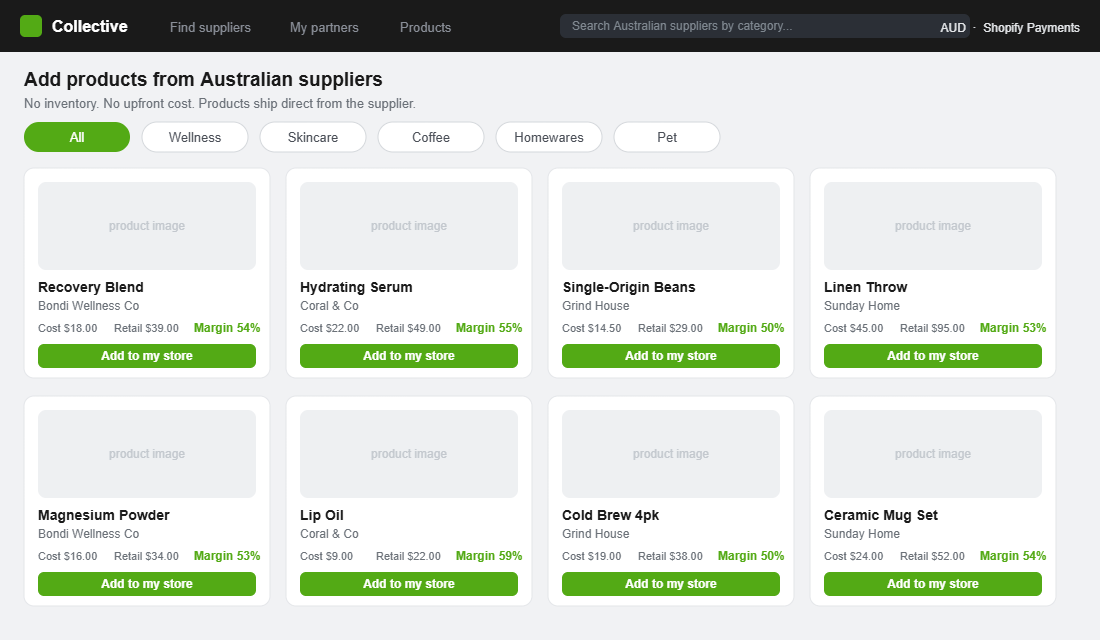
Collective is Shopify’s native marketplace that connects two kinds of store: retailers and suppliers. A retailer lists and sells another brand’s products on their own storefront. A supplier makes and ships those products. It is built directly into Shopify, so there is no third-party app tax and no clunky integration to babysit.
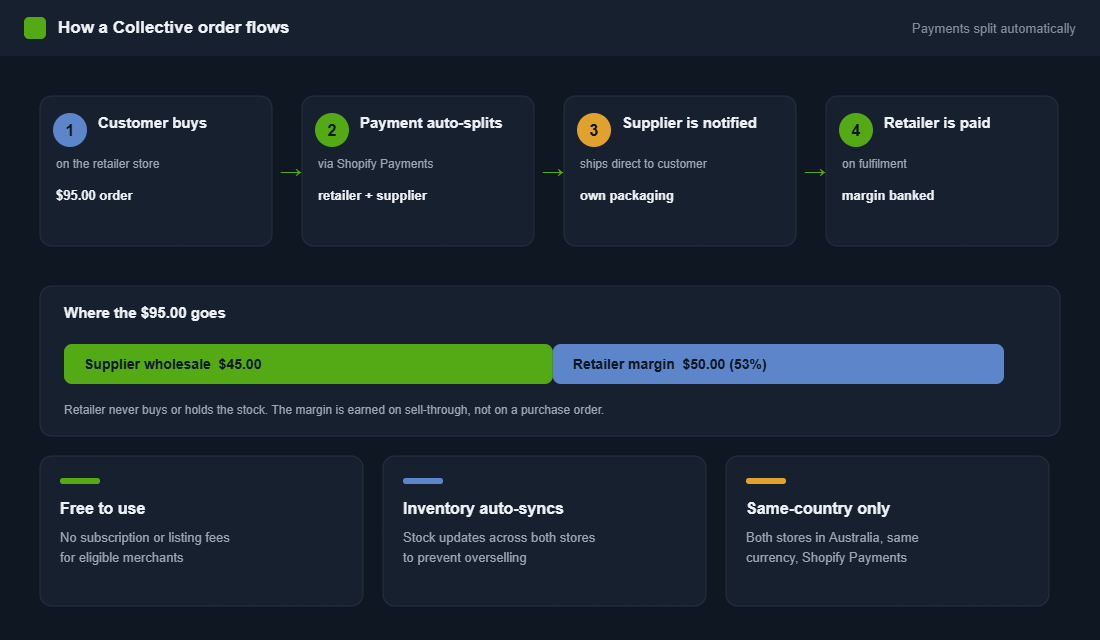
When a customer buys a Collective product from your store, Shopify splits the payment automatically through Shopify Payments. The supplier is notified, ships the order direct to your customer in their own packaging, and once it is marked fulfilled you are paid your margin. You never buy the stock, never store it, and never pack a box.
It is free to use for eligible merchants, with no subscription or listing fees. The catch is eligibility: both stores must be based in Australia, trade in the same currency, use Shopify Payments, and be on a paid Shopify plan. Inventory syncs automatically between the two stores, so you are never selling units the supplier ran out of an hour ago. Shopify has now rolled Collective out to more than 36 countries, and Australia is one of the newest.
Because it is native, the data flows cleanly. Orders, tracking and payouts all live in the same Shopify admin you already use every day. There is no separate portal to log into, no CSV shuffling, and no reconciliation headache at the end of the month. For a lean Aussie team, that operational simplicity is half the value.
Why This Beats Launching Another Product
Think about what a new product actually costs you. A purchase order is cash out the door months before the first sale. Then there is freight, storage, and the risk that it simply does not move. Dead stock is one of the quietest killers of Aussie ecommerce margins, and once it piles up your only exit is discounting it to the floor. We break down that cash trap in the dead stock playbook.
Collective removes every one of those costs from the equation. You add a product, set your retail price, and only ever pay the supplier once a customer has already paid you. Your cash stays in your account. Your risk is close to zero. Your catalogue can double without a single extra dollar of inventory.
That rewrites the maths on growth. Instead of betting cash on what you hope will sell, you can test complementary products with no downside and double down only on the ones that move. A wider, smarter range also lifts average order value, because a customer who came for one thing now has a reason to add two more to the cart before checkout.
The cash-flow difference alone is worth pausing on. On your own range, a strong month usually triggers a big reorder, which drains the exact cash that strong month just generated. Collective breaks that cycle. Because you only pay the supplier after the customer has paid you, every incremental Collective sale is cash-positive from day one, which is a genuinely rare thing in physical products.
The Retailer Play: Curate a Bigger Store Without Buying Stock
The winning move as a retailer is curation, not clutter. Do not bolt on random products chasing a fat margin. Add the products your existing customers already want next.
If you run an activewear brand, the customer buying leggings also wants recovery supplements, a drink bottle and a gym towel. If you sell skincare, they want the wellness and haircare adjacencies. Pick supplier brands whose quality and price sit alongside yours, not below them, because every order they fulfil now carries your brand’s reputation to your customer’s doorstep.
Then price with intent. You and the supplier agree the wholesale cost, and you set the retail price. Retailer margins on Collective typically land between 20% and 40%, but on well-chosen premium adjacencies you can often hold more. Treat these products as an average-order-value and margin lift, not as an excuse to race competitors to the bottom on price.
Placement is where the money is made. Do not bury these products on a lonely “more from our partners” page. Surface them where buying intent is highest: as cart cross-sells, in post-purchase upsells, inside curated bundles, and on the collection pages your customers already browse. A partner product shown at the right moment reads as a helpful recommendation, not an ad.
A Concrete Aussie Example
Picture an Aussie activewear label doing $150k a month. Its customers are fit, health-conscious and loyal, but the brand only sells apparel. Under the old model, moving into supplements or recovery gear means sourcing, sampling, and a five-figure first order with all the risk that carries.
With Collective, that same brand connects with a complementary Australian wellness supplier, imports a tight range of magnesium, electrolytes and a recovery balm, and lists them beside the leggings. No purchase order, no warehouse space, no risk. The apparel customer adds a tub of magnesium at checkout, average order value climbs, and the brand earns a healthy margin on a product it never had to buy. Real Aussie brands from Frank Body to Who Gives A Crap have built loyal, repeat audiences precisely because their range fits a clear customer identity. Collective lets you extend that range in an afternoon instead of a quarter.
The quiet superpower here is data. Because there is no inventory downside, you can list ten adjacent products, watch which ones your customers actually add, and keep only the winners. That is real demand data on what you might bring in-house later, gathered at zero risk. A lot of smart retailers now use Collective as a live test lab before they ever commit cash to a new category.
The Supplier Play: Turn Other Stores Into Your Sales Team
Collective runs both ways, and the supplier side is just as powerful. If you make a product other stores would love to stock, listing as a supplier turns dozens of other Aussie storefronts into a distributed sales team you do not pay a salary or a commission to chase.
You keep control of fulfilment, packaging and the unboxing, so the experience still feels like your brand. You gain distribution and brand-new customers without spending a cent on ads to reach them. It is the digital version of getting your product onto the right retail shelves, except the shelf is another brand’s website and the setup takes an afternoon. If you already run any manual wholesale, Collective automates the messy parts of it. Our B2B and wholesale playbook covers how to structure those relationships.
One thing to nail early as a supplier is pricing discipline. Agree clear recommended retail pricing with your retailers so your product is not selling at wildly different prices across a dozen storefronts, which erodes both your brand and your own direct sales. Collective lets you approve exactly who stocks you, so treat that like choosing a stockist rather than running a free-for-all. The suppliers who win are precious about which retailers get to represent them.
There is a longer game on the supplier side too. A customer who discovers you through another Aussie store is a customer you can win for life. Deliver a great unboxing and a product they love, and many will come straight to your own site for the reorder, where you keep the full margin. Treat every Collective order as the top of your own funnel, not just a one-off wholesale sale.
How to Set It Up on Both Sides
Collective is the tool, and setup is refreshingly quick. If you are coming in as a retailer:
- From your Shopify admin, add the Shopify Collective channel and confirm you are on Shopify Payments and a paid plan.
- Browse the supplier directory, filter by category, and request to connect with brands that genuinely fit your customer.
- Import the products you want, set your retail prices, and publish them into the right collections.
- Build them into your merchandising: bundles, cart cross-sells and post-purchase offers.
- Let fulfilment and payment run automatically once the orders start landing.
If you are listing as a supplier, the flow is just as short:
- Install the Collective: Supplier app and set your wholesale pricing and margins.
- Publish the catalogue you want to make available to retailers.
- Approve retailer connection requests that match your brand and positioning.
- Fulfil incoming orders from your dashboard with your own packaging and carriers.
What Good Looks Like
Set your expectations correctly. Collective is a revenue and average-order-value lever, not an overnight channel that replaces your own products. The retailers winning with it are adding a curated 20 to 40 complementary products, not 400, and they treat partner selection like a hiring decision rather than a shopping spree.
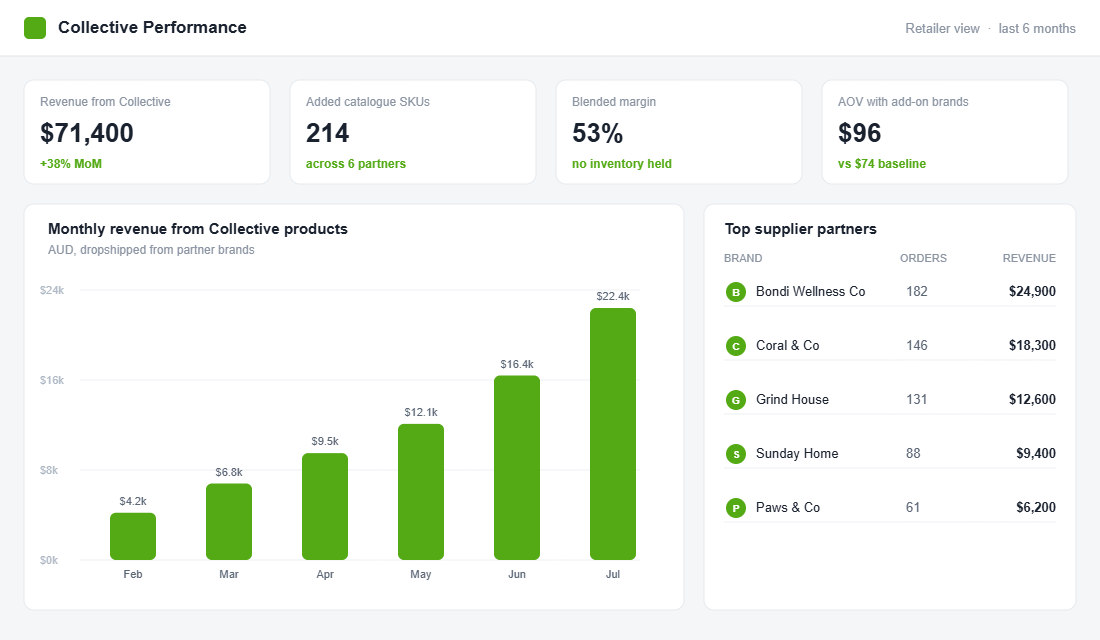
Track three numbers. Revenue from Collective products, your blended margin across them, and the average-order-value difference between orders that include a partner product and orders that do not. If partner-inclusive orders are running noticeably higher, your curation is doing its job. Margin discipline still matters exactly as much as it does on your own range, so keep an eye on it the same way. Our contribution margin playbook shows how to work out the number that actually counts.
Give it a real runway too. The first month is setup and curation, the second is learning which partner products your audience actually adds, and by the third you should be pruning the losers and doubling down on the two or three clear winners. Founders who judge Collective on week one always underrate it. Treat it like a new collection you are merchandising over a season, because that is exactly what it is.
Where Founders Get It Wrong
The feature is free and easy, which is exactly why it is easy to misuse. The mistakes are predictable, and all of them are avoidable.
- Adding products for margin, not for the customer. A random gadget with a 50% margin that none of your shoppers actually want is just clutter that slows the store and confuses your brand.
- Partnering with brands below your quality bar. The supplier’s shipping speed and packaging become your problem the second your customer is disappointed. Their weak link is now your review.
- Ignoring the delivery experience. A Collective item may ship separately from your own stock, so set clear delivery expectations on the product page and in the confirmation email.
- Treating it as set-and-forget. Merchandise these products properly, feature the winners on collection pages and in flows, and quietly drop the ones that do not move.
- Forgetting it is a two-way street. If you only ever act as a retailer, you are leaving the free distribution of the supplier side on the table. Most brands can profitably play both roles at once.
Who Should Lean In, and Who Should Hold Off
Collective is not for every store, and being honest about that saves you time. Lean in if you have a clear customer identity and obvious adjacent products you do not currently sell, if your cash is tied up in inventory and you want to grow without adding more, or if you make a great product other stores would be proud to stock.
Hold off if your store is still finding product-market fit on its core range, because bolting on other brands before your own hero products are dialled in just splits your focus. Fix the foundations first. If your margins on your own products are already thin, tighten those before you lean on 20% to 40% partner margins to carry the store. Collective is an accelerant, not a rescue.
Do The Margin Maths Before You Say Yes
Collective looks like free margin because you never buy the stock. It is not free, and the founders who get burned are the ones who compared the supplier’s wholesale price to their own retail price and stopped there.
Work it as a full contribution line on a real order. Take a $120 partner product at a 55% wholesale price. Your gross margin looks like $54. Now subtract the parts that only show up later: your blended payment processing (roughly 1.9% plus 30c on Shopify Payments in Australia, so about $2.60), the shipping you promised the customer but the supplier charges you for ($9 to $14 on an east coast metro parcel, more to WA), and a returns allowance. Even a modest 8% return rate on a $120 item costs you around $9.60 an order once you carry freight both ways.
That $54 is realistically $28 to $32. Still good, but it is a 24 to 27% contribution rate, not 45%, and it needs to clear your CAC on those orders. If partner products only sell on discount-led campaigns, you can end up doing meaningful revenue at close to zero contribution.
The number that actually decides it is incremental. Ask whether the partner product raised average order value or simply replaced something you already sold. A partner SKU that lifts AOV from $95 to $128 on 18% of orders is a genuine win. A partner SKU that cannibalises your own $110 hero product is a margin swap dressed up as growth. Tag partner products in Shopify and run the comparison on orders containing them versus orders without, and use a proper cross-sell structure so they are presented as an add-on rather than an alternative.
The Ops Reality: Split Shipments, Returns And Who Owns The Complaint
Collective’s commercial model is clean. Its operational model creates three problems that nobody warns you about, and all three land on your support inbox rather than the supplier’s.
Split shipments break your delivery promise. A customer orders one of your products and one partner product, and receives two parcels on two different days from two different couriers. That is fine if you told them. It generates a WISMO ticket every single time if you did not. Add a line to the cart and the confirmation email: “Items from partner brands ship separately and may arrive on a different day.” One sentence removes most of the tickets.
Returns need a decision before your first order, not your first return. Where does the item physically go back to? Who pays the return freight? How long does the supplier have to confirm receipt before you refund the customer? Under Australian Consumer Law the customer’s remedy sits with you as the seller of record, so waiting on a partner to approve a refund is not a defence. Agree a maximum turnaround in writing, and refund on your own timeline regardless. Our returns playbook covers the policy language.
The complaint is always yours. If a partner item arrives damaged, the review lands on your store, your Google profile and your inbox. Which means you need the same three things from every supplier before you list a single SKU: a named contact who answers within one business day, a dispatch commitment you can put on your product page, and packaging you would be happy to have your own logo on.
Set the guardrails early. Cap partner products at 20 to 30% of your catalogue while you learn, review every partner on a 90-day cycle against dispatch time, damage rate and return rate, and cut anyone who fails two cycles running. The brands doing this well treat Collective partners the way they treat any other supplier, which is to say with a scorecard rather than a handshake.
The Compound Effect: A Two-Way Growth Engine
Here is where it clicks. As a retailer you widen your catalogue and lift average order value with next to no inventory risk. As a supplier you win distribution and new customers with no ad spend. Run both sides and you have bolted a two-way growth engine onto the platform you already pay for, at no extra cost.
The brands that pull ahead over the next year will be the ones treating Collective as a deliberate part of their assortment and distribution strategy, not a novelty they switched on once. Every complementary product you add without buying stock is pure upside. Every store that lists your product is a new shopfront you did not have to build or fund. That is the kind of asymmetric bet that quietly separates the stores that plateau from the ones that keep compounding.
Your Collective Partner Scorecard
Before you connect with any supplier, or approve any retailer, score the fit from 0 to 2 on each line (0 = no, 1 = maybe, 2 = strong yes). A score of 8 or more means go. Under 6 means pass and keep looking.
- The product is something my existing customers already want next.
- The brand’s quality and price sit at or above my own.
- Their fulfilment speed and packaging will not embarrass me.
- The margin still works after my real costs.
- It lifts average order value, not just the size of my catalogue.
Inside eCommerce Circle, expanding revenue without expanding risk is one of the core pillars we work on with every member, and Collective is one of the sharpest new tools for doing exactly that. If you want a second opinion on whether it fits your store, let’s talk.