You have wholesale enquiries sitting in your inbox right now. A boutique that wants to stock your hero product. A gym that wants 40 units a month. A pharmacy chain asking for a price list and net 30. And if you are like most Aussie Shopify founders, you are handling all of it by hand: quoting in a reply email, taking payment through a one-off invoice, then re-keying the order into Shopify at 11pm so it actually ships.
What’s in This Article
That is the trap. Most founders treat wholesale as a favour they do off the side of the desk, or they ignore it completely because they have decided they are a DTC brand. Both choices leave money on the table. The first one buries you in admin. The second one hands a free growth channel to your competitor.
Here is the context that should change your mind. B2B ecommerce is on track to reach roughly $36 trillion by 2026, growing at about 14.5% a year, and it is already around three times the size of B2C. Shopify grew its own B2B GMV by 96% in a single year. The founders winning here are not bolting wholesale on as an afterthought. They are building a proper channel that lifts total revenue 20 to 40% at close to zero acquisition cost. This is the 6-step system to do it without cannibalising your DTC margin or drowning in order admin.
Why Wholesale Is the Cheapest Revenue Most Aussie Stores Ignore
Run the unit economics side by side and the appeal is obvious. On DTC you keep the most per order, with healthy brands landing a 60 to 70% contribution margin, but you carry the full cost of acquisition. Every sale is rented from Meta, Google or TikTok, and that rent keeps going up. Wholesale flips it. You give away 40 to 50% of the retail price upfront, so you typically run a 40 to 50% contribution margin, but you pay almost nothing to acquire the order. The stockist does the selling for you.
Wholesale also behaves differently to DTC. Orders are larger, they repeat on a predictable cadence, and a single account can reorder for years once it is set up. The average B2B order on Shopify dwarfs a typical DTC basket, and a stockist who sells through will come back every few weeks without a single dollar of ad spend. That is revenue you can actually forecast.
The behaviour shift is structural, not a fad. Around 80% of B2B sales are now generated digitally, up from just 13% in 2019. Buyers expect to order from you online, on their terms, the same way they shop everywhere else. The Aussie brands you admire already run both engines. Frank Body built a loyal DTC base and then placed its range selectively into Mecca and a tight set of international retailers, walking away from partners that did not fit the brand. Who Gives A Crap runs a dedicated wholesale arm alongside its subscription business and made its retail debut with a focused set of SKUs. Neither brand abandoned DTC. They added a channel.
Step 1: Run the Wholesale Readiness Test Before You Email a Single Buyer
Wholesale punishes brands that open the channel before they are ready. Discounting 50% off a product that already runs thin, or promising stock you cannot reliably supply, turns a growth lever into a cash leak. Run this five-point test first and fix any gap before you take an order.
- Margin headroom. Can you give a stockist 40 to 50% off your RRP and still clear at least 30% contribution? If your DTC product only works at full price, it is not wholesale-ready yet.
- Supply consistency. Wholesale buyers reorder on a schedule and stock-outs break the relationship fast. You need reliable lead times and safety stock on the lines you push.
- Genuine pull. The best signal is unsolicited demand. If retailers already email you asking to stock the brand, that is your green light. If nobody is asking, validate before you build.
- Fulfilment capacity. A 30-unit case order is a different pick-and-pack job to a single DTC parcel. Make sure your 3PL or your own warehouse can handle cartons, pallets and freight without falling over.
- Retail-ready packaging. If your product will sit on a shelf, you will likely need barcodes (GS1 in Australia), outer cartons and compliant labelling. Sort this before a buyer asks, not after.
Score yourself honestly. Three or more gaps means you are not ready to scale wholesale yet, and that is fine. Fix the weakest link first. One unreliable supplier or one product running at 22% margin will undo every account you sign.
Step 2: Build Wholesale Pricing That Protects Your DTC Margin
Pricing is where most first-time wholesalers quietly destroy their own business. They copy a competitor’s discount, agree to whatever the buyer asks, and never check whether the order is profitable after freight and packing. Build your wholesale price the same way you build your retail price: from cost up, with a margin floor you never breach.
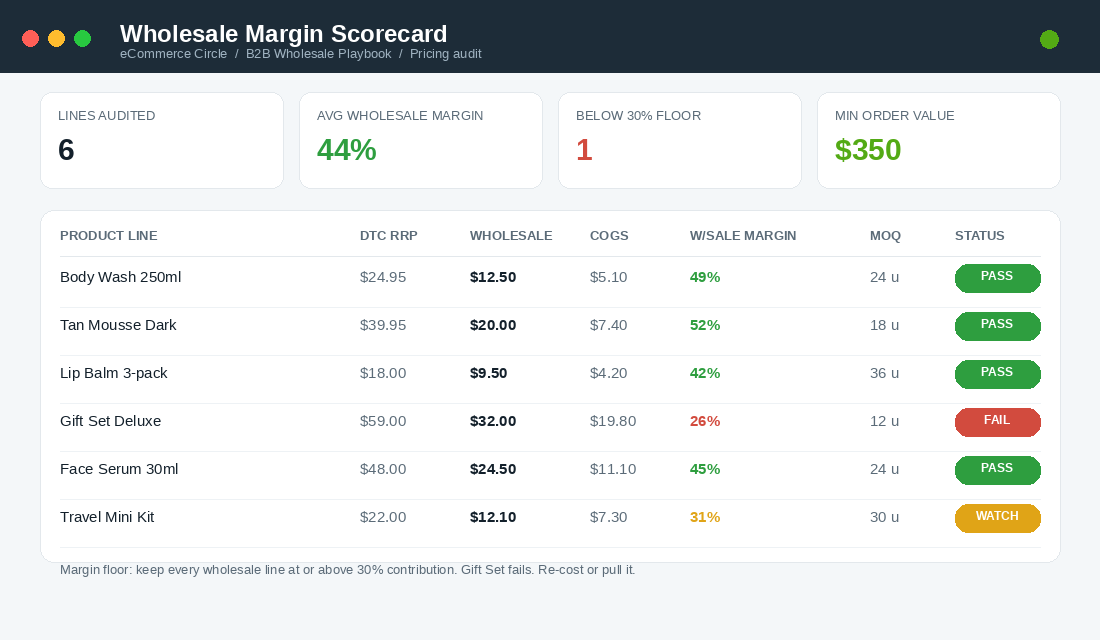
The standard starting point is keystone, which is roughly 50% off your recommended retail price. So a $24.95 body wash becomes about $12.50 wholesale. The non-negotiable rule is that every wholesale line must still clear at least 30% contribution after cost of goods. If a product cannot, you re-cost it or you keep it off the wholesale catalogue. A gift set that runs 26% wholesale margin does not belong in the channel, even if the buyer loves it.
Layer three more controls on top of the base price:
- Volume tiers. Set a Tier A and Tier B (for example 50% off above a case threshold, 40% off below it). This rewards bigger commitments and gives your sales conversation somewhere to go.
- Minimum order value. Every wholesale order should clear at least $200 to $500 so the picking, packing and freight do not eat the margin. Set a minimum order value and a minimum order quantity per line.
- Minimum advertised price (MAP). Tell stockists the lowest price they can advertise your product at. Without a MAP policy, a discount-hungry retailer will undercut your own DTC store and train your customers to wait for the markdown.
Get the full cost-up method and your margin floors right first. Our Pricing Power Playbook walks through the contribution maths so your wholesale tiers strengthen the brand instead of bleeding it.
Step 3: Set Up the B2B Channel on Shopify, Native First and Apps When You Scale
The good news for 2026: you no longer need to be on Shopify Plus to run B2B properly. Shopify moved its native B2B features down to the Basic, Grow and Advanced plans, so company accounts, pricing catalogues, net terms, PO numbers and one-click reorders are available to almost every merchant. The full feature set, including unlimited catalogues, per-customer pricing, deposits and partial payments, still sits on Plus, which also adds a 0.18% platform fee on B2B orders.
Start with what Shopify gives you out of the box. Here is the native setup sequence:
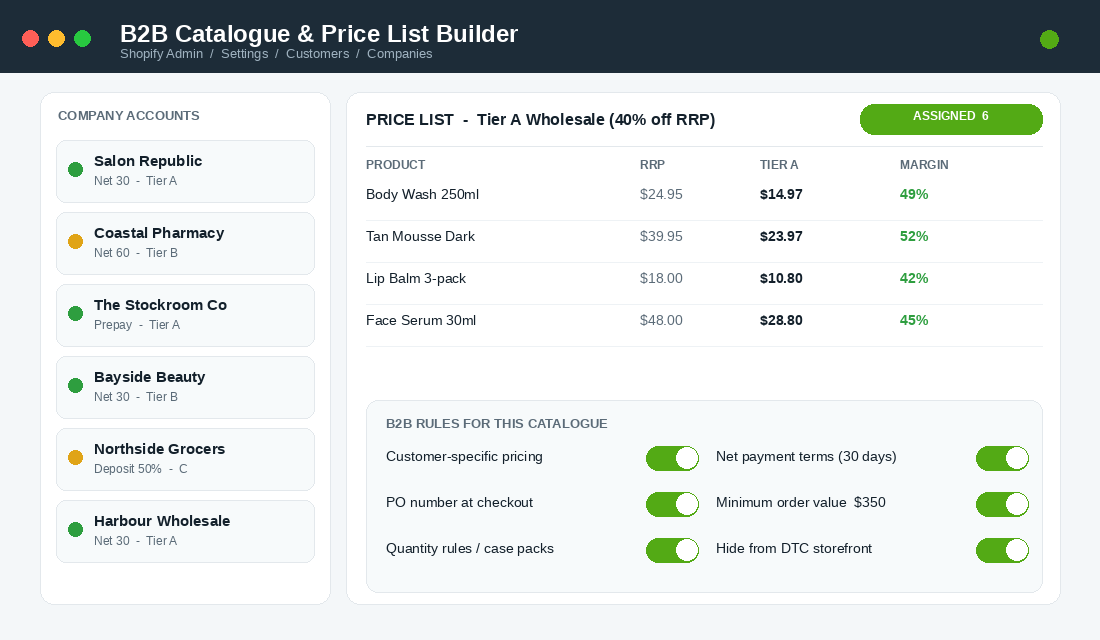
- Create a Company. In Shopify admin go to Customers, then Companies, and create a company record for the stockist with a billing and shipping location.
- Build a catalogue and price list. Under Products, create a B2B catalogue, then attach a price list (for example Tier A at 40% off RRP, or fixed per-SKU wholesale prices).
- Set payment terms. Assign the company a payment terms template such as prepaid, net 15 or net 30, so the right terms apply automatically at checkout.
- Assign the catalogue to the company location. This is what makes the buyer see their pricing and only their pricing when they log in.
- Add quantity rules and a minimum order value. Enforce case packs, increments and your minimum spend so undersized orders cannot get through.
- Invite the buyer to self-serve. Send the company contact a login. From that point they place and reorder their own orders against the agreed catalogue.
When the channel grows past what native handles, a dedicated app earns its keep. SparkLayer is the most common step up: its basic plan is free and mirrors what Shopify includes, then paid plans run from about US$49 a month (up to 50 B2B orders and two sales agents) to US$299 a month (150 orders, five agents, a built-in quoting engine and an API), with no transaction fees on any plan. It adds the things native B2B still lacks: a proper quote-to-order workflow, spreadsheet bulk ordering where a buyer uploads a CSV and the cart builds itself, and automatic branded invoices. Start native, prove the channel, then upgrade when quoting and sales-agent workflows become the bottleneck.
Step 4: Engineer a Self-Serve Buyer Experience
The biggest mistake DTC founders make in B2B is assuming wholesale buyers want a salesperson. They do not. Gartner found that 67% of B2B buyers now prefer a rep-free buying experience, and around 83% prefer to place orders online through self-serve platforms. McKinsey research goes further: 71% of B2B buyers are willing to spend over US$50,000 through self-service or remote channels, and more than a quarter are open to transactions above US$500,000 with no direct sales contact. Your buyer wants to log in at 9pm after closing their shop and reorder in two minutes. Give them that.
A self-serve wholesale experience that actually converts has a few non-negotiables:
- One-click reorder. The single highest-value feature in B2B. A stockist’s third order should take 30 seconds from their order history, not a fresh email thread.
- Account-specific pricing on login. The buyer sees their tier and their catalogue, never your DTC prices and never another account’s deal.
- Saved carts and order history. Buyers build orders over days. Let them save a draft and come back to it.
- No “call for pricing”. Hiding prices behind a form is friction that sends a busy buyer to a competitor who shows the number.
- Mobile that works. Retail buyers place orders from the shop floor on a phone. If your wholesale portal is clumsy on mobile, you are losing reorders you already earned.
Every hour your buyer spends fighting your ordering process is an hour they could have spent placing the order. Self-serve is not you being lazy. It is you matching how modern buyers actually want to buy.
Step 5: Control Cash With Terms, Deposits and Credit Rules
Offer net terms and you have just become a bank. That is fine if you do it deliberately, and dangerous if you do it by accident. Net terms tie up working capital: net 60 consumes roughly 15 to 20% more working capital than net 30, because you are funding the stockist’s inventory until they pay. Sign three big accounts on net 60 with no plan and you can post record revenue while your bank balance goes backwards.
Set terms with rules, not vibes:
- New accounts pay upfront. Prepaid or card on the first one to three orders. Terms are earned, not granted on day one.
- Graduate to terms on a track record. After a few clean prepaid orders, offer net 15 or net 30 to accounts that have proven they pay and reorder.
- Use deposits for large or custom orders. A 50% deposit upfront protects you on big production runs and filters out tyre-kickers.
- Run a basic credit check before extending real terms. For sizeable accounts, a quick credit check and a signed trading agreement are cheap insurance against a bad debt.
- Automate the chase. Late invoices are normal in B2B. Build a reminder sequence so you are not personally chasing money every week.
Wholesale only works if the cash works. Before you hand out net 30 across the board, run the numbers in our Cash Conversion Cycle Playbook so you know exactly how much working capital each terms decision is locking up.
Step 6: Acquire and Retain Stockists Like a Channel, Not an Inbox
The founders who plateau treat wholesale as whoever happens to email. The founders who scale it run wholesale like a pipeline with stages, targets and a cadence. You are not waiting for buyers. You are building a stockist base on purpose.
The repeatable acquisition motion looks like this:
- Build a line sheet. A clean one or two page PDF or self-serve link with your hero products, wholesale and RRP pricing, MOQs, case packs and lead times. This is your wholesale shopfront.
- Build a target list. Identify 50 to 100 retailers that fit your brand and customer. Independent boutiques, gyms, salons, pharmacies, gift stores, whatever matches your product.
- Reach out with a reason. A short, specific pitch that shows you understand their store beats a mass blast. Reference their range and why your product fills a gap.
- Sample and convert. Send a sample or a small first order at a sharp intro deal. Aim to move a new account from line sheet to first order inside 14 days.
- Onboard properly. Set up their company account, catalogue and login so the second order is self-serve.
- Drive reorders. Nudge at day 30, flag any account that has not reordered in 90 days as at-risk, and work it before it churns.
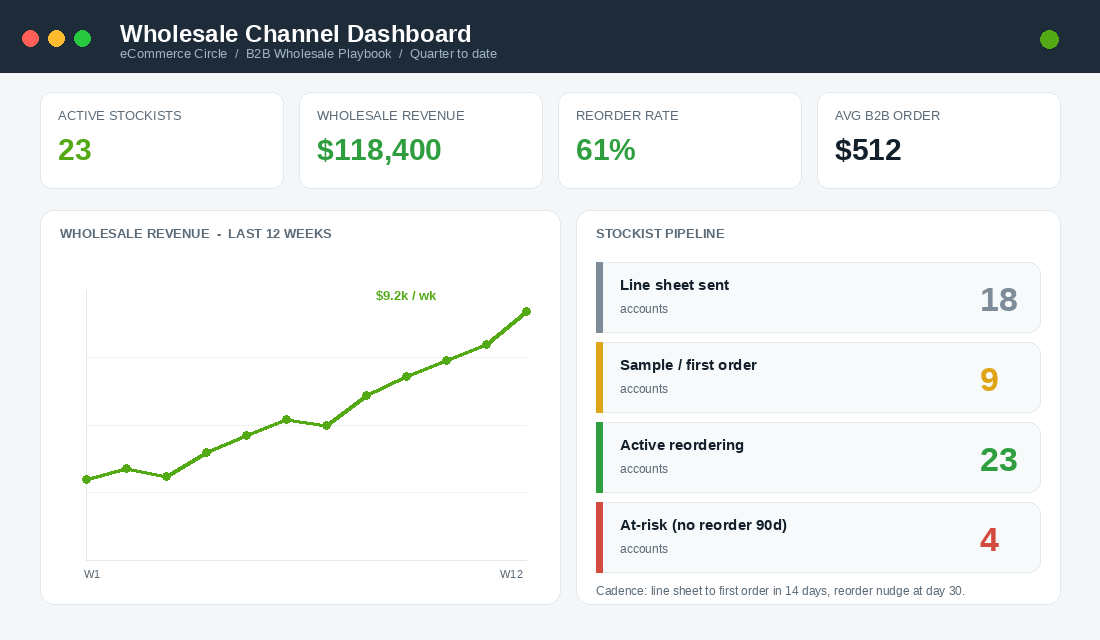
Reorder rate is the metric that matters most. A healthy wholesale channel sees the majority of active stockists reordering on cadence. If your reorder rate is low, the problem is usually sell-through, not your pitch. Help your stockists move product with point-of-sale support, a small co-marketing push or staff samples, and the reorders follow. Wholesale and retail reinforce each other, which is exactly why a stockist channel pairs so well with the in-person tactics in our Omnichannel Playbook.
The Compound Effect: What a Real Wholesale Channel Does to Your P&L
Put the pieces together and the maths is hard to argue with. Take a $2M-a-year DTC brand running an 85 dollar AOV and paying real money for every order through ads. It opens a wholesale channel and, over twelve months, builds to 23 active stockists with an average B2B order around $512 and a 61% reorder rate.
That channel adds roughly $470,000 in annual wholesale revenue, lifting total revenue about 23%. At a 44% contribution margin, that is around $207,000 in contribution, and critically, it carries almost no acquisition cost. The same brand on DTC would have to spend tens of thousands in ad budget to add that volume. Here, the stockists do the selling.
The compounding is the real prize. Each stockist you sign is an annuity. Once their company account is set up and they are reordering on cadence, they generate revenue for years with no repeat acquisition spend. Sign two solid accounts a month and within a year you have a second revenue engine that grows while you sleep, smooths out the volatility of paid DTC, and gives you negotiating power with suppliers because your volume just went up. That is what a channel does that a pile of inbox enquiries never will.
The Operational Load Nobody Budgets For
Wholesale revenue looks clean on a spreadsheet and messy in a warehouse. Before you chase your tenth stockist, be honest about the work each account actually creates, because that is where wholesale margin quietly disappears.
- Pick and pack changes shape. A DTC order is one to three units into a satchel. A wholesale order is 40 to 200 units, often carton-packed, sometimes with barcode or labelling requirements the retailer specifies. If your 3PL charges per pick, ask for a wholesale rate card before you sign your first stockist, not after.
- Every account carries admin. Budget 2 to 4 hours a month per active stockist across order chasing, credit checks, reorder prompts and the occasional damaged-carton claim. Ten accounts is a part-time job. Twenty without a system is a full-time one.
- Stock allocation becomes a decision, not a default. The moment one SKU is selling through both channels you need a rule for who gets the last 200 units. Most brands protect DTC because the margin is higher, then wonder why their stockists stop reordering. Decide the rule in advance and write it down. Our stock allocation playbook covers how to set one that survives a stockout.
- Payment timing moves against you. DTC is cash on order. Wholesale on 30-day terms means you fund the inventory, the freight and the labour up to 60 days before the money lands. A $30k wholesale month can make your P&L look great and your bank account look worse. Run the numbers through a cash conversion cycle view before you scale the channel.
The practical fix is a minimum order value that reflects the true cost to serve. For most Australian brands that lands somewhere between $500 and $1,500 depending on unit price and freight. Set it too low and you will spend an hour of admin servicing a $180 order at 50% off retail, which is a loss dressed up as growth.
Your Wholesale Channel Launch Checklist
Print this and work it in order. Do not open the channel until the readiness block is green.
Readiness and pricing
- Every wholesale line clears at least 30% contribution after cost of goods
- Supply and lead times are reliable on the products you will push
- Wholesale price set from cost up, with Tier A and Tier B defined
- Minimum order value ($200 to $500) and per-line MOQ set
- MAP policy written so stockists cannot undercut your DTC store
Platform and experience
- Native Shopify B2B enabled: company accounts, catalogues, price lists, payment terms
- Quantity rules, case packs and minimum order value enforced at checkout
- One-click reorder and account-specific login tested end to end
- Wholesale catalogue hidden from your DTC storefront
- App upgrade (such as SparkLayer) earmarked for when quoting and sales agents are needed
Cash and growth
- New accounts on prepaid, terms earned after a clean track record
- Deposits required on large or custom orders, credit checks on sizeable terms
- Line sheet built and a target list of 50 to 100 retailers ready
- Cadence set: line sheet to first order in 14 days, reorder nudge at day 30
- Reorder rate and at-risk accounts tracked on a simple dashboard
Inside eCommerce Circle, adding a profitable wholesale channel is one of the core growth plays we work on with members who have hit the ceiling on paid DTC. If you want a second opinion on whether your brand is wholesale-ready and how to price it, let’s talk.