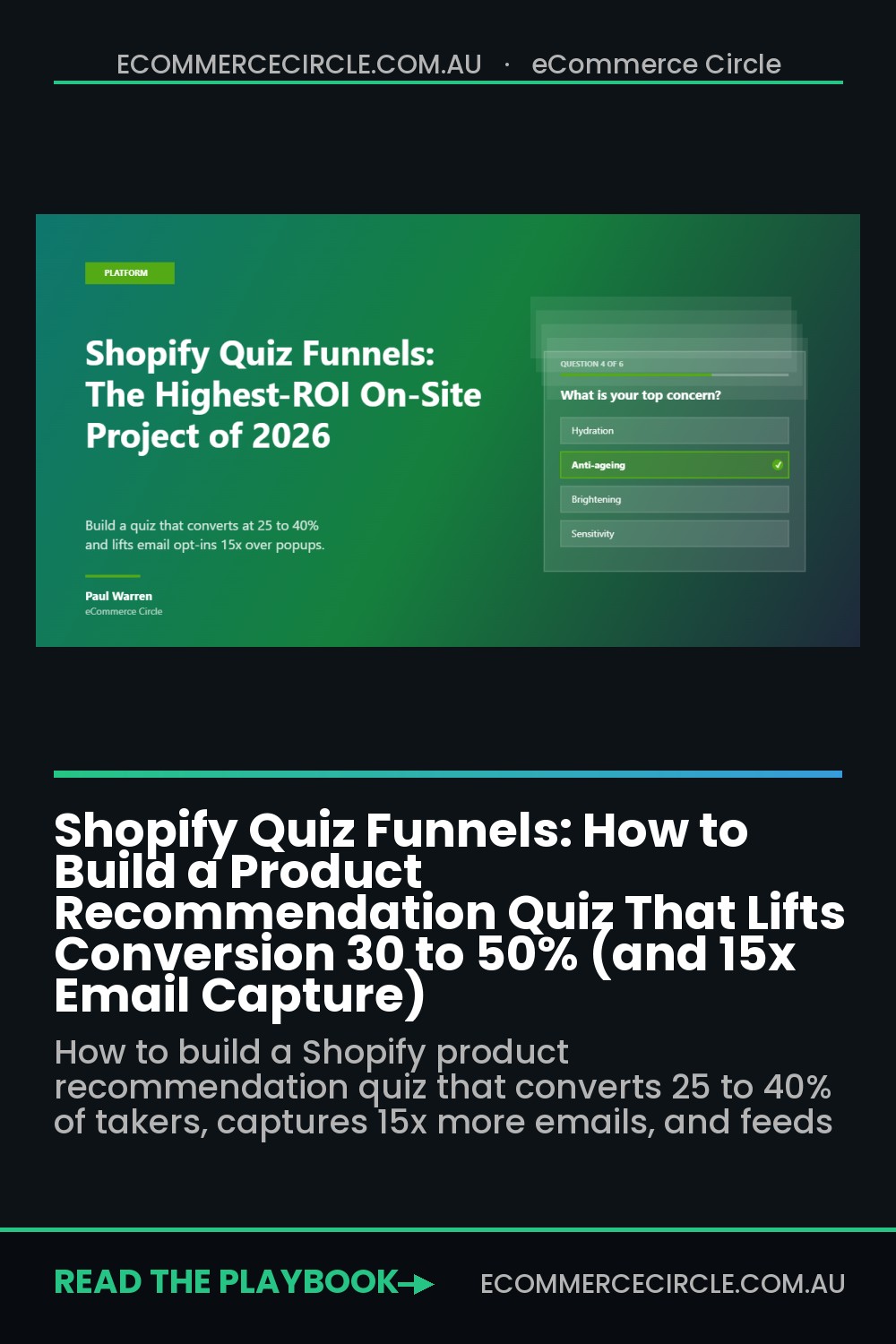
The most underused conversion lever on a Shopify store right now is not a popup, a cart drawer tweak, or a fresh hero image. It is a quiz. And if you have ever clicked the back button on a generic collection page because you had no idea what was actually right for you, you have felt exactly why.
What’s in This Article
Most Aussie founders treat their store like a catalogue. They put the products on the shelf, write decent copy, and hope buyers self-select. The data says buyers do not want to self-select. According to Epsilon, 88% of online shoppers want personalised product recommendations. Yet most stores still rely on category pages, search bars, and the customer’s willingness to read every product description before they leave.
Brands that fix this with a product recommendation quiz are seeing conversion rates between 25 and 40% on quiz traffic, against an industry baseline of around 2 to 3% on standard pages. Function of Beauty reports that 80% of customers who complete their quiz make a purchase. Blume saw 22% conversion on quiz traffic versus 2% on regular site traffic. Prose built a $100m+ brand on the back of one. The point is not the brands. The point is the mechanic.
This is the playbook for building a quiz funnel that pulls its weight on a Shopify store doing $40k to $500k a month. We will cover what a quiz funnel actually is, the architecture of one that converts, where to put it, the apps worth using in 2026, how to wire it into Klaviyo so the segmentation does the heavy lifting, and the build checklist you can hand to a VA to get it live this week.
Why Quizzes Convert at 10x the Rate of a Normal Page
Three things happen inside a quiz that do not happen on a collection page. First, the buyer offloads the cognitive work to you. Choosing between 47 serums is hard. Answering five questions about your skin is easy. Second, the buyer commits in tiny increments. By question three, they have already invested. By question five, they want to see the result. This is the foot-in-the-door effect doing what it has always done in good sales conversations.
Third, you collect intent data on every click. By the time the buyer hits the result screen, you know their skin type, their price sensitivity, the goal they are trying to solve, the format they prefer, and (if you ask for it the right way) their email address. That is more first-party data in 90 seconds than most stores collect in 90 days.
The downstream numbers compound. Email opt-in rates on quiz funnels run 15 to 20 times higher than standard popup forms. Octane AI publishes case studies showing 42% opt-in rates. Once those subscribers are in your list, the emails sent to them open at 60 to 80% and click at 10 to 20%, which dwarfs a generic welcome series. The reason is simple. The buyer asked for the recommendation. You are not interrupting them. You are continuing a conversation they started.
The Three Jobs Your Quiz Has to Do
A bad quiz is a personality test that ends in an irrelevant product. A good quiz is a sales tool with three distinct jobs. If you build it without all three, you will end up with a fun engagement piece that sells nothing.
- Job 1: Capture qualified leads. The opt-in moment must be timed so the buyer wants to give you the email, not so they feel held to ransom for it. More on this in a moment.
- Job 2: Recommend products with confidence. The result page should feel like the buyer was just spoken to by a knowledgeable salesperson. Three to five recommendations, ordered by best fit, with a short explanation of why this product matches what they answered.
- Job 3: Segment for the next 30 days. Every answer should map to a Klaviyo profile property so the buyer enters a tailored flow the moment they close the tab. Generic welcome series die here. Segmented quiz flows print money.
If your quiz can only do two of these, prioritise capture and segmentation. The product recommendation matters, but a buyer who joined your list because they trusted your recommendation logic will buy in the next email if you nurture them right. A buyer who got perfect product recs and zero email tag has converted once and disappeared.
The Architecture of a Quiz That Converts
Five to seven questions is the sweet spot. Below five and the buyer feels the recommendation is shallow. Above seven and completion rates fall off a cliff. RevenueHunt’s benchmark data has quizzes with six questions completing at roughly 70%, falling to 40% by ten questions. Build for completion, not depth.
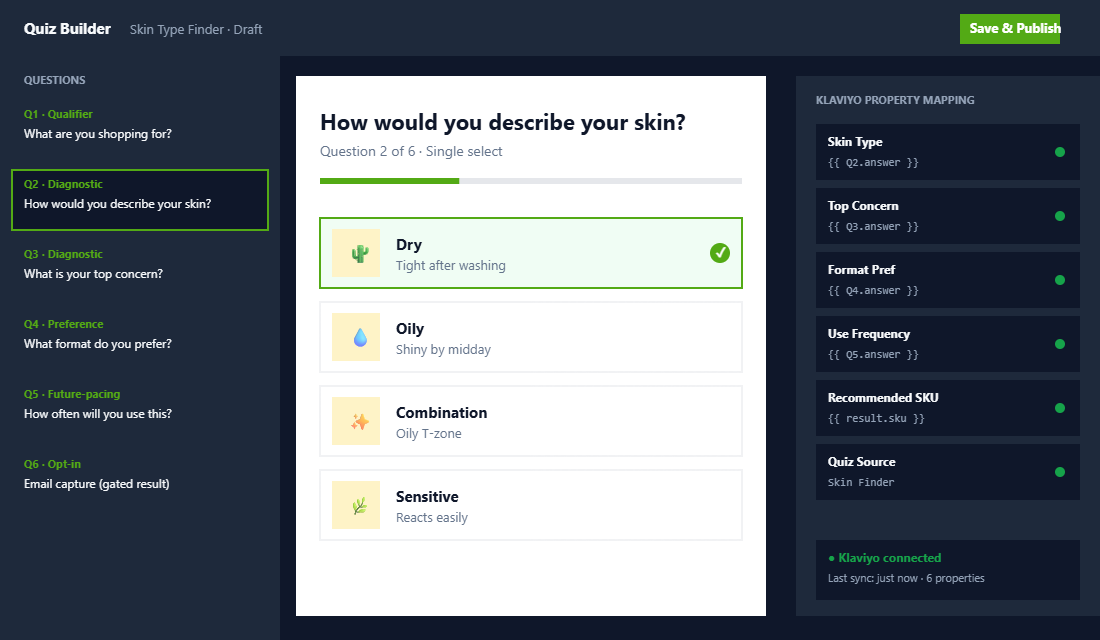
Each question should do one of three things: qualify (skin type, hair length, body shape, fitness level), diagnose (the goal the buyer is trying to solve, the problem they have), or preference (price range, format, frequency). The diagnostic questions are the highest value. They are the bridge between what the buyer thinks they want and what you know will solve the problem.
The structure I use with Aussie brands inside eCommerce Circle workshops is this:
- Question 1: A soft qualifier. Easy to answer, builds momentum. “What are you shopping for?” or “Who is this for?”. One tap, no thinking.
- Questions 2 and 3: The diagnostic. What is the goal? What is the problem? These are the inputs your recommendation engine needs to do real work.
- Question 4: A preference. Format, scent, intensity, price range. Whatever filters your catalogue meaningfully.
- Question 5: A future-pacing question. “How often do you want to use this?” or “How long has this been a priority?”. This question signals readiness to buy and feeds your urgency in the follow-up email.
- Optional Question 6: A name or pronoun ask. Adds 8 to 12 points to the email open rate when you use the name in the subject line.
Use icons or images on every option, not just text. Quiz Kit and RevenueHunt’s data both show image-based options lift completion by 15 to 25% versus text-only options. The buyer is moving fast. Their eyes are doing the work, not their brain.
The Email Opt-In: Where Most Quizzes Bleed Trust
This is where 90% of quizzes fall over. The classic mistake is the “hard wall” model: ask for the email before the buyer can see the result. It feels efficient. It captures more emails on paper. It also tanks completion, kills trust, and trains the buyer to type a fake email so they can see the answer they were promised.
The two patterns that work in 2026 are the soft wall and the value gate. The soft wall shows the buyer their result on screen and offers to email a personalised plan, discount code, or full breakdown. The opt-in is optional. Adore Beauty does this well using Preezie. The buyer never feels held to ransom, which is why their quiz traffic converts at agency-grade numbers.
The value gate shows a teaser of the result (the category, not the specific product) and asks for the email to reveal the full recommendation plus a 10 to 15% intro discount. Frank Body’s skin quiz is the textbook example. The discount does the heavy lifting. Done well, this pattern captures 35 to 45% of completers, against industry norms in the low single digits for popup forms.
Pick your wall pattern based on the catalogue. If your average order value is over $100, lean into the value gate with a real incentive. If your AOV is sub-$60 and you are competing on convenience, soft wall. The buyer who completes a soft wall but does not opt in is still pixelled and added to a Klaviyo browse-abandon flow as long as you fire the right events.
Where to Place the Quiz: Four Spots That Matter
The quiz only works if traffic finds it. Building a beautiful quiz and burying it three clicks deep is the most common reason these projects fail. The four placements that actually drive volume are:
- Homepage hero or sub-hero. A “Find Your Perfect [Product]” CTA above the fold. The work we do on homepage design always includes a quiz placement decision. Treat it as one of your top three CTAs.
- Collection pages. A sticky banner at the top of the page: “Not sure which one is right? Take the 60-second quiz.” Conversion on collection pages with a quiz banner runs 15 to 25% higher than collection pages without.
- Paid ad landing pages. Run cold Meta or TikTok traffic straight to the quiz, not the homepage. Quiz-as-landing-page typically lifts CPL by 30 to 50% on cold traffic and dramatically improves the quality of the email list because every subscriber is segmented from day zero.
- Exit intent on the homepage. Replace the generic “wait, here’s 10% off” popup with “Wait, let us help you find the right one. Take the 60-second quiz.” Frank Body and similar Aussie brands use this and report email capture lifts of 2 to 3x against the discount popup.
If you can only run the quiz in one place, run it as a paid ad landing page first. The traffic is already qualified, you control the entry pace, and the data you generate is gold for retargeting. Then add it to the homepage hero. Then collection pages. Then exit intent. In that order.
The 2026 App Stack: Five Quiz Apps Worth Considering
The quiz app market has consolidated. There are five apps doing the bulk of the serious work in 2026. Here is the honest comparison.
- Octane AI ($50 to $500/mo). The enterprise option. Best-in-class branching, conditional logic, AI-powered recommendations, and the deepest Klaviyo and Shopify integration. Worth it once your quiz is driving real revenue, overpriced for stores still validating the funnel.
- RevenueHunt Shop Quiz (free tier, $40 to $250/mo). 4.9 stars on the App Store with 400+ reviews. The free tier covers 100 responses a month, which is enough to validate. Strong lead capture features and good Klaviyo sync. The default choice for stores under $200k a month in revenue.
- Quiz Kit (Built for Shopify certified). AI-driven quiz generation, clean editor, native Shopify performance. Good middle ground if you want speed of build and decent customisation without paying Octane prices.
- Prehook ($45 to $195/mo). Simpler editor, less depth, but very fast to launch. Good for a brand that wants the quiz live this week with minimal design fuss.
- Visual Quiz Builder. The image-heavy specialist. If your quiz lives or dies on visual options (fashion, beauty, food), this is the one to test against the others.
The honest answer for most Aussie brands sitting between $40k and $200k a month is to start on RevenueHunt’s free tier. Build the quiz, ship it, get to 50 quiz takers a week, prove the model works, and only graduate to Octane AI when the volume justifies the price step up. The fastest way to waste $500 a month is to buy the enterprise tool before you have validated the funnel.
Wiring the Quiz Into Klaviyo (Where the Money Actually Lives)
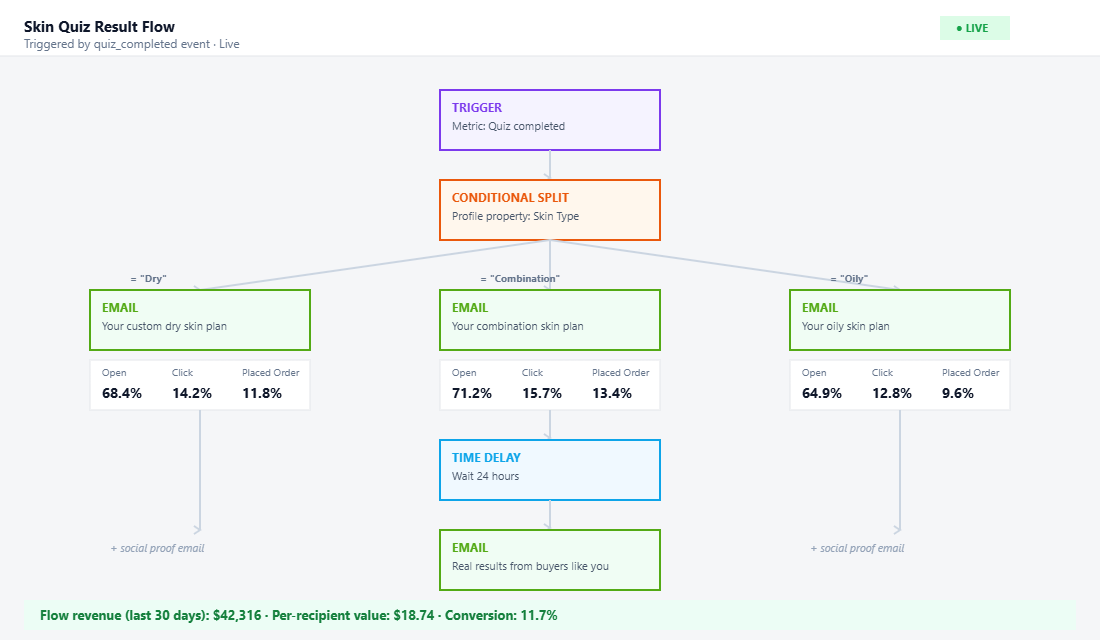
The quiz is the front door. The Klaviyo flow behind it is the engine. Every quiz app worth using syncs answers to Klaviyo as profile properties in real time. That means by the time the buyer closes their browser, your Klaviyo profile already knows their skin type, their goal, their preferred price range, and the recommended product SKU.
The flow architecture I use with members is a three-stage sequence:
- Email 1: The personalised plan (sent immediately). Subject line uses the result. “Your custom skin plan inside” or “Your hair routine, [first name]”. Body is a clean, branded summary of the recommendation, reasons why, and the discount code. Open rates here typically run 60 to 75%.
- Email 2: The social proof punch (sent 24 hours later). Reviews, before-after, UGC from customers who match the buyer’s quiz result. “How [other Aussie buyers] with [skin type] used the recommendation”. Click rates here run 12 to 18%.
- Email 3: The urgency close (sent 72 hours later). Discount code expiry plus a soft scarcity line. Conversion typically runs 8 to 12% of the segment, which is several multiples of a generic welcome series.
Wire this on top of strong Klaviyo segmentation and the quiz becomes the highest-revenue acquisition flow in the account. Most stores I audit are doing this with three generic welcome emails and wondering why their list is not converting. The list is fine. The segmentation is missing.
What Aussie Brands Are Doing Right Now
Three Aussie examples worth studying. Frank Body’s skin quiz uses the value gate model with a 10% off intro code. Image-based options throughout, six questions, soft branching. The quiz traffic is a meaningful slice of their first-purchase revenue and the email list it builds runs hot for months.
Adore Beauty’s skincare quiz uses Preezie with a soft wall. No email required to see the result. The result page redirects straight to a Shopify cart with the recommended bundle pre-loaded. They optimise for purchase first, list second. With their AOV and traffic volume, that maths works.
Internationally, Function of Beauty reports that 80% of quiz takers convert to purchase. Their entire business model assumes the quiz is the funnel. There is no homepage browse path of any consequence. The quiz is the storefront. That is an extreme commitment, but for any brand with a “right product depends on the buyer” thesis, it is the lesson worth stealing.
The Compound Effect: Why a Quiz Outlives the First Sale
Most stores treat a quiz as a single-touch acquisition tool. The brands that win treat it as a permanent personalisation layer that touches every email, every retargeting ad, and every replenishment cycle for the next 12 months.
Once the quiz answers sit on the Klaviyo profile, every email after the first sequence can speak directly to that buyer’s segment. Your BFCM email goes out 12 different ways instead of one. Your replenishment email recommends the right next product, not a generic restock. Your win-back campaign uses the original quiz answer to re-pitch the result, not a one-size discount.
The same data feeds your Meta and Google retargeting. Build custom audiences off the quiz result properties (Klaviyo passes them to Meta natively), and every paid impression after the quiz speaks to the buyer with context. The CPM does not change. The relevance does. ROAS on quiz-driven retargeting typically runs 1.5 to 2.5x higher than generic retargeting in our member accounts.
Compare this to the alternative. The buyer who landed on a collection page, browsed for two minutes, and bounced. You have a pixel hit and nothing else. No email. No segment. No relevance. The quiz buyer gives you 90 seconds of intent data that compounds for a year. That is the trade.
Your Quiz Funnel Build Checklist
This is the build sequence. Hand this to a VA, a developer, or your in-house marketer. Every Aussie brand we work with ships their first quiz inside two weeks using this list.
- Step 1: Pick the goal. Acquisition (paid traffic LP), conversion (homepage and collection pages), or retention (post-purchase replenishment quiz). Pick one. Build for it.
- Step 2: Map the recommendation logic. Open a spreadsheet. List your top 15 to 20 products. Against each, write which buyer profile it fits and why. This is the actual work. The app is just the wrapper.
- Step 3: Write five to seven questions. One soft qualifier, two or three diagnostics, one preference, one future-pacing. Use image options where possible.
- Step 4: Choose the wall pattern. Soft wall if AOV is under $60. Value gate with discount if over $100. Test both eventually.
- Step 5: Pick the app. RevenueHunt free tier to validate. Octane AI when volume justifies it.
- Step 6: Wire to Klaviyo. Map every answer to a profile property. Build the three-email post-quiz flow with conditional splits per result.
- Step 7: Place the quiz. Homepage hero CTA, collection page banner, paid ad landing page, exit intent. In that priority order.
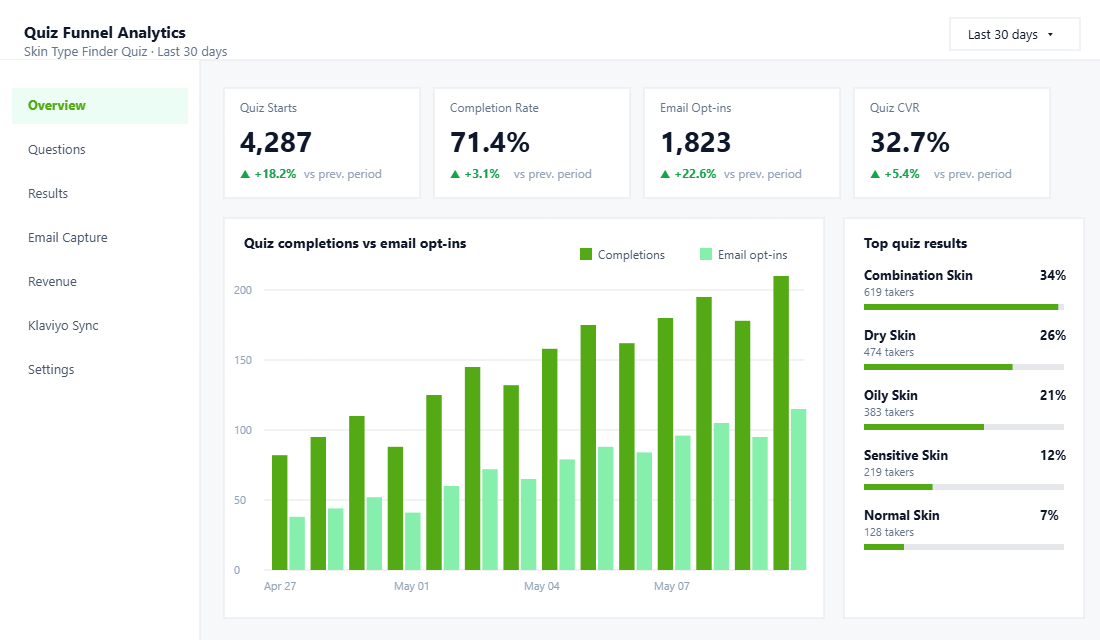
- Step 8: Set up tracking. Quiz starts, completions, opt-ins, and quiz-attributed revenue need to be visible in your weekly dashboard, not buried in app analytics.
- Step 9: Iterate the questions monthly. Look at completion drop-off per question. Rewrite or replace any question with a drop-off rate over 25%.
- Step 10: Build the second quiz. Once the first one is humming, build a post-purchase quiz for replenishment or upsell. Different goal, same architecture.
The whole build is two weeks of focused work for a competent operator. The payoff lasts as long as the brand does. If you are aiming to beat the Shopify conversion benchmarks for your niche this year, a quiz funnel is the single highest-ROI on-site project on the list.
The Quiet Truth About Quizzes
Buyers want help choosing. They have always wanted help choosing. The catalogue model of ecommerce assumed the buyer would do the work of matching themselves to the product. The brands winning in 2026 are the ones giving the buyer a 90-second conversation instead.
The infrastructure to do this costs less than $50 a month. The Klaviyo integration is included in your existing plan. The only real input is the time to map your products to your buyer profiles and write five questions worth taking. That is one Saturday afternoon for a founder who knows their catalogue.
Inside eCommerce Circle, quiz funnels sit inside the Platform pillar of the M