Every store has it. The SKU that looked like a sure thing, so you ordered 500 units, sold 80, and now the other 420 sit in a corner of your 3PL quietly charging you rent. You know the one. You scroll past it in your inventory report and feel a little pang, then move on to something more fun.
What’s in This Article
Most founders handle dead stock in one of two ways, and both are wrong. The first is to ignore it and hope it sells eventually. The second is to panic in the middle of a slow month and slash 50% off across the whole catalogue. Option one bleeds cash slowly. Option two bleeds it fast, trains your customers to wait for the next fire sale, and cheapens everything else on the site.
Here is what makes dead stock so dangerous: it is not a sales problem, it is a cash problem. Carrying costs eat 20 to 30% of a product’s value every single year in storage, insurance and handling. For a lot of Aussie ecommerce brands, 15 to 25% of total inventory is effectively dead. That is money you already spent, sitting on a shelf, earning nothing. This playbook is the 5-part system we use inside eCommerce Circle to turn that pile back into cash without torching your margin.
Part 1: Find It (Run the Dead Stock Audit)
You cannot clear what you have not measured. The first job is separating three things people lump together: healthy stock, slow movers, and genuinely dead stock. Slow is still selling, just gently. Dead has not moved in months and is not going to without intervention.
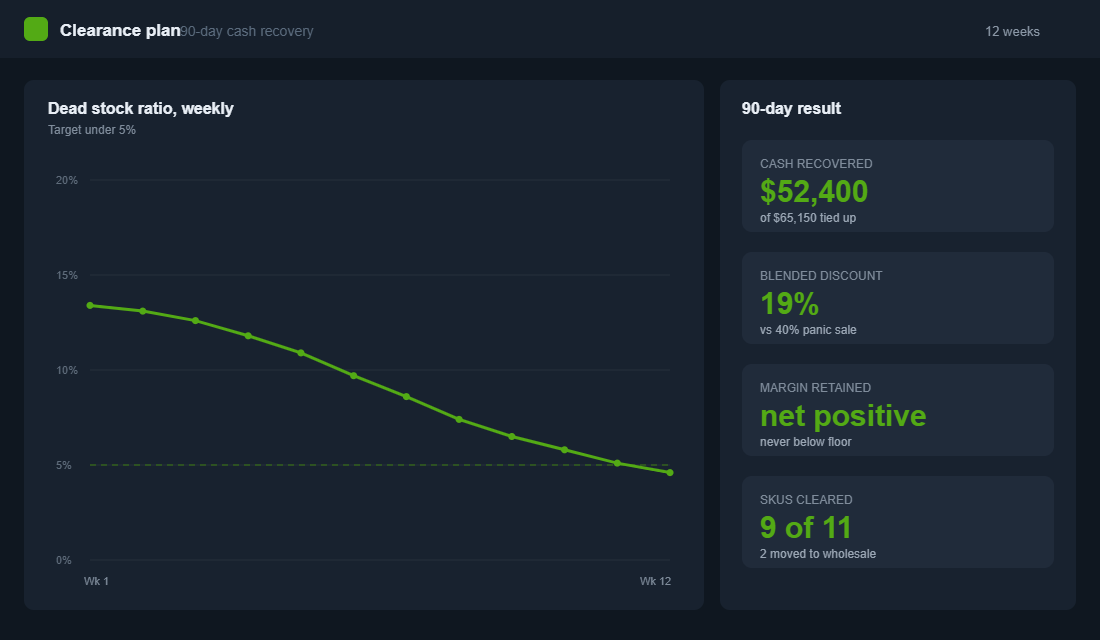
Two numbers tell you where you stand. Your dead stock ratio is the value of unsellable stock divided by total inventory value. Under 5% is healthy, 5 to 10% is a warning, and anything over 10% signals a real inventory problem. Your inventory turnover should sit around 4 to 6 times a year for most ecommerce categories. If you are turning stock twice a year, cash is trapped on your shelves.
You do not need a fancy tool to start. Shopify’s built-in reports will surface this in an afternoon.
- Open Analytics, then Reports. Pull the “ABC analysis by product” report to see which SKUs drive revenue and which are dead weight (your C and D grade products).
- Add the sell-through and days-of-inventory columns. Sort by days of inventory remaining, highest first. Anything with 120+ days of cover is a flag.
- Cross-check against last sale date. Any SKU that has not sold a unit in 60 to 90 days goes on the dead list, regardless of how much stock is left.
- Tag the tied-up cash. Multiply dead units by landed cost. That dollar figure is your recovery target, and it is usually bigger than founders expect.
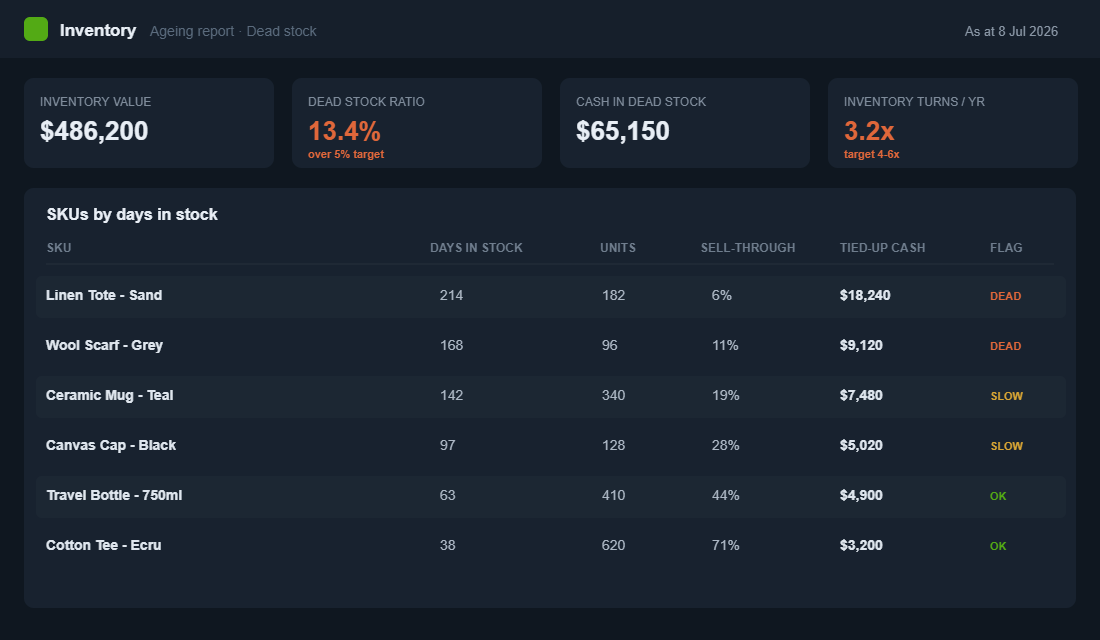
When you total up the tied-up cash column, you have the real prize. In the example above, over $65,000 of cash is frozen in dead and slow stock. That is not a rounding error. That is a hire, an ad budget, or three months of runway sitting in cardboard boxes.
Part 2: Know Your Floor (The Margin Math Before You Touch a Discount)
This is the step almost everyone skips, and it is the one that turns a clearance into a loss. Before you drop a single price, you need to know the lowest number you can sell at and still come out ahead. Marking down without knowing your break-even is how you accidentally sell at a loss and feel busy doing it.
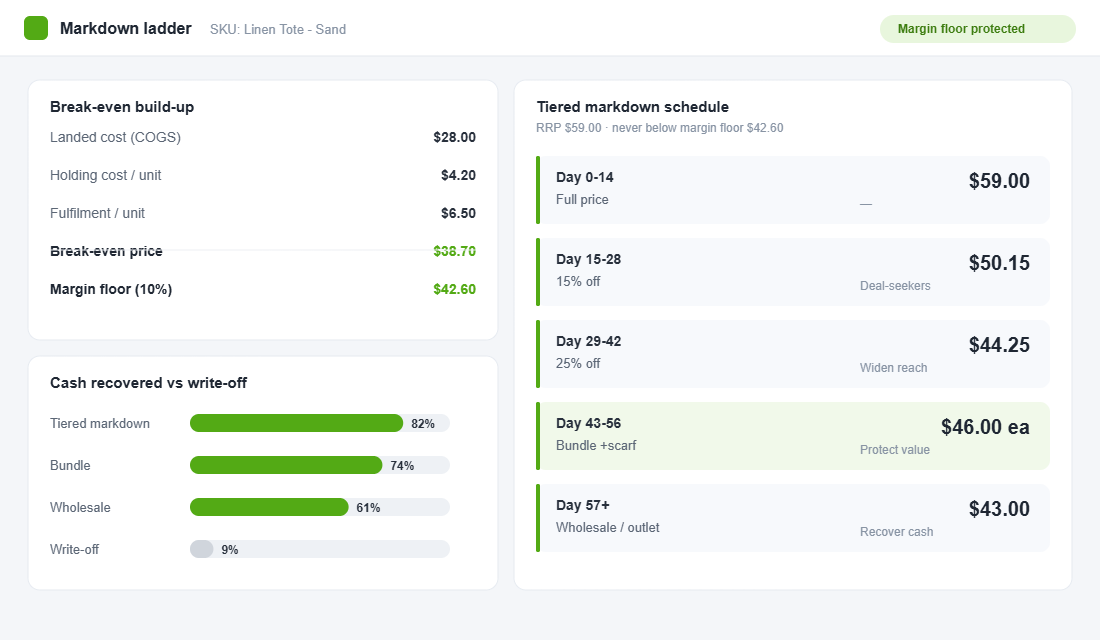
Build your break-even from the ground up: landed cost (COGS), plus holding cost per unit, plus fulfilment per unit. That total is the price where you break even. Add a small margin on top, say 10%, and you have your margin floor: the price you will never go below no matter how desperate the month feels.
If you have not nailed your true cost per unit yet, do that first. The Shopify landed cost playbook walks through finding your real COGS including freight, duties and the fees most founders forget. Every discount decision in this playbook depends on that number being right.
The mindset shift: a clearance is not about getting rid of stock at any price. It is about recovering the most cash you can while staying above your floor. Selling 420 units at a $2 loss each is not “clearing dead stock”. It is paying customers $840 to take your inventory.
Part 3: The Markdown Ladder (Tiered, Not Panic)
One dramatic markdown signals desperation and trains customers to wait for the next one. A tiered markdown works the opposite way. You start shallow to capture the deal-seekers who still act quickly, then deepen the cut only for the stubborn stock that refuses to move.
A simple ladder for a slow SKU looks like this. Full price for the first two weeks. A 15% nudge for weeks three and four to catch the fence-sitters. A 25% cut for weeks five and six to widen reach. Then, and only then, the heavier plays. Each step has a deadline, so the stock keeps moving instead of stalling at one price forever.
This is not just tidier, it is materially more profitable. McKinsey has found that proper markdown optimisation improves margin rates by 400 to 800 basis points compared to blunt, across-the-board discounting. On a category doing $200,000 a year, that is $8,000 to $16,000 in recovered margin from timing alone.
Two rules keep the ladder honest. First, never drop below the margin floor you set in Part 2. Second, never discount your whole catalogue to clear a handful of SKUs. Target the specific dead stock, leave your heroes at full price, and protect the perceived value of the range.
Part 4: Move It Without Discounting At All
Discounting is the obvious lever, but it is not the only one, and often not the best one. The smartest operators clear dead stock while barely touching the sticker price. Here are the four plays that move units without teaching customers to wait for a sale.
- Bundle it with a winner. Instead of marking a slow scarf down 40%, pair it with a best-selling coat and offer the set for 15% off the combined price. The customer sees the overall saving, the dead SKU moves, and your hero product keeps its full perceived value.
- Turn it into a gift with purchase. Offer the dead item free over a spend threshold. You clear units, lift average order value, and the customer feels rewarded instead of sold to. The stock leaves at cost, not at a loss.
- Open a wholesale or liquidation channel. Move a pallet to a wholesale buyer, a marketplace, or a liquidator at a flat rate above your floor. You recover cash in one transaction without a single markdown on your own storefront.
- Run a members-only outlet. A dedicated clearance collection or a private sample sale to your email list keeps the discount away from your main shopfront, so full-price shoppers never see it.
Australian retail is full of this playbook if you look. The Iconic runs a permanent outlet section and timed end-of-season clearances that sit apart from the main catalogue, so full-price fashion never shares a page with the markdowns. Cotton On Group leans on dedicated clearance ranges and outlet channels to move end-of-line stock at volume without dragging down the pricing of its current season. Neither brand trains its core customer to wait, because the clearance lives in its own lane.
If bundling is the play you reach for most, build it properly rather than bolting it on. The Shopify product bundle playbook covers the bundle types that lift average order value while quietly clearing the stock you need gone.
Part 5: Stop Making It (Prevent the Next Pile)
Clearing dead stock once feels great. Clearing it every quarter means you have a buying problem, not a clearance problem. The final part of the system is making sure the pile does not build back up, because prevention is far cheaper than any markdown.
Most dead stock is born at the purchase order, not on the shelf. It comes from ordering on gut instead of data, buying deep on unproven products, and reordering on a calendar instead of on real demand. Fix the buying and the clearance problem mostly disappears.
- Test small, then scale. Order a shallow first run on any new product. Prove the sell-through before you commit to a deep buy. A sold-out test is a good problem. A warehouse full of an unproven SKU is not.
- Reorder on sell-through, not gut. Set a simple rule: only reorder products clearing a target sell-through rate inside a set window. Let the slow movers run down instead of automatically topping them up.
- Watch demand signals. Rising returns, falling repeat rate, or a stalling sell-through curve all warn you a product is cooling before it becomes dead. Catch it while a 15% nudge still works.
- Review aged stock on a cadence. Put a monthly 20-minute inventory review on the calendar. Anything crossing 90 days without a sale enters the markdown ladder automatically, while the discount to clear it is still shallow.
This review fits naturally into the rhythm you should already run on your numbers. If you close your books each month, bolt the aged-stock check onto it. The Shopify month-end close playbook shows the monthly financial review where this belongs, so dead stock gets caught in the same pass as everything else.
The Real Cost of Doing Nothing
Founders sit on dead stock because doing nothing feels free. It is the most expensive option on the table. That inventory is not just failing to earn, it is actively costing you every month it stays put.
Run the numbers on a small example. A retailer with $5,000 of dead stock and a 20% carrying cost is paying an extra $1,000 a year just to keep it in storage. Scale that to a brand carrying $65,000 in dead and slow stock, and at a 22 to 35% annual carrying cost you are burning $14,000 to $22,000 a year on inventory that is not selling. That is a full-time contractor’s salary going up in storage fees and handling.
Then there is the cost you cannot see on any invoice: opportunity cost. Every dollar frozen in a dead SKU is a dollar that cannot buy your best seller, fund a winning ad, or sit in the bank as breathing room. In a business where cash is the constraint, that is the number that actually hurts. Doing nothing is a decision, and it is the priciest one you can make.
When Writing It Off Is the Right Call
Sometimes the honest answer is that stock will never sell at a price worth chasing, and clinging to it just extends the bleed. Knowing when to cut the cord is part of running a tight operation, not a failure of one.
If a SKU sits below its margin floor even after bundling and wholesale offers, stop paying to store it. You have better options than a warehouse invoice. Donate it to a registered charity, which clears the space and can carry a tax benefit worth confirming with your accountant. Move it as B-stock or seconds through a clearly labelled outlet. Or use it as free samples and gifts that buy goodwill on future orders.
The rule of thumb: once the cost to keep a unit outweighs any realistic recovery, the write-off is not the loss. The stubborn holding cost is. Take the deduction, free the shelf, and redeploy the space and attention to stock that actually moves.
One timing note for Australian brands specifically: the end of the financial year on 30 June is your natural forcing function. A lot of founders scramble to clear aged stock in June for the tax and cash reasons, which means the smart move is to start the ladder in April or May, not the last week of the quarter. Stock valued honestly and cleared before EOFY tidies both your books and your cash position going into the new year. Build the aged-stock review into your Q4 rhythm and you turn a panicked June write-off into a planned, margin-aware clearance.
The Compound Effect: Dead Stock Is a Cash Flywheel
Here is why this system matters more than it looks. Every dollar you free from dead stock is a dollar you can put into inventory that actually sells, into ads that actually convert, or simply into your cash buffer. Recovering $52,000 from a pile of dead SKUs is not a one-off tidy-up. It is working capital back in the business.
Run all five parts together and they compound. You find the dead stock early, you never sell below your floor, you clear it at a shallow blended discount instead of a brutal one, you move half of it without discounting at all, and you buy more carefully so less of it forms next season. Each pass gets easier, and your cash cycles faster.
That is the real difference between brands that scrape by and brands that scale. It is rarely more traffic. It is a tighter cash cycle, where money is never left sitting in cardboard when it could be out working. Dead stock is where a lot of that trapped cash hides.
Think of it as a quarterly discipline, not a rescue mission. The brands that never seem to have a dead stock crisis are not lucky buyers. They simply run this loop every quarter, so nothing ever piles up high enough to hurt. Small, regular clearances beat one giant fire sale every time, on both margin and brand.
Your Dead Stock Clearance Checklist
Work through this in order the next time you spot stock going stale. Do not jump to discounting before the first two rows are done.
- Audit. Pull the ABC and days-of-inventory reports, flag any SKU with 90+ days and no recent sale, and total the tied-up cash.
- Floor. Calculate break-even (COGS plus holding plus fulfilment) and set a margin floor you will never sell below.
- Ladder. Build a tiered markdown with deadlines: shallow first, deeper only for what refuses to move, never below the floor.
- Move. Clear as much as possible without discounting: bundles, gift with purchase, wholesale, and a members-only outlet.
- Prevent. Test small, reorder on sell-through, watch demand signals, and run a monthly aged-stock review.
- Measure. Track cash recovered, blended discount, and your dead stock ratio trending back under 5%.
Inside eCommerce Circle, protecting cash and margin is one of the core Profit pillars we work on with every member, and dead stock is where a surprising amount of it hides. If you want a second opinion on how much cash is frozen in your inventory right now, let’s talk.