You did not start a Shopify store to spend your Tuesday morning copying tracking numbers into a spreadsheet and answering the same sizing question for the eleventh time. Yet here you are. The store is doing $80k, maybe $200k a month, and somehow you are busier than you were at $20k.
What’s in This Article
This is the solo trap. Revenue went up, but instead of buying you freedom it bought you a second full-time job. Most founders respond by working harder. They wake up earlier, answer DMs at 11pm, and tell themselves they will hire once things calm down. Things never calm down. That is the whole point.
The founders who break out of it do one specific thing differently. They stop treating hiring as a reward for surviving and start treating it as the system that lets the business grow past them. In Australia, where a good offshore hire costs a fraction of a local one, that move is available to you far earlier than you think. This is the playbook for making it.
The solo trap is a maths problem, not a mindset problem
Founders love to frame their overwork as a character trait. Hustle. Grind. Doing whatever it takes. The numbers tell a less flattering story. Roughly 25% of small business owners work more than 60 hours a week, and 33% clock more than 50. You are not special for being tired. You are average.
The cost is not just your weekend. In a 2023 survey, 72% of entrepreneurs reported burnout symptoms in the past year, and a 2025 study covered by Fortune found 87% dealing with anxiety, depression, or burnout, sometimes all three at once. Burned-out founders make worse calls on buying, cash, and hiring, which is exactly when the business needs sharp thinking most.
Here is the part that should change your behaviour today. Most of the work eating your week is not founder work. It is $8-an-hour work you have priced at your own hourly rate by refusing to hand it over. Every hour you spend on returns admin is an hour you are not spending on product, margin, or the next channel. That is not grit. That is a rounding error compounding against you.
There is a hidden tax on top of the hours. When you are the only person who can answer a question, the whole business waits on you. Suppliers wait, customers wait, campaigns wait. That single point of failure caps your growth at whatever one tired person can process in a day. Hiring is not just about buying time back. It is about removing yourself as the ceiling.
Run a time audit before you write a single job ad
The most common hiring mistake is hiring against a feeling instead of a fact. You feel swamped, so you post a vague ad for a rockstar all-rounder, hire the first friendly person, and then cannot describe what they should actually do. Within a month you are managing them badly and doing your own work anyway.
Fix this by measuring first. For one full week, log every work task in 30-minute blocks. Be honest. At the end of the week, sort every task into three buckets using a simple value test.
- $10 tasks. Anyone could do this with a short instruction. Order tracking, data entry, basic support replies, scheduling, listing checks.
- $100 tasks. Needs a skill you can hire for. Email flows, paid ads, creative editing, bookkeeping.
- $1,000 tasks. Only you can do this. Product strategy, brand, big supplier deals, the next growth bet.
When Aussie founders do this properly, the result is almost always the same. More than half the week is $10 work. The chart below is a real shape we see again and again: customer support, order admin, and inbox alone can swallow 20-plus hours.
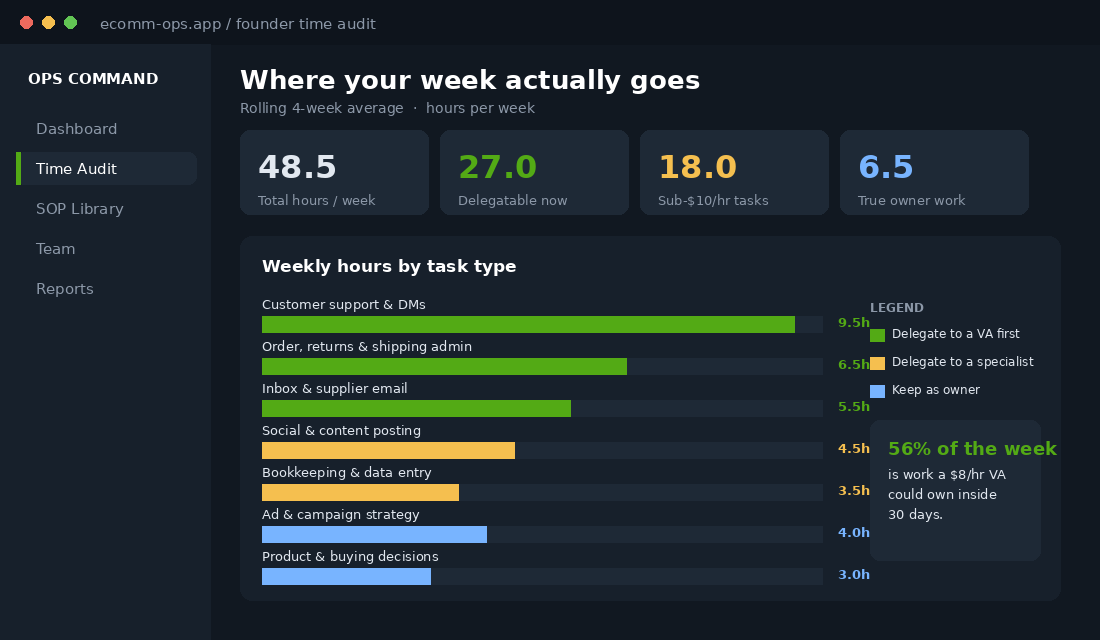
That green block is your job description. You do not need to imagine what to delegate. You just measured it.
Automate the busywork before you hand it to a human
Do not pay a person to do a job software will do for free. Before you delegate a repetitive task, ask whether it should exist at all. A surprising amount of the $10 pile can be deleted with automation, which means you hire for less and your new team member spends their time on judgement calls instead of button-clicking.
Think order tags, shipping notifications, low-stock alerts, review requests, and back-in-stock emails. Handing a human a task that should be a rule is how you end up with an expensive person doing robot work. We break the exact setup down in our Shopify Flow automation playbook, which shows how to pull 10-plus hours of admin off your week before a single hire starts.
The sequence matters. Automate what you can, document what is left, then delegate the rest. Skip the automation step and you are just paying someone to be a slow computer.
Role 1 is almost always a customer-support VA
For nearly every Australian DTC store between $40k and $500k a month, the first hire is a customer-support and admin virtual assistant. Support is high-volume, emotionally draining, endlessly repeatable, and the single fastest thing to take off your plate. It also happens to be where your brand is won or lost, so it deserves a dedicated owner, not your leftover attention.
The economics make this a straightforward decision. A skilled offshore VA in the Philippines typically costs $5 to $15 an hour, which is 60 to 80% less than a comparable local hire, and ecommerce-experienced VAs who know Shopify, Klaviyo, and Gorgias sit at the upper end for good reason. A full-time support VA landing around $1,400 to $1,600 a month AUD can clear 15 hours a week off your calendar in the first month.
Hire for the customer, not just the CV. Olivia Carr, the Aussie founder of Shhh Silk, advises brands to hire talent that lives in the world of their customer. A support person who genuinely gets your buyer will de-escalate a refund and turn it into a repeat order. One who does not will process it like a robot and cost you the relationship. Look for warmth and written communication first, tools second.
- Where to look. OnlineJobs.ph for direct full-time hires, or a managed agency if you want vetting and cover built in.
- What to test. Give a paid trial task: reply to three real (anonymised) support tickets in your brand voice.
- What to pay for. Timezone overlap with your peak support hours matters more than a rock-bottom rate.
Write the SOP before the person starts, not after
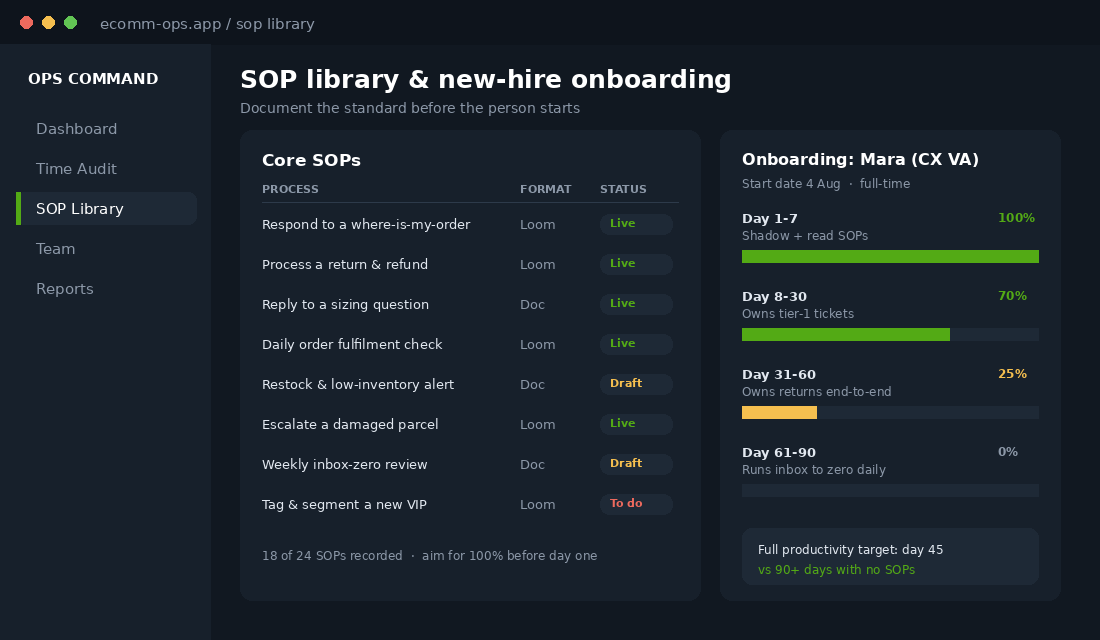
Delegation fails for one reason more than any other: the founder never defined what good looks like. If you cannot explain your standard, a new hire cannot hit it, and you will conclude that hiring does not work when the truth is you handed over a job with no instructions.
Documented process is not bureaucracy. It is what makes delegation actually pay off. Standard operating procedures reduce onboarding time by around 70% and improve retention by up to 82%, and structured onboarding gets a new hire to full productivity as much as 50% faster. Given that replacing a bad hire can cost 90 to 200% of their annual salary, the hours you spend documenting are the highest-return hours in the whole process.
The fastest way to build SOPs: record, do not write
Nobody has time to write a 40-page manual, and nobody reads one. Use Loom, a free screen-recording tool, to build your SOP library by narrating the work as you already do it. Here is the exact setup.
- Install the Loom Chrome extension and create a free account. The free plan covers up to 25 videos, which is enough for a first hire.
- Create a folder called Support SOPs. Every core task gets its own short video.
- The next time a real support ticket, return, or fulfilment check lands, hit record and talk through exactly what you do and why, start to finish.
- Keep each video under five minutes. One task per video so it is easy to find later.
- Drop every Loom link into a single Google Doc or Notion page, grouped by task. That doc becomes your training manual.
- Have your new hire record themselves doing the task back to you. That is how you confirm the standard actually transferred.
Do this for two weeks of real work and you will have 15 to 20 SOPs without writing a manual. The library is reusable forever, so hire number two costs a fraction of the time hire number one did.
The five-role delegation ladder
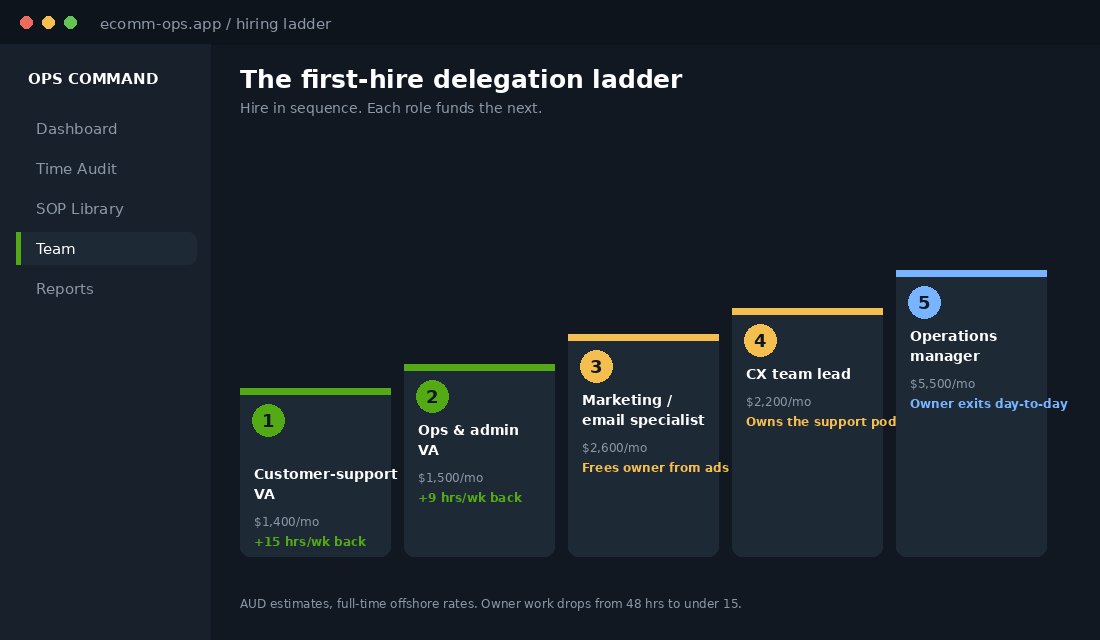
You do not build a team in one hire, and you do not build it in a random order. You climb a ladder where each role frees you up and, ideally, funds the next one. Try to hire all five at once and you will run out of cash and management capacity at the same time.
Davie Fogarty built The Oodie into more than A$600 million in cumulative sales, and his summary of how is blunt: it comes down to getting the right people and the right process, in that order. He credits strong hires with saving the company millions. The lesson for a smaller store is not to copy his headcount. It is to copy his sequence: people plus process, one deliberate rung at a time.
It is all about getting the right people and process, in that order. Davie Fogarty, founder of The Oodie.
The temptation at every rung is to skip ahead to the senior, expensive hire because it feels more impressive. Resist it. A $5,500 operations manager with no team to run and no documented processes to manage is just a very expensive assistant. Earn each rung by clearing the one below it first. Here is the order that works for most Aussie DTC brands.
- Rung 1: Customer-support VA. Takes tickets, DMs, and returns. Buys back the most hours, fastest.
- Rung 2: Ops and admin VA. Order processing, supplier email, data entry, listing updates. Clears the rest of the $10 pile.
- Rung 3: Marketing or email specialist. Owns your Klaviyo flows and campaigns or your paid ads, so you stop being the bottleneck on revenue.
- Rung 4: CX team lead. Once support volume needs two people, promote or hire someone to own the support pod so you stop managing it directly.
- Rung 5: Operations manager. The role that finally lets you exit the day-to-day. They run the team and the calendar so you run the business.
Onboard on a 30, 60, 90 so the hire actually sticks
A new hire without a plan drifts, underperforms, and gets blamed for a system failure. Give every hire a simple 30-60-90 with one clear ownership milestone per phase. It removes ambiguity for them and gives you an honest way to measure progress.
- Days 1 to 30. Shadow, read the SOPs, and take full ownership of tier-one tasks. Success looks like handling routine tickets without asking you.
- Days 31 to 60. Own a full process end to end, such as returns from request to refund. Success looks like you no longer touching it.
- Days 61 to 90. Run their function to a standard, such as inbox to zero every day. Success looks like a metric, not a vibe.
Attach one number to the role so performance is not a matter of opinion. First-response time under two hours. Zero unanswered tickets by end of day. A CSAT score above a set line. Numbers protect both of you, and they make the next promotion or pay rise an easy, evidence-based conversation.
Three mistakes that make founders swear off hiring
Plenty of founders try one hire, have a bad experience, and decide delegation is not for them. Almost always the hire was fine and the setup was broken. These are the three failures that do the damage.
Hiring a mirror of yourself. You are a generalist who does a bit of everything, so you hire another generalist to do a bit of everything. Now you have two people with no clear ownership and twice the confusion. Hire for a defined role with a defined outcome, even if the person grows into more later.
Delegating outcomes you have never systematised. If a task lives only in your head and changes every time you do it, a new person has no chance. Do the task the same way three times, write down what you did, and only then hand it over. Undefined work is unmanageable work.
Hovering instead of handing over. Micromanaging a new hire back into your own inbox defeats the purpose. Give them the SOP, a clear metric, and the room to make small mistakes while they learn. Your job shifts from doing the task to owning the result, and that is a different, smaller job. This is the same discipline that lets automations run without you babysitting them.
Get these three right and the first hire stops feeling like a gamble. It becomes a repeatable move you make every time your calendar tells you it is time.
The compound effect: from operator to owner
Play this forward. Rung one buys back 15 hours a week. You reinvest some of that time into rung three, which lifts revenue, which funds rung five. Within a year the founder doing 48 hours of mostly $10 work is doing under 15 hours of pure $1,000 work, and the store no longer stops when they take a day off.
That shift is worth more than the hours. A business that depends entirely on you is fragile and, if you ever sell, worth less. The same systems that free your week also make the business more valuable, which is the exact logic behind our Shopify exit readiness playbook. A team plus documented process is the difference between owning an asset and owning a job.
It compounds on the customer side too. A dedicated support owner replies faster and warmer, which lifts repeat purchase rates, which is where the real profit sits. Pair the delegation ladder with the retention systems in our Shopify customer accounts playbook and the hire that started as a cost centre quietly becomes a growth lever.
Your first-hire checklist
Run these seven steps in order. Do not skip a rung.
- Audit. Log one week in 30-minute blocks and sort tasks into $10, $100, and $1,000 buckets.
- Automate. Delete every $10 task a Shopify Flow or app can handle for free.
- Define. Record a Loom SOP for each remaining repeatable task. Aim for 15-plus before anyone starts.
- Hire. Bring on a customer-support VA first. Test with a paid trial in your brand voice.
- Onboard. Set a 30-60-90 with one ownership milestone and one number per phase.
- Measure. Review the metric weekly for the first month, then monthly.
- Climb. Once the hours are truly back, hire the next rung. Repeat.
Inside eCommerce Circle, building the team and the systems behind it is one of the core pillars we work on with every member. If you want a second opinion on your first hire, your SOPs, or which rung to climb next, let’s talk.