Open your phone right now and look at your two most-used apps. For 13 million Australians, WhatsApp is sitting in that top row, checked dozens of times a day, with every message read within minutes. Now ask yourself how many messages your store has ever sent there. For most Aussie Shopify founders, the answer is zero.
What’s in This Article
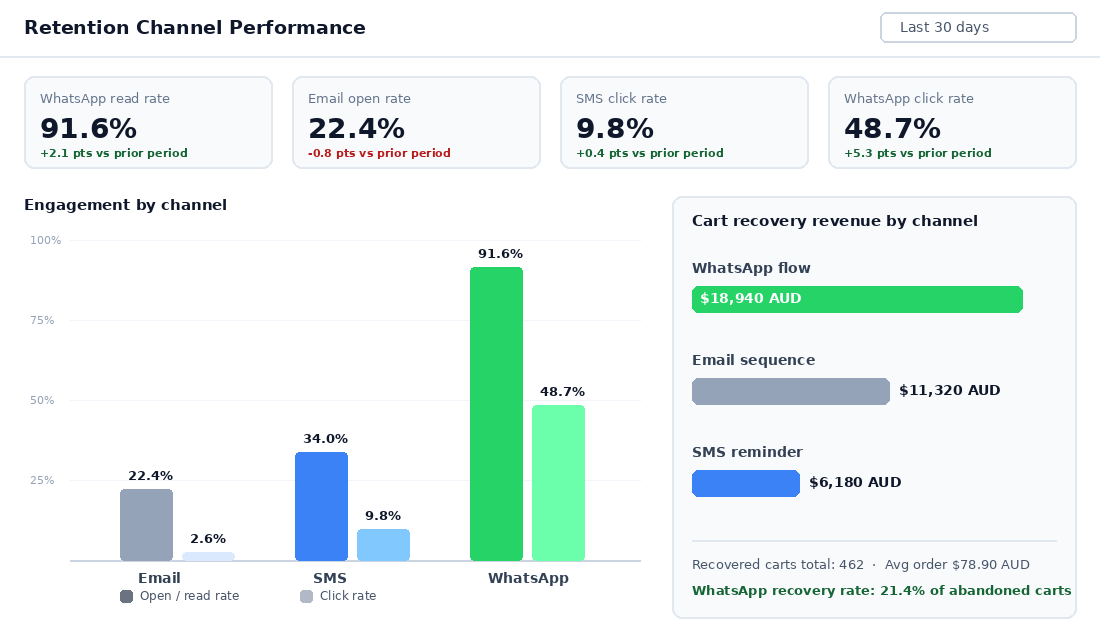
Here is what that blind spot costs. WhatsApp messages get opened at rates north of 90%, against roughly 20% for email. Click-through rates on well-built WhatsApp campaigns land between 45% and 60%, where a good email campaign scrapes 2% to 3%. Stores running structured WhatsApp cart recovery report winning back 18% to 23% of abandoned carts, and some promotional campaigns have pushed that far higher.
Most brands do this wrong in one of two ways. They either ignore WhatsApp completely because “Australians use SMS”, or they blast broadcast messages until Meta throttles their number. This playbook gives you the third option: a 5-flow system that treats WhatsApp as a lifecycle channel, built on the same segmentation discipline we teach hundreds of Aussie Shopify founders inside eCommerce Circle.
The Honest Australia Caveat: When WhatsApp Beats SMS (and When It Does Not)
Let’s deal with the elephant first. Australia is an SMS-first market. Unlike the UK, India, Brazil or most of Europe, Aussies still text each other on the default messages app, and every carrier delivers SMS reliably. If your entire customer base is domestic and over 45, SMS probably stays your primary mobile channel. We covered that build in our SMS Marketing Playbook.
But the picture shifts fast when you look at who actually uses WhatsApp here. Around 13 million Australians are active on it as of mid 2025, roughly half the country. Usage skews heavily toward metro 18 to 40 year olds, recent migrants, and anyone with family or business ties overseas. Messaging app usage hits 89% among 18 to 24 year olds.
So run this quick audit before you invest a dollar:
- You sell internationally. If the UK, Europe, Southeast Asia, India or the Middle East show up in your Shopify sales by country report, WhatsApp is the native channel for those buyers, not a nice-to-have.
- Your audience is metro and under 40. Fashion, beauty, fitness, tech accessories and lifestyle brands with capital-city heavy orders will find a large share of their list already lives on WhatsApp.
- You sell high-consideration products. Furniture, jewellery, custom goods and anything over $300 AUD benefits from two-way conversation before purchase. WhatsApp is built for that; SMS is not.
- Your SMS costs are climbing. Australian SMS runs 5 to 8 cents per segment. WhatsApp utility conversations are billed per 24-hour conversation window, which often works out cheaper for multi-message sequences.
Tick two or more of those boxes and WhatsApp deserves a lane in your retention stack. Tick none and you can close this tab with a clear conscience. That honesty matters, because the worst outcome is building a channel your customers never wanted.
The Foundation: API Access, Opt-Ins and the 24-Hour Window
WhatsApp is not email. You cannot buy a list, you cannot message anyone who has not opted in, and Meta polices the platform hard. Get the foundation right and the channel prints money. Get it wrong and your number gets restricted within weeks.
Use the Business API, not the free app. The free WhatsApp Business app is fine for a market stall, useless for a Shopify store. The API version (accessed through platforms like Zoko, Wati or Interakt) gives you automation, cart data sync, template messages and multi-agent inboxes.
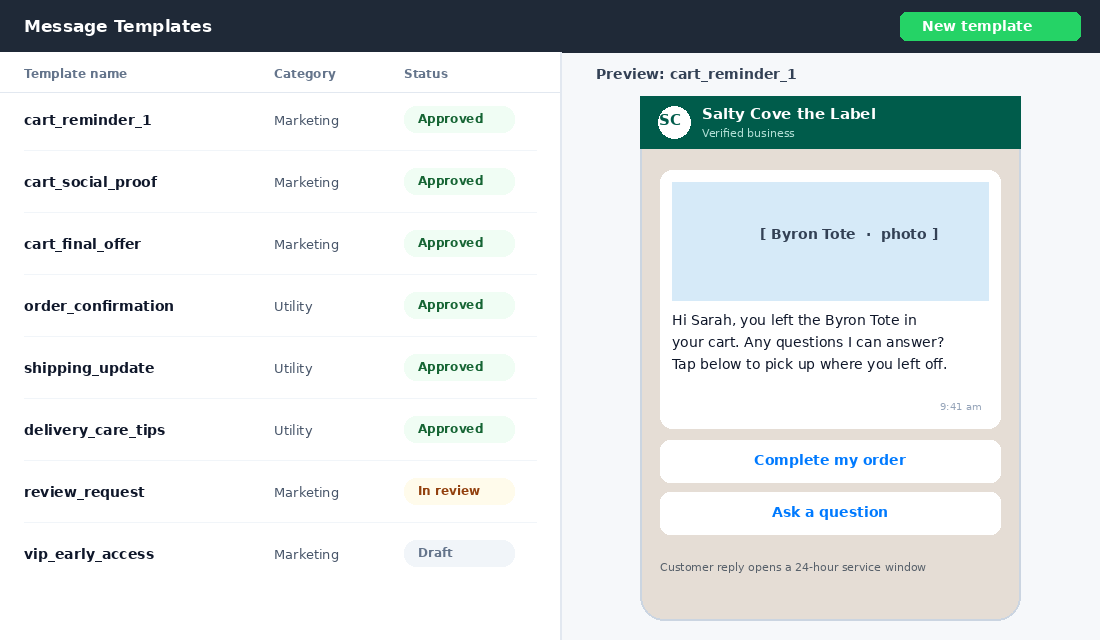
Understand the two message types. Inside a 24-hour window after a customer messages you, you can send anything free-form. Outside that window, you can only send pre-approved template messages, which Meta reviews before you can use them. Templates are classified as marketing, utility or authentication, and each class is billed differently per conversation.
Collect explicit opt-in. Under Australian spam law and Meta policy, you need clear consent for marketing messages. The highest-converting collection points are a checkbox at checkout (“Get order updates and exclusive offers on WhatsApp”), a spin-to-win or welcome popup offering a first-order incentive, and a click-to-WhatsApp button on product pages for pre-sale questions.
Set frequency guardrails on day one. Cap marketing messages at 2 to 4 per month per subscriber. WhatsApp shows customers a “block or report” prompt on every business message, and Meta tracks your quality rating. High block rates cut your daily sending limits automatically. Treat every send like it costs you list health, because it does.
Flow 1: Abandoned Cart Recovery (Your First 30 Days of ROI)
Roughly 70% of ecommerce carts are abandoned, and your 7-email recovery sequence only reaches the inboxes that open. WhatsApp cart recovery is where the channel proves itself fastest, which is why it should be the first flow you build.
The global benchmarks are hard to ignore. Well-structured WhatsApp recovery sequences win back 18% to 23% of abandoned carts, with the best programs reporting up to 45%. Audio brand Skullcandy reports recovering 25% to 40% of lost sales through automated WhatsApp reminders, and Under Armour hit a 63% recovery rate during a promotional week by pairing reminders with a discount.
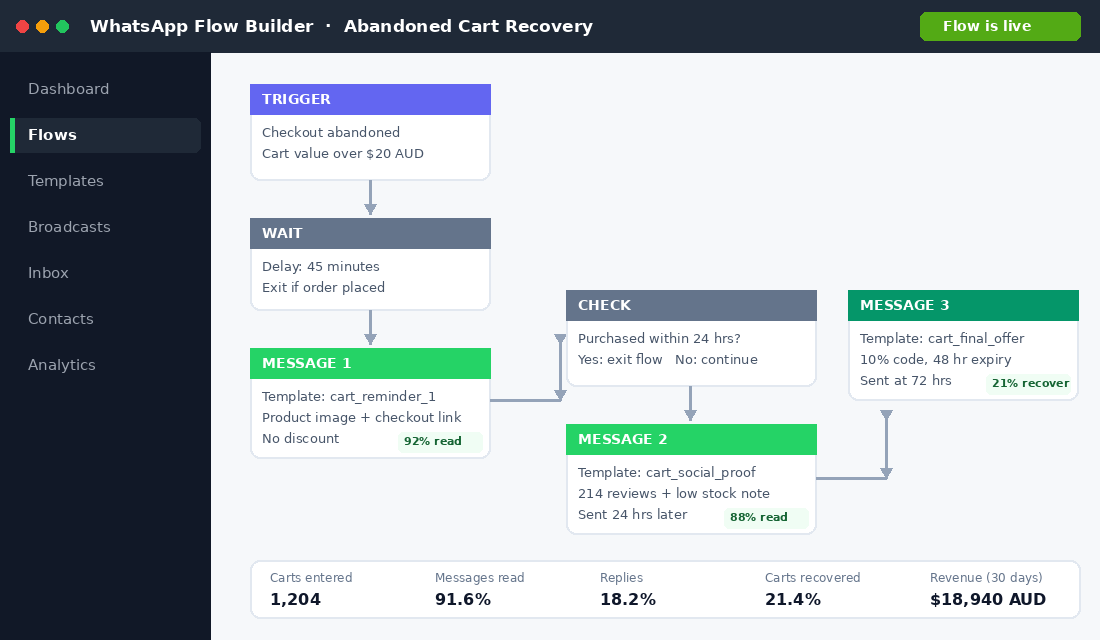
Here is the 3-message sequence that works:
- Message 1, 30 to 60 minutes after abandonment. Helpful, not salesy. “Hi Sarah, you left the Byron Tote in your cart. Any questions I can answer? Tap below to pick up where you left off.” Include the product image and a direct checkout link. No discount yet.
- Message 2, 24 hours later. Add social proof and urgency. “The Byron Tote has 214 five-star reviews and stock is down to 9 units. Here is your cart.” Still no discount for full-price protection.
- Message 3, 48 to 72 hours later. Your closer. A 10% code or free shipping with a 48-hour expiry. This is the only message in the sequence that costs you margin, and it only goes to people the first two did not convert.
Two execution details separate the pros from the spammers. First, exclude anyone who purchased between messages; your platform should handle this, but test it with a live order. Second, keep message 1 conversational, because replies open the 24-hour free-form window where your team can answer objections and close the sale by chat.
Flow 2: Order Updates That Build the Thread
Here is the strategic trick most brands miss: transactional messages are the cheapest way to make WhatsApp a place your customers expect to hear from you. Order confirmation, shipping notification and delivery confirmation are utility conversations, billed at a fraction of marketing message rates.
Every update lands in the same chat thread. By the time your first marketing message arrives, it sits under three helpful messages the customer actually wanted. That context is why WhatsApp marketing messages get read instead of blocked, and it is a trust asset SMS simply cannot build.
Ship four utility messages as standard: order confirmation within a minute of purchase, dispatch notification with tracking link, out-for-delivery day-of alert, and a delivery confirmation that doubles as a care-instructions message. Australian customers obsess over tracking (blame our delivery distances), so this flow alone lifts repeat purchase intent and cuts your “where is my order” tickets dramatically. Stores we work with typically see support ticket volume on shipping questions drop by a third once WhatsApp tracking updates go live.
Flow 3: The Post-Purchase and Replenishment Engine
Your second sale is where the margin lives, and WhatsApp is a precision tool for it. Because open rates sit above 90%, a single well-timed message can do what a 4-email sequence attempts.
Review request, day 10 to 14. One message, one link, sent after delivery confirmation plus a buffer for product use. Brands consistently report higher review completion on WhatsApp than email because the friction is lower: the customer is already in a chat, not digging through promotions tabs.
Replenishment reminder, timed to your product cycle. If you sell consumables (coffee, skincare, supplements, pet food), calculate your median reorder gap from Shopify order data and send a one-tap reorder message 5 days before it. “Your last bag of the Ethiopian blend usually lasts about 4 weeks. Want me to send another?” We built the full timing model in our Replenishment Flow Playbook, and it ports straight across to WhatsApp.
VIP early access, monthly at most. Segment your top 10% of customers by spend and give them genuine first access to drops and restocks. Keep this list small and the offers real. A VIP broadcast to 400 true fans will outperform a blast to 4,000 lukewarm subscribers on both revenue and block rate.
Flow 4: Conversational Selling (the Part SMS Cannot Do)
Everything so far, SMS can approximate. This flow is where WhatsApp pulls away. WhatsApp supports product catalogues, carousel messages, quick-reply buttons and payment-linked carts inside the chat itself. That makes it a genuine selling surface, not just a notification pipe.
Start with a click-to-WhatsApp button on your product pages for high-consideration items. A shopper weighing up a $450 AUD leather jacket has questions: fit, leather grade, returns. Answering in chat converts those conversations at rates your product page cannot touch, because objections get handled by a human in real time.
Then wire up three quick wins. Build a quick-reply menu for your five most common pre-sale questions (sizing, shipping times, returns, stock, materials) so your VA clears most chats in one tap. Sync your Shopify catalogue so your team can drop a tappable product card into any conversation. And route your live chat overflow to WhatsApp after hours, so a 9pm browser becomes a next-morning conversation instead of a lost session.
Measure this flow on assisted revenue: orders placed within 7 days of a two-way conversation. Stores selling considered purchases routinely find chat-assisted sessions convert at 3 to 5 times the site average.
Flow 5: The Broadcast Calendar (Careful, This Is Where Brands Die)
Broadcasts are the flow every founder wants to start with and the one you should build last. A broadcast is a marketing template sent to a segment: new drop, restock, sale, BFCM early access. Done well it drives the biggest single-day revenue spikes of any flow here. Done lazily it torches your quality rating and your sending limits with it.
The rules that keep you alive:
- Segment before you send. Never broadcast to your full list. Slice by purchase history, category interest and recency. A restock alert goes to people who viewed or bought that product, not everyone.
- Cap the calendar. 2 to 4 broadcasts per month, full stop. Every send should be something a customer would honestly want to know about.
- Watch your quality rating weekly. Meta scores your number green, yellow or red based on blocks and reports. Yellow means tighten segmentation immediately. Red means your daily message cap just got slashed.
- Time for Australia. Send between 11am and 1pm or 7pm and 8:30pm local time, and stagger by state during daylight saving so Perth is not getting pinged at breakfast.
The Stack: Setting Up Zoko on Shopify in an Afternoon
You need a WhatsApp Business API platform to run any of this. For Shopify stores, Zoko is the one we see deployed most cleanly: it is Shopify-native, syncs cart and order data out of the box, and pricing starts around $50 USD per month plus Meta’s per-conversation fees. Wati (from $59 USD per month, with a $4.99 Shopify plugin for cart recovery and COD flows) and Interakt (from around $21 USD per month) are solid alternatives at different budgets.
Here is the setup sequence:
- 1. Get a dedicated number. Use a fresh number or a virtual one for the API; once a number is registered to the API it cannot run the normal WhatsApp app. Do not sacrifice your personal number.
- 2. Verify your Meta Business account. Have your ABN and website matching your business name. Verification usually clears in 1 to 3 days and lifts you into higher sending tiers.
- 3. Install the platform’s Shopify app. Approve the data scopes for checkouts, orders and customers. This is what powers abandoned cart triggers and order update flows.
- 4. Submit your message templates. Write your cart recovery, order update and welcome templates and submit them for Meta approval. Most clear within 24 hours. Write them in plain Australian English and avoid ALL CAPS and excessive emoji, which trigger rejections.
- 5. Add opt-in collection. Turn on the checkout opt-in checkbox and add your welcome popup incentive. From this moment your list starts compounding.
- 6. Switch on flows in order. Order updates first (day 1), cart recovery second (week 1), post-purchase third (week 2), conversational selling and broadcasts once volume justifies them.
Measure It Like a Channel, Not a Toy
WhatsApp fails in stores that never define what success looks like. Set your targets before the first flow goes live, and review them monthly alongside your email and SMS numbers in the same dashboard.
The benchmarks worth holding yourself to: opt-in rate at checkout of 15% to 25% once the checkbox copy is dialled in, cart recovery of 15% or better by month two, read rates above 85% (if yours drop below that, your list quality or frequency is off), and block rate under 1% on every broadcast. Track revenue per subscriber per month the same way you do for email; healthy programs land between $1.50 and $4 AUD once all five flows are live.
One warning on attribution. Most WhatsApp platforms claim every order from anyone who received a message in the last 7 days. Cross-check their revenue numbers against Shopify UTM data before you celebrate, the same discipline you would apply to any ad platform’s self-reported ROAS.
How the 5 Flows Compound
Look at what you have built when all five run together. Order updates train customers to open your messages and build the thread. That trust lifts cart recovery performance, because message 1 arrives from a sender they recognise. Recovery conversations open free-form windows that feed conversational selling. Post-purchase flows drive the second order, which qualifies customers for the VIP segment. And your broadcast calendar lands on a warm, segmented list instead of a cold one.
Each flow makes the next one cheaper and more effective. That is the same compounding logic behind every retention system we teach: channels do not work as isolated tactics, they work as loops. Email did this for the last decade. WhatsApp does it with 4 to 5 times the open rate.
Your 7-day launch checklist:
- Day 1: Run the Australia audit above. Confirm WhatsApp fits your audience before spending anything.
- Day 2: Sign up to Zoko (or Wati/Interakt), register your dedicated number, start Meta business verification.
- Day 3: Install the Shopify app, sync catalogue, submit your first four templates for approval.
- Day 4: Switch on order update flows and test with a live order to your own phone.
- Day 5: Build the 3-message cart recovery sequence with purchase exclusions. Test it end to end.
- Day 6: Add checkout opt-in and your popup incentive. Start collecting subscribers.
- Day 7: Set your frequency caps, book a weekly quality-rating check into your ops calendar, and schedule your first segmented broadcast for when your list clears 200 opted-in subscribers.
Inside eCommerce Circle, messaging channels like this sit under the Promotion pillar of the More Orders Operating System, and getting the sequencing right is one of the core things we work through with every member. If you want a second opinion on whether WhatsApp deserves a lane in your stack, let’s talk.