If Meta sneezed tomorrow, how much of your revenue would catch a cold? For most Aussie Shopify brands the honest answer is “most of it”. One storefront, one or two paid channels, and a CPM bill that creeps up every quarter. That is not a growth strategy, it is a single point of failure with a nice logo.
What’s in This Article
Meanwhile, there is a sales channel sitting next door that most DTC founders refuse to take seriously: eBay Australia still puts your products in front of roughly 12 million unique Aussie visitors a month, and it remains one of the two biggest marketplaces in the country. Founders dismiss it as a digital garage sale, then spend $40 a click fighting for the same customer on Meta.
The brands quietly winning here treat eBay as what it actually is: a second storefront with built-in traffic, bolted onto the Shopify stack you already run. Since Shopify shipped its own Marketplace Connect app, the integration argument is dead too. This playbook walks through the 5-part system: when eBay makes sense, the margin maths, the setup, the listing engine, and the operational guardrails that stop channel number two from wrecking channel number one.
Part 1: The Case for eBay as Your Second Channel (With the Honest Caveats)
Let’s start with the honest picture, because the eBay story in Australia has two halves. The cautionary half: eBay’s share of Aussie online shoppers has slipped from 62% in 2023 to around 51%, while Amazon has climbed past it to roughly 60%, according to marketplace tracking reported by Value Added Resource. eBay is not the default anymore, and it skews older: fewer than 4 in 10 Aussies aged 18 to 24 bought there in recent surveys.
The opportunity half: 51% of a market that shops online as heavily as Australia is still an enormous pool of buyers, the platform connects you to 134 million active buyers globally if you turn on international postage, and around 40,000 Australian businesses already sell there. More importantly, eBay buyers behave differently to your Instagram audience. They search with intent, they compare on price and postage, and whole categories (parts and accessories, tools, tech, collectables, home, refurbished anything) start their shopping journey on eBay rather than Google.
So the filter looks like this. eBay deserves a spot as your second channel if at least two of these are true:
- Your category has native eBay demand. Auto and bike parts, tools, tech and accessories, appliances, sporting goods, hobby and collectable niches, and anything with a spec-driven purchase decision. If buyers search by model number, eBay wants you.
- You carry depth in evergreen SKUs. eBay rewards listings that stay live and accumulate sales history. A stable core range beats a fast-fashion drop cycle.
- You have margin room of 15%+ after all channel costs. We will do the exact maths in Part 2.
- You have stock you need to move. Older colourways, discontinued lines and open-box returns can earn back cash on eBay without a sitewide sale training your DTC customers to wait for discounts.
If Amazon is also on your radar, good: the two are complements, not substitutes, and we covered the other side in The Amazon Australia Shopify Playbook. Plenty of Aussie retailers run both. Bing Lee and The Gamesmen, two of the longest-running retail names on eBay Australia, have spent well over a decade treating eBay as a permanent storefront rather than a clearance bin, and their review counts (hundreds of thousands of transactions) are the moat that new competitors cannot buy.
Part 2: The Margin Maths (Do This Before You List a Single SKU)
eBay’s fee structure is simple compared to Amazon’s, but it still eats 10 to 14% of most sales. Here is the stack for an Australian seller:
- Final value fee: typically 10 to 13.9% including GST depending on category, calculated on the total including postage, plus a small per-order fee.
- Store subscription: optional but usually worth it once you pass a few dozen listings, because it cuts final value fees in key categories and adds free listings each month.
- Promoted Listings: optional ad spend, usually 2 to 8% of sale price in competitive categories. Treat it as your eBay CAC.
- Marketplace Connect: free with your Shopify plan for the first 50 synced orders a month, then a 1% fee per synced order, capped at USD $99 a month. At scale it is effectively a rounding error.
Now run the comparison that actually matters: eBay’s all-in take versus your blended cost of acquiring the same sale on your own store. If you are paying a 25 to 35% marketing efficiency cost on Meta and Google to drive DTC orders, a 13% marketplace fee plus 4% promoted listings does not look like a tax. It looks like a cheaper customer, with the postage subsidised by 12 million people already on the site.
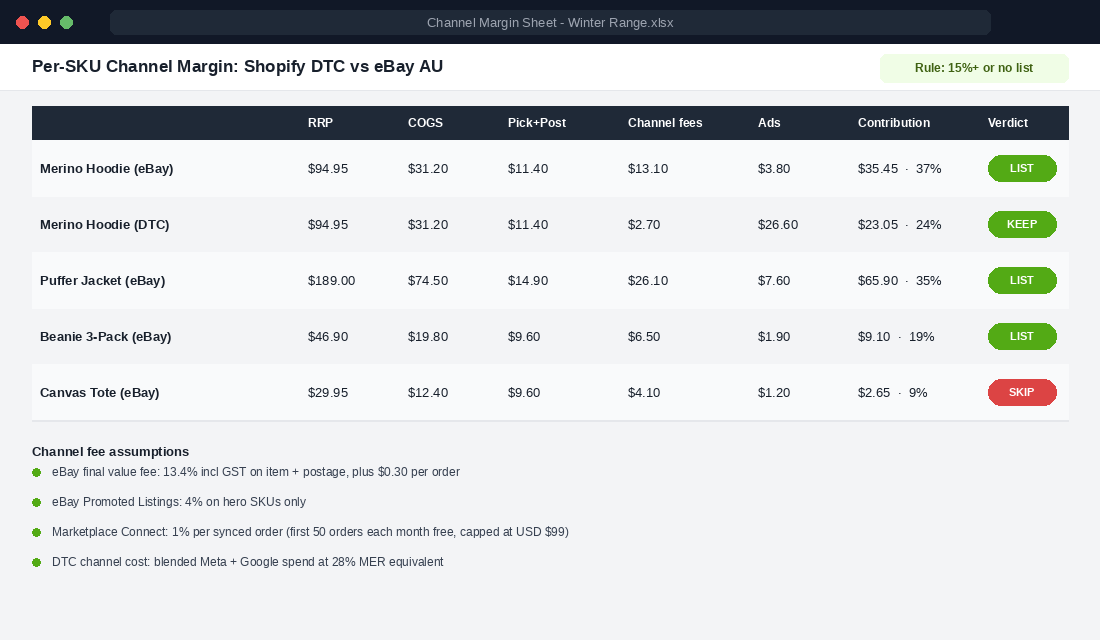
Build a per-SKU channel margin sheet before launch: RRP, COGS, pick and pack, postage, eBay fees, promoted listings allowance, GST. Then set two rules. Rule one: no SKU goes on eBay below 15% contribution margin after everything. Rule two: your eBay price is never lower than your own store’s price for current-line products. Price parity protects your DTC funnel; if you want to be cheaper somewhere, be cheaper on old stock only. If contribution margin is a fuzzy number in your business, fix that first with The Shopify Contribution Margin Playbook.
Part 3: The Setup (Marketplace Connect in an Afternoon)
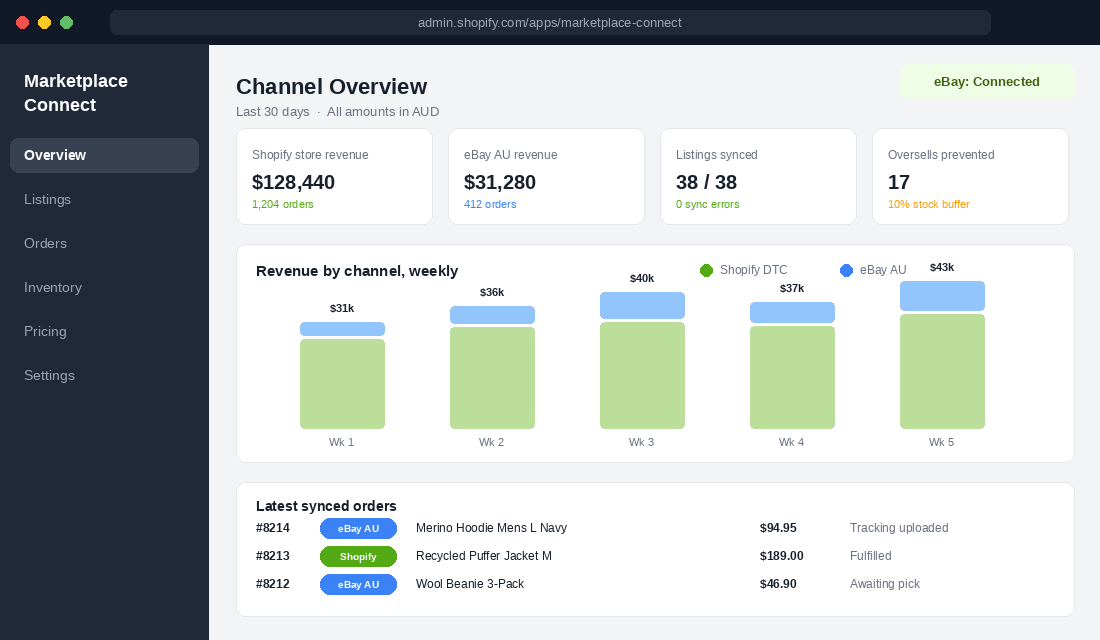
The old excuse for skipping eBay was operational: separate logins, manual stock updates, oversells every weekend. Shopify Marketplace Connect killed that excuse. It is Shopify’s own app, it syncs listings, inventory, orders and pricing between Shopify and eBay (plus Amazon and others), and eBay orders land in your normal Shopify order list tagged by channel.
The setup sequence:
- Install Marketplace Connect from the Shopify App Store and connect your eBay account. If you are starting fresh, register an eBay business account with your ABN first so fees and GST reporting stay clean.
- Start with a pilot batch of 20 to 40 SKUs, not the whole catalogue. Pick evergreen products that pass the Part 2 margin test and have strong photography.
- Map categories and item specifics carefully. This is where most integrations get lazy. eBay’s search engine leans heavily on item specifics (brand, size, colour, model, compatibility), so a listing with half-filled specifics is invisible no matter how good the product is.
- Set an inventory buffer. Sync total stock minus a safety margin (say 10%) so a busy DTC weekend cannot oversell your eBay listings. Marketplace Connect lets you cap or offset quantity per channel.
- Configure postage to match buyer expectations. eBay Australia buyers filter by free postage constantly. Bake postage into the price for items under about a kilo and offer “free” shipping; use calculated rates only for bulky goods.
- Set your returns policy to 30 days. It matches what eBay rewards in search visibility, and your Australian Consumer Law obligations sit underneath any policy you write anyway.
Total time for a competent operator: one afternoon, plus a week of watching the pilot batch before you scale the range. That is the whole barrier to entry that has been “on the roadmap” for two years.
One admin note while you are in there: make sure your eBay payout account, GST registration and Shopify tax settings all tell the same story. Marketplace sales are still your sales for GST purposes, and your accountant will want the channel split at BAS time. Tag it properly now and month-end takes minutes instead of a spreadsheet archaeology session.
Part 4: The Listing Engine (How eBay Search Actually Ranks You)
eBay’s search engine, Cassini, is a different animal to Google or Amazon. It ranks listings on relevance, seller performance and buyer conversion signals, and it gives you more direct levers than either of the others. The stores that win on eBay treat listing optimisation as a weekly discipline, not a set-and-forget upload.
- Titles: keywords first, brand ego last. You get 80 characters. Lead with what buyers type: product type, brand, model, size, colour, key attribute. “Merino Wool Hoodie Mens Large Navy Heavyweight 400gsm” beats “The Somerton Hoodie by [YourBrand]” every single time.
- Fill every item specific eBay offers. Listings with complete item specifics show up in the filtered searches serious buyers actually use. This is 20 minutes per product that most competitors skip.
- Photos: white background hero, then lifestyle. Twelve slots are free. Use at least six: hero, angles, detail, scale reference, packaging, size chart. Reuse your Shopify assets.
- Compete on the total, not the sticker. Cassini and buyers both evaluate price plus postage. A $49 item with $9.95 postage loses to $56.95 delivered, even though it is cheaper.
- Protect your seller metrics like they are revenue, because they are. Tracking uploaded on time, fast dispatch, low defect rate. Seller standards gate your search visibility and your fee discounts.
- Use Promoted Listings surgically. Start at 2 to 4% on your best sellers to build sales velocity, because sales history compounds: the listing that sells ranks better, so it sells more. Do not blanket the catalogue at 10% and call it strategy.
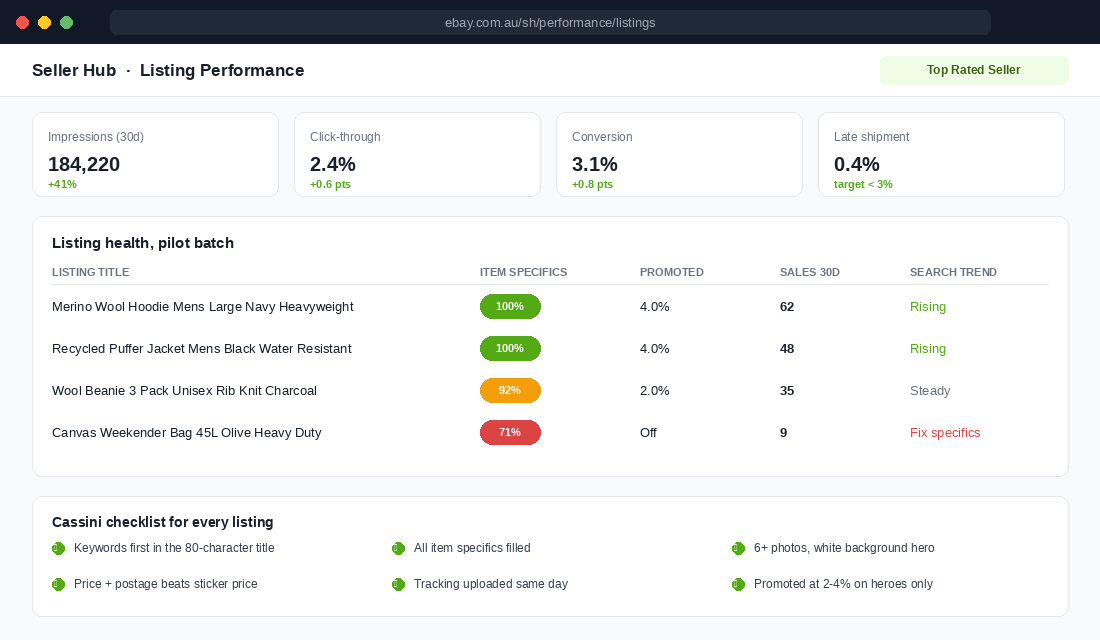
One mindset shift matters here. On your own store, the product page sells the brand story. On eBay, the listing answers a specification query. Same product, different job. Write accordingly and resist the urge to paste your DTC copy across.
Part 5: The Guardrails (Ops, Reviews and Channel Conflict)
The most common way founders quit eBay is not low sales. It is operational friction and a vague feeling that the channel is “cannibalising” the store. Both are solvable with rules you set on day one.
- Treat eBay orders as first-class citizens in your 3PL flow. Same-day or next-day dispatch, tracking uploaded automatically via Marketplace Connect. A late-shipment rate above a couple of percent quietly throttles your visibility.
- Answer eBay messages within 24 hours. eBay buyers ask pre-sale questions far more than DTC customers. Fast answers convert them and feed your service metrics.
- Ring-fence the range if you fear cannibalisation. Current hero products at full parity price, last season’s range eBay-only. You will usually find the overlap between your Instagram-raised DTC buyer and the eBay searcher is far smaller than you feared. They are different people at different moments.
- Make the unboxing do the brand work. eBay policy stops you from pushing buyers off-platform with discount inserts, so let the packaging, quality and a well-branded thank-you card do the talking. A great eBay experience turns a marketplace bargain hunter into someone who Googles your brand next time. That second purchase lands on your store at full margin.
- Review the channel P&L monthly. Revenue, fees, promoted listings spend, returns, contribution margin, and the trend in impressions and conversion per listing. Thirty minutes a month keeps the channel honest.
And if holding extra stock for a second channel makes your cash position twitchy, remember the model we unpacked in The Shopify Collective Playbook: channel expansion is about spreading demand risk, not multiplying inventory risk. eBay draws from the same stock pool you already own, which is exactly why the buffer in Part 3 matters.
The Five Mistakes That Kill eBay Channels in the First 90 Days
Before the checklist, learn from the founders who tried this and quit. The failure patterns are remarkably consistent, and every one of them is a decision, not bad luck.
- Dumping the whole catalogue on day one. Five hundred listings with auto-mapped categories and empty item specifics do not make a channel, they make a mess that takes a month to clean up. The pilot batch exists so you learn on 30 SKUs, not 500.
- Judging the channel in week two. Cassini rewards sales history and seller tenure. New listings start from zero trust and climb. Give the pilot 60 to 90 days of clean metrics before you decide anything, because the listing that limped through month one often compounds in month three.
- Copying DTC pricing psychology across. Charm pricing and bundle-heavy offers built for your funnel confuse marketplace buyers comparing total delivered cost in a grid. On eBay, the winning move is a sharp delivered price on a complete listing, not a clever offer stack.
- Ignoring the messages tab. A pre-sale question on eBay is the highest-intent signal the platform gives you. Brands staff Instagram DMs within the hour and leave eBay questions for four days, then wonder why conversion is flat.
- Letting one bad month of dispatch wreck the account. Seller standards are cumulative and slow to repair. If your 3PL has a meltdown, pause the eBay sync for a week rather than shipping late across 200 orders. A paused channel recovers instantly; a downgraded seller rating takes months.
Notice the theme: none of these are demand problems. Aussie buyers are on eBay in the millions every day. The channels that die are killed by impatience and neglect, which also means the founders who simply run the system with discipline inherit the category while everyone else churns through it.
The Compound Effect: A Portfolio of Demand, Not a Single Bet
Run the five parts together and the shape of the business changes. Part 1 picks the SKUs where eBay demand already exists. Part 2 guarantees every marketplace sale is profitable on paper before it happens. Part 3 removes the operational tax that killed your last multichannel attempt. Part 4 compounds visibility inside a search engine most of your competitors ignore. Part 5 keeps the channel from ever threatening the brand.
The result is a demand portfolio. Your Shopify store carries the brand and the margin. eBay carries reach into 12 million monthly shoppers, absorbs your ageing stock at real prices, and hands you a stream of customers you paid a 13% commission for instead of a $45 Meta CAC. When the next iOS update, ad account ban or CPM spike arrives (and one of them always arrives), you will feel it. You just will not be knocked over by it.
The eBay Channel Launch Checklist
Work through this in order. If a box will not tick, stop and fix it before spending another hour on the channel.
- Category demand confirmed (search your top products on eBay AU and study who is selling)
- Per-SKU margin sheet built: 15%+ contribution after fees, postage and promoted listings
- Price parity rule set: never undercut your own store on current-line products
- eBay business account registered with ABN, GST settings checked
- Marketplace Connect installed, pilot batch of 20 to 40 SKUs mapped
- Item specifics 100% complete on every pilot listing
- Inventory buffer configured so DTC weekends cannot oversell eBay
- Free-postage pricing applied to sub-1kg items
- 30-day returns policy live, dispatch SLA agreed with your 3PL or packing bench
- Promoted Listings at 2 to 4% on hero SKUs only
- Monthly channel P&L review booked in the calendar
Inside eCommerce Circle, channel strategy is one of the core pillars we work on with every member, and the single-channel dependency problem comes up in almost every first session. If you want a second opinion on where your next channel should come from, let’s talk.