Your gross profit did not fall last quarter because your ads got worse. It fell because the Australian dollar moved and nobody in your business owned that number.
What’s in This Article
This is the quietest profit leak in Aussie ecommerce. You negotiate hard on unit cost, you argue over freight, you run split tests on your product page. Then the currency shifts four cents, your next container lands 6% dearer, and the whole thing is written off as "cost of goods went up a bit". On 28 July 2026 the AUD/USD sat at 0.6975 after climbing 7.09% across the previous twelve months. Anyone who bought USD stock at the bottom of that range and priced their range off it has been quietly handing back profit ever since.
Most operators between $40k and $500k a month treat the exchange rate as weather. Something that happens to you. The brands that hold their gross profit through a currency swing treat it as a system with policies, owners and numbers. That is the whole difference, and it is learnable in an afternoon.
Lever 1: Size your real exposure before you touch a hedging product
Almost every founder underestimates this. You think of FX as "the invoice we pay our factory". In practice a typical Aussie Shopify brand is exposed in five places at once, and four of them never show up on a supplier invoice.
- Supplier payments. Deposits and balances in USD, RMB or EUR. The obvious one.
- Freight and duty. Sea and air freight is quoted in USD far more often than founders realise. Your forwarder converts it, adds a spread, and bills you in AUD.
- Software and ad spend. Klaviyo, Shopify apps, Meta and Google are all USD-denominated for most accounts. At a $30k a month ad spend, a five cent move costs about $2,100 a month in AUD.
- International revenue. If you sell into the US or UK through Shopify Markets, you are earning foreign currency and converting it back. That is exposure in the opposite direction.
- Marketplace payouts. Amazon US, Etsy and eBay settlements sit in the source currency until you repatriate them.
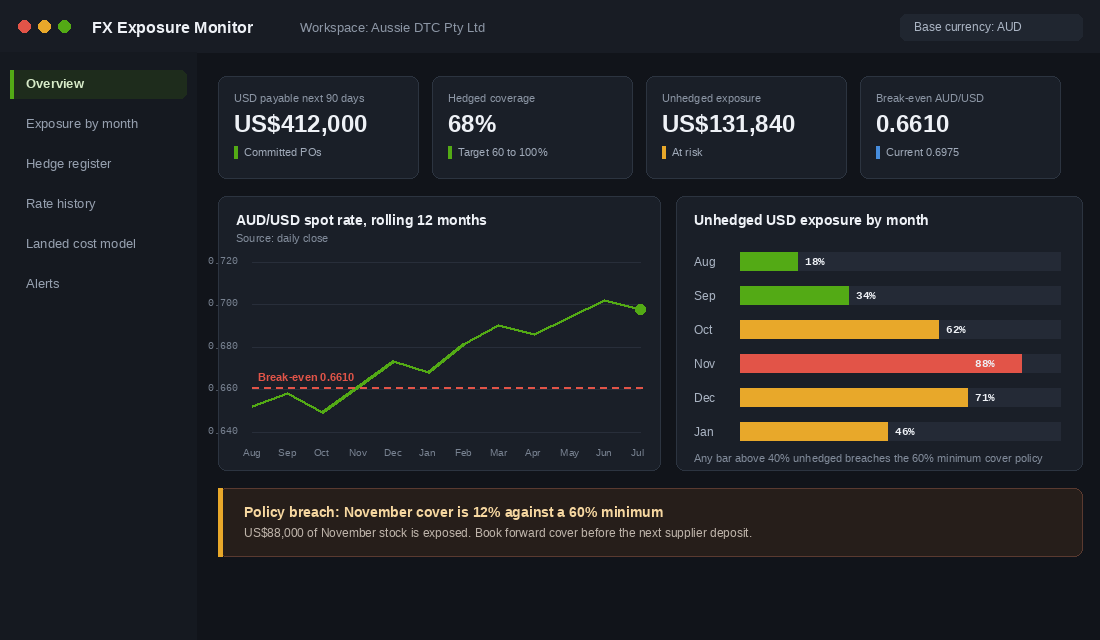
Build one sheet. Twelve rows, one per month. For each month list every committed foreign currency outflow and inflow you already know about. Committed means a purchase order is signed or a subscription is running, not a hopeful forecast. Sum the net position per currency.
That net number is your exposure. Until you have it, every conversation about hedging is theatre. Most brands find their real annual USD outflow is 20% to 40% higher than the number they had in their head, because software and freight were never counted.
Lever 2: Fix the payment rails before you fix anything clever
Before you go anywhere near forward contracts, check what your bank is charging you to move money. This is the fastest money in the entire playbook and most founders have never audited it.
Australian banks typically apply a margin of 2.5% to 5% above the mid-market rate on business international payments. Specialist providers sit far lower. Wise operates at roughly a 0.43% margin, OFX generally lands between 0.5% and 0.7%, and Airwallex quotes 0.3% to 0.6% for Australian businesses with local receiving accounts.
Run the maths on your own numbers. A brand importing a million dollars of stock a year, paying a 3% bank margin instead of a 0.5% fintech margin, is losing about $25,000 a year. That is a full time contractor, or four months of your ad budget, disappearing into a spread nobody itemises on a statement.
How to audit it this week
- Pull your last six international payments from your bank statement. Note the AUD debited and the foreign amount sent.
- Divide to get the effective rate you actually received on each one.
- Look up the mid-market rate for those exact dates. Google "AUD USD rate 14 May 2026" or use the xe.com historical tool.
- Calculate the gap as a percentage. That is your true FX cost, including any spread that was buried in a "free transfer" offer.
- Multiply by your annual foreign spend. That is your first year saving from switching rails.
Setting up an Airwallex or Wise Business account takes about 20 minutes plus verification. Register with your ABN, upload your director ID and a proof of business address, then open receiving accounts in USD, GBP and EUR. Fund the AUD wallet, convert inside the platform when the rate suits you, and pay suppliers out of the foreign wallet. The material change is that conversion becomes a decision you make, rather than something that happens automatically the moment a supplier invoice hits.
While you are in there, check your Shopify settings too. Shopify Payments applies a currency conversion fee of either 1.5% or 2% depending on your store location, and from 6 April 2026 that fee is calculated directly on the gross order amount rather than after deductions. If you sell internationally, that fee is a real line in your international unit economics and it belongs in your model.
Lever 3: Build a landed cost model that moves with the rate
Here is the test. Someone asks you what happens to your hero product’s gross profit if the dollar falls to 0.62. If you cannot answer inside 30 seconds, you do not have a landed cost model, you have a spreadsheet from eighteen months ago.
A working model takes your FOB cost in the source currency and adds freight, duty, insurance, inbound handling and payment fees, then converts at a rate you choose. The point is not accuracy to the cent. The point is that you can slide the rate and watch the margin move.
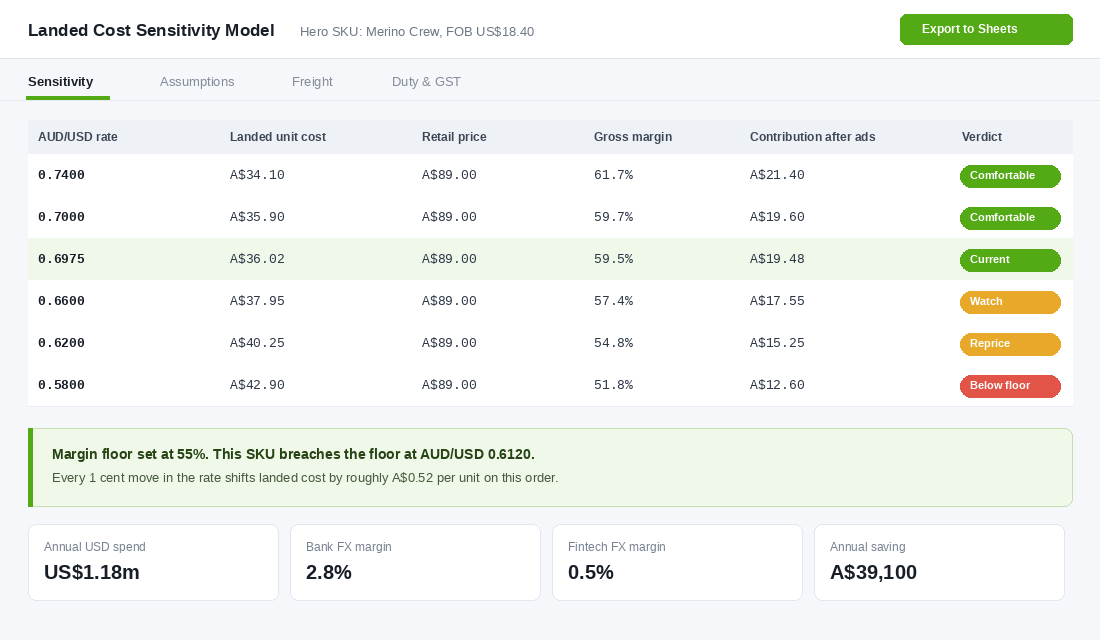
Build the sensitivity table across six rates: your best case, current spot, and four steps down to a genuine worst case. For an AUD/USD model in the current environment, 0.74 down to 0.58 is a defensible range. Then set a floor. Pick the gross profit percentage below which a product no longer earns its place in the range, and mark the exact rate where each SKU crosses it.
That single number, the rate at which your hero product stops working, is the most useful figure in your business. It tells you exactly how much protection you need to buy and when. If you want the deeper version of this calculation, we walk through the full build in the Shopify landed cost playbook, and the profit logic behind the floor sits in the contribution margin playbook.
If you cannot name the exchange rate at which your best seller stops making money, you are not running a pricing strategy. You are running a hope.
Lever 4: Set a cover ladder instead of guessing
This is where most founders freeze, because hedging sounds like something that requires a finance degree. It does not. A forward contract is one thing: an agreement to buy a set amount of foreign currency at a set rate on a future date. You lock the rate today for money you already know you have to pay.
The mistake is treating it as a bet. You are not trying to pick the top of the market. You are trying to make your costs predictable enough to price with confidence. So you do not hedge everything, and you do not hedge nothing. You build a ladder.
Lovisa, one of the most disciplined importers on the ASX, publishes a cover ladder that runs 60% to 100% of expected USD purchases hedged across the 0 to 6 month horizon, 40% to 75% across 7 to 9 months, and 30% to 50% across 10 to 12 months. Their gross profit expanded 470 basis points over five years, from 77.3% to 82.0%, on a USD-priced inventory book. That is not luck. That is a policy applied without emotion for twenty consecutive quarters.
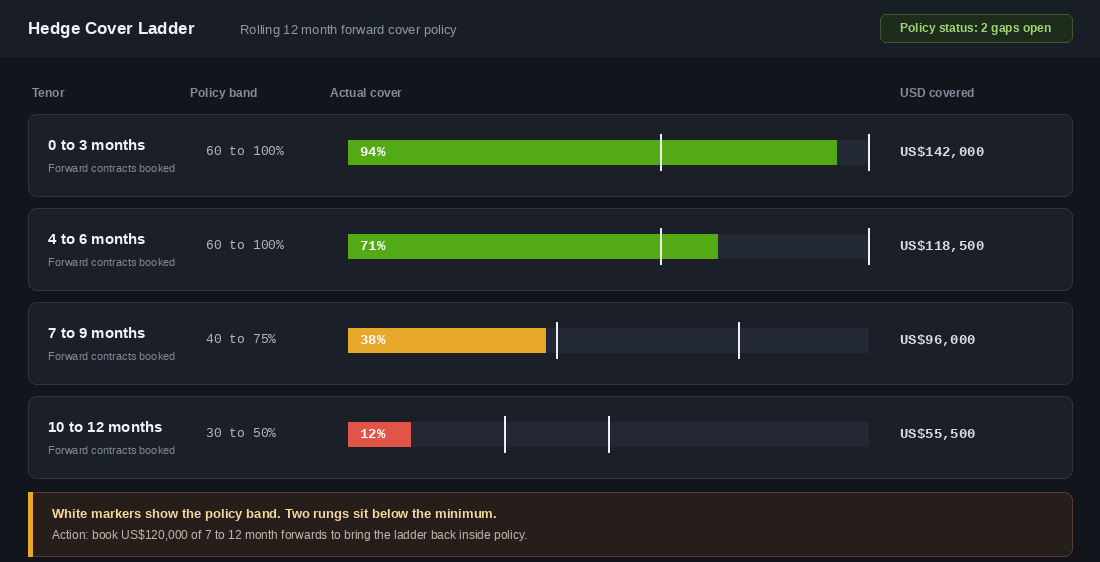
The logic behind the shape is simple. Near-term commitments are certain, so you cover most of them. Far-out commitments are less certain and your order quantities may change, so you cover less and leave room to move. Steal the structure and scale it to your size.
Getting your first forward contract
- Open an account with an FX provider that offers forwards to small business. OFX, Corpay and Airwallex all do. Banks usually will, but often with higher minimums and a credit assessment.
- Expect to post a margin deposit, typically 3% to 10% of the contract value, held until settlement.
- Start small. Cover 50% of your next three months of committed USD payments and nothing else.
- Diarise a monthly review. Each month you roll forward, top up the near rungs and add a little to the far ones.
- Track hedging cost honestly. Across the market it runs roughly 2% to 3% a year once you count the forward points and the provider spread. Compare that against the swing you are protecting, not against zero.
The counter-example is instructive. Temple & Webster booked a 1.5 million dollar unrealised FX loss in its FY26 result. Large listed businesses with finance teams still get caught. The reason to have a policy is not that you will beat the market. It is that a policy stops you making a large decision on a bad day.
Lever 5: Use natural hedges before you buy financial ones
Some of the best protection costs nothing and does not involve a contract at all. Work through these before you add a hedging line to your P and L.
- Match currencies. If you sell into the US through Shopify Markets, keep those takings in a USD account and pay your USD suppliers from it. Every dollar you never convert is a dollar with no spread on it.
- Negotiate the invoice currency. Plenty of Chinese factories will quote in RMB rather than USD. Some Australian-based distributors will hold AUD pricing for a season. Ask. The worst outcome is a no, and the ask often surfaces a better price. The full approach is in the supplier negotiation playbook.
- Shorten the gap between order and payment. A 120 day window between quoting a retail price and settling the invoice is 120 days of rate risk. Tighter terms with clearer trigger points cut the exposure window without any financial product.
- Split your sourcing. Two suppliers in two currency zones spreads the risk across currencies that rarely move together. This costs you some volume buying power, so weigh it properly rather than doing it reflexively.
- Build a buffer into the quoted cost. Price your range using a conservative planning rate, not spot. If you plan at 0.66 while spot is 0.6975, the gap is a cushion instead of a shock.
That last one is underrated. A planning rate set three to five cents below spot means small adverse moves never reach your price list. You only reprice when the move is genuinely structural, which is the difference between a business that adjusts twice a year and one that panics every quarter.
Lever 6: Reprice on a schedule, not in a panic
Currency moves are permission to review pricing. They are not permission to change it on a Tuesday because you read something worrying.
Set two dates a year where you formally review the retail price of every SKU against the current landed cost model. Most Aussie brands do well with a February review and an August review, which sits clear of the BFCM and EOFY crush. In between, you hold price and let the buffer absorb the noise.
When a review does trigger a change, the sequence matters.
- Move the SKUs furthest below your gross profit floor first. Do not do a blanket percentage across the range.
- Round to psychologically sensible price points rather than exact cost pass-through. A move from $89 to $94 reads better than $92.35.
- Change the bundle and the free shipping threshold at the same time, so the average order value math stays intact.
- Say nothing publicly unless a customer asks. Quiet, well-timed price moves rarely generate complaints. Announced ones always do.
- Watch conversion rate for fourteen days on the changed SKUs only, then decide whether the move held.
The brands that get hurt are the ones that let costs run for six months, then take a 15% price rise in one hit and wonder why conversion fell off a cliff. Two moderate moves a year almost always beats one large one.
How the six levers compound
Each lever on its own is worth a bit. Stacked, they change the shape of your gross profit line.
Better payment rails give you back roughly two percentage points on every dollar converted. The landed cost model tells you exactly which SKUs are fragile, so you stop cross-subsidising losers with your hero product. The cover ladder holds your input costs steady for six to nine months at a time, which means your planning rate is actually reliable. Natural hedges shrink the amount you have to cover at all, which cuts hedging cost. And the pricing calendar converts all of it into a decision you make deliberately twice a year.
The compounding sits in the confidence. When you know your input cost is locked for the next two quarters, you can commit to a media budget, sign a bigger purchase order, and quote a wholesale price without a hedge in your voice. The operators who scale through a currency cycle are almost always the ones who could plan through it, not the ones who guessed the rate correctly.
The one-page FX policy
Write this on a single page, put it in your shared drive, and review it every six months. It is the whole system in ten lines.
- Owner. Name the one person accountable for FX. In most brands under $10m that is the founder or the ops lead.
- Exposure review. Rolling twelve month sheet, updated on the first Monday of every month.
- Payment rails. Named provider, target FX margin under 0.7%, audited each January.
- Planning rate. The rate used for all pricing decisions. Reviewed twice a year, set conservatively below spot.
- Gross profit floor. The percentage below which a SKU is repriced or discontinued.
- Cover ladder. Your target percentage bands by tenor, written down in advance.
- Cover review. Monthly. New forwards booked to bring rungs back inside the band.
- Repricing calendar. Two fixed dates a year, with the SKU-first sequence above.
- Escalation trigger. The rate move that forces an off-cycle review. Five cents is a sensible starting point.
- Reporting. One slide in your monthly numbers meeting showing cover percentage, unhedged exposure and effective rate achieved.
None of this requires a CFO. It requires an hour a month and the discipline to follow a policy you wrote when you were calm.
Where to start on Monday
Do not try to build all six levers at once. In order of return on effort: audit your payment rails first, because the saving is immediate and requires no forecasting. Then build the exposure sheet, because you cannot do anything else without it. Then the landed cost sensitivity table. Only then look at forwards.
Most brands find the first two steps pay for the entire exercise several times over before a single hedging contract is signed. The dollar will keep moving. The question is whether it moves through your profit or around it.
The Revenue Side: What Shopify Markets Does to Your FX Position
Every lever so far deals with money going out. Stock bought in USD, ad spend billed in USD, software subscriptions that quietly reprice. But the moment you switch on Shopify Markets and start selling in USD or NZD, you create exposure in the other direction, and most founders never account for it.
Here is what actually happens. A US customer pays USD 100. Shopify Payments converts it to AUD and takes a currency conversion fee on the way through, typically around 1.5% on top of your normal processing rate. So your effective take rate on international orders is meaningfully worse than on domestic orders, and it never shows up as a line item you look at.
Then there is the pricing mechanism. If you use automatic currency conversion, Shopify prices your USD store off the live market rate with a rounding rule applied. Your USD price moves every time the AUD moves. That is fine for margin and terrible for trust, because a repeat customer who saw $49 last month now sees $52 and assumes you put prices up.
The three decisions worth making deliberately
- Fixed prices per market, reviewed quarterly. Set explicit USD and NZD prices rather than letting the rate drive them. You give up a little margin when the AUD falls and you gain price stability, which matters more for repeat rates. Build a rate buffer of 3 to 5% into the fixed price so a normal move does not put you underwater.
- Know your break-even rate per market. For every international market, work out the AUD/USD level at which that market stops being profitable after conversion fees, international shipping and higher return rates. Write it on the same one-page FX policy as your cover ladder. When the rate crosses it, you reprice, and you already decided that in advance.
- Treat international as a natural hedge, deliberately. If you buy stock in USD and also sell in USD, those two flows offset. Netting them before you buy any forward cover is free, and it is the cheapest hedge available to you.
That last point is the one worth sitting with. A brand doing 25% of revenue in USD and paying 40% of COGS in USD has already hedged more than half its exposure without a single conversation with a bank. Size that natural offset first, then only buy cover on the gap. Founders who skip this step routinely over-hedge and end up paying for protection against a risk they had already cancelled out.
Run the numbers this week. Shopify Analytics, Sales by billing country, last 12 months. Convert each market to AUD, compare it to your USD purchasing commitments over the same period, and you will know your real net exposure in about twenty minutes. Then rebuild your landed cost model using the net figure rather than the gross one.
Inside eCommerce Circle, protecting gross profit through currency and cost swings is one of the core pillars we work on with every member. If you want a second opinion on your own numbers, let’s talk.