You open your laptop on a Tuesday morning, coffee still too hot, and there it is. A red banner across Meta Business Manager. Ad account disabled. Every campaign stopped at once. No warning email the day before, no phased warning, no human to ring. Just a button that says Request Review and a form with a 300 character limit.
What’s in This Article
Most Aussie founders treat this as bad luck. Something that happens to dropshippers and supplement sellers, not to a real brand with an ABN, a warehouse in Dandenong and four years of trading history. So they build their entire acquisition engine on one ad account, one Business Manager, one payment method, and one person who knows the login.
Then the numbers hit. Australia’s internet advertising market reached 4.9 billion dollars in Q1 2026 alone, up 15.3% year on year, and Meta reaches roughly 88% of online Australians across Facebook and Instagram. If Meta is 60 to 70% of your new customer acquisition, a fourteen day disablement is not an inconvenience. It is most of a month’s revenue, plus a fortnight of attribution data your algorithms will spend weeks trying to relearn. The brands that survive this are not luckier. They built five layers of protection before they needed them.
What Actually Changed in 2026
The old model was reactive. You ran an ad, a reviewer or a classifier caught a problem, the ad got rejected, you fixed it and moved on. Account level action was rare and usually the end of a long pattern of ignored warnings.
Through 2026 Meta shifted to proactive risk assessment. Real time policy scanning on creative, behavioural pattern analysis on your account activity, and cross account reputation scoring that links your assets to every other asset they have ever touched. That last one is the part founders underestimate. A page you administered in 2019 for a mate’s side hustle is part of your risk profile.
The 2026 breakdown of why accounts get banned is worth memorising, because four causes explain almost everything:
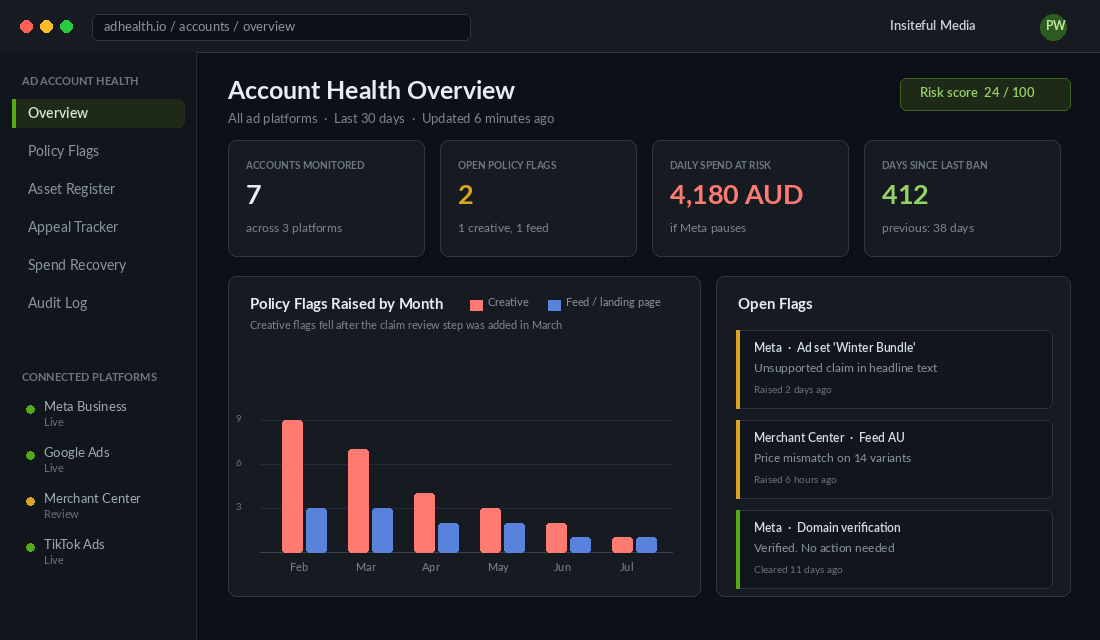
- Policy violations, roughly 38%. Prohibited claims, before and after imagery, personal attributes, misleading offers.
- Payment and identity mismatches, roughly 22%. Card name against profile name, IP geography against billing country, a new card on an old account.
- Circumvention signals, roughly 17%. Recycled pages or domains that were previously flagged, shared devices across banned assets.
- Restricted verticals, roughly 13%. Supplements, skincare with outcome claims, finance, anything health adjacent.
Read that list again. Only the first bucket is about your ads. The other 62% is about your account plumbing. That is the good news, because plumbing is fixable in an afternoon.
Layer 1: Asset Hygiene (The Boring Setup That Survives a Review)
Almost a quarter of bans come down to identity and payment mismatches. Meta is asking a simple question: is this business who it says it is? Most Aussie stores fail that question in small, stupid ways.
Work through this list once and you remove the entire category:
- Business verification completed. ABN, registered business name and a utility bill or bank statement that matches the trading address in Business Manager. Not your home address if your ABN says otherwise.
- Payment method in the business name. A personal Visa on a company ad account is the single most common identity flag. Use a business card or a business PayPal.
- Two-factor authentication on every admin. Meta now requires it for Business Manager admins, and an account takeover that runs dodgy ads for six hours will get you banned for someone else’s behaviour.
- One person per login. Shared logins across a VA, an agency and a founder look exactly like circumvention. Add people as users, never share credentials.
- Domain verified and owned by your Business Manager. This is the one that also enables conversion event prioritisation.
Verify your Shopify domain in Meta Business Manager (the exact steps)
This takes about ten minutes and it is the highest impact housekeeping job on the list. Domain verification proves you own the domain, ties your conversion events to your Business Manager, and stops a third party from claiming your domain out from under you.
- Open Meta Business Manager and go to Business Settings, then Business Assets, then Domains.
- Click Add, enter your primary domain exactly as customers see it (for example yourstore.com.au), and select Add Domain.
- Choose the Meta tag verification method and copy the tag Meta generates.
- In Shopify admin go to Online Store, then Themes, then Actions, then Edit code. Open theme.liquid.
- Paste the meta tag on a blank line directly under the opening
<head>tag. Save. - Return to Meta and click Verify. It usually resolves in minutes, though Meta allows up to 72 hours to detect the tag.
- While you are there, prioritise your eight conversion events under Aggregated Event Measurement, with Purchase at the top.
Do the same tidy up on Google. Merchant Center treats misrepresentation as an egregious violation, which means there is often no warning period before suspension, and account reviews typically take seven business days. Google is checking that your website, your feed and your business information all tell the same story. A returns policy that says 30 days on the page and 14 days in the feed is enough to fail that test.
Layer 2: Claim Discipline (The Creative Rules Most Brands Break by Accident)
Here is the part that stings. The creative that performs best is usually the creative that carries the most policy risk. Specific outcomes convert. Before and after shots convert. Countdown timers convert. Meta’s computer vision auto flags all three.
Think about category exposure honestly. Hismile, the Australian oral care brand, sits in teeth whitening, a category where the natural creative instinct is a shade comparison shot. That is a restricted claims category by default, and every asset has to earn its way through review. Compare that with Who Gives A Crap, the Melbourne founded toilet paper brand, whose ads lean on humour, product in use and the donation model. Almost no claim surface to flag. Same country, same platform, wildly different risk profile. Neither is wrong, but only one of them can afford to be casual about creative review.
The fix is a pre-flight review step that sits between your creative team and the upload button. One documented case in the supplement category is instructive: a brand that kept copping disapprovals built a compliance checklist and started substantiating claims with third party studies. Their approval rate improved by 90% and the account level suspensions stopped entirely.
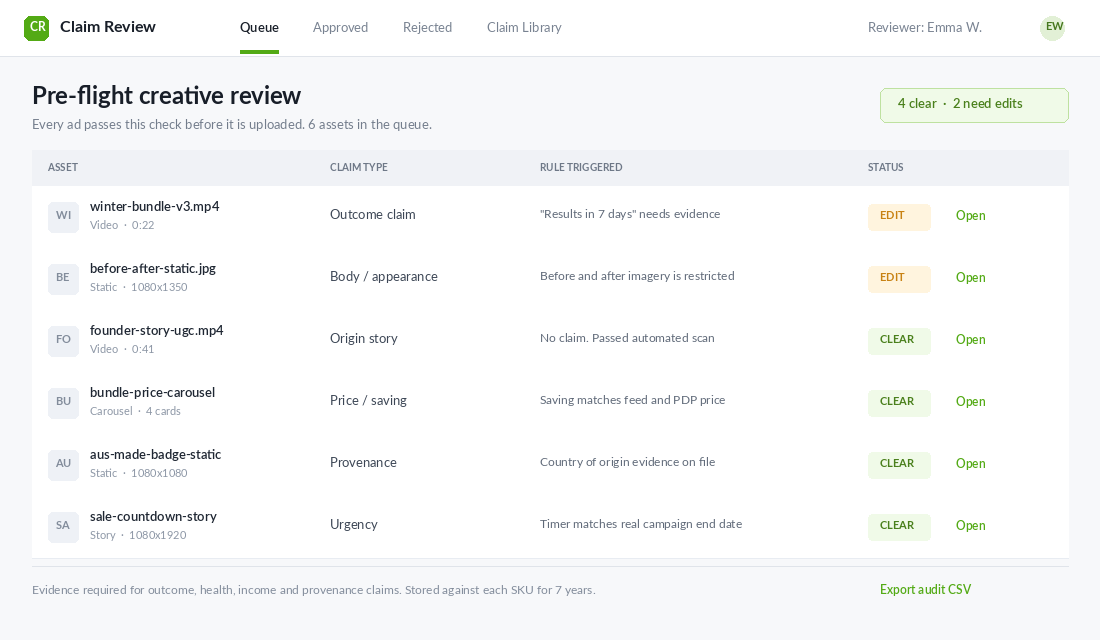
Your review step only needs four questions:
- Does this ad promise an outcome? If it says results, in seven days, or names a number, you need evidence on file before it goes live.
- Does it show or imply a body change? Before and after, weight, skin, hair. Restricted. Reframe to product in use.
- Does every price and saving match the feed and the product page? Mismatches trigger Merchant Center misrepresentation and Meta offer violations at the same time.
- Is the urgency real? A timer that resets on refresh is not a timer. It is a false representation.
The Australian double jeopardy nobody mentions
Overseas advertisers worry about one regulator: the platform. Australian advertisers have two. The same overclaim that gets your ad set paused is also a potential breach of the Australian Consumer Law, and the stakes went up sharply this year. From 28 March 2026, maximum penalties for ACL breaches doubled to 100 million dollars per contravention.
The ACCC is actively looking, too. It ran a sweep of 2,000 Australian retail websites checking returns policies and terms and conditions against the ACL. And it does not only chase the big end of town. Online travel agency eDreams paid 59,400 dollars in penalties after three infringement notices for misleading subscription pricing claims and failing to display the total annual cost prominently.
Greenwashing has a dedicated ACCC taskforce, which matters if your creative leans on carbon neutral, plastic free or sustainably made. If you want the deeper treatment on this, our Shopify Consumer Law Playbook covers what you can and cannot say on a product page. The useful reframe is this: build your claim library to ACL standard, and Meta compliance comes free.
Layer 3: The Redundancy Stack You Build Before You Need It
Prevention gets you a long way. It never gets you to zero. Meta’s automated enforcement produces false positives, and appeals succeed at roughly 30% under normal conditions. Plan for the day it goes wrong anyway.
Redundancy for an Aussie DTC brand looks like this:
- A second ad account inside the same Business Manager. Warmed with a small spend, its own payment method, and at least a few weeks of clean history. A cold account you spin up on the day of a ban is a circumvention signal, not a backup.
- A properly configured second channel. Google Shopping or Performance Max carrying at least 20% of paid revenue. If Google has been sitting at 5% for a year, it cannot absorb Meta’s budget overnight without wrecking your efficiency.
- An owned audience you can actually reach. Email and SMS lists with active flows. The brands that hold the most revenue through an outage are the ones already generating 25 to 35% of revenue from retention.
- Server side tracking already running. When you rebuild campaigns, clean conversion data is what shortens the learning phase. Our server side tracking playbook walks through the setup.
- An offline evidence pack. ABN certificate, business bank statement, supplier invoices, claim substantiation documents, and screenshots of your policy pages. Stored in a folder, not scattered across three inboxes.
One clarification that saves people a lot of grief. Redundancy is not the same as circumvention. Meta permits multiple ad accounts under one verified business. It does not permit new business managers created to escape enforcement on an old one. The first is insurance. The second gets everything you own permanently disabled.
Layer 4: The First 72 Hours (Your Recovery Protocol)
The single biggest predictor of whether you get reinstated is what you do in the first two hours, and almost every founder does the wrong thing. They panic, submit three appeals, change the payment method, add a new admin, and rename the ad account. Every one of those actions looks like evasion to an automated system.
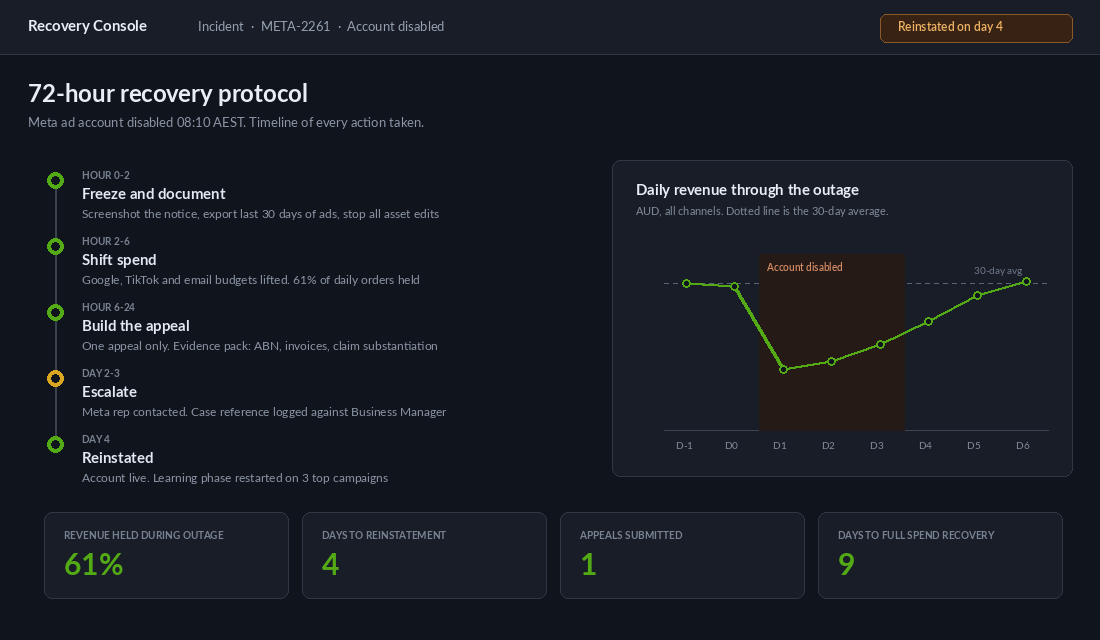
Run this instead.
- Hours 0 to 2. Freeze and document. Screenshot the exact notice including any policy reference. Export the last 30 days of ad performance while you still can. Change nothing on the account. No new admins, no payment edits, no renaming.
- Hours 2 to 6. Shift the spend. Lift Google, TikTok and retention budgets to soak up the demand. Push an email or SMS campaign to your warm list that day. This is where a redundancy stack earns its keep.
- Hours 6 to 24. Build one appeal. One. Multiple appeals reset your position in the queue and read as spam. Address the specific policy cited, state what you changed, and attach evidence. Be plain and factual. No emotion, no legal threats.
- Days 2 to 3. Escalate properly. If you spend enough to have a Meta rep, use them. If not, chat support inside Business Manager creates a case reference, which is what gets an actual human involved. Keep every reference number.
- Days 4 to 14. Wait without breaking things. Automated first pass review usually resolves in 24 to 72 hours. Manual review can stretch to two weeks. You have up to 180 days to appeal with documentation, after which a disablement is effectively permanent, so a slow response is not the same as a lost cause.
Write this protocol down now and put it where your team can find it at 8am on a Tuesday. Nobody makes good decisions about a 4,000 dollar a day channel while their hands are shaking.
Layer 5: The Rebuild (Getting Spend and Data Back)
Reinstatement is not recovery. The account comes back with damaged signal, and if you slam yesterday’s budget straight back in, you will burn a week of learning and blame the platform.
Ramp deliberately over roughly nine days:
- Days 1 to 2. Restart two or three proven campaigns at 40 to 50% of previous daily spend. Nothing new, nothing experimental.
- Days 3 to 5. Step up 20 to 30% per day while cost per acquisition holds. Watch your delivery, not your ROAS, because attribution is still catching up.
- Days 6 to 9. Return to full budget and reintroduce testing. Only now do you upload fresh creative, and every asset goes through the claim review from Layer 2.
Judge the recovery on blended numbers, not platform reported ones. Platform ROAS will look strange for a fortnight while modelling rebuilds. Marketing efficiency ratio, total revenue divided by total ad spend, tells you the truth during exactly this kind of mess. Our MER framework explains how to read it.
Then run the post mortem while it is fresh. What specifically was cited? Which layer failed? What changes so this exact thing cannot happen twice? Log it. Ad account risk compounds in both directions.
Why the Five Layers Compound
Each layer looks modest on its own. Together they change the shape of the risk completely.
Asset hygiene removes the 22% of bans caused by identity and payment mismatches and most of the 17% caused by circumvention signals. Claim discipline attacks the 38% caused by policy violations at the source. That is the bulk of the risk gone before you have spent a dollar on protection.
The redundancy stack converts whatever slips through from a revenue event into an inconvenience. Instead of losing 100% of paid revenue you lose 30 to 40%, because Google, email and SMS carry the rest. The recovery protocol shortens the outage, because one clean, documented appeal beats five frantic ones. And the rebuild protects the fortnight after, which is where most brands quietly lose more money than they lost during the ban itself.
There is a second dividend. Every one of these layers makes you a better operator regardless of whether you are ever banned. Verified assets improve event matching. Substantiated claims survive ACCC scrutiny. A second channel at 20% of revenue is just a healthier business. You are not buying insurance. You are buying insurance that pays a return while you hold it.
The Owned-Channel Insurance Policy Every Banned Advertiser Wishes They Had Built
The five layers reduce the odds of a ban and shorten the recovery. They do not make you immune. The question that decides whether a suspension is a bad fortnight or a solvency event is simple: how much revenue can you generate next week without buying a single click?
For most Aussie DTC brands the honest answer is not enough, because the email list has been treated as a nice-to-have while paid social did the heavy lifting.
The benchmark to aim at: email and SMS together should carry 25 to 35 per cent of total store revenue. Under 15 per cent means a ban takes most of your top line with it. Over 35 per cent and you have genuine negotiating position, because you can turn ads off for a month and survive.
Four things to build now, while your accounts are healthy:
- A capture rate you can measure. Aim for 3 to 5 per cent of sessions converting to a subscriber. Most stores sit at 1 to 2 per cent because the popup is a single generic offer. The email popup playbook covers the trigger architecture that lifts it.
- SMS consent on the same forms, not a separate afterthought. SMS lists are smaller but a well-run broadcast to an engaged list typically returns $8 to $20 AUD per message sent. In a ban week that is the fastest lever you own.
- Deliverability that actually works. A 40,000-person list that lands in Promotions is not insurance. Authenticate the domain, keep engaged-only segments, and watch your sending reputation before you need it.
- An organic audience with a direct line. Back-in-stock alerts, a customer community, an SMS VIP segment, a genuinely active Instagram. Anything where you reach people without an auction.
Track one number monthly: owned-channel revenue as a percentage of total. Put it next to your MER in the same report. If ad spend grows and that percentage falls, your risk is rising even while the business looks healthier.
What to Do With the Budget on Day One of a Ban
The instinct when Meta goes dark is to shovel the whole budget into Google by lunchtime. That instinct costs money, because you are bidding into a channel with no warm-up, no learning data and a CAC that has not been tested at that volume.
Work in this order over the first seven days.
- Day 1: spend nothing new. File the appeal, then send to owned channels. A win-back to lapsed customers and a genuine offer to your engaged 90-day segment will typically do more revenue in 48 hours than a cold campaign in a channel you have never scaled.
- Day 2 to 3: protect branded search. If you run Google, make sure branded terms are funded first. Losing your own brand name to a competitor while you are already down is the avoidable version of this problem.
- Day 3 to 5: reallocate at 50 per cent, not 100. Move half the paused budget into your best-performing non-banned channel and watch CAC daily. Expect it to run 30 to 60 per cent higher than your Meta baseline at first. That is normal and it is why you do not commit the full amount on day one.
- Day 5 to 7: decide on the redundancy account. If Layer 3 is built, this is a switch. If it is not, resist standing up a new business manager in a panic, because duplicate accounts and shared payment methods are one of the fastest routes to a second, harder ban.
Set your floor before any of this happens. Write down the weekly revenue number below which you cut variable costs, and the number of weeks of runway you have at zero paid traffic. Most founders discover the answer is four to eight weeks, which is exactly the window an appeal can take.
Keep judging the reallocation on blended numbers rather than platform ROAS. And model the cash impact before you commit, because a ban week is a cash-flow event as much as a marketing one. The 8-week rolling forecast tells you how long you can hold the line, and the welcome email flow is where most of the recovered demand should land while you wait.
Your One Page Ad Account Risk Audit
Block 45 minutes this week and run this. Score one point for each yes. Anything under 10 out of 14 and you are one automated flag away from a very bad fortnight.
- Business verification is complete with an ABN that matches your trading details.
- The card on file is in the business name, not a personal card.
- Two-factor authentication is on for every Business Manager admin.
- No shared logins. Every person has their own user access.
- Your primary domain is verified and owned by your Business Manager.
- Your eight conversion events are prioritised with Purchase first.
- Merchant Center shows no open policy issues and your feed matches your site.
- Returns, shipping, contact and privacy pages exist, are findable, and say the same thing as your feed.
- Every outcome, health or provenance claim has written evidence on file.
- No before and after imagery is running anywhere in your account.
- A second warmed ad account exists inside the same verified business.
- A second paid channel carries at least 20% of paid revenue.
- Email and SMS flows are live and generating at least 25% of total revenue.
- Your 72-hour recovery protocol is written down and your team knows where it lives.
Fix the gaps in order of the score, not in order of how interesting they are. The boring items at the top of that list prevent more bans than anything clever you will do with creative.
The brands that get wiped out by an ad account ban are almost never the ones doing something dodgy. They are the ones who built a great business on a single channel they do not own, and never wrote down what to do if the switch got flicked. Ten minutes on domain verification and one afternoon building a claim library is a ridiculous price for the difference between a bad week and a bad quarter.
Inside eCommerce Circle, channel resilience is one of the core pillars we work on with every member, because the brands scaling fastest on Meta are also the ones with the most to lose. If you want a second opinion on your setup, let’s talk.