Open your Google Ads account and find the campaign with the best return. Nine times out of ten on an Aussie Shopify store, it is the one bidding on your own name. Twelve times return, eighteen times, sometimes higher. It sits at the top of the report every month and nobody touches it, because why would you touch the thing that is working.
What’s in This Article
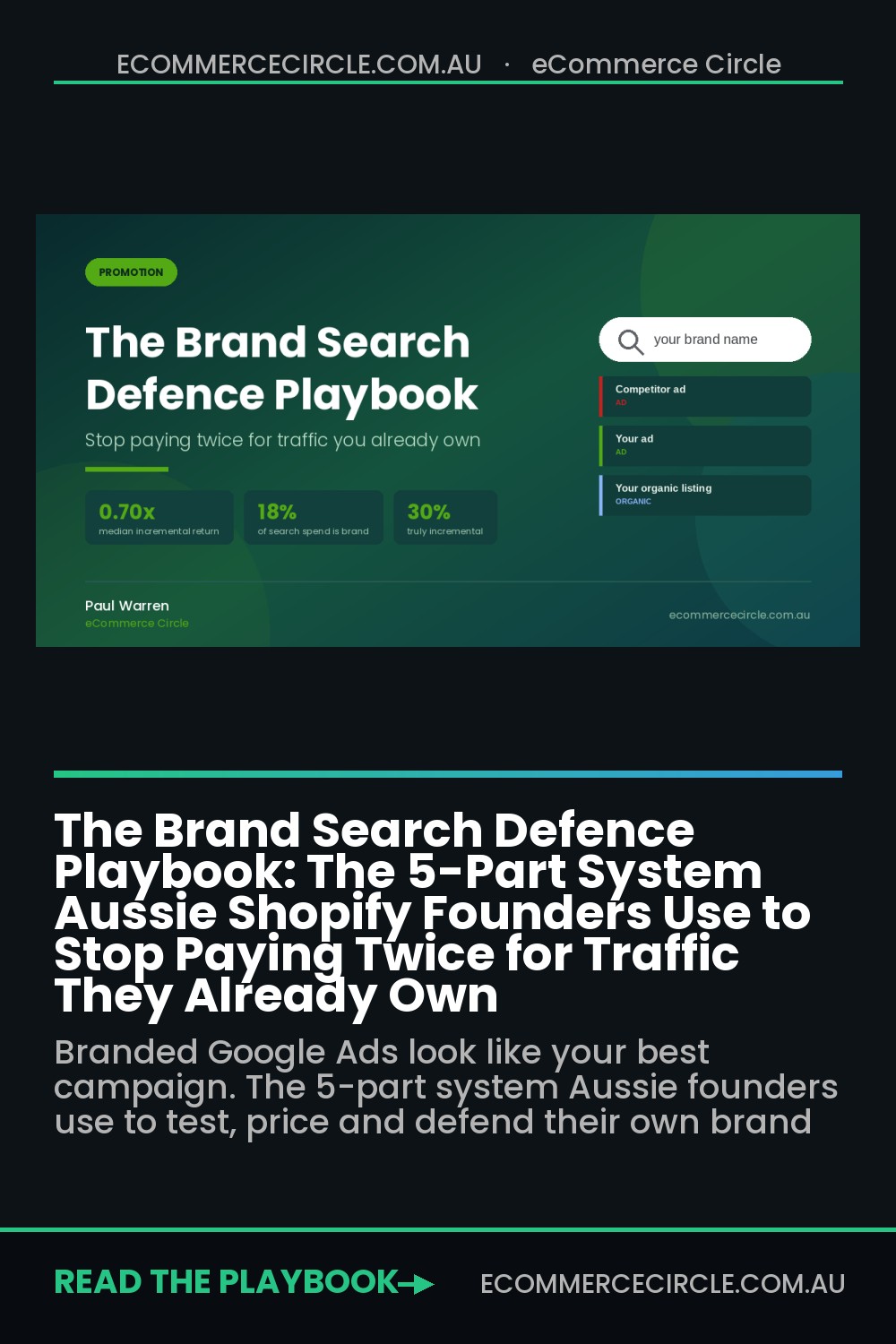
Here is the uncomfortable part. Independent incrementality studies put branded search at a median incremental return of 0.70x, the lowest of any paid channel measured. Not 12x. Zero point seven. That gap is not a rounding error. It is the difference between a channel that creates demand and a channel that photographs demand you already created, then bills you for the photo.
That does not mean you switch it off tomorrow. Roughly 18% of all Google search spend goes to branded keywords, and for a lot of Australian stores the number is closer to 25%. Some of that spend is genuinely defensive and worth every cent. Some of it is you outbidding your own organic listing. The problem is that almost nobody knows which one they have, because the reporting is built to make you feel good rather than make you correct.
This is the five-part system we run with members to get a real answer. Split the traffic, read the right three numbers, run a proper holdout, pick a defence posture, then take back the parts of the search page you should never have been renting.
Part 1: Split Brand Out of Everything Else Before You Judge It
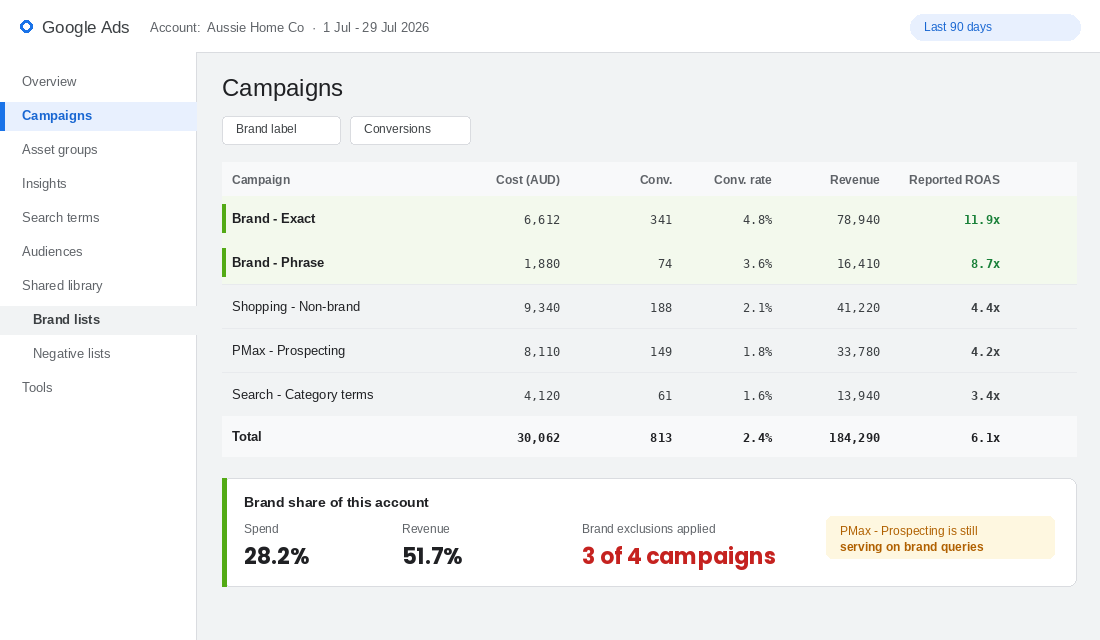
You cannot assess brand search while it is mixed in with everything else. Most accounts we audit have brand traffic leaking into three places at once, which means the founder is looking at a blended number and calling it performance.
The three leaks, in the order they cost you money:
- Performance Max swallowing brand searches. PMax will happily serve on your own name and book the conversion at a spectacular return. If you have never applied a brand list, a large slice of your PMax result is brand traffic wearing a prospecting costume.
- Broad match creeping onto brand terms. A non-brand campaign on broad match with smart bidding will find your brand name, because that is where the cheap conversions live. Smart bidding is not cheating. It is doing exactly what you asked.
- Shopping campaigns catching brand plus product queries. Someone searching your brand name plus a product name is a customer, not a prospect, and Shopping will bid on them all day.
The fix is mechanical. In Google Ads, build a brand list under Tools, then Shared library, then Brand lists. Add your brand name, your store name, common misspellings, your hero product names and any sub-brand you own. Then open each Performance Max campaign, go to Settings, scroll to Other settings, and apply the brand list under Brand exclusions. Brand exclusions cover misspellings and related terms that negative keywords miss, and they apply to both Search and Shopping inventory inside PMax.
Then add your brand terms as exact and phrase negatives across every non-brand campaign, and build one dedicated brand campaign that owns that traffic on purpose. Now you have a clean line item. Everything from here depends on that line item being honest.
One warning from experience. Do not run this split during a sale window or a big launch. Do it in a quiet fortnight, because the first week after a proper brand split usually looks alarming as spend redistributes and the non-brand campaigns finally show their true cost per acquisition. That is not a problem you caused. That is a problem you uncovered.
Part 2: Read the Three Numbers That Tell You What Brand Is Actually Worth
Once brand is isolated, ignore the return on ad spend column for a minute. It is the least useful number on the page, because it credits your brand campaign with sales that a free organic click would have delivered anyway. Look at these three instead.
Number one: brand share of paid spend versus brand share of paid revenue. Pull the last 90 days. If brand is 15% of spend and 55% of revenue, your paid account is largely a harvesting machine and your prospecting is weaker than you think. If brand is 35% of spend, you are almost certainly buying clicks you would have received free.
Number two: paid brand click share versus organic brand click share. Open Google Search Console, filter queries to your brand name, and note the clicks and average position. Then compare with paid brand clicks over the same window. If you already hold position one organically with sitelinks, every paid click on that same query is a click you were going to get. One documented case saw organic branded click-through rate move from 45% to 65% within weeks of pausing paid brand, which is the cannibalisation effect in plain sight.
Number three: competitor impression share on your brand terms. In the brand campaign, open Auction insights and segment by day. This tells you who is actually standing on your name and how often. A store with zero conquesting has a very different defence problem to a store where three rivals hold 40% impression share between them.
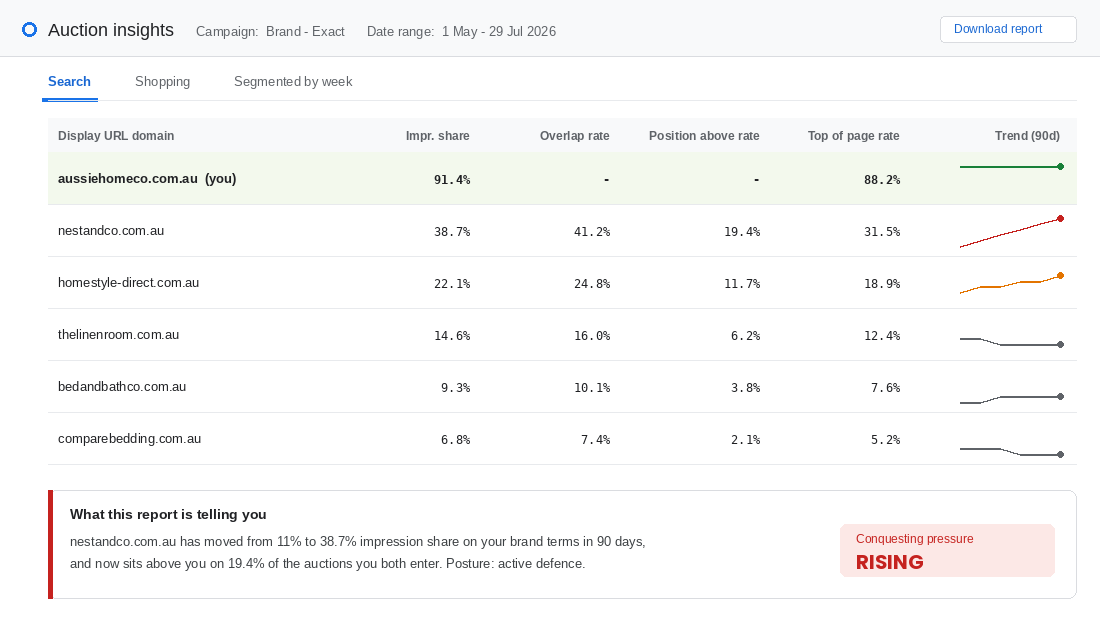
The mattress category in Australia is the clearest local example. It is a market of roughly 700 million dollars growing around 5% a year, with Koala, Ecosa, Sleeping Duck, Eva and Emma all chasing the same considered purchase. In a category like that, a shopper who types your brand name is often mid-comparison, not mid-purchase, and the search page is a genuine battleground. In a category with no direct rivals bidding, the same click is close to worthless.
Benchmarks help you sanity check the read. Branded paid search typically converts at 3% to 5%, against 1.5% to 2.5% for non-brand. If your brand campaign is converting under 3%, you are not capturing buyers, you are capturing browsers, researchers and possibly your own existing customers looking for the login page. That is a different problem and it is not solved with a higher bid. If you want the wider view on how paid numbers roll up, our blended ROAS playbook covers how to stop platform-reported returns from setting your budget.
Part 3: Run the Holdout Test (Four Weeks, One Answer)
Everything above is inference. The holdout is proof. It is also the single highest value test in a Shopify store’s paid account, because branded search is where last-click attribution and reality diverge most violently, so every test dollar buys a bigger correction than it would anywhere else.
There are two ways to run it. Pick based on your volume.
The geo split (better, needs volume)
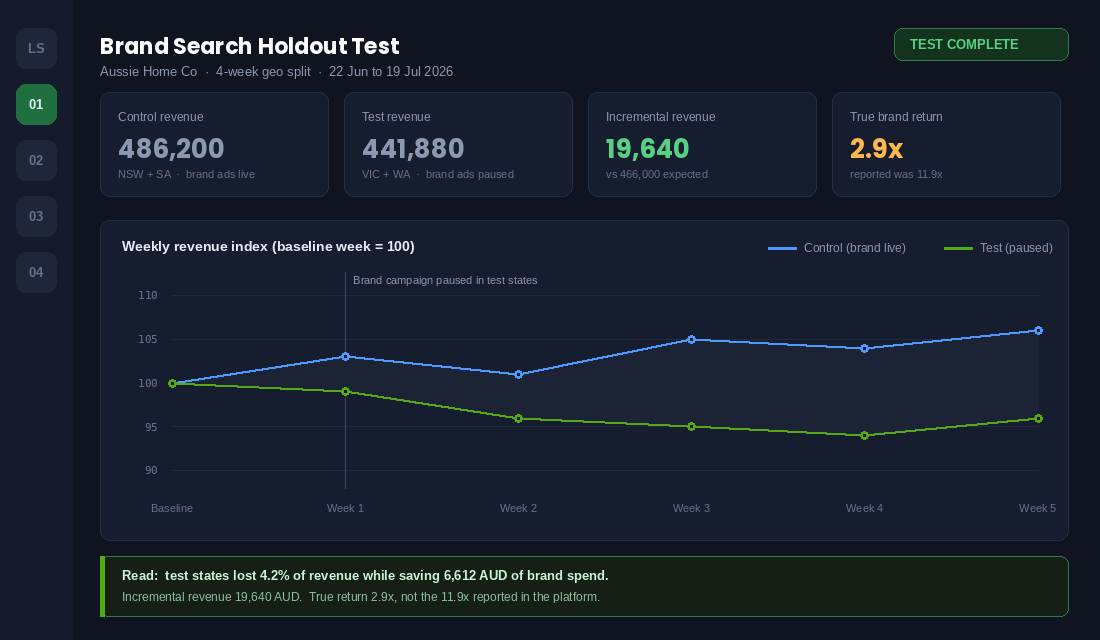
Split Australia into two roughly matched groups by revenue, not by population. A common pairing is New South Wales plus South Australia as the control against Victoria plus Western Australia as the test, but check your own state revenue mix first because most Aussie stores skew heavily to one state.
- Week 0. Record baseline. Total revenue by state, branded organic clicks by state, paid brand spend and revenue by state.
- Weeks 1 to 4. Turn the brand campaign off in the test states. Leave it running in the control states. Change nothing else. No new creative, no new offers, no email sends that skew one region.
- Measure. Compare total revenue in test versus control against the baseline ratio, not against last year.
Four weeks is the minimum because Aussie DTC purchase cycles run long enough that a two week test just measures the pause, not the outcome. If you sell a considered purchase over 400 dollars, run six weeks.
The time split (simpler, noisier)
If you do not have the volume for a clean geo split, alternate whole weeks on and off for eight weeks, so four on and four off. Exclude any week containing a promotion, a public holiday, a big email send or a viral moment. You will need to be ruthless about that exclusion list or the test tells you nothing.
Reading the result
Calculate incremental revenue as test revenue minus expected test revenue, where expected is the control revenue multiplied by your baseline ratio. Then divide incremental revenue by the brand spend you saved. That number is your true brand return.
Published incrementality work puts branded search somewhere between 20% and 50% incremental, with the higher end in categories where rivals are actively conquesting. Testing across DTC accounts suggests only about 30% of branded search conversions would not have happened anyway. So if your platform says 14x, your honest number is probably somewhere between 3x and 6x. Still often positive. Just not what the dashboard claimed.
Write the result down with a date on it and re-test every six months. Conquesting changes, your organic position changes, and a brand campaign that was waste in March can be essential by October when a competitor raises a round and points it at your name.
Part 4: Choose Your Defence Posture
Now you have two facts: how much competitor pressure sits on your brand terms, and how strong your organic hold is. Those two axes give you four postures. Pick one deliberately instead of drifting into the expensive default.
Posture 1: Stand down (low conquesting, strong organic)
Nobody is bidding on you and you own position one with sitelinks. Turn brand off entirely, or cap it at a token daily budget of 10 to 20 dollars purely as a tripwire so you notice when a rival shows up. Redeploy the saved budget into non-brand or creative testing. This is the single fastest profit improvement available to a lot of stores and it takes an afternoon.
Posture 2: Thin shield (low conquesting, weak organic)
No rivals, but marketplaces, resellers or a stubborn review site sit above you organically. Keep a small exact-match brand campaign running, tightly capped, with your best sitelinks and a promotion extension. The job here is not to beat a competitor, it is to control the first result and the message inside it. Fix the underlying organic weakness in parallel using the approach in our Shopify SEO playbook, then revisit in 90 days.
Posture 3: Active defence (high conquesting, strong organic)
Rivals are standing on your name and you still rank first. Run brand, but run it as a defensive line with a defined cost, not as a return-maximising campaign. Use manual or target impression share bidding at around 80% absolute top impression share, not maximise conversions, because the goal is presence rather than volume. Cap the daily budget at a number you have consciously decided to spend on defence, and treat it as a brand cost rather than a performance line.
Posture 4: Full contest (high conquesting, weak organic)
The worst position and the only one where aggressive brand spend is clearly justified. Run brand hard, but fix the root cause on a deadline. Weak organic on your own name in a contested category is a structural problem, not a bidding problem, and no budget makes it go away permanently.
Whichever posture you pick, write the decision and the reasoning in one paragraph and put a review date on it. Postures drift. The founder who quietly spends 4,000 dollars a month defending a name nobody is attacking is not careless, they just never scheduled the review.
Part 5: Win the Search Page Without Renting It
The cheapest defence is owning more of the page organically so the paid click has less work to do. Five moves, in order of impact.
- Earn sitelinks under your organic listing. Google generates these from site structure and internal linking. A clean main navigation with distinct, well linked category pages is what produces them. Six sitelinks under your organic result pushes a competitor’s ad materially further down the page on mobile.
- Claim the knowledge panel. Organisation schema on the homepage with your logo, social profiles and a sameAs array, plus a consistent name across your Australian Business Register listing, socials and Google Business Profile. This is unglamorous work that takes an hour and pays for years.
- Own the comparison query. Someone searching your brand plus “review” or “versus” is going to land somewhere. Publish an honest comparison page yourself. Aussie brands that do this well capture the query instead of handing it to an affiliate site that then sells the click to your competitor.
- Rank your own login and order tracking pages. A surprising share of brand search volume is existing customers looking for their order. Every one of those clicks costs you money in a brand campaign and converts at zero. Give them a fast organic path and watch your brand campaign conversion rate rise while spend falls.
- Set up a brand term alert. A weekly automated rule or a simple script that emails you when competitor impression share on your brand terms rises above a threshold. That is how you catch a new conquesting campaign in week one instead of month three.
The legal reality in Australia, briefly
Founders often ask whether a competitor bidding on their registered trade mark is illegal here. The short answer, based on Veda Advantage Limited v Malouf Group Enterprises in the Federal Court, is that buying a competitor’s trade mark as an invisible keyword is generally not trade mark use, because consumers never see the keyword and so it cannot function as a badge of origin. Using your trade mark visibly in the ad headline, copy or display URL is a different matter and is where the court found the line.
Practically, that means your lever is Google’s own trademark policy rather than a lawyer’s letter. Google will act on ad text that uses your registered mark, and since February 2025 that enforcement is advertiser specific, so a complaint against one rival does not clear the others. You lodge one complaint per offender, and you re-check quarterly. Nothing to be scared of, but do not assume a single takedown solves it. For the broader picture on protecting the name itself, our brand protection playbook covers registration, monitoring and takedowns.
This is general information, not legal advice. If a competitor is running your registered mark in their ad copy and refusing to stop, get an Australian IP lawyer involved.
The Compound Effect: Why This Fixes More Than One Line
Each part on its own is a tidy-up. Together they change how the whole account gets managed.
Splitting brand out (Part 1) makes your non-brand campaigns tell the truth for the first time. Most founders discover their real prospecting cost per acquisition is 30% to 60% higher than they believed, because brand conversions were quietly propping up the average. That is painful for a week and clarifying forever, because you finally know what a new customer costs.
Reading the three numbers (Part 2) and running the holdout (Part 3) gives you a defensible figure to plan against. Once you know brand is 30% incremental rather than 100%, your blended targets change, your acquisition budget changes, and the conversation with your agency changes from “brand is smashing it” to “brand costs us this much and buys us this specific thing”.
Choosing a posture (Part 4) turns a recurring monthly leak into a deliberate line item with an owner and a review date. And owning more of the page organically (Part 5) shrinks the size of the defence you need to fund, which is the only version of this that keeps improving while you sleep.
Run the numbers on a store spending 30,000 dollars a month on Google with 22% going to brand. That is 6,600 dollars a month on your own name. If the holdout shows 30% incrementality, roughly 4,600 dollars a month is buying clicks you already owned. Redeployed into prospecting at even a modest return, or simply kept, that is a meaningful annual swing for a business where the founder is still checking whether they can afford another hire. And it came from a test, not a guess. If you want the framework for judging where that redeployed budget should go, our marketing efficiency ratio framework is the next read.
Your Brand Search Audit: The 12-Point Checklist
Block ninety minutes. Work down the list in order. Tick each one or write the date you will fix it.
Isolate
- A brand list exists in the shared library and includes misspellings, sub-brands and hero product names.
- Brand exclusions are applied to every Performance Max campaign.
- Brand terms are added as phrase and exact negatives to every non-brand campaign.
- One dedicated brand campaign owns all brand traffic, on exact and phrase match only.
Measure
- Brand share of paid spend and brand share of paid revenue are recorded for the last 90 days.
- Organic brand clicks and average position are pulled from Search Console for the same window.
- Auction insights on brand terms are reviewed and every conquesting competitor is named.
- Brand campaign conversion rate is above 3%, or you know why it is not.
Decide
- A four to six week holdout test is scheduled with a defined control group and a written baseline.
- A defence posture is chosen, written down, and given a review date within six months.
- Organic sitelinks, schema and a comparison page are in place or booked into the content calendar.
- An alert fires when competitor impression share on your brand terms crosses your threshold.
Twelve boxes. If you can tick nine of them today, you are ahead of nearly every store we audit. If you can tick four, you have found this quarter’s most profitable ninety minutes.
The Point of All This
Brand search is not good or bad. It is either a defence you have chosen and priced, or a tax you are paying without noticing. The founders who get this right are rarely the ones who spend the most or the least. They are the ones who can tell you, in one sentence, exactly what their brand budget buys and how they know.
Go and pull your last 90 days. Work out what percentage of your Google spend went to people who already typed your name. Then decide, on purpose, whether that is a number you are happy with.
Inside eCommerce Circle, knowing what each channel actually buys you is one of the core pillars we work on with every member. If you want a second opinion on your brand line, let’s talk.