For the better part of a decade, Aussie brands had a quiet structural advantage selling into the United States. Anything under USD 800 walked through the border duty free. No classification, no formal entry, no brokerage fee. You shipped a parcel out of Melbourne and it landed in Denver behaving almost exactly like a domestic order.
What’s in This Article
That window is shut. The US suspended the de minimis exemption for every country on 29 August 2025, and in June 2026 Customs and Border Protection moved the suspension out of executive-order territory and into permanent regulation. Every commercial shipment entering the US now needs a customs entry, a ten-digit tariff classification and duty paid in full. Value does not matter. Shipping method does not matter.
Most founders I speak to have not repriced. They are running a 2024 landed cost model against 2026 border rules, watching US contribution margin bleed two to four points a quarter, and blaming Meta for it. Australia-origin goods now carry an average effective US duty of around 12.5%, up from the 10% baseline set in April 2025. If you sell 300 orders a month into America and you have absorbed that silently, you have handed back roughly a full salary a year without noticing.
The brands still making money in the US treat this as a pricing and operations problem, not a shipping problem. Here is the six-step system.
What Actually Changed at the US Border
Three things broke at once, and each one hits a different part of your P&L.
- Duty now applies to every parcel. The old USD 800 threshold is gone for all origins. A USD 60 order and a USD 6,000 order are treated the same way at the border.
- Classification is now your job. Every shipment needs a correct ten-digit HTSUS code. Get it wrong and you are looking at delays, re-classification, penalties and back-duty.
- Brokerage and entry fees are now a real line item. Carriers charge for filing entries. On a small parcel that fee can be larger than the duty itself.
There is a fourth change most founders miss. The informal entry limit sits at USD 2,500, and a new postal informal entry process took effect on 24 July 2026 with monthly duty remittance through Pay.gov. CBP is also running a voluntary electronic entry test (Entry Type 13) in ACE from 22 September 2026. Translation: the paperwork is becoming systematised, which means the days of hoping a parcel slips through are finished.
The good news is that Australia is not being singled out. We sit at the lower end of the rate table and we retain a Section 232 exemption on steel and aluminium that most trading partners do not have. The bad news is that your competitors in the US are domestic, and they pay none of this.
Step 1: Classify Every SKU Before Customs Does It For You
Classification is the foundation. Everything downstream, your duty rate, your checkout calculation, your carrier’s entry filing, depends on getting a correct HTSUS code onto every product. If you leave this to a freight forwarder guessing from your product titles, you will end up with codes chosen for speed rather than accuracy, and the difference between two plausible codes is often five to fifteen percentage points of duty.
Work through your catalogue in one sitting. For each SKU you need four data points.
- Material composition by weight. A jumper that is 60% merino and 40% acrylic classifies differently to one that is 90% merino. Get the percentages from your supplier spec sheet, not from your marketing copy.
- Construction method. Knitted or woven. Moulded or assembled. This single distinction moves apparel and footwear codes materially.
- Country of origin. This is where the goods were manufactured or substantially transformed, not where you ship from. An Aussie brand manufacturing in China is subject to China-origin rates, not Australia-origin rates. That trips up a lot of founders.
- Intended use. A leather strap classifies differently as a watch band, a belt, or a bag component.
Store the code in a Shopify metafield rather than a spreadsheet. Create a definition under Settings, then Custom data, then Products, named HTS code with a single-line text type. Shopify Markets reads customs information from product-level fields, so the code follows the product into your checkout calculation and onto your commercial invoice automatically. A spreadsheet on someone’s desktop does not.
The country-of-origin point deserves a second read. If you are an Australian brand with Chinese manufacturing, the US border does not care about your Sydney head office. Your duty exposure is set by where the goods were made, and China-origin rates have been sitting far above the Australia-origin rate since 2025. For some brands, the single biggest lever available is shifting production to a lower-rate origin, which is a twelve-month decision, not a quarterly one.
Step 2: Rebuild Your Landed Cost Model From the Customer Backwards
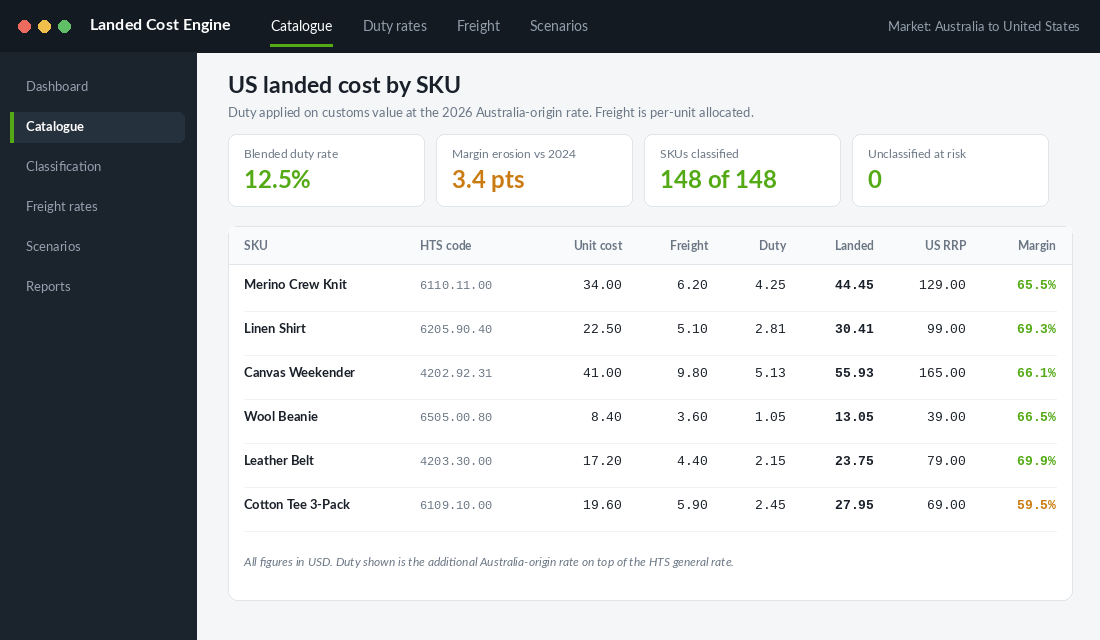
Most US landed cost models were built when duty was zero, so they have a duty field of zero, or no duty field at all. Rebuild it properly. For every SKU you sell into the US, the stack is now:
- Unit cost of goods at your true landed-into-warehouse figure, not your supplier’s quoted price.
- Outbound freight per unit, allocated realistically. Two-unit orders do not cost twice a one-unit order.
- Duty at your classified rate, calculated on customs value.
- Entry and brokerage fees spread across the parcel. Budget USD 6 to 15 per entry depending on carrier and mode.
- Payment processing at your international card rate, which is usually 60 to 100 basis points above domestic.
- Expected returns and refusals as a percentage haircut, which we will come back to in Step 5.
Run this per SKU, not blended. Blending is what hides the problem. In a typical apparel catalogue, the top-margin SKUs absorb 12.5% duty comfortably and the entry-price SKUs stop being viable altogether. A three-pack tee at USD 69 with a landed cost near USD 28 is running a very different contribution profile to a knit at USD 129. If you have not read our breakdown of contribution margin by SKU, start there, because this exercise is that exercise with a new cost line in it.
Set a floor. Most Aussie brands I work with hold a rule that no SKU ships into the US below 55% contribution margin after duty. Anything under the floor gets repriced, bundled to lift order value, or pulled from the US market entirely. That last option is not a failure. Selling a product at a loss into a market with a duty wall is worse than not selling it.
Step 3: Collect the Duty at Checkout, Not on the Doorstep
This is the single highest-impact change on the list, and most brands are still doing it the wrong way round.
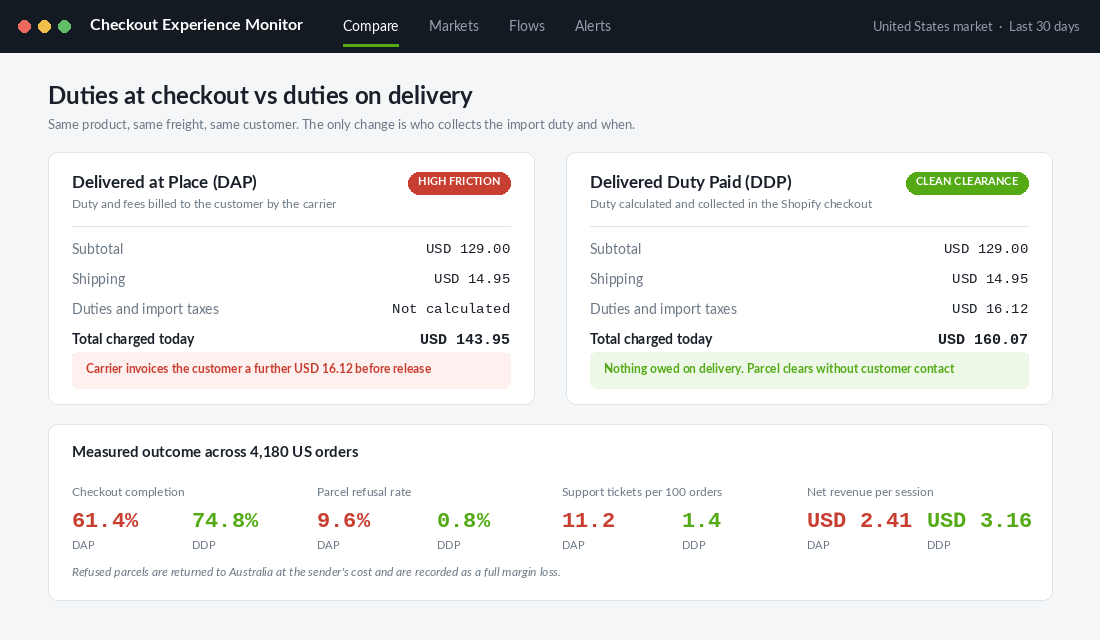
If you ship Delivered at Place (DAP), the carrier bills your customer for duty before releasing the parcel. Your customer sees a total at checkout, then gets a second invoice days later from a company they have never heard of. Industry data puts cart abandonment from unexpected costs at around 48% of shoppers, and roughly one in ten DDU parcels is refused or returned outright over surprise charges. A refused parcel is a full margin loss plus return freight back to Australia.
Delivered Duty Paid (DDP) collects the duty in your Shopify checkout and pays it on the customer’s behalf. The total is higher on screen and nothing is owed on delivery. Cross-border conversion typically improves 15 to 20% moving from DAP to DDP, because you have removed the largest friction point in the international buying journey.
Shopify’s native duties and import taxes calculator is available on Advanced and Plus. Setting it up takes an afternoon.
- Go to Settings, then Markets, and open your United States market.
- Under Duties and import taxes, switch on collection at checkout.
- Confirm every product has an HTS code and country of origin populated. The calculator falls back to a generic rate without them, and generic rates are almost always wrong in the expensive direction.
- Set your duty handling so the collected amount appears as its own checkout line, not buried in shipping. Transparency is the whole point.
- Switch your US shipping labels from DAP to DDP with your carrier. This step is not optional. If you collect duty at checkout and still ship DAP labels, your customer gets charged twice and you will be issuing refunds all quarter.
On Basic or Grow, use a third-party layer such as Zonos or Passport to calculate and remit. The economics still work: the app fee is far cheaper than a 10% refusal rate. If you are still standing up your US market properly, our Shopify Markets playbook covers the market configuration underneath this.
Step 4: Choose One of Three Pricing Moves and Commit
Once duty is visible at checkout, you have to decide who pays for it. There are only three honest answers, and picking one deliberately beats drifting between them.
- Pass it through. The customer sees a duty line and pays it. Cleanest option, protects margin fully, costs you some conversion. Works best where your product is differentiated and there is no direct US substitute.
- Absorb it into a US-specific price. Raise your US RRP to cover duty and show a single all-in price with no separate duty line. Feels premium and converts well, but you are betting your positioning can carry a 10 to 15% higher headline price.
- Split it at a threshold. Absorb duty above a spend level, pass it through below. A “duties covered on orders over USD 150” offer does the same psychological work as free shipping thresholds and lifts average order value while doing it.
The third option is where most Aussie brands land, and for good reason. It protects the low-value orders where duty plus brokerage is proportionally brutal, while giving customers a clear reason to add another item. Set the threshold just above your current US average order value, not below it, or you are giving away duty on orders that were already going to clear.
Whatever you choose, price the US market separately in Shopify Markets rather than relying on currency conversion from your AUD price. Automatic conversion means every duty and freight change quietly rewrites your US price list, which is no way to run a market.
Step 5: Fix Returns and Refunds Before They Eat the Gain
Here is the trap. You collect duty at checkout, the customer returns the item, you refund the full order total including duty, and that duty is now sitting with US Customs rather than with you. Do that across 8% of US orders and you have handed back a meaningful slice of the margin you just protected.
Three fixes, in order of effort.
- File duty drawback where volume justifies it. US drawback lets you reclaim duty paid on goods that are subsequently exported, including returns sent back to Australia. It is administratively heavy and generally only worth it once you are paying more than five figures a year in duty. A licensed broker will run it for a percentage of the recovery.
- Offer store credit as the default return path. If the customer takes credit instead of cash, the duty stays inside your business rather than leaving it. Sweeten it with a 10% bonus and most customers will take it.
- Reduce the returns themselves. Cheapest fix by a distance. Better size guides, more on-model imagery, clearer fit language. Our returns playbook walks through the diagnostic, and every point of return rate you remove is now worth more than it was in 2024, because each return carries duty with it.
Update your US returns policy page to state plainly whether duties are refundable. Customers accept a clearly stated policy. What they escalate, and chargeback, is a surprise.
Step 6: Know the Point Where a US Warehouse Beats Cross-Border Parcels
When every parcel needs its own customs entry, shipping individual orders from Australia stops scaling. One bulk import into a US third-party warehouse means one entry, one brokerage fee and one duty calculation across hundreds of units, then domestic ground shipping to the customer at a fraction of international parcel cost.
The trade-off is capital. A US 3PL means inventory sitting offshore, storage fees, minimums and a much longer cash conversion cycle. At low volume the fixed costs are punishing. There is a crossover point, and you can calculate yours.
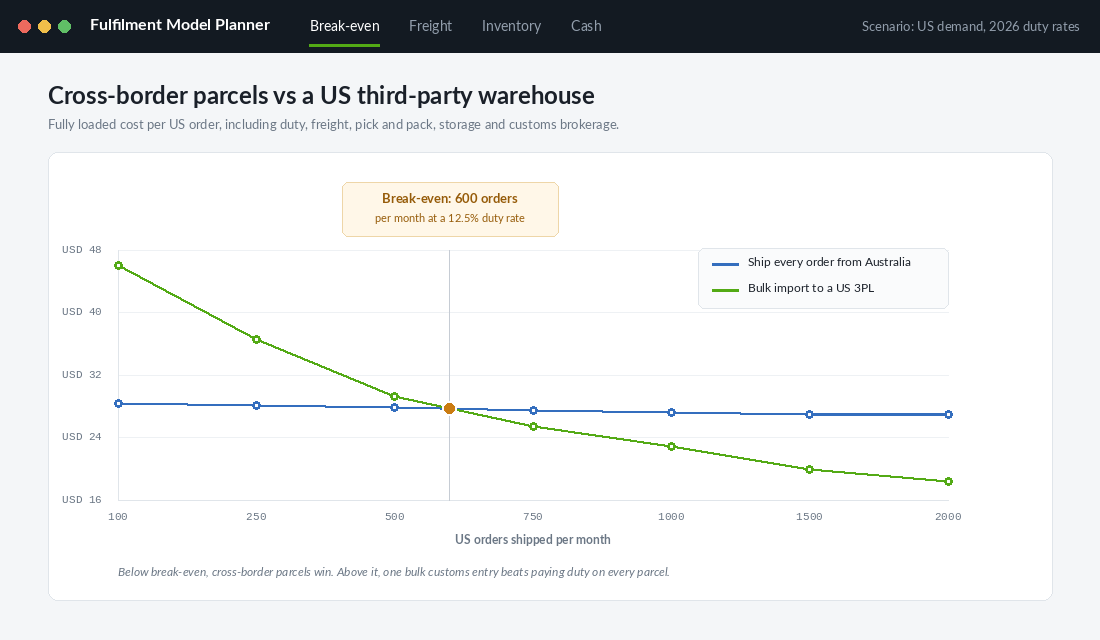
For most apparel and accessories brands the crossover sits somewhere between 400 and 800 US orders a month. Heavier or bulkier products cross earlier because international parcel freight punishes weight. High-value, low-weight products such as jewellery or skincare cross later, because the freight saving is smaller relative to the goods value.
The Aussie brands that have scaled hardest in America made this move deliberately. Luggage brand July, founded in 2019, grew US sales 400% over three years on the back of local presence and market-specific messaging rather than shipping suitcases across the Pacific one at a time. Who Gives A Crap runs US operations out of California and now sits on Whole Foods shelves. Gold Coast brand Hismile has pulled more than USD 2.67 million in GMV through TikTok Shop in the US in 2026 alone, which is a volume you simply cannot service on cross-border parcels.
You do not need to commit to a full 3PL to test this. Most US fulfilment partners will run a pilot on a subset of your top ten SKUs with a three-month minimum. Ship one bulk consignment, fulfil your fastest movers locally, keep the long tail on cross-border, and compare the real numbers after ninety days.
How the Six Steps Compound
Run in isolation, each of these is a modest fix. Run together, they change the shape of your US market.
Classification makes your duty rate accurate instead of a worst-case guess, which usually pulls the effective rate down on at least a third of the catalogue. An accurate rate makes the landed cost model trustworthy, which lets you set a pricing rule you can actually defend. Duties at checkout convert that rule into cash and kill the refusal rate at the same time. Fixing returns stops the collected duty leaking straight back out. And once the volume is there, moving to a US warehouse removes the per-parcel entry cost that made the whole exercise expensive in the first place.
A brand doing 500 US orders a month at an average order value of USD 140 is moving roughly USD 70,000 in monthly US revenue. Recovering four points of contribution margin across that base is about USD 33,000 a year. Cutting a 9% refusal rate to under 1% is worth roughly the same again. That is real money for an afternoon of classification work and a checkout setting.
The same discipline applies on the way in, incidentally. If your inbound freight and duty into Australia is still a rough estimate, our landed cost playbook runs the same exercise on the supply side.
Your US Duty Readiness Checklist
Work through this in order. Most brands can clear the first five items in a single day.
- Every US-eligible SKU has a ten-digit HTSUS code stored in a Shopify metafield.
- Every SKU has a correct country of origin recorded, based on manufacture and not on your head office address.
- Your landed cost model includes duty, entry and brokerage fees as named line items, calculated per SKU.
- You have a stated contribution margin floor for the US market, and you know which SKUs sit below it.
- Duties and import taxes are calculated and collected in your Shopify checkout, shown as their own line.
- Your US shipping labels are DDP, matched to the checkout collection, so nobody is charged twice.
- Your US pricing follows one deliberate rule: pass through, absorb, or split at a threshold.
- Your returns policy states clearly whether duties are refundable, and store credit is offered as the default.
- You have modelled your cross-border versus US 3PL crossover point and know your current monthly order volume against it.
- You review your effective duty rate quarterly, because the rate schedule has moved three times in eighteen months and will move again.
The US is still the biggest and best market most Aussie brands will ever access. It just costs more to get into than it did two years ago, and the founders who reprice for that reality will take share from the ones who keep pretending the free window is still open.
Inside eCommerce Circle, US market economics is one of the core pillars we work on with every member scaling past their home market. If you want a second opinion on yours, let’s talk.