An email lands on a Tuesday. A boutique in Byron wants to stock you. They ask for your trade price list, your minimum order and whether you offer terms.
What’s in This Article
Most founders reply inside the hour with a number they invented on the spot. Usually half of retail, because someone once told them that is what wholesale means. Six weeks later a pallet leaves the warehouse, an invoice sits on Net 30, and the busiest month of the year somehow produces less cash in the bank than the quiet one before it.
That is not a wholesale problem. That is a pricing and terms problem wearing a growth costume. The Aussie brands that get this right treat wholesale as a second profit and loss with its own cost structure, its own minimums and its own scorecard. When it is built that way it works: brands that land meaningful retail distribution typically see their DTC customer acquisition cost fall 15 to 25% within six to twelve months, because shoppers meet the brand on a shelf and then come to your store to buy the full range.
This is the six-step system we walk through with members who are ready to open a trade channel. Follow it in order. The founders who skip steps one and three are the ones who end up funding a retailer’s inventory with their own working capital.
Why Wholesale Is Suddenly Back on the Table for Aussie Brands
Two things changed. The first is that DTC growth has become expensive to buy. When paid acquisition eats 20 to 30% of revenue, every extra dollar of DTC revenue costs more than the last one, and most brands hit a plateau long before they hit their market size. If you have not read it yet, the market ceiling playbook covers how to work out whether you have actually saturated your audience or just run out of ideas.
The second is that the technology stopped being a barrier. Shopify B2B GMV grew 96% across the full 2025 financial year, and on 2 April 2026 Shopify pushed its foundational B2B features well beyond Plus. Basic, Grow and Advanced merchants now get company profiles, up to three active catalogs, volume pricing, quantity rules, vaulted cards and payment terms at no extra cost. Unlimited catalogs, direct catalog assignment and deposits stay on Plus.
That matters because the old excuse is gone. You no longer need a Plus contract or a $200 a month wholesale app to run a proper trade channel. You need a price architecture and some discipline. Across B2B generally, digital channels now account for 56% of revenue, up from 32% in 2020, so the buyer on the other side already expects to log in and reorder without emailing you a spreadsheet.
The Australian playbook here is well established. Bondi Sands launched in Melbourne in 2012 and was in Priceline and Chemist Warehouse inside its first year. Who Gives A Crap sells through Woolworths and ALDI while still running its own separate wholesale portal for cafes, offices and independent grocers. Same brand, two very different order profiles, two very different sets of terms.
Step 1: Run the Contribution Test Before You Quote Anyone a Price
Wholesale is not a discount. It is a different business model with a different cost base, and the only honest way to compare the two channels is contribution per unit after every cost that channel actually causes.
The default trade price in most categories is keystone: the retailer buys at roughly half your recommended retail price so they can double it on their shelf. That only works if your landed cost is low enough to survive it. As a rule, your cost of goods needs to sit at or under 25 to 30% of retail before wholesale is viable at keystone. If your landed cost is 40% of RRP, you are not ready to wholesale at half price and no amount of volume fixes that.
Here is the honest gap. DTC gross margin in apparel typically runs 60 to 75% of retail. Wholesale gross margin for the same DTC brand usually lands at 30 to 40%. That looks like a downgrade until you finish the sum. Wholesale carries no paid acquisition, far lower pick and pack cost per unit, and much higher units per order. For listed consumer brands, wholesale EBIT averages around eight points higher than DTC EBIT for exactly that reason.
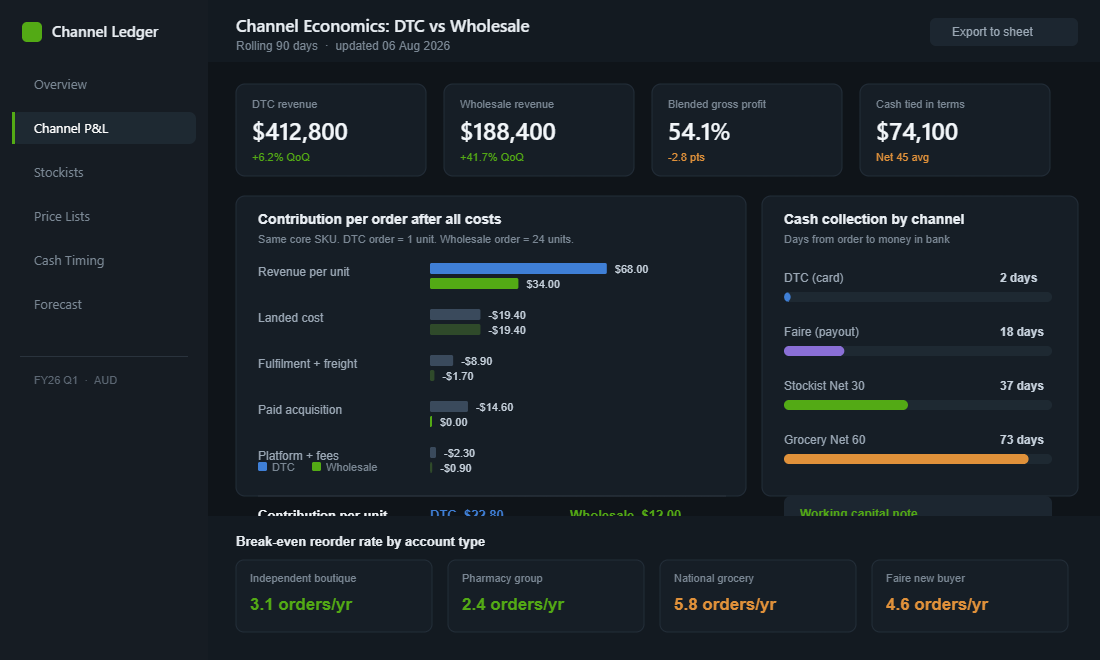
Build this on one page before you quote anybody. Take your best-selling SKU and lay out both columns: revenue per unit, landed cost, fulfilment and freight, paid acquisition, platform and payment fees. If you do not have a clean landed cost number, stop and go fix that first. The inbound freight playbook covers how to load duty, freight and handling back onto each unit so this exercise is not built on a guess.
A worked example. A serum with a $68 RRP, a $34 wholesale price and a $19.40 landed cost returns about $12.00 of contribution per unit through the trade channel, against roughly $22.80 through DTC. Per unit, DTC wins. Per order it is not close, because the boutique buys 24 units in one line and does not need a $14.60 acquisition cost attached to each one.
Set a hard floor before you go any further. We use 30% wholesale gross profit as the minimum, and any SKU that cannot clear it either gets repriced, repacked or stays off the trade list.
Step 2: Build a Price Architecture That Protects Your Own Store
The fear every founder has is real. You put your hero product in 40 stores, one of them runs it at 30% off in a clearance bin, and now your own website looks expensive to your own customers.
Here is the part most Australian founders get wrong, and it is worth being precise about. Under section 48 of the Competition and Consumer Act 2010, resale price maintenance is a per se breach. You cannot prevent or attempt to prevent a retailer from advertising or selling your product below a minimum price, you cannot make supply conditional on them holding a price, and you cannot threaten to cut them off for discounting. It is illegal whether or not it damages competition, and the ACCC has taken action over exactly this behaviour in the apparel category.
What you can do is recommend. Supplying an RRP list is fine. Setting a maximum price is fine. Refusing to supply a reseller engaged in loss leader selling is fine. Anything that looks like enforcing a price floor is not. Get your own legal advice before you write terms, because this one carries real penalties.
So you protect your store with architecture instead of threats. Four levers do most of the work:
- Pack architecture. Trade gets different sizes or different counts. Your 200ml refill pouch is DTC only. Retail gets the 150ml. Now a shopper cannot line the two prices up on a screen.
- Bundles and kits stay yours. The starter trio, the seasonal set, the personalised option. Retailers buy singles. Your site sells the experience.
- Subscription and loyalty stay yours. Repeat value is the whole reason DTC exists. A boutique cannot offer a 15% ongoing subscription discount, so your best customers still have a reason to come direct.
- Launches go DTC first. A 60 to 90 day exclusive window on new products gives your own audience a reason to check your site and gives you clean sell-through data before you offer it to trade.
Set your RRP once and publish it everywhere, including on your own site. If you routinely discount your own store 20%, you have already told every stockist that your recommended price is fiction, and they will price accordingly.
Step 3: Set the Trade Terms Before the First Order, Not After
Terms are where wholesale quietly eats your business. DTC collects the money in about two days. Wholesale, once you factor in net terms and late payers, commonly waits closer to 73 days. Same revenue line, completely different cash reality.
Run the numbers on your own exposure. Every $100k of Net 60 wholesale revenue ties up roughly $16.4k of cash for an entire quarter. Three of those accounts and you are funding somebody else’s shelf out of your own inventory budget going into peak.
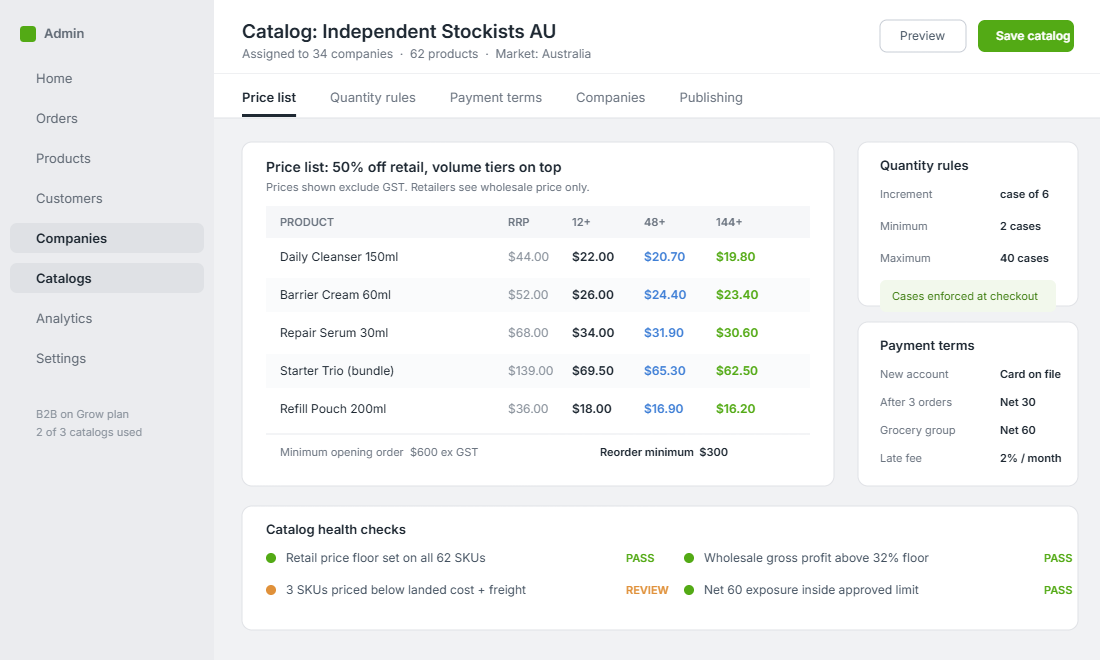
Set these five before you send anyone a login:
- Opening order minimum. Big enough that the account is worth servicing. Around $600 ex GST works for most independents. Reorder minimum can drop to about $300 so a small store can top up without drama.
- Case increments. Sell in cases of 6 or 12, not singles. This is the single biggest lever on your pick and pack cost per unit, and Shopify quantity rules enforce it at checkout so you are not policing it by email.
- Volume tiers. Reward depth rather than negotiating one-off deals. Something like 12+, 48+ and 144+ with a few percent between each tier. Published tiers stop every buyer treating your price as an opening bid.
- A terms ladder. New accounts pay by card on file. After three clean orders they move to Net 30. Only large groups with a real credit history get Net 60, and only inside a total exposure limit you set in advance.
- A late payment position. State it in the trade terms, apply it consistently, and pause supply on overdue accounts. Nothing personal, just the policy.
Vaulted cards and payment terms are both native in Shopify B2B now, including on non-Plus plans, so the terms ladder can be enforced by the platform rather than by your memory.
Step 4: Choose Your Doors Deliberately, Not Alphabetically
Not every stockist is worth having. A door that orders once, sells through slowly and never reorders costs you more in samples, freight and admin than it ever returns. Sort your targets into four types and treat each one differently.
- Independents. Small orders, fast decisions, high loyalty, and the best margin because they rarely ask for support money. This is where almost every Australian brand should start.
- Buying groups and banner networks. Pharmacy groups, health food banners, homeware collectives. One conversation opens several doors, but expect a group discount and a slower approval cycle.
- National chains. The Chemist Warehouse or Woolworths outcome that founders daydream about. Real volume, real credibility, and also longer terms, promotional contributions and the risk that a single ranging decision moves half your revenue. Do not build your forecast on one chain.
- Wholesale marketplaces. Faire is the obvious one, connecting well over 700,000 retailers with more than 100,000 brands across roughly 35 countries. Treat it as a customer acquisition channel with a price attached: 25% commission on a retailer who discovers you there, 15% on their reorders, and 0% on Faire Direct orders from retailers you introduce yourself.
That Faire structure tells you exactly how to use it. Discovery is expensive, reorders are cheaper, and buyers you bring yourself are free. So use the marketplace to be found, then move the relationship to your own Shopify B2B catalog for repeat business wherever you can.
One more filter before you say yes to any door. Ask where their customers overlap with your paid media. If you are already running Meta ads to the same 8km radius, adding a stockist there might just move the same sale to a lower margin channel. That overlap question is the same discipline behind any honest incrementality read.
Step 5: Run Stockists Like a Pipeline, Not an Inbox
Wholesale that grows is outbound. Wholesale that stalls is a founder waiting for boutiques to email them. The brands that build a real trade channel run it like a sales function with stages, owners and a cadence.
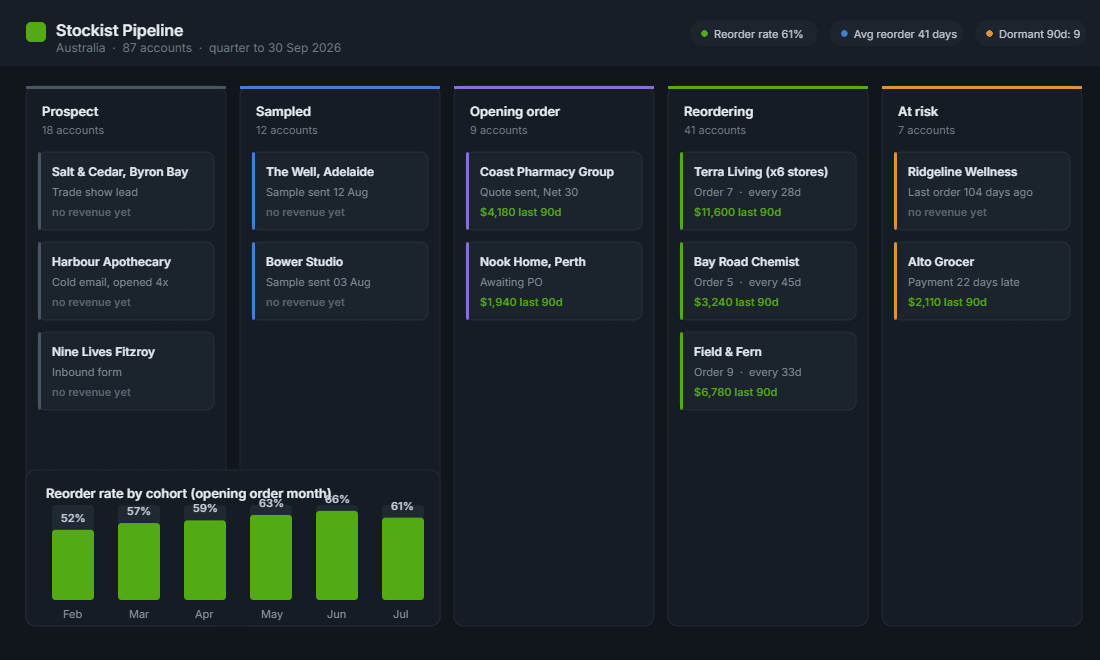
Five stages cover it. Prospect, sampled, opening order, reordering, at risk. Each has one job:
- Prospect. Build the list properly. Walk the strips you want to be in, use Google Maps by suburb, check who stocks your closest comparable brand. Fifty named stores beats a thousand scraped emails.
- Sampled. Nothing converts a buyer like the product in their hands. Budget for it, cap it at a set number per month, and always attach a dated follow-up so a sample never disappears into a stockroom.
- Opening order. Make it easy to say yes. A clear trade page, a self-serve login, a PDF line sheet with RRP, wholesale price, case size and barcodes. Buyers reorder from whoever is least painful.
- Reordering. This is the only stage that pays your wages. Track days between orders per account, and reach out before the gap you expect, not after.
- At risk. Ninety days quiet or an invoice past due. Both need a phone call, not another email.
Give the channel a rhythm. Fifteen new prospects contacted a week, samples out every Friday, a reorder check on any account past its usual cycle, and one call a month to your top ten doors asking what is actually selling through. That last question is worth more than any report, because a buyer will tell you which SKU is dead long before your numbers will.
Step 6: Measure the Channel on Reorder Rate, Not Opening Orders
Opening orders are vanity. Any brand can buy a first order with a generous sample program and a soft minimum. The number that tells you whether you have a channel is the second order.
Six metrics, checked monthly, alongside the rest of your numbers in the weekly scorecard:
- Reorder rate. The share of accounts that order again within 120 days. Healthy independent programs sit above 55%. Below 40% means your product is not selling through and you have a merchandising problem, not a sales problem.
- Days between reorders. Your natural cadence per account type. Once you know it is 41 days on average, an account at day 55 is a phone call, not a mystery.
- Revenue per door, rolling 90 days. Sort it descending. Most brands find the bottom third of doors produces under 5% of trade revenue and most of the admin.
- Break-even reorders per account. Take the cost of winning and servicing a door, including samples, freight and merchandising, and work out how many orders it needs before it pays for itself. Independents often clear it in about three orders a year. A chain with promotional support can need six.
- Days sales outstanding. Track it by account type. If it is drifting past your terms, your credit policy is theatre.
- Wholesale contribution. Not gross margin. Contribution after freight, samples, support and terms cost.
Review dormant doors quarterly and close the ones that never move. Ninety percent of a healthy trade channel is a small number of accounts reordering reliably, and pretending otherwise just hides a lot of unpaid work.
The Shopify B2B Setup: Catalogs, Companies and Terms in One Afternoon
Everything in steps two and three can be enforced by the platform instead of by your inbox. Here is the order to build it in, on any Shopify plan since the April 2026 change.
- Create your trade catalog. In Products, then Catalogs, create a catalog called “Trade” and set a percentage adjustment off retail (usually 50%) or upload a fixed wholesale price list by CSV. Exclude your DTC-only products (refills, bundles, subscription SKUs) from the catalog entirely, so a stockist cannot see them, let alone buy them at trade.
- Add quantity rules. On each product in the catalog, set the minimum, the case increment (6 or 12) and the volume tiers from step three. Checkout will refuse an order of 5 units. No email policing.
- Create company profiles. Settings, then Customers, then Companies. Add each stockist as a company with one or more buyer contacts, assign the Trade catalog, and set the payment terms per company: card on file for new accounts, Net 30 after three clean orders, Net 60 only inside the exposure limit you set.
- Turn on B2B checkout and the customer login. Buyers log in, see only their prices, reorder from history and pay against terms without a single manual invoice.
- Build two Shopify Flow automations. First: when a B2B order is placed with terms and the company’s outstanding balance exceeds your limit, tag the order for review. Second: when a company has not ordered in 45 days, send you an internal notification so the reorder call from step five happens on time.
Budget three to four hours for the first pass and one more for testing with a friendly stockist. If your product data is messy, the metafields playbook shows how to add case size, barcode and carton dimensions as structured fields so your line sheet and your catalog stay in sync.
A Worked Example: The First 12 Months of Trade for a Byron Skincare Brand
Take the $68 serum from step one and run it through a full year, so you can see what a healthy channel looks like before you have one.
Year one goal: 40 independent doors. You contact 15 prospects a week, sample 6, and convert one in four samples to an opening order, which gets you there by month ten. Opening orders average $720 ex GST (24 serums plus a cleanser). Reorder rate at 120 days lands at 58%, so 23 doors are reordering by year end, on a 41-day average cycle at $410 a reorder.
Revenue: $28,800 in opening orders and roughly $45,000 in reorders, about $74,000 of trade revenue in year one. Contribution after freight, samples and the 30% wholesale gross profit floor is around $19,000, or 26% of trade revenue. That is lower than the DTC percentage and higher than the DTC dollars per hour of work, because a reorder takes eleven minutes to process and zero dollars of ad spend.
Cash: with the terms ladder in place, 60% of doors are still paying by card, so days sales outstanding across the channel sits at 19 days rather than the 73-day industry average. Only three accounts are on Net 30 and none on Net 60. Your maximum exposure at any point is about $4,800, which is a number you can sleep on. The cash conversion cycle playbook shows how that DSO figure flows into the working capital you need for the next container.
The number to watch in month twelve is not the $74K. It is the bottom third of doors. In this example 13 doors produced under $3,000 combined. Close or park them in the quarterly review, put the sample budget into the buying group you have been circling, and the same effort produces a much better year two. The upside compounds from there: brands with steady independent distribution typically see branded search on their own store rise 15 to 30% within a year, which is the DTC acquisition cost saving from the introduction showing up in your weekly scorecard.
Where the Two Channels Start Feeding Each Other
Run all six steps and something useful happens around month nine. The channels stop competing and start compounding.
Stockists become a paid-for awareness layer you do not pay for. A shopper picks the product up in a store in Fremantle, likes it, then searches your brand and lands on your site for the refill, the bundle and the subscription that no retailer can sell them. Your branded search volume climbs, your DTC acquisition cost drops, and your blended contribution improves even though your average gross margin percentage went down.
Your DTC store becomes your R&D lab. You launch new products to your own list, get clean sell-through data in a fortnight, and only put the winners on the trade list. Retailers get proven sellers, which lifts reorder rate, which lifts revenue per door.
Your cash cycle gets sturdier too. DTC pays in two days and covers the weekly bills. Wholesale pays in 30 to 60 and covers the container. As long as you have sized your terms exposure deliberately, one funds the volatility of the other. That mix is also what makes international expansion less frightening, because you are not relying on a single acquisition channel to carry a whole new market, which is the same tension behind the US duty question most Aussie brands are working through right now.
The Six-Step Wholesale Channel Framework
Print this and work down it in order. Do not start step four until steps one to three are signed off.
- Contribution test. Model contribution per unit for DTC and wholesale on your top three SKUs. Set a wholesale gross profit floor of 30%. Any SKU under it gets repriced, repacked or excluded.
- Price architecture. Publish an RRP, recommend rather than enforce it, and keep refills, bundles, subscription and new launches exclusive to your own store.
- Trade terms. Lock the opening minimum, reorder minimum, case increments, volume tiers, the terms ladder and your total Net 60 exposure limit before you issue a single login.
- Door selection. Tier your targets into independents, groups, chains and marketplaces. Start with independents. Use marketplaces for discovery, then move reorders to your own catalog.
- Pipeline cadence. Five stages, fifteen new prospects a week, samples with dated follow-ups, and a proactive call on any account past its usual reorder gap.
- Monthly scorecard. Reorder rate, days between reorders, revenue per door, break-even reorders, days sales outstanding and wholesale contribution. Close dormant doors quarterly.
Most Aussie brands can get steps one through three done in a fortnight. The Shopify B2B setup itself is an afternoon now that catalogs, company profiles and payment terms sit on every plan. The hard part was never the software. It was deciding what your product is worth to somebody else before they told you.
Inside eCommerce Circle, channel architecture is one of the core pillars we work on with every member, because it is usually the difference between growth that adds profit and growth that just adds work. If you want a second opinion on whether wholesale is the right next channel for your brand, let’s talk.