You have spent years getting good at selling to 26 million Australians. Right now, one currency toggle away, sit 330 million Americans, 67 million Brits, and 5 million New Zealanders who would happily buy what you make. Most Aussie founders never reach them properly. They flick on “sell internationally” in Shopify, watch a handful of USD orders trickle in, then quietly switch it back off when the surprise-duty complaints and the refund requests start piling up.
What’s in This Article
Here is the number that should bother you. Only 6% of international shoppers say they buy from Australian stores, yet cross-border sales now make up 54% of all gross merchandise value flowing through Shopify globally. The demand is enormous and the local supply is tiny. That gap is the opportunity, and almost nobody is set up to capture it.
The brands that win overseas do not treat international as a switch. They treat it as a system with a handful of moving parts, each one tuned for the market they are entering. This is the 5-lever system we walk through with members inside eCommerce Circle when they are ready to turn a second country into a second growth engine. Pull these levers in order and you stop leaking money at the border and start compounding revenue from people who were always willing to pay.
Why “flick the switch” almost always fails
The default Shopify international setup is built to be easy, not to be profitable. You enable a market, Shopify auto-converts your AUD prices into rough USD, and the customer lands on a store that still talks like an Australian shop shipping from Australia.
The cracks show up fast. Prices read as odd amounts like $63.47 instead of clean numbers. Shipping looks slow and expensive. Then the parcel hits customs and your customer gets pinged for a duty bill they never agreed to.
Baymard Institute found 47% of shoppers abandon a cart when they hit unexpected extra costs, and a surprise duty invoice after checkout is the worst version of that experience.
Cross-border ecommerce grew 25% in 2025 and is on track to hit 7.9 trillion dollars by 2030. You are not early to this. You are late, and the cost of a sloppy launch is not just a flat result.
It is bad reviews from your first overseas customers and a market you have now taught yourself to avoid. Let’s fix the order of operations.
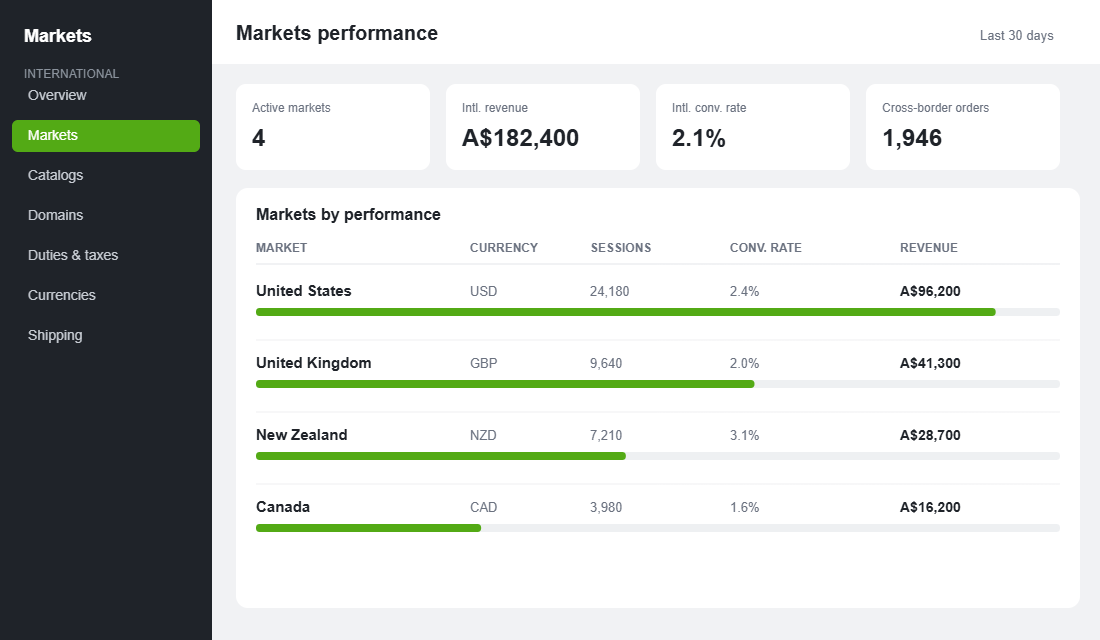
Lever 1: Pick one beachhead market, not the whole planet
The first mistake is enabling 40 countries at once because the toggle makes it free to do so. Spreading yourself across every flag means none of them get localised properly, and you cannot read the data because the volume is split into noise.
Choose one beachhead. For most Aussie brands the shortlist is short. New Zealand is the training-wheels market: same language, similar consumer behaviour, fast freight, and no duty headache on most low-value parcels.
The United States is the big prize and the hardest, with 47% of Aussie cross-border purchases already flowing the other way across that lane. The United Kingdom sits in the middle, an English-speaking market of 67 million where Aussie brands like Frank Body have rolled into 350 Boots stores off the back of strong direct-to-consumer demand.
Pick the market where three things line up: you already see organic traffic or orders from there, your freight cost to that country is sane, and your product does not hit a regulatory wall (think supplements, skincare actives, or anything battery-powered). Prove the model in one country before you copy it into the next.
- Check your analytics first. Pull last 12 months of sessions by country in GA4 or Shopify Analytics. Demand usually already exists somewhere before you have done anything.
- Map your freight per country. A parcel that costs 9 dollars to send within Australia and 38 dollars to the US changes the entire pricing maths.
- Score regulatory friction. Some categories need local compliance labelling or registration. Know this before you launch, not after a shipment is held.
Lever 2: Price in their currency, in their head
Showing prices in a shopper’s own currency is not a nice-to-have. 92% of shoppers prefer to buy from a site that prices in their local currency, and 33% will abandon the cart outright if they only see US dollars and they are not American. Your job is to remove every moment where a customer has to do mental currency maths.
Shopify Markets handles the conversion, but the default leaves money on the table because it produces ugly converted numbers. A 99 AUD product auto-converts to something like 64.12 USD, which reads as cheap and untrustworthy at the same time. Use price rounding rules so every market lands on clean psychological price points: 64.12 becomes 65.00, or you set a dedicated USD price of 69.00 that protects your margin and looks deliberate.
This is where you decide whether to absorb or pass on the cost of selling abroad. A product priced at 99 AUD at home does not have to be the converted equivalent overseas. If your US freight and duty add 18 dollars of cost per order, build that into a US-specific price rather than quietly eating it on every sale. Your contribution margin per order is the number that decides whether this market is worth running at all.
- Turn on currency rounding. In Settings, Markets, set rounding so converted prices end in clean amounts. This single change lifts perceived trust.
- Set market-specific prices on hero products. Do not let auto-conversion decide the price of your best sellers. Set them by hand.
- Localise the payment methods. Americans expect Shop Pay and PayPal. Germans expect Klarna and direct debit. Offer what the market trusts.
Give each market the payment methods it actually trusts
Local currency gets a shopper to your checkout. Local payment methods get them through it. A card-only checkout is normal in Australia and close to a closed door in half of Europe.
The numbers are brutal once you look. iDEAL carries roughly 70% of online payments in the Netherlands, and German shoppers skew heavily to bank transfer, PayPal and buy-now-pay-later rather than credit cards. Brands that add the right local method to a market commonly see a 5% to 15% lift in checkout completion from that one change.
| Market | Method you must have | Why it matters |
|---|---|---|
| United States | Shop Pay, Apple Pay, PayPal | Wallets clear over 50% of mobile checkouts and remove card entry entirely |
| United Kingdom | Cards, PayPal, Klarna | BNPL is mainstream for baskets over 60 GBP, not a fringe option |
| Netherlands | iDEAL | Around 70% of online payments. Card-only is effectively no checkout |
| Germany | PayPal, Klarna, SEPA direct debit | Card penetration is low and pay-after-delivery is expected |
| New Zealand | Cards, Apple Pay, Afterpay | Closest to Australian behaviour, so your existing stack mostly works |
Check what your entity can actually offer before you promise it. Shopify Payments supports an Australian business selling into most of these markets, but some local methods route through Stripe or a Klarna app instead, and each one adds its own fee to your landed cost model.
Then make the total honest. If your category needs more precision than Shopify’s native duty calculator, Zonos quotes landed cost at the checkout, and Avalara handles the tax registration and threshold tracking once volume builds. Your shipping and fulfilment setup needs to feed real rates into that same checkout, not a flat guess.
- Audit your abandoned checkouts by country. A market with normal add-to-cart rates and terrible checkout completion is almost always a payment method problem.
- Turn on wallets first. Apple Pay and Shop Pay are the cheapest conversion win in any English-speaking market and take an afternoon to enable.
- Price the fee in. Klarna and local rails cost more than a domestic card. Build the difference into your market-specific price, not into your margin.
Lever 3: Kill the surprise at the border
The single biggest reason international orders turn into refunds and one-star reviews is the duty surprise. The customer pays at checkout, feels good, then a courier demands another 40 dollars before they will hand over the parcel. That customer never buys from you again, and they tell people why.
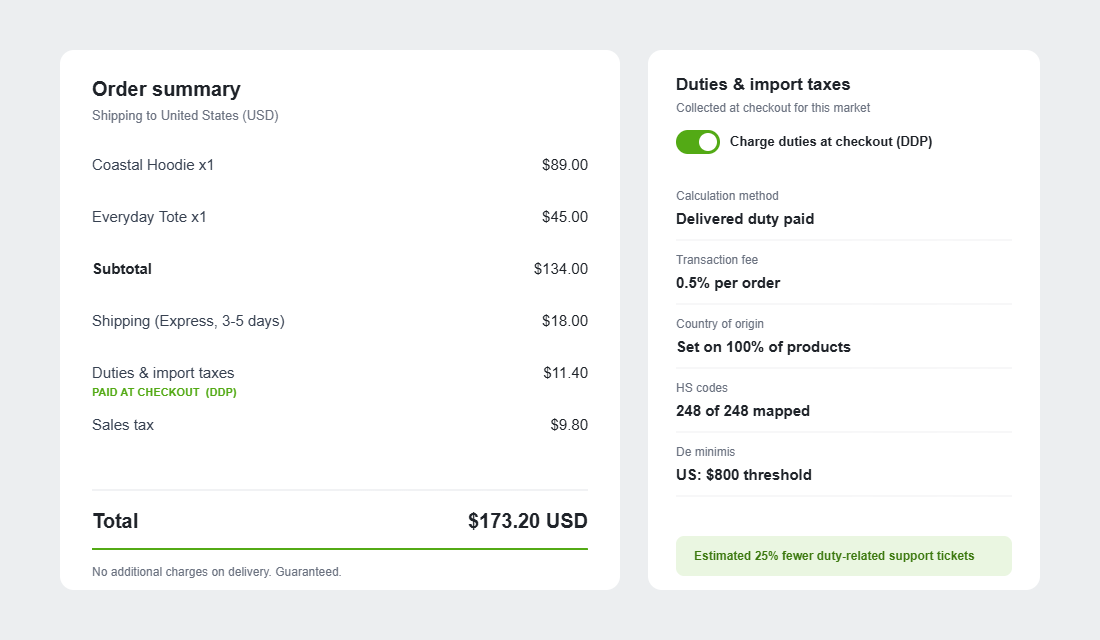
The fix is to collect duties and import taxes at checkout so the price the customer pays is the final price. This is the difference between DDU (delivered duty unpaid, where the customer gets ambushed later) and DDP (delivered duty paid, where you handle it up front). Shopify lets you calculate duties and import taxes at checkout on every plan, and as of February 2025 the transaction fee for that calculation was temporarily lowered to 0.5% per order.
DDP is not just kinder, it is operationally cheaper. Brands that move to duties-paid-at-checkout report up to a 25% drop in customer service tickets about duty disputes and roughly three times fewer “where is my order” enquiries when customs delays stop catching people off guard. Every one of those tickets you do not receive is margin you keep and a team member you do not have to hire.
- Add the country of origin and HS code to every product. Missing or wrong Harmonized System codes are the main cause of inaccurate duty estimates that still surprise the customer at the door.
- Show the all-in price. Make sure your checkout line items spell out product, shipping, and duties so the total feels honest, not hidden.
- Set a clear de minimis expectation. Some markets have a threshold under which no duty applies. Know each market’s limit so you can price and message around it.
Lever 4: Localise the storefront, not just the price
A converted price on an otherwise-Australian store still feels foreign to an overseas buyer. Localisation is the work of making a shopper in Auckland or Austin feel like you built the store for them, even when you are shipping from a warehouse in Melbourne.
Start with the language of trust signals. An American shopper reads “free returns” and “ships from our US partner” very differently to “returns to our Sydney warehouse.” Spelling matters too: a US storefront should say “color” and “favorite” even though your Aussie store says “colour” and “favourite”. Shopify Markets supports per-market content and language variants so you are not maintaining two separate stores.
Then handle the plumbing. Decide whether each market lives on a subfolder like yourstore.com/en-us or a dedicated domain, and set geo-routing so a US visitor lands on the US experience automatically rather than seeing AUD and wondering if you even ship to them. Speed counts double here, because your international visitors are physically further from your servers and your apps. A slow store loses overseas shoppers faster, which is why your site speed work pays off again the moment you go global.
- Localise delivery promises. Show real delivery windows per market, not a single generic “7 to 14 days” that scares off buyers used to two-day shipping.
- Translate the returns story. Make the returns address and process market-specific. Overseas buyers fear being stuck with a parcel they cannot send back.
- Match the feed to the market. If you run Google Shopping abroad, your product feed needs the right currency, language, and shipping data per country or the ads simply will not serve.
Decide where the stock sits before you scale
Localising the front of the store only works if the back of the store can keep up. Fulfilment is the lever most founders ignore until their first wave of overseas orders turns into a backlog of slow deliveries and refund requests. Decide your model before volume forces the decision for you.
There are three honest options. Ship every order from your Australian warehouse, which is simple but slow and expensive once a market grows. Hold stock with a third-party logistics partner inside the destination country, which gets you two-day delivery and lower per-parcel freight but ties up cash in inventory you cannot see. Or use a hybrid where you ship from home until a market proves itself, then move stock in-country once the orders justify it.
The trigger to move stock into a market is volume, not excitement. A common rule of thumb is to wait until a country is doing 50 to 100 orders a month consistently before you commit to local 3PL storage. Until then, ship from Australia and let DDP and clear delivery windows manage the expectation. Get this wrong and your beautifully localised storefront still ends in a two-week delivery and a one-star review.
- Start home, move close. Ship from Australia to validate, then place stock in-market once volume is steady and predictable.
- Match the promise to the method. Do not advertise two-day delivery while shipping from Melbourne. Let your stated window match reality.
- Watch the cash, not just the speed. In-country stock is faster but locks up working capital. Model both before you commit.
Service and returns when you are asleep and they are shopping
Sydney is 14 to 16 hours ahead of New York and 9 to 10 hours ahead of London. Your new market’s peak shopping window lands squarely in the middle of your night, which means every question sits unanswered until your team wakes up.
Fix that with automation before you fix it with headcount. Set up macros and an auto-reply in Gorgias or Reamaze that fires instantly with tracking status and a realistic response time, so an overnight enquiry gets an answer at the moment it is asked.
Expect a “where is my order” spike. WISMO already runs at 30% to 40% of support volume for most stores, and it climbs when transit runs 10 to 20 business days on Australia Post International Standard versus 4 to 6 days on DHL Express at roughly three to five times the cost per kilogram. Publish the real window on the product page and the WISMO tickets drop before they are ever raised.
Returns are where overseas margin quietly disappears. You have three options: send it back to Australia, hold a local return address with a 3PL or returns agent, or refund without return under a value threshold.
Do the maths per SKU. Return rates run 20% to 30% in apparel and 2% to 5% in supplements and consumables, and a return posted from the US back to Australia costs 30 to 60 AUD before you have touched the product. Under about 60 AUD of item value, refunding without a return is usually the cheaper and warmer decision, which is exactly the logic in a returns policy that protects margin instead of leaking it.
Imagine you run a 50-SKU supplements brand doing 3 million AUD a year in Australia and you open the UK. At a 3% return rate on 200 UK orders a month, that is six returns. You do not need a London warehouse for six parcels. You need a refund-and-keep rule under 60 AUD and a documented exception process above it.
Lever 5: Protect the contribution margin, not the revenue line
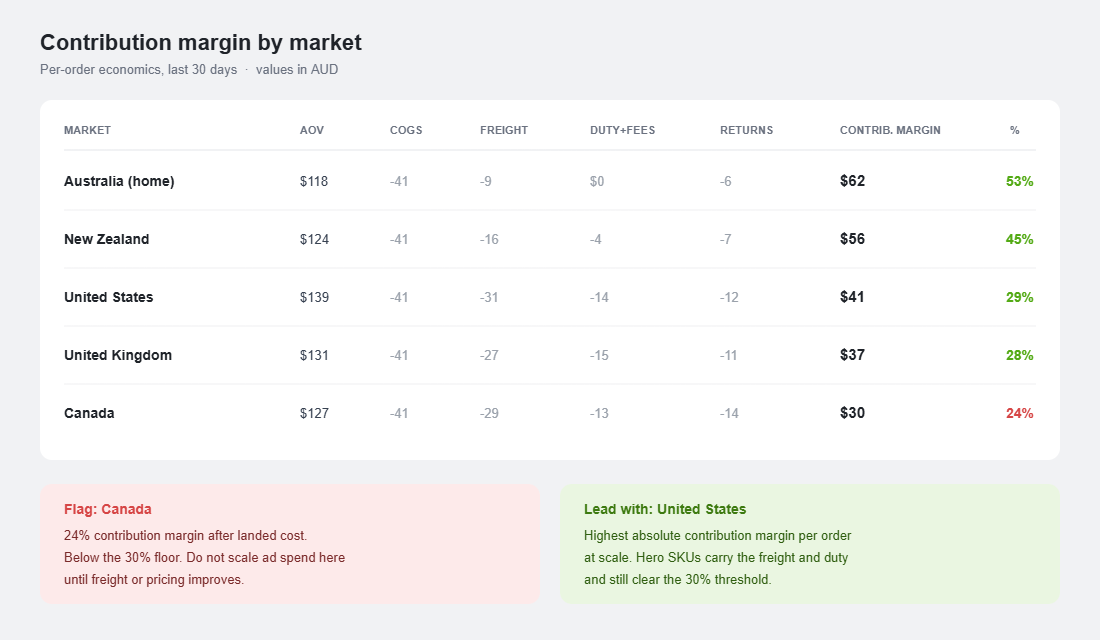
This is the lever that separates a real international business from a vanity one. It is easy to celebrate your first 10,000 dollars of US revenue and miss that it cost you 11,000 dollars to earn it once you load in freight, duty, FX spread, payment fees, and a higher return rate.
Build a landed-cost model per market before you spend a dollar on ads. Start with your cost of goods, then add international freight, your duty rate, the 0.5% Shopify duties fee, foreign card processing fees, and a realistic returns allowance for that country. Whatever is left after all of that is your true contribution margin, and it is almost always thinner overseas than at home.
If a product only works at home-market margins, do not expand it. Lead your international launch with your highest-margin, lowest-return hero products and hold the rest back. When you start running paid traffic into the new market, track efficiency separately, because a US customer acquisition cost can look nothing like your Australian one. Your blended ROAS needs to be measured per market or you will cross-subsidise a losing country with a winning one and never notice.
- Model before you launch. Know your per-order contribution margin in the new market before the first sale, not after the first quarter.
- Lead with hero SKUs. Expand the products that survive the added cost, not your full catalogue.
- Report per market. Separate revenue, margin, and ad efficiency by country so each market earns its place.
The boring compliance that keeps the market open
Nobody starts an international expansion excited about tax registration, and that is exactly why it trips so many Aussie brands. The duties at checkout from Lever 3 cover the customer’s import costs. They do not cover your obligation to register and remit sales tax in the markets where you cross a threshold.
The rules differ by market, and you need to know them before volume builds, not after a letter arrives. The UK expects you to register for VAT and charge it on most consumer sales once you are shipping into the country. The European Union runs an IOSS scheme that lets you collect VAT at the point of sale on low-value parcels so the customer is not stung on delivery. The United States is the messy one, with sales tax nexus rules that vary state by state and usually kick in once you pass a revenue or order-count threshold in a given state.
You do not need to become a tax expert. You need to know where your thresholds sit and have a bookkeeper or a tool that flags when you are getting close. Shopify can calculate and collect the right tax per market once you have registered, but it cannot register on your behalf. Treat this as a setup task per country, tick it off, and it stops being scary.
- Know your thresholds. Each market has a point where registration becomes mandatory. Find yours before you hit it.
- Register before you scale ads. A market you are about to pour ad spend into is a market you should already be compliant in.
- Automate the collection. Once registered, let Shopify charge the correct rate per market so you are not reconciling it by hand.
How the five levers compound into a second growth engine
Run these levers in isolation and you get marginal gains. Run them as a system and they multiply. A clean beachhead market gives you readable data. Local-currency pricing lifts conversion.
Duties at checkout cut refunds and support load. A localised storefront raises trust and repeat rate. Margin discipline makes sure every extra order is actually profit. Each lever makes the next one work harder.
This is not theory. Bondi Sands started as a Melbourne idea and is now sold in 32 markets, including more than 7,700 Walgreens stores in the US, before being acquired by Japan’s Kao for an estimated 450 million US dollars.
Frank Body, launched in 2013 with 5,000 dollars, now earns more than half its total sales from the United States and grows around 40% a year. Hismile took an Aussie teeth-whitening product global on the back of social proof and tight market focus. None of them got there by flicking a switch. They built the system, one market at a time.
The reason this matters for you specifically is reuse. You already have the product, the supply chain, the brand, and the Shopify store. International expansion reuses all of that fixed work and points it at a market many times the size of home. A second country done properly is the cheapest growth you will ever buy, because you are not building a new business, you are extending the one you already run.
Know by month 6 whether the market stays or goes
Most founders never set an exit line, so a mediocre market limps along for two years soaking up attention. Write the criteria on day one, when you are still honest, and review them at month six.
Four numbers decide it. Contribution margin per order at 70% or more of your Australian number, CAC payback inside 90 days, a 90-day repeat purchase rate within 5 points of home, and order volume growing month on month rather than flat since the launch spike.
Pull the supporting evidence from GA4 and Google Search Console, not from vibes. Rising branded search and direct traffic in that country means you are building something. Paid-only traffic with no organic tail after six months means you are renting revenue.
If three of the four fail, close it. Closing well is a skill: stop paid traffic immediately, keep the market live in Shopify Markets for at least 90 days so existing customers can still order consumables and lodge returns, then email the list before you switch it off.
- Honour every warranty and open return. Keep the returns address and support inbox live for the full warranty period, even after the storefront goes.
- Redirect, do not delete. Point the market subfolder or domain at your main store so the SEO equity you built is not thrown away.
- Cancel the registrations. Deregister for VAT or state sales tax properly once you stop selling, or you keep filing nil returns forever.
- Write the post-mortem. Note which of the four numbers failed and why, because the next market you enter will fail the same way if you do not.
Your market-entry scorecard
Before you turn international selling on for any country, run it through this scorecard. If you cannot tick at least eight of the ten, you are not ready for that market yet. Save this and use it for every country you consider.
- Demand signal. You already see sessions or orders from this country in your analytics.
- Freight sanity. You know your real shipping cost per order to this market and it does not destroy your margin.
- Regulatory clearance. Your product can legally enter and be sold there without registration you do not have.
- Local currency. Prices display in the market’s currency with clean rounding, not raw conversions.
- Market-specific hero pricing. Your best sellers have prices set by hand, not by auto-convert.
- Duties at checkout. Import taxes are collected up front so there is no surprise at the door.
- HS codes loaded. Every product has a country of origin and a correct Harmonized System code.
- Localised trust signals. Returns, delivery windows, and spelling match the market.
- Geo-routing live. Visitors land on the right market automatically.
- Margin modelled. You know your per-order contribution margin in this market before launch.
Work the scorecard top to bottom and you will catch the expensive mistakes on paper instead of in your bank account. The brands that scale internationally are rarely the ones with the biggest ad budgets. They are the ones who refused to launch a market until the system underneath it was ready.
Inside eCommerce Circle, international expansion is one of the core pillars we work on with members who have outgrown the Australian market. If you want a second opinion on which market to enter and whether your margins can carry it, let’s talk.