Paid acquisition has quietly stopped being a growth strategy for most Australian Shopify brands. It is a tax you pay to stand still.
What’s in This Article
The numbers back that up. Average DTC customer acquisition cost now sits somewhere between $45 and $70, and acquisition costs have climbed roughly 222% over the past eight years. You are bidding against better funded brands for the same shopper, in the same auction, with roughly the same creative. Meanwhile 71% of consumers say they enjoy co-branded campaigns, and 64% of social users say they buy more from a brand when it partners with someone they already like.
That gap is the opportunity. A collaboration lets you put your product in front of an audience that has already decided to trust somebody, and borrow a slice of that trust instead of buying attention cold. Liquid Death and Van Leeuwen proved the ceiling on this when their hot fudge sundae sparkling water sold out in seven hours off a run of roughly 10,700 packs.
Most Aussie founders do collabs badly, though. They pick a partner they think is cool, split the design work, post about it twice and never find out whether it made money. Here is the six-step system that turns a collab from a nice moment into an acquisition channel.
Step 1: Pick the Partner on Audience Overlap, Not on Vibe
The instinct is to partner with a brand you admire. The discipline is to partner with a brand whose audience looks like your best customer but has not met you yet.
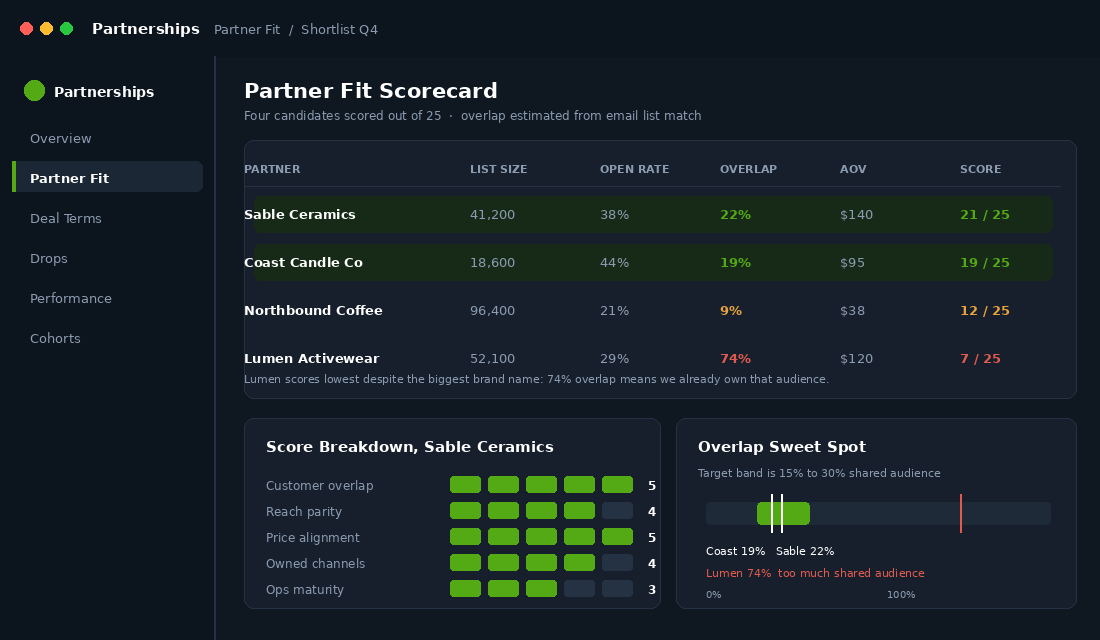
Score every candidate out of 25 across five factors, five points each.
- Customer overlap. You want adjacency, not identity. If 80% of their list already buys from you, the collab is a discount to existing customers wearing a costume. The sweet spot is 15% to 30% shared audience.
- Reach parity. A partner with ten times your list will not put real effort in. A partner with a tenth of your list gives you nothing to borrow. Aim within a 3x band either way.
- Price alignment. If your average order value is $120 and theirs is $25, their audience will bounce off your pricing regardless of how good the product is.
- Owned channel strength. Ask for their email list size and their average open rate, not their follower count. Email is the asset you are actually borrowing.
- Operational maturity. Can they ship on a date? A collab with a brand that misses deadlines is a brand risk with your name on it.
Gorman is the Australian benchmark here and has been for over a decade. Their artist collaborations, including the Mangkaja collection made with Aboriginal artists Ngarralja Tommy May and Sonia Kurarra from Fitzroy Crossing, work because the artist brings a genuinely different audience with an existing emotional relationship. That is borrowed trust, not borrowed reach.
Step 2: Match the Format to the Goal You Actually Have
“Let’s do a collab” is not a brief. There are five distinct formats and they solve different problems, cost different amounts, and take wildly different lead times.
- Co-created product. Highest lift, highest risk. New SKU, new tooling, 12 to 20 weeks lead time. Use it when you want press and a genuine reason for someone to switch brands.
- Limited edition packaging or colourway. Same product, new skin. Four to eight weeks. Who Gives A Crap ran this beautifully with Parks Project, putting twelve different wrapper designs on existing rolls. No new product, all of the newness.
- Bundle. Your product plus theirs, sold on both stores at a modest saving. Two weeks. The fastest path to a first collab and the easiest to measure.
- Audience swap. No product at all. You feature them to your list, they feature you to theirs, both with a first-purchase offer. One week and close to zero cost.
- Cultural stunt. Deliberately unexpected, built for share rather than immediate sales. Who Gives A Crap’s C.R.A.P digestive smoothies with Erewhon in May 2025 is the type. Only run this when you already have distribution to convert the attention.
If this is your first collaboration, do a bundle or an audience swap. Prove the audiences respond before anyone commits to a minimum order quantity. Founders who open with a co-created product usually end up with 800 units of a lovely thing in a garage in Braeside.
Step 3: Agree the Commercials Before Anyone Touches the Creative
Collabs fall apart at the money conversation, and they fall apart late, after both teams have fallen in love with the artwork. Have the awkward conversation in week one.
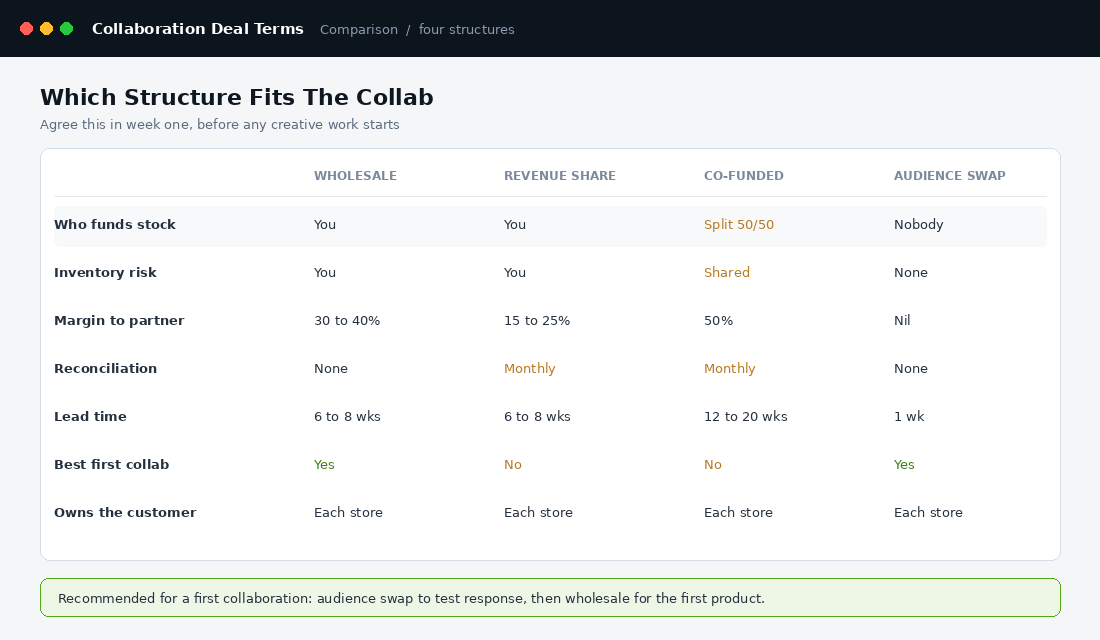
Six things need a written answer before design starts.
- Who funds the stock. Whoever fronts the production cost should hold the margin and the inventory risk. Split funding creates split decisions, which is how you end up with a product nobody will discount.
- Who owns the customer. The default should be that each brand keeps the customers who buy through their own store, and both parties get to email their own buyers. Say it out loud anyway.
- Revenue share or wholesale. Wholesale is cleaner. They buy units from you at cost plus a margin and sell them how they like. Revenue share needs reconciliation and reconciliation needs trust.
- Marketing minimums. Two dedicated emails, four organic posts, one paid boost each. Written down. A collab where one side does all the promotion is a sponsorship you forgot to charge for.
- Exclusivity window and channel rules. Who can sell it, where, and until when. Include wholesale accounts and marketplaces explicitly.
- What happens to leftover stock. Agree the markdown date and who wears it, before you need to know.
Two pages is enough. You do not need a lawyer for a bundle. You do need one for a co-created product with artwork licensing attached, particularly where First Nations artists or cultural material are involved, where fair remuneration and ongoing consent are the standard, not a nice-to-have.
Step 4: Build the Drop Mechanics Around a Waitlist
The most expensive mistake in collaborations is launching to a cold audience on day one. You get one spike of attention from your partner’s channels and no way to re-contact the people who saw it and did not buy.
Run a two-phase launch instead. Phase one sells nothing.
- Announce 10 to 14 days out with a landing page that captures email and mobile, and nothing else. No product page, no price, no add to cart.
- Both brands drive to the same page with different UTM sources so you can see whose audience actually shows up.
- Give the waitlist a genuine head start, two to four hours of early access, not a token discount code. Access converts harder than a percentage.
- Publish the stock number. If it is 600 units, say 600 units. Real scarcity outperforms invented urgency and it does not put you on the wrong side of Australian consumer law.
- Set the sell-through target before launch, usually 70% in the first 72 hours for a limited run. That number decides whether you repeat the collab or not.
The waitlist is the actual asset. Even if the drop underperforms, you finish with a segment of people who raised their hand for a product that no longer exists, which is a very warm audience for your next launch. The product drop playbook covers the launch day mechanics in more detail, and the urgency and scarcity playbook covers how to signal limited stock without inventing it.
Step 5: Track It Properly or You Will Never Know If It Worked
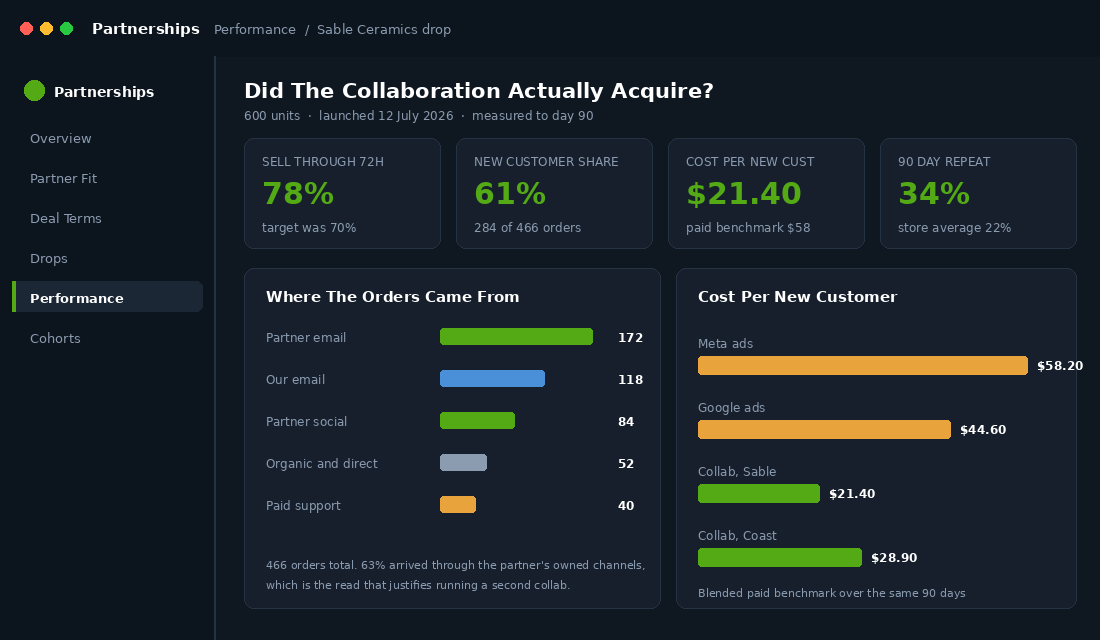
Most collab post-mortems consist of a screenshot of a sell-out and a group chat full of fire emojis. Revenue is the wrong headline metric, because a collab that sells out to your existing customers has cannibalised, not acquired.
Shopify Collabs is the easiest place to start if your collaboration involves creators or a partner who will promote on commission, and it is free on all Shopify plans. Setup runs about thirty minutes.
- Install Shopify Collabs from the app store and complete the brand profile, including the products you want partners to promote.
- Create a dedicated offer for the collaboration rather than using your general affiliate terms, so the reporting stays isolated to this campaign.
- Invite the partner and issue a unique affiliate link and discount code. The code is what survives when link attribution fails, which on mobile it frequently does.
- Set the commission and the cookie window deliberately. Thirty days is standard, seven days if you want a clean read on immediate impact.
- Tag every collab order automatically using Shopify Flow so the cohort stays identifiable in six months when you are deciding whether to run it again.
Then measure four things and only four things: the share of collab orders that came from first-time customers, the effective acquisition cost of those new customers against your paid benchmark, the sell-through rate against your target, and the 90 day repeat rate of the collab cohort compared to your store average. If new customer share is under 40%, you ran a promotion to your own list.
Step 6: Convert the Borrowed Audience Before It Evaporates
A collaboration customer bought a hybrid. They know the partner. They do not know you. Drop them into your standard welcome flow and you will lose most of them, because that flow assumes an interest in your brand that has not been established yet.
Build a separate 21 day sequence for the collab cohort.
- Day 0, bridge the brands. “You came to us through [partner]. Here is what we make and why.” Lead with the shared value that made the collab make sense.
- Day 4, the hero product, not the range. One product, one story. A new customer cannot process a catalogue.
- Day 10, proof. Reviews, press, founder story. This is where you earn the right to be considered on your own.
- Day 18, a reason to buy again that is not a discount. Early access to the next drop works far better than 10% off with this audience.
- Day 21, segment and exit. Anyone who has not opened three consecutive emails goes to a low frequency segment rather than your main list.
Judge the collaboration on the 90 day repeat rate of this cohort, not on launch week revenue. That is the number that separates a genuine acquisition channel from an expensive PR exercise, and it is covered properly in the repeat purchase playbook.
Three Ways Collaborations Quietly Lose Money
Every failed collab I have looked at with a member fails in one of three predictable ways, and all three are avoidable in the planning week.
- The margin gets eaten by the split. A co-created product carries new tooling, new packaging, a shorter production run and a partner margin, then gets priced at the same level as your core range because that felt right. Price the collab on its actual landed cost, not on your normal price architecture. A limited edition can and should carry a premium, and the audience expects one.
- The launch lands on a dead week. Collabs get scheduled around when the artwork is finished rather than when the audience is buying. Check the partner’s calendar against yours for competing launches, and avoid the fortnight either side of a major sale event, because a limited drop and a storewide discount are contradictory messages that confuse both lists.
- Nobody owns the follow-up. The collab ships, both teams move on, and the cohort from step six never gets its sequence built because it was nobody’s job. Assign one named owner on your side before launch, with the 14 day and 90 day review dates already in their calendar.
There is a fourth trap worth naming, which is running a collab because a partner asked rather than because it fits your plan. Saying no to a flattering approach from a bigger brand is hard, and it is usually right when the audience overlap is wrong. A collaboration takes six to twelve weeks of a small team’s attention. That is the same attention you would otherwise spend on your own range, and the opportunity cost never shows up in the post-mortem.
Why Collaborations Compound When Ads Do Not
A paid campaign resets to zero the moment you stop funding it. A collaboration leaves assets behind.
The waitlist from step four survives the drop. The creative from step two gets reused across your own campaigns for a year. The relationship from step three makes the second collab faster, because the commercial terms are already agreed and both teams know how the other operates. And each collaboration makes the next partner easier to sign, since a brand with a track record of running these well is a far easier yes than a cold pitch from a stranger.
Gorman has been doing this for more than ten years across dozens of artists. Who Gives A Crap brought the Parks Project edition back a second time after the first run performed. Neither of those is a one-off marketing moment. They are a repeatable system with a calendar slot, which is exactly what most Australian brands treat as a once a year novelty.
Two or three collaborations a year, run properly, will out-earn the same spend in the auction. The reason most founders do not get there is not creativity. It is that they never measured the first one, so they never had the evidence to justify the second.
Where to Actually Find Partners (Five Sources That Work)
Everything above assumes you have a shortlist. Most founders don’t — they have one mate in another brand and a vague sense that collabs are a good idea. Here’s how to build a real pipeline of twenty candidates in an afternoon.
Your own customer list. Start here, always. Export your top 200 customers by lifetime value and look at what else they follow and buy. If you sell skincare and forty of your best customers all follow the same Melbourne activewear label, that’s not a coincidence, that’s an overlap signal you can act on this week.
Meta Audience Insights and your ad account. Look at the interest clusters Meta already associates with your converters. Brands that show up repeatedly as adjacent interests are, by definition, sitting on an audience that responds to your category.
Your shared suppliers and 3PL. This one is badly underused. Your fulfilment partner services dozens of Aussie brands at a similar stage to you. Ask your account manager for two introductions to non-competing brands in the same revenue band. They’ll usually make the call, because a collab that grows both clients grows their volume too.
Creator overlap. Pull the last twenty creators who’ve posted about your product and look at which other brands they’ve worked with in the past six months. A creator who genuinely uses both products is the warmest possible introduction, and they’ll often broker it for a small fee or a gifting arrangement.
Markets, trade shows and founder communities. Unfashionable but effective. Two hours at a Finders Keepers or a category trade show puts you in front of thirty founders who are all thinking about the same acquisition-cost problem you are.
Scoring a Shortlist Before You Send a Single Email
Once you have twenty names, score each out of 5 on four criteria and only approach the top five. It takes ten minutes per brand and it saves you from the collab that eats a quarter and returns nothing.
- Audience size parity. Within roughly 2x of your own engaged following. Chase a brand ten times your size and you’ll do all the work for a fraction of the return.
- Price-point parity. If their average order value is $45 and yours is $220, their audience will bounce off your pricing regardless of how well the collab is executed.
- Operational credibility. Do they ship on time? Is their customer service any good? Check their Google reviews and their Instagram comments. Their service failures become your brand damage the moment your name is on the box.
- Founder responsiveness. If it takes eleven days to get a reply to the first email, the launch will slip twice. Treat the response speed of that first exchange as data.
A brand scoring 16 or above out of 20 is worth a proper pitch. Anything under 12 is a polite no, no matter how much you like their branding. Aim to have three live conversations running at once — roughly one in three initial approaches converts to an actual collaboration, so a single outreach email is not a strategy.
The One-Page Collaboration Brief
Take this to your next partner conversation. If you cannot fill in every line, you are not ready to start the creative.
- Partner and fit score. Name, and the score out of 25 from step one with the overlap estimate written next to it.
- Primary goal. New customers, press, or list growth. Pick one. A collab optimised for all three achieves none.
- Format. Co-created, limited edition, bundle, audience swap or stunt, with the lead time attached.
- Units and funding. How many, who pays, and what the landed cost per unit is.
- Retail price and margin split. Including the markdown floor you will not go below.
- Marketing minimums per brand. Emails, posts, paid support, with dates.
- Launch date and waitlist open date. Waitlist opens 10 to 14 days before launch.
- Sell-through target. The percentage in 72 hours that means you run it again.
- New customer share target. 40% minimum, 60% is a good collab.
- Tracking setup. Discount code, UTM structure, order tag, and who is checking it.
- Leftover stock plan. Markdown date and who carries the cost.
- Post-launch review date. 14 days after launch and again at 90 days.
Start with the audience swap. It costs nothing, it takes a week, and it gives you a real reading on whether the two audiences respond to each other before anyone commits capital to a minimum order quantity. If the swap performs, you have earned the right to make something together. If you are also weighing up creator partnerships alongside brand-to-brand work, the creator gifting playbook covers where that fits.
Inside eCommerce Circle, partnership-led acquisition is one of the pillars we work on with members who have hit the ceiling on paid, because it is usually the cheapest growth available to a brand that already has a good product. If you want a second opinion on yours, let’s talk.