Most Shopify stores bolt a countdown timer onto the product page, drop an “Only 2 left!” badge under the buy button, and watch conversion tick up. For a week it feels like a win. Then a slice of those rushed orders comes back as refunds, the timer resets every time someone reloads the page, and one sharp-eyed customer screenshots it and posts it to a buy-swap-sell group with the caption “lol this is fake”.
What’s in This Article
Here is the number that should stop you cold. In April 2026, the Federal Court ordered Emma Sleep to pay fifteen million dollars in penalties for using countdown timers that reset during sale campaigns and “Last chance” messaging on products that stayed at the same price for weeks. The ACCC ran a Black Friday enforcement sweep through late 2025 looking for exactly this, and dark patterns sit near the top of its 2026 to 2027 priorities. Fake urgency is no longer a clever growth hack. It is a line item of legal risk.
The frustrating part is that urgency works. Genuine scarcity can lift sales by as much as 226% in controlled tests (ConversionXL), and a real low-stock notice lifts purchase likelihood by around 20%. So the question was never urgency versus no urgency. It is real urgency versus fake urgency. One compounds trust and revenue. The other borrows a sale today and pays it back with interest in refunds, chargebacks, and a brand customers stop believing. This playbook gives you five levers that are genuinely true, convert hard, and keep you on the right side of the ACCC.
Why Fake Urgency Just Got Very Expensive in Australia
Emma Sleep is the cautionary tale every Aussie founder should keep pinned. The court found the brand told customers discount prices were available for a limited time, using a countdown timer that reset campaign after campaign, while the products kept selling at the same discount. The ACCC called out the false sense of urgency that pressured people into rushed decisions. The penalty was fifteen million dollars, plus the brand damage that does not show up in a court order.
This is not an Australia-only crackdown. Hungary’s competition authority fined Booking.com around seven million euros for “only 1 room left” messages and countdowns that did not reflect reality, and the EU’s incoming Digital Fairness Act explicitly targets manufactured urgency. Regulators in three jurisdictions have now drawn the same line in the sand within twelve months. If your store sells to Australians, the relevant rule is the Australian Consumer Law, and it is blunt: you cannot represent something as scarce or time-limited when it is not.
There is a quieter cost too. Dark patterns drag on search performance over time, because Google’s systems increasingly reward pages that deliver a genuinely good experience. A store littered with fake timers tends to collect high bounce rates, short sessions, and low return-visit rates, and those are exactly the signals that push rankings down. So the fake-urgency tax is not just a fine you might cop one day. It is a slow leak in organic traffic and repeat custom every single day you run it.
The trust maths matters even more than the legal maths. When roughly 70% of carts already get abandoned, the last thing you want is to give a hesitant buyer a reason to distrust the page. A buyer who suspects the timer is fake does not just leave. They discount everything else on the page, including your genuine reviews and your real shipping promise. If you want the full breakdown of what the ACL actually requires for sales and pricing claims, we go deep on it in the Shopify Consumer Law Playbook. For now, hold onto one rule: every urgency claim on your store must be a fact you could defend to a regulator with a screenshot.
Lever 1: Show Real Stock Counts, Not Invented Ones
The single highest-trust urgency lever is the one most stores fake first: low-stock messaging. Best Buy’s “3 left” badges drive around 17% more purchases, and broader studies put the lift from genuine low-stock notices near 20%. The catch is the word genuine. The badge has to read straight from your live inventory, so when it says “Only 4 left”, there really are four.
Shopify makes this easy without a single app if you are on a modern Online Store 2.0 theme like Dawn. Here is the setup:
- Open the theme editor. Online Store, then Themes, then Customise, then a product template.
- Select the Product information section and find the Inventory or “Show inventory quantity” block.
- Set a low-stock threshold (5 to 10 units is a sensible default). Below it, the theme shows the count. Above it, the badge hides so you are not advertising that you have 400 units.
- Keep the label honest. “Only {{ quantity }} left in stock” pulls the real number. Never hard-code a static “Only 3 left”.
- Save and test by adjusting a variant’s inventory in Admin and confirming the badge updates.
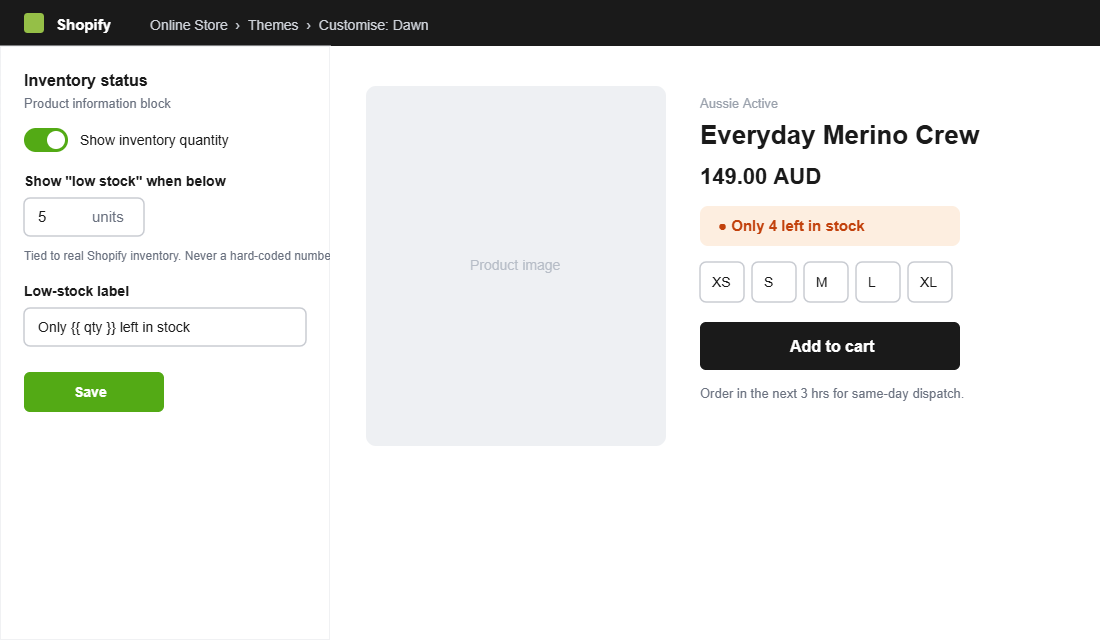
If you want more control (per-product thresholds, “selling fast” labels triggered by real sales velocity, or viewer-style counters you can actually justify), an app like Hey!Scarcity Low Stock Counter installs in minutes and reads from live inventory. Whatever you use, run one test before you trust it: drop a variant to zero and make sure the badge disappears instead of freezing on “Only 1 left”. That frozen badge is the exact pattern the ACCC went after.
Lever 2: Use Deadlines That Actually End
Countdown timers are not banned. Fake countdown timers are. A timer is perfectly legitimate when it counts down to a deadline that is real and that you honour: a sale that genuinely closes, an early-bird window that genuinely lifts the price, or a shipping cutoff for same-day dispatch. Done right, a timer on a real deadline can lift conversion by up to 22%.
The rules that keep a timer honest are simple. The timer ends and the offer ends with it, full stop. It does not reset when the page reloads or when a new visitor lands. And the price after the deadline is actually different from the price during it. If your “sale” price is your everyday price, you do not have a deadline, you have a prop.
The cleanest place to use a real deadline is a structured promotion with a hard start and end, which is exactly how a well-run flash sale is built. We map the full mechanics, including how to set a deadline customers believe without training them to wait for the next one, in the Shopify Flash Sale Playbook. Shipping cutoffs are the other underused win. “Order in the next 3 hrs 12 mins for same-day dispatch” is urgency you can defend to anyone, because it is a logistics fact, not a marketing invention.
Here is a worked example most Aussie stores can copy this week. You ship same-day if an order is placed before your 2pm courier pickup. So you show a live “Order in the next X hrs for dispatch today” message that counts down to 2pm and then resets to tomorrow’s cutoff. It is genuinely urgent, it is genuinely true, and it nudges the buyer who was going to “do it tonight” to do it now. No invented sale, no resetting clock, no claim you could not back up. That single honest deadline often outperforms a fake storewide timer, because customers can feel the difference between a real cutoff and a pressure tactic.
Lever 3: Surface Genuine Demand, Not Fake Live Counters
“14 people are viewing this right now” is one of the most abused widgets on the internet, because most of them generate a random number on page load. When a savvy shopper reloads and watches the figure jump from 14 to 3 to 22, you have just told them the entire page might be theatre. The fix is not to remove social proof. It is to make it true.
Genuine demand signals you can stand behind:
- Real recent-sales notices. “Sold 38 times this week” pulled from actual order data, not a fabricated ticker.
- Verified review counts and recency. “Reviewed 412 times, 4.7 average” carries more weight than any viewer counter and never expires.
- Honest bestseller and trending tags applied to products that genuinely rank in your top sellers, refreshed from sales data rather than set once and forgotten.
- Back-order and waitlist depth. “263 people are waiting for this restock” is one of the strongest, most truthful scarcity signals you can show.
The test is the same every time. If a customer reloaded the page or asked you to prove the number, would it hold? If yes, it lifts conversion and trust together. If no, you are building on the Emma Sleep foundation.
Lever 4: Turn Stockouts Into a Waitlist Engine
Most founders treat a sold-out product as lost revenue and a dead page. The brands that scale treat it as the most honest scarcity event they will ever get. The product is genuinely unavailable. Nobody can argue with that. Your job is to capture the demand instead of bouncing it.
Swap the greyed-out “Sold out” button for a “Notify me when back in stock” capture. You convert a dead end into an email or SMS subscriber, and you build a list of people who have told you, in the clearest possible way, that they want to buy. When the restock lands, that waitlist is the warmest send you will run all month, and the scale of it (“412 people waiting”) becomes a genuine demand signal for everyone else browsing. Around 60% of shoppers are more likely to commit when they believe supply is genuinely limited, and a real restock is that belief earned rather than manufactured.
Klaviyo, paired with a back-in-stock app, handles the whole loop: capture on the sold-out variant, an automated “it’s back” flow on restock, and a short head-start window before you reopen it to everyone. The urgency is real because the stock really was gone, and the customer really did choose to wait.
Lever 5: Time-Bound the Bonus, Not the Product
Here is the most underused move in the whole playbook. When you cannot honestly say the product is scarce or the price is ending, attach a real deadline to a bonus instead. The product stays available at its normal price, so there is no misleading claim, but the extra is genuinely time-limited.
- Free gift with purchase for orders placed before a real cutoff, while the gift stock lasts.
- Bonus loyalty points (for example, double points this weekend only) that genuinely revert on Monday.
- An expiring shipping upgrade, like free express on orders before midnight.
- Early access to a new drop for subscribers, which is real exclusivity because non-subscribers genuinely cannot buy yet.
This is the lever that keeps your urgency engine running between sales without lying. The deadline is real, the scarcity is real (the bonus genuinely runs out), and your core pricing stays clean. It is also far easier to defend, because you are adding value with a deadline rather than threatening to take value away.
One word of caution on the gift-with-purchase version: if you promise a free gift “while stocks last”, you have to actually run out, and you have to stop offering it when you do. The moment you keep advertising a bonus that is permanently available, you are back in Emma Sleep territory. Set a real cap, track it, and let the offer genuinely end. Done that way, this lever lets you create three or four legitimate urgency moments a month without ever touching your core pricing or your inventory claims.
How to Tell Whether Your Urgency Is Actually Working
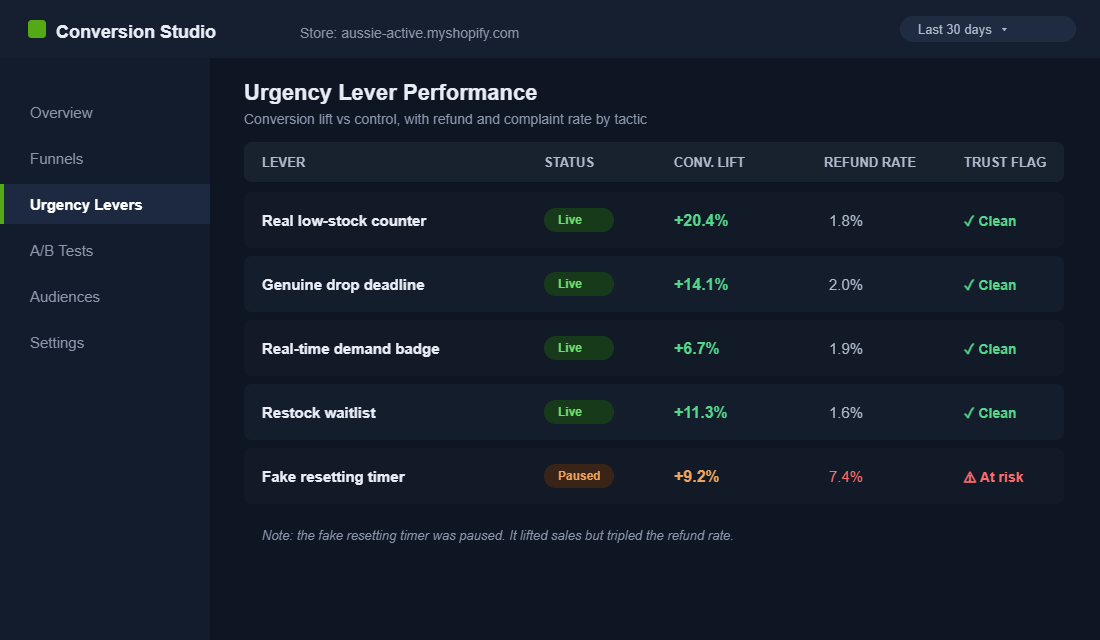
Most stores judge urgency on one number: did conversion go up? That is the trap. Fake urgency almost always lifts conversion in the short term. The cost shows up one layer down, in refund rate, chargebacks, and repeat-purchase rate. You have to watch both at once.
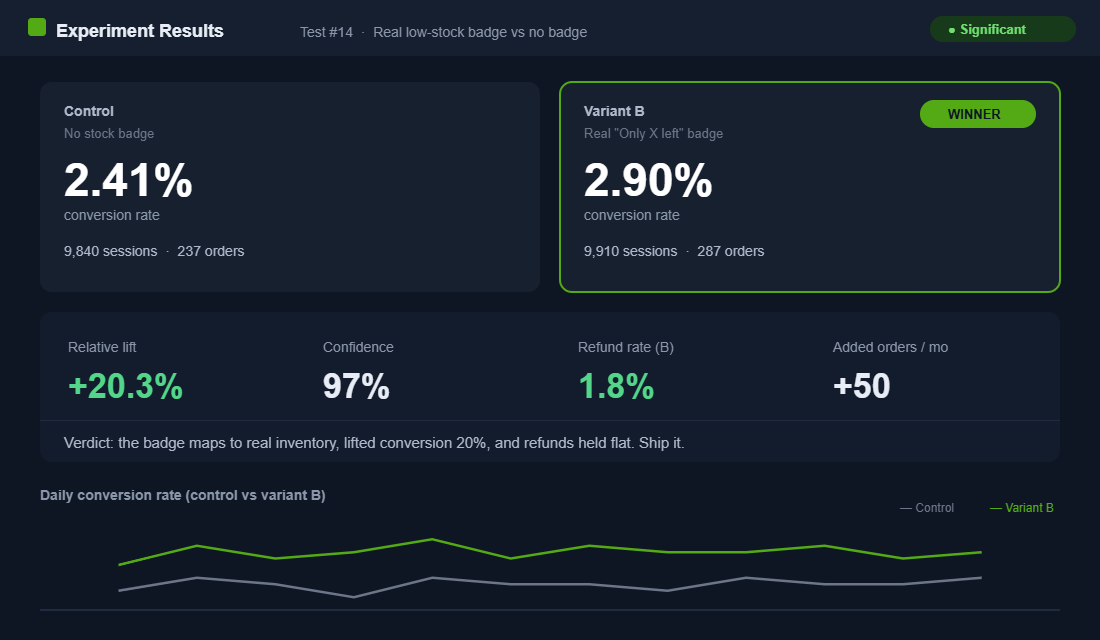
Run every urgency change as a proper test rather than a hunch. Split traffic, give it enough volume to reach significance (the example above hit 97% confidence across roughly 20,000 sessions), and judge the variant on conversion and refund rate together. A genuine lever, like the real low-stock badge above, lifts conversion while refunds hold flat. A manipulative one lifts conversion while refunds and complaints climb. If you want the structure for running these properly, the Shopify A/B Testing Playbook covers sample sizes, significance, and how long to run before you call it.
The three numbers to keep on one screen: conversion rate (is the lever pulling its weight), refund and dispute rate (is it pulling in buyers who regret it), and 90-day repeat rate (is it costing you the relationship). Urgency that grows all three is a keeper. Urgency that grows the first and quietly erodes the other two is a loan you will be repaying for a long time.
The Compound Effect: Urgency That Builds Trust Instead of Burning It
Run the five levers together and something useful happens. The low-stock counts are real, so the timer is believable. The timer is real, so the demand signals land. The demand signals are honest, so the waitlist fills. The waitlist proves real scarcity, so the next launch sells out faster. Each lever makes the next one more credible, because the customer has learned that when your store says something is true, it is true.
That is the asset fake urgency can never build. A store that has trained customers to believe its claims can use urgency for years and keep getting the lift. A store that got caught faking it once has to keep escalating, because the old tricks stop working the moment people stop believing the page. Trust is the multiplier on every single conversion tactic you will ever run.
Use this five-point checklist before any urgency element goes live on your store:
- Lever 1, Real stock: the count reads from live inventory and hides above a threshold.
- Lever 2, Real deadline: the timer ends the offer, never resets, and the post-deadline price is genuinely different.
- Lever 3, Real demand: every social-proof number would survive a page reload and a regulator’s question.
- Lever 4, Real scarcity: sold-out pages capture a waitlist instead of bouncing the buyer.
- Lever 5, Real bonus: when nothing else is scarce, the deadline sits on a genuinely expiring extra, not on a fake price.
If every element on your page passes that checklist, you can run urgency as hard as you like. It will lift conversion, it will hold up in front of the ACCC, and it will make customers trust you more, not less.
Inside eCommerce Circle, conversion architecture that earns trust is one of the core pillars we work on with every member. If you want a second opinion on the urgency running on your store right now, let’s talk.