Your subscriber did not cancel. Their card just did not go through on a Tuesday morning, they never saw the email, and eleven days later your app quietly marked them as churned.
What’s in This Article
That customer still wants your product. They still have the empty jar under the sink. Nobody made a decision to leave. A bank declined a charge, a retry schedule ran out of patience, and your monthly recurring revenue took a hit that no acquisition campaign will ever explain.
This is involuntary churn, and it is the single most under-managed number in Australian subscription commerce. Recurly’s benchmark research puts it at 20 to 40 percent of all subscription cancellations, and failed payments cost subscription businesses somewhere between 10 and 20 percent of potential revenue. Most founders I sit down with have never opened the report that shows it. They are pouring money into Meta to replace customers they already had.
The fix is dunning: the retry logic, the messages and the update-payment experience that sit between a declined card and a cancelled subscription. Done properly it recovers 60 to 70 percent of failed charges. Done on defaults it recovers about a third. Here is how to build the version that works.
Involuntary Churn Is the Quietest Line Item in Your Business
Voluntary churn is loud. Someone clicks cancel, picks a reason, maybe replies to your exit survey. You can see it, argue with it, and build a save flow around it.
Involuntary churn is silent. There is no cancellation reason because there was no cancellation intent. The subscriber’s card expired, or their account was 40 dollars short on the day you billed, or their bank flagged the recurring charge as suspicious because it hit from an unfamiliar descriptor.
Here is what makes it worth your Saturday morning. A recovered subscriber costs you nothing to reacquire. No creative, no CPM, no agency fee. You are not buying a new customer. You are keeping one who already trusts you, already has the habit, and already sits further along the lifetime value curve than anyone you could acquire this month.
Across the Aussie subscription brands I work with, involuntary churn typically sits between 25 and 45 percent of total cancellations before anyone touches it. Getting recovery from 35 percent to 65 percent on a store doing 1,200 renewals a month at 60 dollars usually shows up as an extra 20,000 to 25,000 AUD a year. That is a settings change and five emails, not a growth campaign.
Read the Decline Code Before You Touch a Single Setting
Almost every store that gets dunning wrong makes the same mistake: they treat all failed payments identically. One retry schedule, one email, same message whether the card expired in March or the customer was simply broke on the 3rd.
Decline codes tell you what to do. They split into two families, and the correct response is completely different for each.
Soft declines: retry them
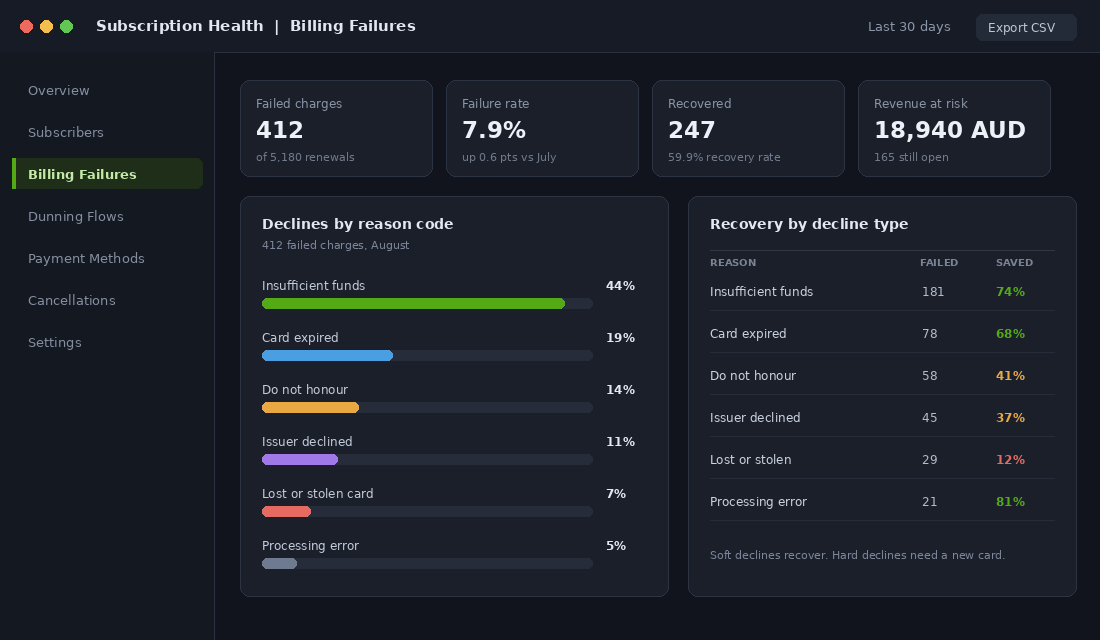
Soft declines are temporary. The card is valid, the account just could not pay right now. Insufficient funds alone accounts for around 44 percent of all payment declines, which makes it both the most common failure and the most recoverable one. Processing errors, issuer timeouts and velocity limits sit in the same family.
For a soft decline, the customer does not need to do anything. They need you to try again at a better moment. Retries do the heavy lifting here, and around 21 percent of failed payments are recovered by retries alone before the first dunning email is ever opened.
Hard declines: message them
Hard declines are structural. Card expired, card reported lost or stolen, account closed, card cancelled by the issuer. No amount of retrying will fix a card that no longer exists.
Retrying a hard decline six times does not just waste attempts. Some acquirers penalise merchants for repeated retries on codes that will never approve, and it burns your window before the subscriber’s next delivery date. For hard declines, the retry is irrelevant and the message is everything. Get them to a card update page fast.
- Insufficient funds, do not honour, issuer unavailable. Retry aggressively across 14 days, message lightly.
- Expired card, lost or stolen, invalid account. One retry at most, then go straight to a card update prompt by email and SMS.
- Suspected fraud or risk block. Do not hammer this one. A support email works better than a robot retry.
If your subscription app cannot segment messages by decline reason, that is the first upgrade to look at. Loop, Recharge, Skio and Churn Buster all expose the reason code. Native Shopify Subscriptions surfaces it in the billing attempt record.
The Retry Schedule That Recovers the Most Cards
Default retry schedules are built for the platform, not for your customer. Most Shopify subscription apps ship with three to five attempts inside a week, then cancel. Loop allows up to 15. The number of attempts matters less than when they land.
The schedule that consistently outperforms in Australian subscription stores is four attempts spread across 14 days: day 0, day 3, day 7, day 14. It works because it straddles at least one pay cycle. A huge share of Australian workers are paid weekly or fortnightly on a Wednesday or Thursday, so a charge that fails on a Monday has a genuinely different chance of approving on Thursday.
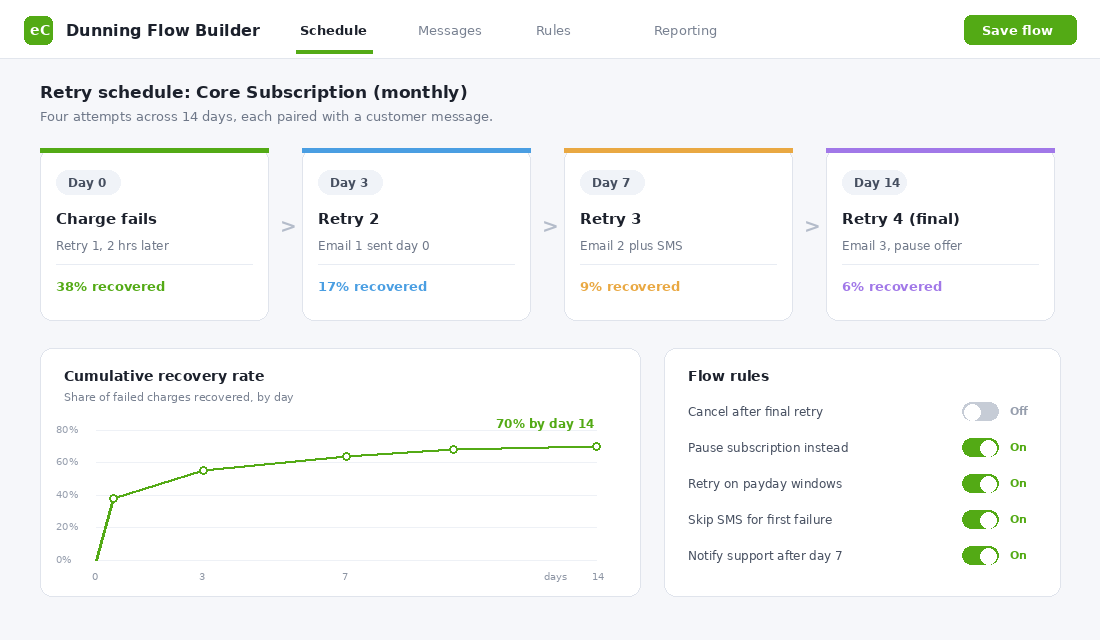
The shape of the recovery curve matters for how you set expectations internally. Roughly 38 percent of what you will ever recover comes back on the first same-day retry. By day 7 you are at about two thirds of your eventual total. The tail from day 7 to day 14 is small but it is the cheapest revenue in the business, and 42 percent of all recovery happens after day 14 in programmes that keep the subscription alive rather than cancelling it.
How to configure it, step by step
- Open your subscription app settings. In Recharge it sits under Settings, then Payments, then Dunning. In native Shopify Subscriptions it is stored in the app’s settings metaobject. In Loop it is under Retention, then Failed Payments.
- Set four retry attempts at 0 days, 3 days, 7 days and 14 days. If your app only allows day intervals, use 0, 3, 4 and 7 as the gaps.
- Turn on the immediate same-day retry if your app offers it. A two hour gap after the first failure catches a surprising number of temporary holds.
- Set the action after the final attempt to pause, not cancel. More on this below.
- Segment the schedule by decline family if your app supports it. Hard declines get one attempt and a heavier message cadence.
- Save, then run a test subscription with a card testing tool so you can watch the full sequence fire before it touches a real customer.
Prevent the Failure Before It Happens
The best dunning email is the one you never send. Three preventive layers cost almost nothing and take failures off the table entirely.
Network tokens
A network token replaces the raw card number with a token issued by Visa or Mastercard. When the underlying card is reissued because it expired or was replaced, the card network updates the token automatically. Your next billing attempt fires against valid credentials with no action from you or the customer. Network tokens also lift issuer approval rates by roughly 2 to 7 percent on their own, and card schemes offer interchange incentives for them in Australia. If you are on Shopify Payments, this is largely handled for you. If you are running an external gateway, ask them directly whether tokens are enabled on your recurring MID.
Account updater
Account updater is the complementary service. It syncs new card details from issuing banks into your vault when a stored card expires or changes. Tokens and account updater cover different failure paths, which is why most serious subscription merchants run both. Between them they remove most of the expired card bucket, which in the dashboard above was 19 percent of all failures.
The card expiry warning
This is the one almost nobody does, and it is free. Query your subscribers for cards expiring in the next 45 days and send a single message: your card ending 4417 expires next month, update it here. Sending it before the failure converts far better than sending it after, because the customer is not currently annoyed at you. Aim to run this as a monthly automation, not an ad hoc job.
Pre-dunning outperforms dunning every time. A customer who updates a card because you asked nicely in advance never enters your failure funnel at all.
The Five-Message Sequence That Does the Persuading
Retries recover roughly half of what is recoverable. The other half needs the customer to act, which means your messages have to be good. The day-of-failure email is the highest-performing touchpoint in the whole sequence at around a 13 percent recovery rate on its own, so do not waste it on a template that reads like a bank notice.
Five messages across 14 days. Email plus one SMS. Here is the cadence and the angle for each.
- Day 0, email: the helpful heads-up. Subject line: “Quick one about your next delivery.” Lead with the product, not the payment. Tell them what is at risk (their August box), then the one-tap fix. No apology, no red warning icons.
- Day 3, email: the specific reason. Now name the cause. “Your bank declined the charge because the card ending 4417 has expired.” Specificity converts because it removes the customer’s suspicion that it is a phishing email or your bug.
- Day 7, SMS: the short nudge. One sentence, one link, sender name they recognise. “Hi Sarah, your Vitals subscription payment did not go through. Update your card here to keep the 22 Aug delivery: [link]” SMS lifts total recovery meaningfully because 40 percent of these emails are never opened.
- Day 10, email: the deadline. Give a real date. “If we cannot process this by 26 August, we will pause your subscription and hold your pricing.” A concrete deadline beats a vague “soon” every time.
- Day 14, email: the graceful pause. Confirm the pause, confirm their price and their spot are held, and give one link to restart. This message is what turns a dead subscriber into a warm one you can reactivate later.
Two rules on all five. Send from a real person’s name at your domain, not billing@ or noreply@. And never use the word “dunning”, “delinquent” or “overdue” with a customer. They did not do anything wrong. Their bank did.
The Update Payment Page Most Aussie Stores Get Wrong
You can nail the retries and write beautiful emails, then lose the customer on a broken update page. This is the highest-payoff 30 minutes in the whole project.
Test your own flow right now on a phone. Click the link in your dunning email and count the taps to a successfully updated card. If the answer is more than three, you have a problem.
- No login required. Use a tokenised, expiring link that drops the customer straight onto the payment method form. Making a customer remember a password to give you money is self-sabotage.
- Apple Pay and Google Pay first. A one-tap wallet update on mobile converts far better than a 16-digit card entry. If your subscription app supports wallet payment methods on the customer portal, turn them on.
- Show what is at stake. The page should say “Update your card to keep your 22 August delivery”, with the product image. Context beats a bare form.
- Confirm immediately and retry immediately. When they save a new card, charge it right then. Do not wait for the next scheduled retry. Then send a confirmation with the new delivery date.
- Mobile keyboard type. Card number fields should trigger the numeric keypad. It sounds trivial until you watch a session recording of someone hunting for numbers on a text keyboard.
Who Gives A Crap, the Melbourne-founded subscription brand, built its whole model on people never having to think about reordering toilet paper. That only holds if the payment side is equally invisible. Vitable, the Sydney personalised vitamins subscription, has the same constraint: a daily-habit product where one failed charge breaks a routine the customer actually values. In both cases the update-card experience is doing quiet retention work every single month.
Never Cancel. Pause Instead.
This is the single setting change with the biggest payoff, and it is switched the wrong way in most stores I audit.
When the final retry fails, the default behaviour in most subscription apps is to cancel the subscription. That is a catastrophic default. Cancelling destroys the record, deletes the schedule, and often wipes any legacy pricing the customer was on. To come back they have to resubscribe from scratch, which almost nobody does.
Pausing keeps everything intact. The subscription, the cadence, the price, the product selection. Restarting is one click. And it changes the emotional register of the final email from “we have cancelled you” to “we are holding your spot”.
It also gives you a real asset for later. A paused subscriber with a five-month history is a far better target for a win-back campaign than a cold lapsed customer, because you know exactly what they bought and when they would next need it. Set a 30 day and a 60 day reactivation trigger on the paused segment and treat it as its own revenue line.
The Four Numbers on Your Dunning Scorecard
If you cannot measure it weekly, it will drift back to defaults within a quarter. Four numbers, reviewed in the same meeting as the rest of your subscription programme metrics.
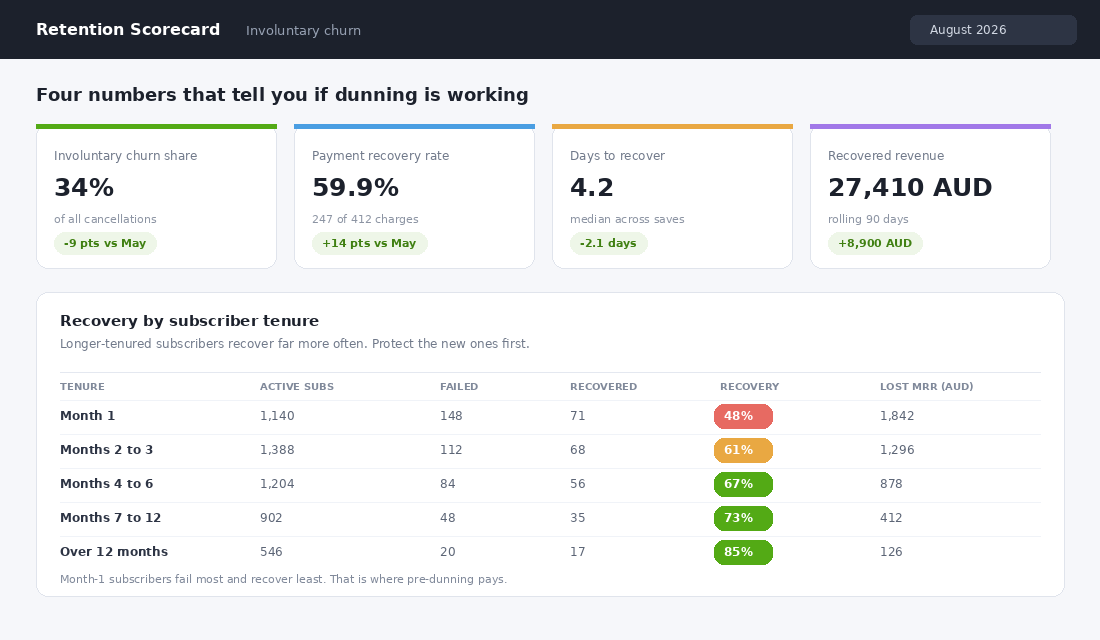
- Involuntary churn share. Failed-payment cancellations divided by total cancellations. If this is above 30 percent, dunning is your highest-ROI project this quarter. Healthy stores get it under 20 percent.
- Payment recovery rate. Recovered charges divided by failed charges. The industry median sits near 47 percent. Layered programmes with retries plus email plus SMS reach 70 to 85 percent. Anything under 40 percent means your defaults are still running.
- Median days to recover. How long a save takes. Under five days is good. If it is creeping up, your day 0 and day 3 messages are underperforming and the retries are carrying the whole load.
- Recovered revenue in AUD. The number you put in front of yourself when you are deciding whether this deserves another hour. Track it rolling 90 days so seasonality does not fool you.
Segment all four by subscriber tenure. The pattern is consistent: month-one subscribers fail most often and recover least often, because the card on file is newer, the habit is not formed, and the emotional attachment is thin. Long-tenured subscribers recover at 80 percent or better with barely any effort. That tells you exactly where to aim your prevention work.
Where This Compounds
On its own, dunning looks like plumbing. Retry settings and transactional emails are not the kind of work that feels like growth. But look at what stacks.
A subscriber saved in month two does not just pay you that month. They pay you every month after, and their lifetime value curve keeps climbing while your acquisition cost stays fixed at whatever you paid a year ago. Save 30 extra subscribers a month at 60 dollars and an 11 month average tenure and you have added close to 240,000 AUD of future revenue in a year without a single new customer.
It also cleans your data. When involuntary churn is running unmanaged, your retention curves lie to you. Cohorts look like they are leaving because the product disappoints, when a third of the drop-off is a card problem. Fix dunning and your cohort analysis finally tells you the truth about your product, which changes what you build next.
And it protects your paid acquisition. Every subscriber you save is one you do not have to buy back at current CPMs. In a market where Australian DTC brands are paying more each year for the same customer, the cheapest growth lever left is usually the one hiding in your billing settings.
When Dunning Is Not Enough: Telling a Failed Card Apart From a Customer Who Wants Out
Everything above assumes the customer wants to stay and the card is the problem. That is true for the majority of failed payments, but not all of them. Somewhere between 15 and 25% of “involuntary” churn on Aussie subscription stores is actually voluntary churn wearing a disguise: the customer let the card fail because it felt easier than cancelling. Treating those two groups the same wastes recovery messages on one and loses the other.
The three signals that separate them
- Engagement before the failure. A subscriber who opened your last four emails and logged into their account in the past 30 days is a card problem. One who has not opened anything in 60 days and skipped their last delivery is a churn risk who happened to hit a decline.
- Order history. Customers past their third renewal recover at roughly double the rate of customers on their first or second, because the habit is formed. Weight your retry effort toward them.
- Decline code, again. A hard decline (card closed, account closed) on a low-engagement subscriber is a strong “they are done” signal. Do not send five messages. Send one, and make it a good one.
Route them to different sequences
For the card-problem group, run the full five-message sequence exactly as written. For the at-risk group, swap message two for a save offer: a skip, a downgrade to a smaller pack, or a 30-day pause, offered before you ask for a new card. That is the same logic as the interception flow in the subscription save flow playbook, applied one step earlier in the journey. Stores that do this see 10 to 15% of the at-risk group accept a pause or downgrade instead of lapsing, and a paused subscriber reactivates at three to four times the rate of a cancelled one.
Feed the result back into your health score
Every failed payment should write a flag to the customer record: recovered, paused, or lost, plus the decline reason. Over a quarter that gives you a dataset most subscription brands never build, and it becomes one of the strongest inputs to a churn prediction health score. A subscriber with two soft declines in six months is not a payment problem yet, but they are 2 to 3 times more likely to cancel in the next 90 days, which is the moment to send a loyalty touch rather than wait for the third decline.
The practical rule: dunning recovers cards. It does not recover intent. Build one extra branch into the sequence for subscribers whose intent is already fading, and you will stop spending your best recovery messages on people who were never coming back, and start catching the ones who would have stayed for a pause.
Your 30-Day Dunning Implementation Checklist
Work through this in order. Week one is settings, week two is messages, week three is prevention, week four is measurement.
- Day 1. Export 90 days of failed billing attempts. Group by decline reason code. Calculate your current recovery rate.
- Day 2. Calculate involuntary churn share: failed-payment cancellations over total cancellations.
- Day 3. Change the post-final-retry action from cancel to pause. Do this before anything else.
- Day 4. Set the retry schedule to day 0, 3, 7 and 14, with an immediate same-day retry if available.
- Day 5. Split retry logic by decline family: aggressive for soft, single attempt for hard.
- Day 8. Rewrite the day 0 email. Lead with the delivery at risk, not the payment.
- Day 9. Write the day 3 email naming the specific decline reason and the last four digits.
- Day 10. Set up the day 7 SMS in Klaviyo or Postscript, triggered off the failed billing attempt event.
- Day 11. Write the day 10 deadline email and the day 14 pause confirmation.
- Day 12. Test the whole sequence on a live test subscription with a decline-triggering test card.
- Day 15. Audit the update payment page on a phone. Remove the login. Turn on Apple Pay and Google Pay.
- Day 16. Add an immediate retry when a customer saves a new card.
- Day 18. Confirm network tokenisation is active on your gateway. Ask your provider in writing.
- Day 19. Turn on account updater or confirm it is running.
- Day 22. Build the card expiry warning automation for cards expiring within 45 days.
- Day 25. Build the paused subscriber segment with 30 and 60 day reactivation triggers.
- Day 28. Build the four-metric scorecard. Put it in your weekly numbers review.
- Day 30. Compare recovery rate to your day 1 baseline. Expect a 15 to 25 point lift.
Nothing on that list requires a developer, a new platform or a budget approval. Most of it is one person with access to your subscription app settings and an afternoon of focus. The reason it does not get done is not difficulty. It is that a declined card never puts its hand up and asks to be fixed.
Inside eCommerce Circle, retention plumbing like this is one of the first things we look at with every member running a subscription, because it is usually the fastest money in the business. If you want a second opinion on yours, let’s talk.