On 10 December 2025, Australia became the first country on earth to bar under-16s from holding accounts on the major social platforms. Within weeks, roughly 4.7 million underage accounts had been removed. Meta alone has since confirmed it pulled access from 756,000 Australian accounts, split 462,000 on Instagram and 294,000 on Facebook.
What’s in This Article
Most Aussie founders read that news, checked whether their customer base skewed under 16, decided it did not, and moved on. That was the wrong read.
Here is the part that matters. Eight months later, eSafety’s own research found that more than eight in ten Australian under-16s are still using social media. Around 58 per cent report using it daily, against roughly 60 per cent before the ban. The audience did not go anywhere. What disappeared was your ability to see it, target it, measure it, or prove it existed. If your growth model depends on renting attention from a platform, the under-16 ban was the clearest warning shot you will get about how quickly that rent can be cancelled.
What the Ban Actually Does Inside Your Ad Account
The Online Safety Amendment (Social Media Minimum Age) Act covers Facebook, Instagram, Snapchat, Threads, TikTok, Twitch, X, YouTube, Kick and Reddit. Platforms that fail to take reasonable steps to keep under-16s off face penalties of up to 49.5 million dollars, which is why compliance moved so fast and so bluntly.
For advertisers, the change is not a setting you can argue with. TikTok’s own advertiser documentation now states that because people under 16 in Australia cannot use the platform, ads will not be delivered to audiences under 16 regardless of your targeting settings. Meta has applied the same logic. Your minimum age selector in the Australian market is effectively locked.
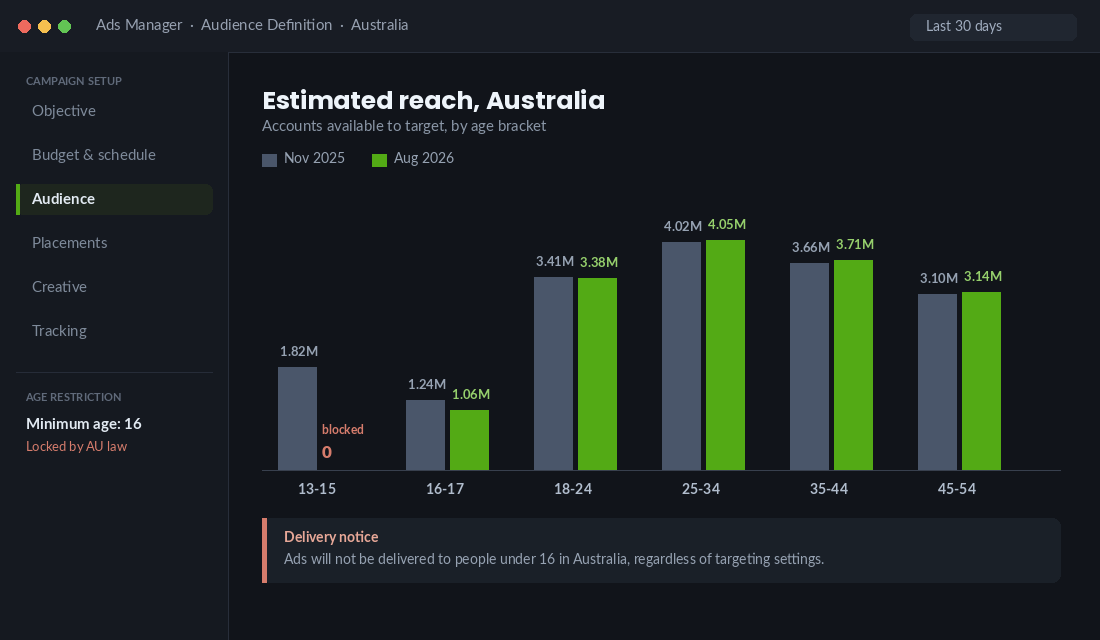
There is a second, quieter consequence that catches people out. The 16 and 17 bracket still exists, but it is now smaller and noisier, because a meaningful share of those accounts were caught in the age assurance sweep and have not been reinstated. If you sell to late teens, your addressable pool in that bracket contracted at the same time your cost per thousand impressions rose.
And do not assume you can route around it with clever interest stacking. The eSafety Commissioner has flagged that brands using contextual proxies for youth audiences, things like gaming, music and fashion interest clusters, could face scrutiny if the intent is to reach under-16s indirectly. The regulator is looking at the targeting system, not just the creative.
The Finding Nobody Planned For: The Teens Never Left
This is the uncomfortable bit, and it changes how you should think about the whole thing.
Age checks have not held. Teens are using VPNs, borrowed birthdates, older siblings’ logins, and platforms outside the covered list. Some have migrated to apps like Lemon8 or into gaming environments that the Act does not touch. The research found most 10 to 15 year olds were using social media just as frequently in March as they were before 10 December.
So you now have a market where a large cohort of consumers is still consuming your category’s content, still influencing household purchases, and still forming brand preference, while being completely invisible to your acquisition stack. They see the organic post. They do not appear in the audience estimate. They convert later, on a parent’s card, through a channel you cannot attribute.
That gap between real influence and measurable reach is the single most important strategic fact of the post-ban Australian market. Brands that keep optimising to what the platform can measure will systematically under-invest in the demand that is actually forming.
Three Second-Order Effects That Hit Stores With Zero Teen Customers
If you sell homewares to 38 year olds, none of the above appears to be your problem. It is. Three flow-on effects reach almost every Australian Shopify store.
- The creator pool changed shape. Australian influencer marketing spend hit roughly 830 million dollars over the past twelve months and is tracking to pass one billion during 2026, but the composition shifted. Creators whose audiences skewed young lost measurable reach overnight, which pushed supply and pricing around in every category, not just youth fashion.
- Age assurance became normal. Once a market accepts identity checks at the platform layer, the same expectation drifts toward retailers. Age-restricted categories in Australia, from alcohol to knives to certain supplements, are already fielding harder questions about what a reasonable check looks like at checkout.
- Platform dependency got repriced. A regulator removed a chunk of your addressable market with a single Act, on a defined date, with no appeal for advertisers. Every board conversation about channel concentration in Australia now has a precedent to point at.
That third point deserves more weight than it usually gets. Channel concentration risk has always been an abstract line in a pitch deck. It is not abstract any more. A brand doing 60 per cent of its new customer acquisition through Meta in Australia woke up on 11 December 2025 with a permanently smaller pool and no recourse. The lesson is not that social is finished. It is that any single channel can be legislated smaller between one quarter and the next, and your only protection is a customer relationship that exists outside it.
Set against the broader picture, this is happening while the market itself is strong. Australians spent a record 82.6 billion dollars online in 2025, up 14 per cent year on year, across 9.8 million households. Online is now 24 per cent of all retail spend. Demand is not the problem. Access to it is.
The 90-Day Owned Audience Sprint
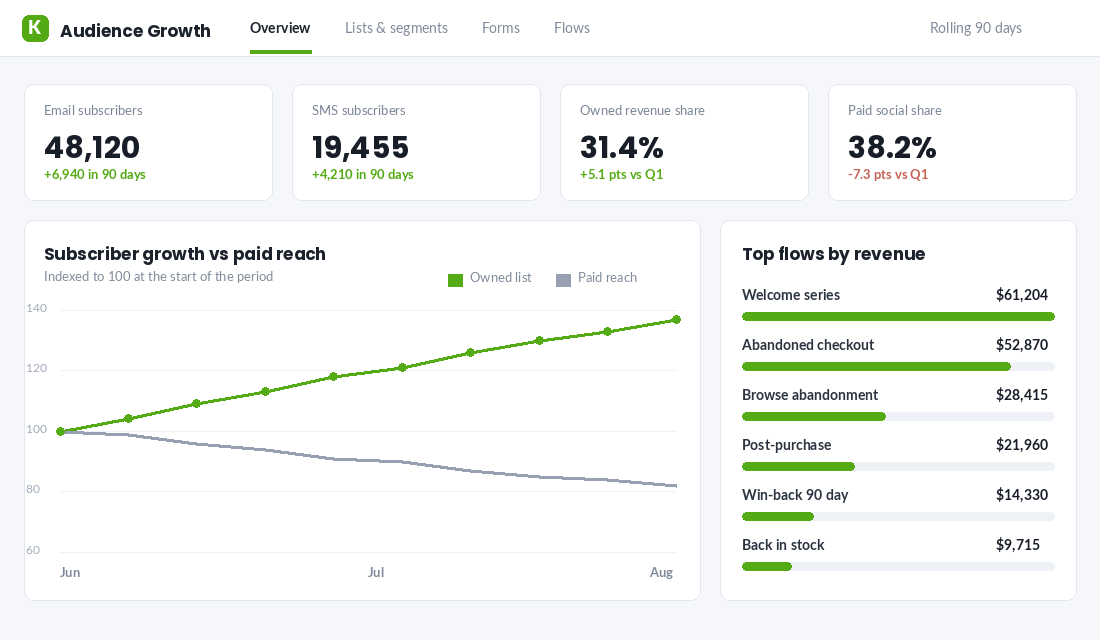
The only durable answer to a channel you do not control is a list you do. Most Aussie stores we look at are sitting well under where they should be. Klaviyo’s data across more than 183,000 brands puts the average email revenue share at 27 per cent, while the top DTC programmes run 30 to 40 per cent of total revenue from email and SMS combined. If you are under 25 per cent, your retention programme is doing less than it should.
Here is the sprint we run with members. Ninety days, three phases, one number to move.
- Days 1 to 30, fix capture. Audit every entry point. Homepage form, exit intent, post-purchase, in-pack card, event and pop-up capture. Add a date of birth field to your main sign-up form and make it required. In Klaviyo this is Forms, then your active form, then add a Date property named Birthdate. It gives you an age-appropriate suppression segment and a birthday flow in one move.
- Days 31 to 60, build the suppression and consent layer. Create a segment where Birthdate is more than 16 years ago, and a second where Birthdate is unknown. Send commercial messaging to the first. Send a single profile-completion prompt to the second. Under the Spam Act you need consent, identification and a working unsubscribe on every commercial electronic message, so keep the consent timestamp on the profile.
- Days 61 to 90, move revenue into flows. Klaviyo benchmarks show flows are only about 5.3 per cent of sends but drive close to 41 per cent of email revenue. Get the six that matter live and tested: welcome, abandoned checkout, browse abandonment, post-purchase, win-back at 90 days, and back in stock.
Australia gives you an unfair advantage here worth using. Australian email campaigns run an average open rate of 47.69 per cent and a click rate of 2.82 per cent, both the highest in the world. An email list in this market works harder than the same list almost anywhere else. If you want the deeper build, we broke the mechanics down in our voice of customer playbook.
Age Assurance at Your Own Front Door: An Eight-Point Checklist
The platforms have done their part badly. That does not transfer the risk away from you. Run this checklist against your own store this week.
- Ad account minimum ages. Set the minimum age explicitly to 16 in every Australian ad set in Meta and TikTok rather than relying on the platform default. It documents intent.
- Interest stacks. Review saved audiences for youth proxies you built before December 2025 and retire the ones that only make sense if you were reaching under-16s.
- Lookalike sources. If a seed list contains profiles with no age data, your lookalike inherits that ambiguity. Seed from purchasers with verified age data only.
- Sign-up forms. Date of birth captured, required, and stored as a date property rather than free text.
- Suppression segment. A live segment excluding anyone under 16 from commercial sends, checked monthly.
- Creator briefs. Written audience-composition requirement, with a screenshot of the creator’s audience age breakdown attached to every agreement.
- Competitions and giveaways. Terms updated with a minimum entry age and a parental consent clause where relevant.
- Privacy notice. Your collection statement should say what you do with date of birth and why. Our privacy compliance playbook covers the wider obligations coming down the line.
Eight items. Most stores can clear the whole list in a morning. Almost none have.
Reallocating the Creator Budget Without Losing the Channel
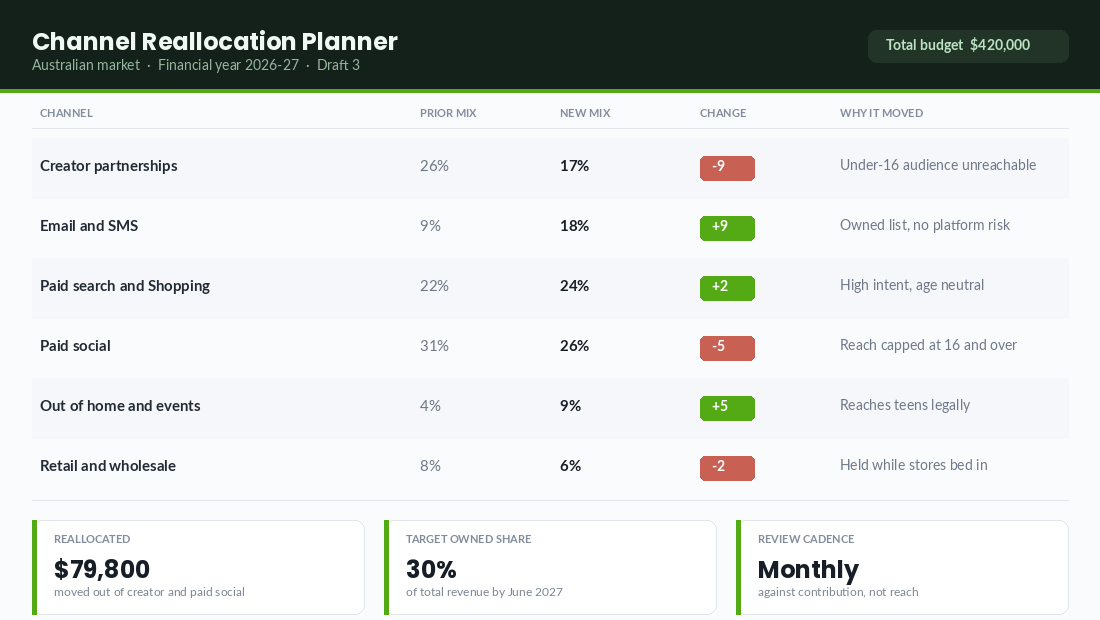
The instinct after December was to cut creator spend. That was an overcorrection. Influencer spend in Australia kept growing. What changed is which creators are worth paying and what you should pay them for.
Three changes to your creator process, and they take about an hour each to implement.
- Demand the audience age breakdown before you negotiate, not after. Any creator worth paying can export it from their professional dashboard in under a minute. If a creator’s Australian audience was heavily 13 to 15 before December, their engagement rate now flatters a smaller and less commercially useful base.
- Pay for usage rights, not just posts. Whitelisted creative running through your own ad account against a 16 and over audience is worth more than an organic post to a mixed-age following you cannot verify. It also survives the next regulatory change, because the asset is yours.
- Split the brief in two. One deliverable for reach, one for conversion. Judge them on different numbers. Reach content earns its keep on branded search lift and direct traffic. Conversion content earns its keep on contribution per dollar.
Our six-phase creator system covers the vetting and contracting side in more detail, and every step of it still applies. The vetting criteria just got sharper.
Stop Reporting Reach, Start Reporting Contribution
If a large cohort of your future customers is active but unmeasurable, then reach has stopped being a useful number. It was always a proxy. Now it is a proxy with a known, government-mandated hole in it, and reporting on it will quietly push your budget toward whatever the platform can still count.
Swap it for three measures that survive the gap. None of them require a new tool.
- Branded search volume, tracked weekly. Pull it from Google Search Console under Performance, filter queries containing your brand name, set the country to Australia, and chart it against your organic and out of home activity. When invisible demand forms, this is where it surfaces first. A creator campaign that produced no measurable in-platform conversions but lifted branded search 18 per cent did work you should pay for again.
- New customer contribution, not new customer count. Take revenue from first-time orders, subtract cost of goods, shipping, payment fees and the acquisition spend that produced them. Track the dollar figure monthly. Contribution is the only number that tells you whether growth is worth having, and it is immune to attribution windows changing underneath you.
- Owned revenue share. Email and SMS revenue divided by total revenue, reported every month next to your paid social share. Two lines on one chart. When the owned line rises while the paid line falls and total revenue holds, your dependency is genuinely reducing rather than just moving around.
Add one qualitative input to keep yourself honest. Put a single post-purchase question on your thank you page asking how the customer first heard about you, in a free text field. It takes ten minutes to set up and it will show you channels your analytics cannot see, including the ones reaching people who are not supposed to be on a platform at all.
Run the three measures for one quarter before you make any large reallocation decision. Most founders find at least one channel they were about to cut is carrying more weight than the dashboard suggested, and at least one they were about to scale is being credited for demand it did not create.
Offline Is Not Nostalgia, It Is Uncontested Attention
Watch what the brands with the most to lose actually did. Billboards and bus wraps carrying the White Fox Boutique logo started appearing on Australian streets in late December 2025, within weeks of the ban taking effect. A label built almost entirely on social reach with Gen Z shoppers moved into out of home, events and in-person activations, because those channels reach a 15 year old lawfully and without a platform in the middle.
The same logic is showing up in physical retail. Princess Polly, the Australian label now inside a.k.a. Brands, has been steadily opening bricks and mortar stores in the United States. Owned physical space does something no ad account can promise. It puts you in front of a customer whose age you can observe, whose consent you can collect properly, and whose visit no regulator can switch off.
The numbers back the direction. Australians spent 18.9 billion dollars on online marketplaces last year, up 13 per cent, which tells you discovery is spreading well beyond the social feed. Meanwhile 9.8 million households now shop online and 41 per cent of them do it at least fortnightly. Frequency is rising while any single channel’s grip is loosening. That is exactly the environment in which a physical touchpoint stops being a vanity project and starts being a cheap, defensible acquisition channel.
You do not need a store lease to act on this. A market stall at a relevant event, a pop-up inside a complementary retailer, a sponsored school sport carnival, or a single well-placed piece of out of home near your highest-density postcode will all do the job at a fraction of the cost. The requirement is simply that you capture something on the day. A QR code to a sign-up form with a real incentive turns an impression into a profile you own.
Why These Moves Compound
Taken one at a time, none of this is dramatic. A date of birth field. A suppression segment. A tighter creator brief. A QR code at a pop-up. Together they change the structure of your business.
The list you build in the first 30 days makes the flows in the last 30 days worth building. The flows push owned revenue share toward that 30 to 40 per cent band, which reduces how much you need paid social to do. Reducing that dependency frees budget to move into out of home and events, which feed the list again. Meanwhile the age data you started collecting makes your suppression clean, your lookalikes sharper and your compliance position defensible.
There is a demand-side reason to move now too. Average basket sizes across Australia are running about 10 dollars lower than they were in 2020, and 32 per cent of Australians already use AI for shopping advice and recommendations. Discovery is fragmenting at the same time value per order is compressing. The brands that win the next few years will be the ones with a direct line to the customer that does not need a platform’s permission.
The under-16 ban did not really take an audience away from Australian brands. It took away the illusion that the audience was ever yours.
Inside eCommerce Circle, building an audience you actually own is one of the core pillars we work on with every member. If you want a second opinion on yours, let’s talk.