You are three weeks out from your next big sale. The creative is booked, the email flow is built, and someone has already dropped a compare-at price on 200 variants so the site looks busy on day one. Nobody in the business has asked the only question that matters: can you prove those products actually sold at the higher price?
What’s in This Article
That question is no longer academic. In 2026 the Federal Court ordered Emma Sleep to pay a combined 15 million dollars in penalties after the company admitted its strikethrough pricing was misleading. The ACCC found that of 74 discounted products, 58 had never sold at the higher reference price at all, and the remaining 16 rarely did. The claims went out to more than 4 million email subscribers and a website that recorded over 4.9 million visits.
Most Aussie Shopify founders read that and think it is a big-brand problem. It is not. In June 2026 a small online retailer, HSK United, paid 79,200 dollars over four infringement notices for the same behaviour, and the ACCC pointed out that the products in question had not sold at the strikethrough price since at least 1 January 2025. That is a store your size. The rules do not scale with revenue, and the ACCC has now run sweeps of Black Friday and Boxing Day advertising two years running.
Here is the good news. Sale price compliance is not a legal project. It is an operations project, and five checks cover almost all of the exposure. Run them before your next promotion and you will also discover something more useful: honest discounting is usually more profitable than the theatre you have been running.
What the ACCC Actually Tests When It Looks at Your Sale
Two-price advertising is legal in Australia. You are allowed to show a higher price with a line through it next to a lower price. What you are not allowed to do is imply a saving that never existed.
The ACCC guidance on price displays comes down to two practical tests, and both are about evidence rather than intent:
- The reasonable period test. The product must have been offered at the higher price for a reasonable period immediately before the promotion started. Not last year. Not for a weekend eighteen months ago.
- The reasonable quantity test. Customers must have actually bought it at that price in meaningful volume. A single order at full price does not make 149 dollars your real price.
Recommended retail price works the same way. Quoting an RRP the product has never sold at, or has not sold at recently, is treated as a comparison claim you have to substantiate. If the RRP came from a supplier deck and nothing else, you do not have substantiation. You have a number.
The penalty context has also changed. On 28 March 2026 the maximum corporate penalty for a breach of the Australian Consumer Law doubled from 50 million to 100 million dollars per contravention, or three times the benefit obtained, or 30 per cent of adjusted turnover during the breach period, whichever is greater. Nobody is suggesting a 2 million dollar Shopify brand gets a nine figure fine. But the infringement notice regime that caught HSK United sits in the same framework, and those notices land fast.
Misleading pricing is also on the record as an enforcement priority. When the ACCC Chair announced the 2026-27 compliance and enforcement priorities in February 2026, consumer and fair trading concerns in the retail sector, with a focus on misleading pricing practices, made the list again.
The Five Claims That Get Aussie Shopify Stores in Trouble
Before the checks, know what you are looking for. When the ACCC swept Black Friday advertising, roughly half of the 50 retailers reviewed made claims the regulator described as concerning. Three of them, Michael Hill, My House and Hairhouse Online, each paid 19,800 dollars in penalties. The patterns repeat across almost every store we audit.
- The phantom reference price. A compare-at price set to make the maths look good, on a product that has only ever sold at the sale price.
- The pre-sale price lift. Raising prices two weeks before a promotion so the discount looks deeper. This is the one that turns a sloppy sale into deliberate conduct.
- The site-wide claim with a wall of exclusions. A banner that says everything is 40 per cent off while a third of the catalogue is excluded in fine print, or not disclosed at all.
- The hollow “up to” claim. “Up to 70 per cent off” where exactly four end-of-line variants hit 70 per cent and the rest sit at 15.
- Urgency that never ends. A countdown timer that resets, or a “final 24 hours” banner that has been live since Easter.
Emma Sleep was pinged for several of these at once, including countdown timers presented alongside discounts that were not real. The pattern the regulator cares about is the combination: a reference price you cannot back up, wrapped in pressure that pushes people to buy before they check.
Check 1: Audit Every Compare-at Price in Your Catalogue
Start with the field itself. In Shopify, the compare-at price is what drives the strikethrough on your product page, your collection cards, your Shopping feed and most third-party apps. It is also the field nobody owns. A staff member sets it during a campaign, the campaign ends, and it never gets cleared.
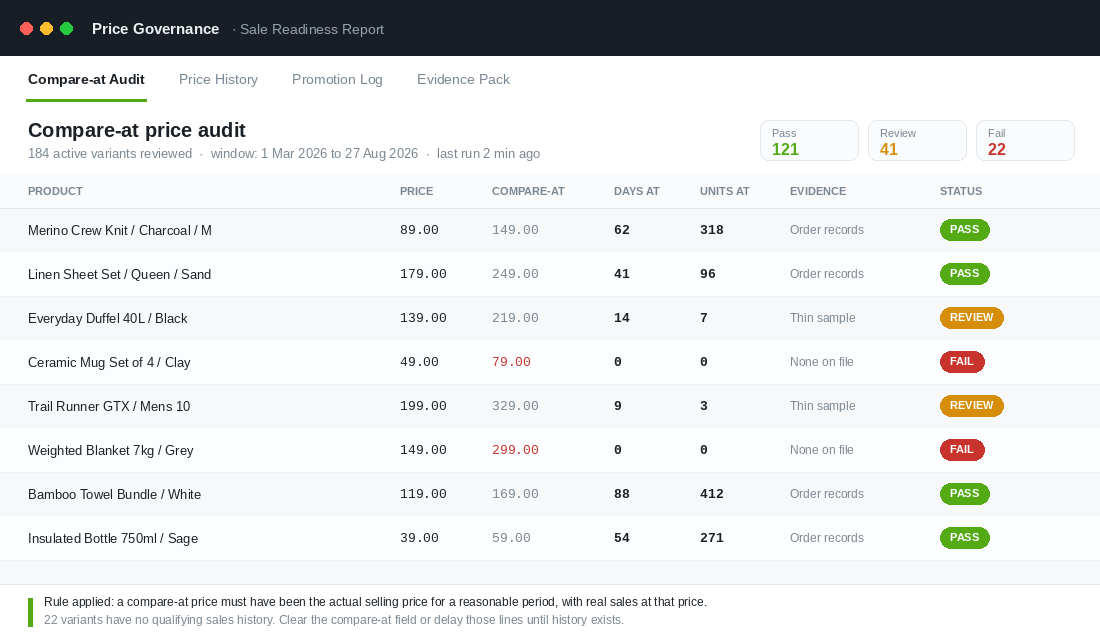
Here is the audit, and you can run it in an afternoon with tools you already pay for.
- Export your catalogue. In Shopify admin go to Products, select all, then Export, and choose “All products” as a CSV for Excel or Google Sheets. The column you care about is
Variant Compare At Price. - Filter to variants where compare-at is populated. That is your exposure list. On most stores it is far bigger than the founder expects, because it includes every line left over from previous campaigns.
- Pull sales at the reference price. Run Shopify Analytics, Reports, then “Sales by product variant SKU” over the last 180 days. Add “Discounts” and “Net sales” so you can see what people actually paid, not what the tag said.
- Match the two. For each variant with a compare-at price, answer two questions: how many days in the last 180 was it genuinely offered at that price, and how many units sold at it. Write the answers into two new columns.
- Sort by units sold at the reference price, ascending. The zeroes at the top are your problem. Those are compare-at prices with nothing behind them.
- Clear the field, do not lower the sale price. For anything with no qualifying history, empty the compare-at value. The product still sells at 89 dollars. It just stops claiming a saving it cannot prove.
If you want this to stay clean rather than becoming an annual clean-up, bulk price tools such as Bulk Price Editor Pro let you schedule a price change and schedule the rollback at the same time, so the compare-at value is removed automatically when the campaign ends. Set the rollback when you set the sale, not after.
One warning from experience: do not fix a failing variant by quietly raising the everyday price for a fortnight so the compare-at becomes true. That is the pre-sale lift, and it is worse than the original problem.
Check 2: Build a Price Trail You Can Produce on Demand
The uncomfortable truth about Shopify is that it does not keep a price history for you. Change a price today and yesterday’s price is gone. If a regulator, a marketplace, or a customer asks what a product sold for in April, you are reconstructing it from order exports and memory.
The ACCC is explicit that businesses should keep complete records substantiating two-price comparison claims, covering current and historical prices, the periods those prices held, and the quantities sold at each. That is a record you have to create deliberately.
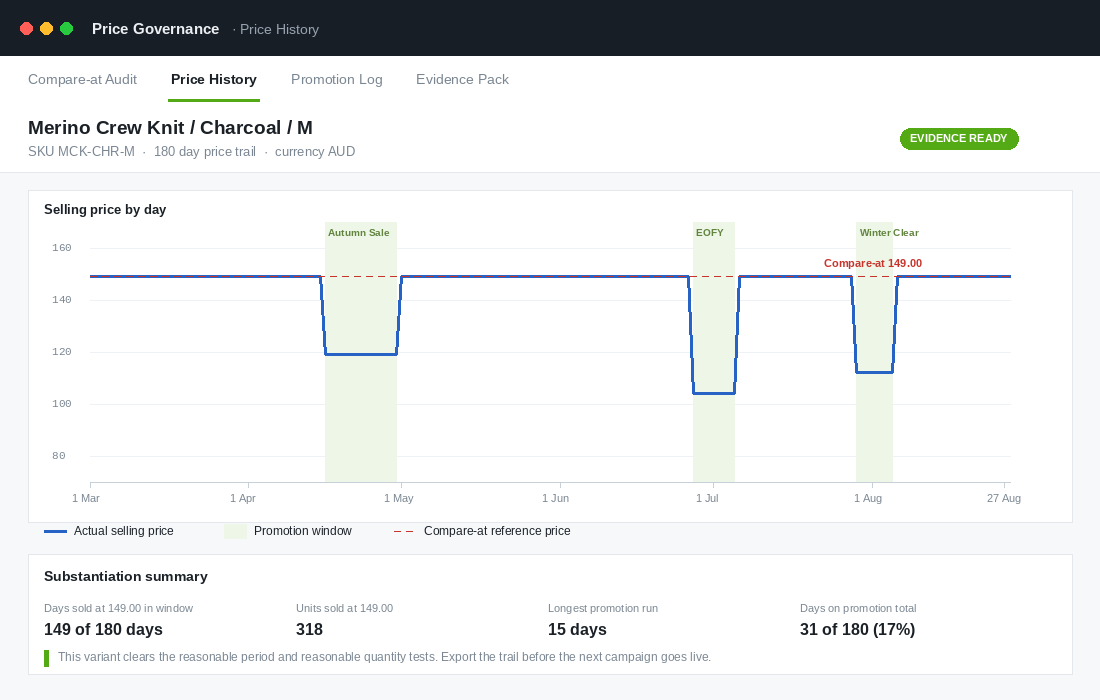
The lightweight version costs you fifteen minutes a month:
- Snapshot on the first of every month. Export the product CSV, rename it with the date, and drop it in a folder called Price Trail. Twelve files a year gives you a complete twelve month history.
- Snapshot before and after every promotion. One export the day before the sale goes live, one the day after it ends. This is the pair that proves the price returned to its reference level.
- Log the campaign, not just the price. A simple sheet with campaign name, start date, end date, variants in scope, exclusions, and the headline claim you ran. Ninety seconds per campaign.
- Keep the order data that backs it up. A sales-by-variant export for each promotion window shows units sold at both prices.
- Retain it for seven years. That aligns with the record keeping period you are already holding financial records for, so it costs nothing extra.
The reason this check earns its keep has nothing to do with regulators. Once you can see a product’s real price line over 180 days, you can see how often you have been discounting it, and that is usually the moment a founder realises the promotional calendar has quietly become the pricing strategy. If that sounds familiar, the discount dependency audit is the natural next step.
Check 3: Make Your Scope Claims Match Your Actual Catalogue
This is where most Aussie stores get caught, and it is almost always sloppiness rather than dishonesty. The marketing team writes “SITE WIDE 40% OFF” because it is punchy. Operations excludes bundles, gift cards, the new season drop and three supplier lines with tight terms. Nobody reconciles the two.
The ACCC has said directly that it targets misleading site-wide and store-wide claims, along with “up to a percentage off” claims where the top discount applies to very few products. Both are scope claims, and both are testable with a spreadsheet before you publish.
- Count the denominator. How many active variants does the store sell? Not products, variants, because that is what a shopper encounters.
- Count the numerator. How many of those are genuinely in the promotion at the advertised rate?
- Apply the plain English test. If a reasonable shopper landed on a random product page expecting the headline offer, would they get it? If the answer is no for a meaningful slice of the catalogue, the word “site-wide” is wrong.
- Rewrite rather than water down. “40% off full price styles” or “40% off all winter knitwear” is specific, accurate, and converts about as well because it tells people what to shop.
- For “up to” claims, publish the spread. If four items hit 70 per cent and most sit at 20, say “20% to 70% off”. You lose a little headline drama and gain a claim you can defend.
- Put exclusions on the same screen as the claim. Not on a terms page three clicks away. Directly under the banner, in a readable size, on mobile as well as desktop.
Do this once and it becomes a template. Every campaign after that is a five minute reconciliation rather than an argument between marketing and ops the night before launch.
Check 4: Urgency That Is Real, and Timers That Actually End
Scarcity works. That is exactly why it gets abused, and why it is now squarely in scope. Part of what the Federal Court dealt with in the Emma Sleep matter was countdown timers running alongside discount claims that did not hold up.
The rule is simple. If you display a deadline, the deadline has to be real, and the price has to change when it passes.
- Audit every timer app on the store. Check whether it is configured as a fixed end date or an evergreen timer that restarts per visitor. Evergreen timers on a store-wide sale are indefensible.
- Set the price rollback before the campaign starts. Schedule it in Shopify or your bulk price tool so the sale ends whether or not anyone is at a desk at midnight.
- Check stock claims against real inventory. “Only 3 left” should read from the inventory count, not from a random number generator inside an urgency app. Several popular apps default to the latter.
- Kill rolling extensions. Extending a sale once, and saying so, is fine. A sale that has been ending for six weeks tells your customers to never pay full price again.
- Match the end time across channels. If the email says midnight Sunday and the banner says Monday 9am, one of them is a false statement.
There is a commercial argument here as well as a legal one. Urgency only works when your audience believes it. Every fake deadline you run teaches a slice of your list to wait, which is a slow tax on every campaign you run afterwards. If you are planning the busiest stretch of the year, the November double peak is where credible deadlines earn or cost you the most.
Check 5: The Pre-Launch Sign-Off That Takes Twenty Minutes
The four checks above are worthless if they only happen when someone remembers. Turn them into a gate. No promotion goes live until one named person has ticked eight boxes, and the campaign is blocked until every box clears.
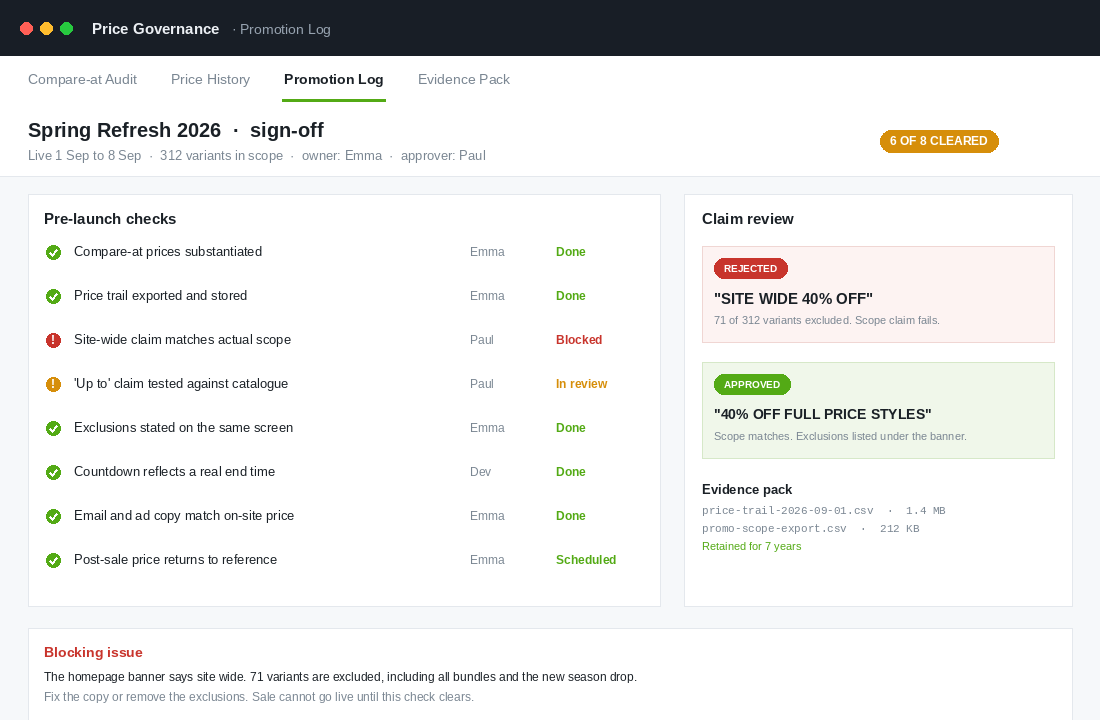
Copy this into your project tool and attach it to every campaign brief:
- Every compare-at price in scope has qualifying sales history. Days offered and units sold are both recorded.
- The price trail is exported and stored for the 180 days before launch.
- The scope claim has been reconciled against the variant count, with the numerator and denominator written down.
- Any “up to” claim states the full range rather than the best case only.
- Exclusions appear on the same screen as the claim, verified on mobile.
- Every countdown reflects a genuine end time, with the rollback scheduled.
- Email, SMS, ads and on-site copy state the same offer, the same scope and the same deadline.
- The post-sale price returns to the reference price, scheduled and dated.
Assign an owner to each line and an approver for the whole gate. In most stores under 10 million dollars a year that is your ops lead running the checks and the founder approving. It takes about twenty minutes per campaign once the price trail habit is in place.
Save the completed checklist with the campaign. If a question ever arrives, you are producing a dated file rather than an explanation.
How the Five Checks Compound
Each check on its own is housekeeping. Run them together for two quarters and they change how the business prices.
The compare-at audit forces you to name a real reference price for every line. The price trail shows you how often you actually hold it. The scope reconciliation stops you from promising the whole catalogue when you meant one collection. The urgency check makes your deadlines mean something again. The sign-off gate keeps all four alive when the business gets busy, which is exactly when they usually collapse.
What falls out the other side is a pricing architecture rather than a promotional habit. You know which products can carry a genuine markdown and which ones have been on permanent sale for a year. You stop discounting lines that never needed it, and you find the ones where a real, well-evidenced sale drives volume without eroding the brand.
The compliance benefit is the smaller half of the return. The bigger half is that customers can finally tell the difference between your sale and your everyday price, which is the whole point of running a sale.
There is a related piece of work worth pairing with this. Your returns and refunds policy sits under the same law and gets swept in the same reviews, and the Shopify consumer law playbook covers that side properly.
Where to Start This Week
Do not try to build the whole system before your next campaign. Do this instead.
- Today. Export your product CSV and count how many variants carry a compare-at price. That number alone will tell you how big the job is.
- This week. Match those variants against 180 days of sales at the reference price, and clear the compare-at field on anything with zero qualifying sales.
- Before the next campaign. Take one snapshot export, reconcile the scope claim, and run the eight point sign-off.
- Then monthly. One export on the first of the month. Fifteen minutes, filed and forgotten until you need it.
Spring campaigns are being built right now, Click Frenzy and Black Friday are close behind, and the ACCC has run a sweep of both peaks two years in a row. The stores that get asked a question in December will be the ones that either have a folder of dated exports, or a very long night ahead of them.
Inside eCommerce Circle, pricing integrity is one of the core pillars we work on with every member, because it sits right where Protection and Profit meet. If you want a second opinion on how your discounts would hold up, let’s talk.
Sources
- ACCC, Bedding supplier Emma Sleep to pay a total of 15m in penalties for misleading statements about sale prices
- ACCC, Online retailer HSK United pays penalties for allegedly misleading pricing and returns policy
- ACCC, ACCC investigating retailers making concerning Black Friday claims
- ACCC, Price displays
- ACCC, Fines and penalties
Related reading: ecommerce insurance for Australian online stores.