Every November, the same thing happens inside Aussie Shopify stores. Orders spike over the Black Friday weekend, the founder celebrates, and by March nobody can explain why most of those “new customers” never came back.
What’s in This Article
Here’s the uncomfortable bit. You didn’t attract one kind of shopper that weekend. You attracted five. Some of them were fans who had been waiting to stock up. Some were people who had wanted your product for months and just needed a nudge. And some were professional bargain hunters who will never pay full price for anything, from anyone, ever.
Most brands treat all five the same. One sitewide code, one depth, one post-purchase flow, one “welcome to the family” email. The brands that come out of peak season with a stronger customer base do something different: they work out which deal hunters they actually want, design the offer to attract those people, and build a plan to turn them into full-price buyers before the January slump.
This playbook gives you five deal hunter types, how to spot each in your data, and a five-step plan to win the right ones this BFCM (Black Friday is 27 November 2026, Cyber Monday 30 November).
Why Deal Hunters Are the Biggest Prospect Segment in Australia (and the Most Misunderstood)
If you think deal hunting is a niche behaviour, the numbers say otherwise. Monash Business School’s Australian Consumer and Retail Studies team surveyed 1,014 Australian shoppers in October 2025 and found that 89% wait for a sale or promotion in at least one product category before buying. Only 11% never wait. Almost two-thirds (64%) said price discounts are highly important to their purchase decisions.
Black Friday is where that behaviour peaks. The Australian Retailers Association and Roy Morgan forecast a record $6.8 billion in spending over the 2025 Black Friday to Cyber Monday weekend, with around 6 million Australians taking part. Finder’s October 2025 survey found 40% of Aussies planned to shop Black Friday, up from 29% the year before, spending an average of $531 each.
So you can’t ignore deal hunters. But the averages hide something: the ARA data shows 66% of Black Friday shoppers plan to buy for themselves as well as for others, and men are almost four times more likely to shop for themselves (27%) than for gifts (7%). Those are completely different buying jobs, with completely different odds of a second order.
That’s the core mistake: founders judge “BFCM customers” as one cohort. Your job this year is to un-blend it, because which deal hunters you attract is a Prospects decision, not just a pricing decision.
The Research Every Founder Should Know Before Setting a BFCM Discount
There’s one study I wish every Shopify founder read before they picked a Black Friday percentage. In 2006, Michael Lewis published research in the Journal of Marketing Research using customer-level data from a newspaper and an online grocer. He found that the depth of the discount used to acquire a customer was negatively related to their repeat-buying rate and long-term value. The headline finding: a 35% acquisition discount produced customers worth about half the long-term value of customers acquired at full price.
Why? A deep discount brings in people who discover they’d happily pay full price, and people who only value you at the sale price. The deeper you go, the more of the second group you pull in.
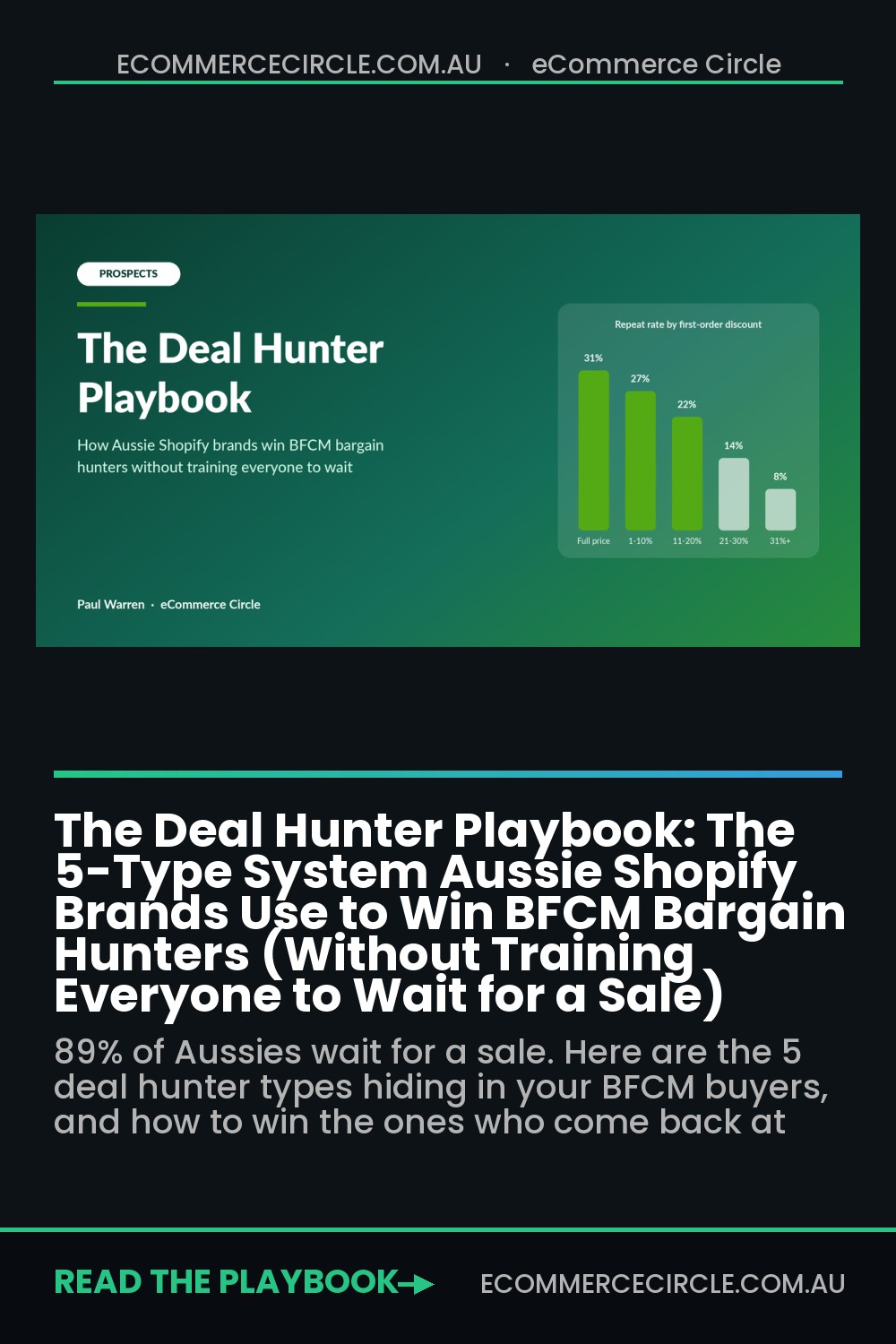
Retention platform Optimove found a similar pattern in its own data: new customers were most likely to repurchase when their first discount sat in the 5-20% range, and there was a negligible difference in repeat rate and lifetime value between 10% and 20% off. That second point matters. If 20% off doesn’t build better customers than 10% off, the extra 10% is pure margin you handed over.
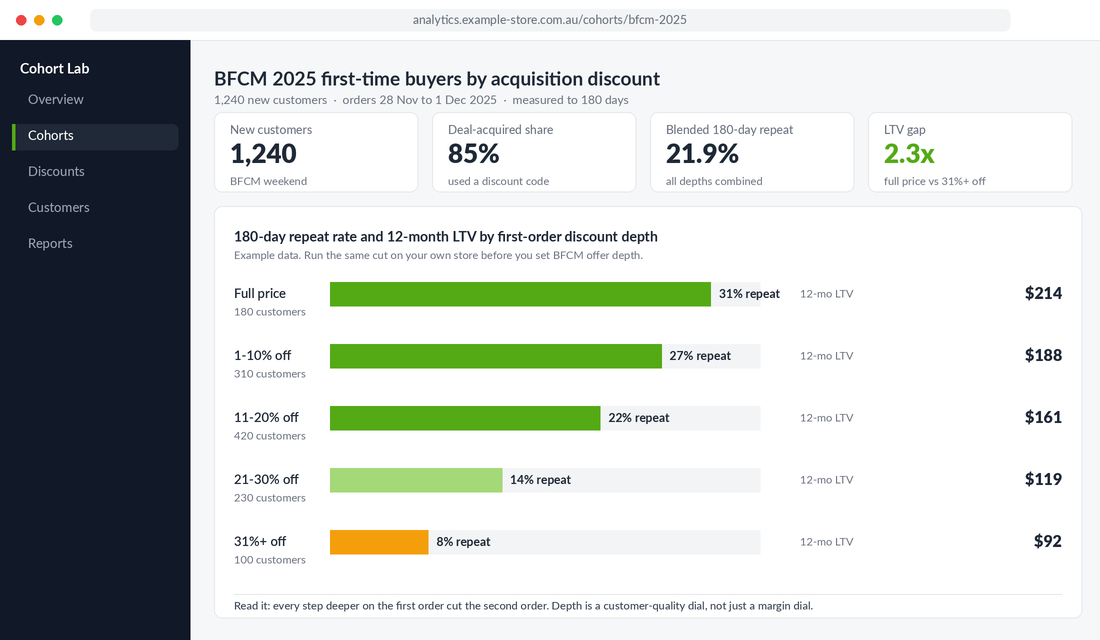
The chart above is the cut I want you to run on your own store this week. Pull every first-time customer from last year’s BFCM weekend, group them by the discount on their first order, and compare their 180-day repeat rate and 12-month revenue. If your store follows the pattern in the research, each step deeper on the first order will lower the odds of a second one.
No fancy software needed. Export last year’s orders from 28 November to 1 December, keep first-time customers, add a column for discount as a percentage of subtotal, then match against your current customer export to see who ordered again. Analytics apps like Peel and Lifetimely have discount cohort views built in if you’d rather not use a spreadsheet.
Once you see your own curve, the conversation about “how much should we take off this year?” changes completely. Depth stops being a margin dial and becomes a customer-quality dial.
The 5 Deal Hunter Types (and Which Ones Are Worth Chasing)
Here’s the framework we use with members inside eCommerce Circle. Every BFCM buyer falls into one of five types. Each has a different signal in your data, a different repeat rate, and a different play.
1. The Stocker-Upper. An existing customer who already loves your product and has been waiting for the sale to buy two or three of it. The signal is a returning customer buying multiples of a SKU they’ve bought before. These are your best people. They will keep buying whether you discount or not, so the goal is to reward them, not chase them. Early access, a bonus gift or free express shipping works better here than a bigger percentage.
2. The Fence-Sitter. Someone who has been on your site, on your list or in your Instagram comments for months, and finally buys because the sale removes the last bit of risk. The signal is a first order from someone who viewed or carted the product in the previous 60 days, or who joined your email list well before BFCM. This is the group from the Lewis study who discover they would have paid full price. They are the highest-value new customers you will acquire all year, and a modest offer is all they need.
3. The Gifter. Buying for someone else, using the sale to make the Christmas budget go further. The signal is a gift note, gift wrap add-on, or a shipping address that differs from the billing address. The buyer’s own repeat rate is usually middling, but the gifter gives you something better: a recipient who has just experienced your product. Capture that person and you’ve turned one sale shopper into two prospects.
4. The Category Shopper. They want a product in your category, not your brand specifically. They compared you against three competitors on Google Shopping and you happened to be cheapest on the day. The signal is a first order from a Shopping ad or price-comparison click, usually a single SKU with no add-ons. Repeat rates are low unless you give them a reason to care about your brand beyond price.
5. The Pro Deal Hunter. The OzBargain regular, the cashback stacker, the person with three coupon extensions installed. The signal is a referral from a deal forum or cashback site, a stacked or shared code, or an order that only uses your deepest offer. They are loyal only to the deal. You don’t need to ban them. You need to stop designing your offer around them.
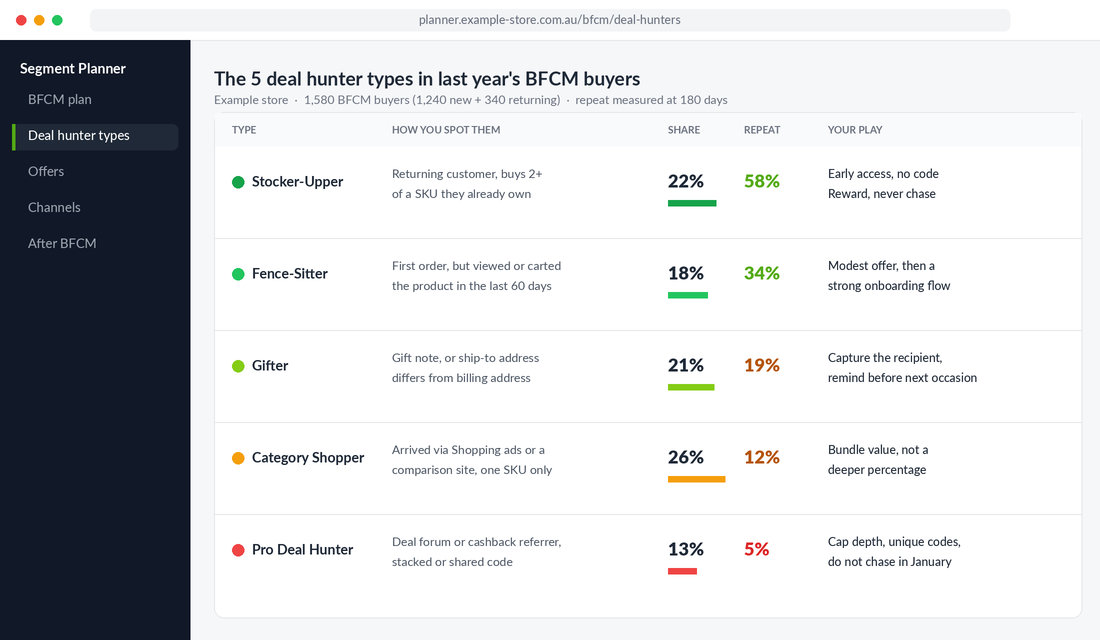
Look at the repeat column. Stocker-Uppers and Fence-Sitters repeat at 58% and 34%; the Pro Deal Hunter at 5%. Yet most BFCM offers and ad creative are built to win that 5% group, because they make the noisiest revenue spike. Flip that.
Step 1: Tag Every BFCM Customer by How They Were Acquired
You can’t manage a segment you can’t see. The first job, before a single BFCM order lands, is to make sure every first order gets tagged with how that customer was acquired. Discount data is surprisingly easy to lose once codes expire and campaigns end. A customer tag stays on the profile forever, and every other tool in your stack can read it.
The easiest tool for this is Shopify Flow, which is free on every Shopify plan. Here’s the exact setup:
- Create a new workflow in Flow and choose the Order created trigger.
- Add a condition that checks the customer’s number of orders equals 1, so you’re only tagging first-time buyers. Add a second check that the order date falls between 27 and 30 November 2026.
- Add a second condition: Order, Discount codes, is not empty.
- On the True branch, add the action Add customer tags with
deal-acquiredandbfcm-2026. - On the False branch, add customer tags
full-price-firstandbfcm-2026. - Turn it on now, not on Black Friday morning, and place a test order with a code to confirm the tag appears.
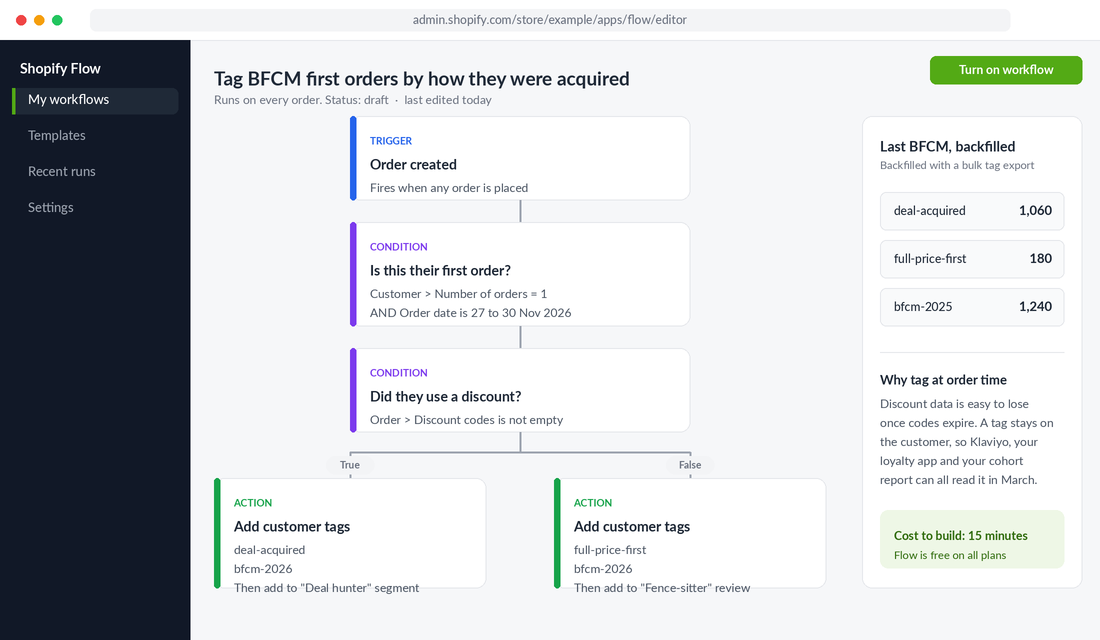
If you want to go further, add tags for the other signals. A Flow condition on the order note or a gift wrap line item can add gifter. If your UTM data lands in order attributes, a condition on the landing site or referrer can add deal-site-referral for traffic from OzBargain or a cashback platform.
In Klaviyo, you can also build segments straight from the Shopify Placed Order event, which carries a Discount Codes property. A segment of “Placed Order at least once where Discount Codes contains BF26” gives you the same view inside your email platform. Do both, so the data lives in Shopify and Klaviyo come January.
Step 2: Design the Offer to Select the Deal Hunters You Want
Here’s the mindset shift. Your BFCM offer isn’t just a price. It’s a filter. Every element of it decides which of the five types shows up. A flat 40% off sitewide code is a magnet for Pro Deal Hunters and Category Shoppers. A smaller offer with early access, a gift with purchase or a bundle is a magnet for Stocker-Uppers, Fence-Sitters and Gifters.
Use these rules when you build this year’s offer:
- Cap first-order depth around 20%. The Optimove data says you gain little from going past 20% on a first order, and the Lewis research says you lose long-term value the deeper you go. If you must go deeper for clearance, restrict it to specific SKUs, not your hero products.
- Lead with value, not percentage. A free gift, a bundle price or free express shipping attracts people who care about your product. A big percentage attracts people who care about the percentage. Bundles also lift AOV, which protects margin.
- Give your list early access, not a bigger code. Opening the sale 24-48 hours early for subscribers and past customers rewards Stocker-Uppers and Fence-Sitters, and gets their orders in before stock runs thin.
- Make gifting easy. Add a gift note field, gift wrap option and a “ship to someone else” prompt. This both serves Gifters and lets you identify them.
- Kill stacking. Set your BFCM discount so it can’t combine with welcome codes, loyalty rewards or other promotions. Stacking is the Pro Deal Hunter’s favourite move.
- Keep your “was” prices honest. The Monash research found 26% of Aussie shoppers are suspicious of misleading discounts during sales. Inflated reference prices hurt trust with exactly the people you want to keep, and they’re an Australian Consumer Law risk.
If you want the full architecture for how BFCM fits into your year-round promotional rhythm, our Discount Discipline Framework breaks down the five tiers from full price through to clearance.
One Aussie example worth studying is Kookai. In 2024, creative director Bianca Vagner-Cromb told Ragtrader the brand had leaned heavily on promotions during COVID and then had to “retrain the customer to show that we’re not always going to be offering discounts and sales.” Kookai pulled back on Black Friday and focused discounting on its mid-year and end-of-season sales. Her result: customers now buy quickly because they know things won’t go on sale, and the brand was struggling to keep up with demand.
Step 3: Choose Your Deal Channels Deliberately (OzBargain, Cashback and Coupon Sites)
Australia has a uniquely powerful deal community, and you need a position on it before November, not during it.
OzBargain is the big one. Back in 2016, Roy Morgan named it Australia’s fastest-growing shopping-related website, with 948,000 unique monthly visitors, more than 2.5 times its 2012 audience. A good deal posted there can send a flood of traffic in hours. That traffic converts, but it’s heavily weighted to Pro Deal Hunters and Category Shoppers. Decide in advance:
- Do you want to be there at all? A spike can be worth it as a one-off acquisition hit, as long as you tag those customers and don’t build January around them.
- If yes, post it yourself. An official post with clear stock limits and terms beats a code leaking from your list, and lets you answer questions in the comments.
- Use a unique, capped code for deal community traffic so you can measure it separately, and so it can’t be reused on your full-price days.
Cashback platforms are the second channel to manage. These sites pay members a slice of the affiliate commission you pay them. The market shifts too: Cashrewards, which had more than two million members, shut down in September 2025. ShopBack and TopCashback still run in Australia. Ask one question: are cashback orders mostly people who would have bought anyway? If your post-purchase survey says yes, you’re paying commission on your own customers.
Coupon extensions and code aggregator sites are the third. They scrape your codes and push them to anyone at checkout, which turns your carefully targeted Fence-Sitter offer into a public discount. The full defence is in the Discount Code Leak Defence Playbook. Short version: unique single-use codes for targeted offers, automatic discounts for public ones.
Then there’s the opposite approach. Australian knitwear label Mia Fratino has shut its website on Black Friday and Cyber Monday every year since launching its #noplayblackfriday campaign in 2021, and in 2025 marked five straight years of boycotting the sale. Instead, co-founder Amy Jones told Ragtrader, the brand rewards loyal customers with considered access to archival lines. That’s a deliberate Prospects choice. You don’t have to go that far, but make your choice on purpose.
Step 4: Run a Different Post-Purchase Path for Each Type
This is where most of the value is won or lost. Sending every BFCM customer the same “here’s 10% off your next order” email trains deal-acquired customers to expect discounts and hands margin to Fence-Sitters who’d have paid full price.
Using the tags from Step 1, split your post-purchase flow in Klaviyo with a conditional split on the customer tag or the discount property. Then run a different path for each group:
- Stocker-Uppers: No discount. Thank them for being a repeat customer, give them a heads-up on what’s coming in the new year, and invite them into your loyalty program’s top tier. They want recognition more than price.
- Fence-Sitters (full-price-first and early-intent buyers): Focus on product success. How to use it, how to care for it, what customers like them buy next. Aim for a full-price second order within 60-90 days.
- Gifters: Ask, “Who did you buy for?” A simple one-question email with a reason to share (a recipient care card, a “give $20, get $20” referral link) turns the recipient into a prospect. Then remind them before the next gifting occasion.
- Category Shoppers: Give them reasons to care about your brand beyond price. Founder story, how the product is made, reviews from long-term customers. If you’re going to offer anything, make it a bundle or free shipping on order two, not a deeper percentage.
- Pro Deal Hunters: Keep them on the list, but don’t chase. Put them in a lower-frequency stream and let them hear about your next genuine sale. Don’t spend paid retargeting budget winning back someone with a 5% repeat rate.
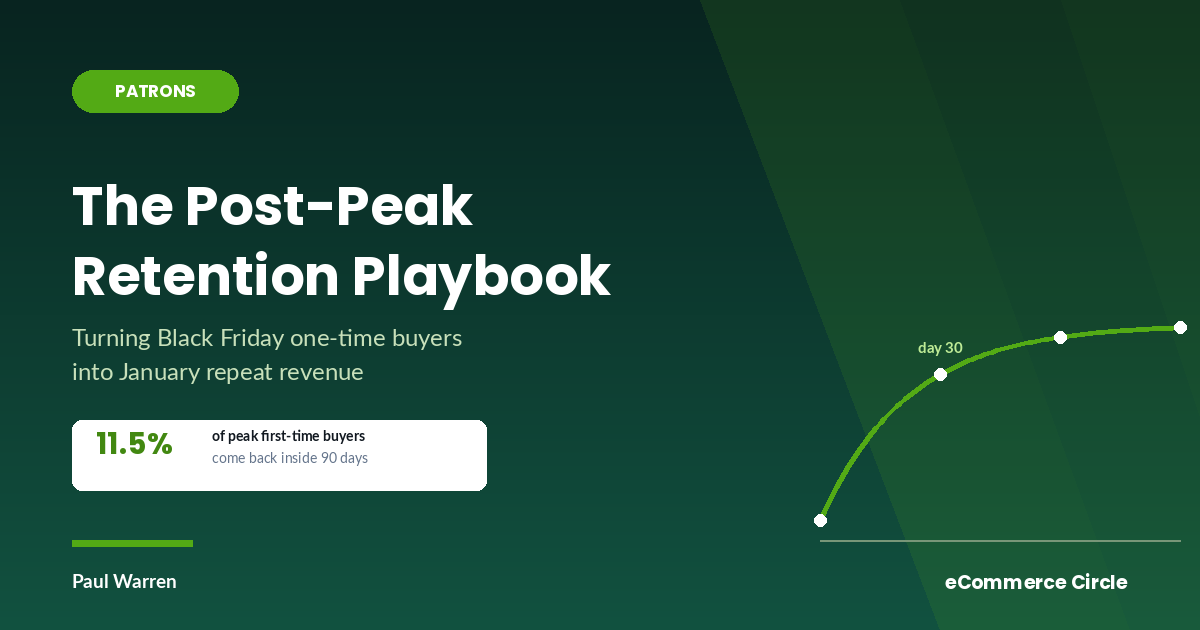
Timing matters too. BFCM orders arrive close to Christmas, so your window for a second order before the January slump is short. Our Post-Peak Retention Playbook walks through how to rebuild your post-purchase flow for that compressed window, including why you should lead with the reorder rather than the cross-sell. Pair it with the type-based split above and you’ll get far more out of the same customers.
Step 5: Score the Cohort in February, Not on Cyber Monday
Cyber Monday night is the worst time to judge your BFCM. Revenue looks great, but the information that matters doesn’t exist yet: whether those customers come back.
Put a calendar reminder in for the last week of February 2027 and run these four numbers, split by your tags:
- 90-day repeat rate for deal-acquired vs full-price-first customers. This tells you how big the gap is in your store.
- Contribution margin per customer after the first order, including discount cost, shipping and acquisition spend. A deep-discount customer who never comes back is often a loss, even if the order looked healthy.
- Share of new customers by type. If Pro Deal Hunters and Category Shoppers are more than half of your BFCM new customers, your offer is filtering for the wrong people.
- Second-order discount usage. Of the deal-acquired customers who did come back, how many paid full price? That number tells you whether your post-purchase flow is retraining them or reinforcing the habit.
Then write down one change for next year. Maybe it’s capping depth at 15%. Maybe it’s posting your own OzBargain deal instead of letting a code leak. Maybe it’s adding a gift note field so you can finally identify Gifters. One deliberate change per year compounds faster than a new tactic every November.
If you want a quick way to see whether your Prospects foundations are strong enough to handle a deal-heavy season, the Prospects section of the free More Orders Scorecard checks exactly this: whether you know who your best customers are and whether your marketing is built to attract more of them.
The Compound Effect: How the Five Steps Change Your Customer Base
Each step feeds the next. Tagging lets you see the five types. Offer design shifts the mix toward the types that repeat. Channel choices stop the offer leaking. Type-based follow-up converts more of the right customers to full price. February scoring tells you what to change next year.
Run the maths on the example store. Say a better offer moves 10 percentage points of new customers out of the Category Shopper and Pro Deal Hunter groups and into the Fence-Sitter and Gifter groups. Across 1,240 new customers, that’s 124 people moving from a repeat rate of roughly 5-12% to 19-34%. Even at a conservative 15-point lift, that’s around 19 extra repeat customers from the same weekend, before you count the margin you saved by not going deeper. Do that every year and your customer base gets stronger with each peak season instead of noisier.
The brands that win the long game don’t avoid deal hunters. They choose them, and use the biggest weekend of the year to add people who’ll still be buying in June.
Your Deal Hunter Checklist: 12 Things to Do Before 27 November
- Run last year’s cohort cut: BFCM 2025 first-time buyers by first-order discount depth, compared on 180-day repeat rate and revenue.
- Estimate your type mix: roughly what share of last year’s BFCM buyers were Stocker-Uppers, Fence-Sitters, Gifters, Category Shoppers and Pro Deal Hunters.
- Build the Shopify Flow tagging workflow and test it with a real order.
- Create matching Klaviyo segments from the Placed Order event’s Discount Codes property.
- Set your maximum first-order depth (we suggest around 20%) and write it down so nobody “just goes a bit deeper” on Thursday night.
- Add one value-led offer: a bundle, gift with purchase or free express shipping.
- Schedule early access for subscribers and past customers 24-48 hours before the public sale.
- Turn on gift notes, gift wrap and a ship-to-someone-else prompt.
- Block discount stacking across BFCM, welcome and loyalty codes.
- Decide your OzBargain and cashback position, and create unique capped codes if you’re participating.
- Build five post-purchase paths in Klaviyo using conditional splits on your tags.
- Book a February review to score the cohort on the four numbers in Step 5.
Win the Right Deal Hunters This Year
Black Friday isn’t going away. With 89% of Australians waiting for sales in at least one category, you’ll be competing for deal hunters whether you like it or not. The difference between a peak season that builds your business and one that drains it comes down to which deal hunters you attract and what you do with them afterwards.
Inside eCommerce Circle, Prospects is one of the core pillars we work on with every member, and BFCM is where it gets tested hardest. If you want to see exactly where your store is being capped, take the free More Orders Scorecard. It takes two minutes and shows you which of the 10 P’s to fix first.