Most Aussie Shopify founders say they sell to “25 to 45 year olds” and then build a store, a promo calendar and an email program that treats that whole band like one person. Then they wonder why their best-spending customers buy once, disappear, and pop up in a competitor’s post-purchase flow three weeks later.
What’s in This Article
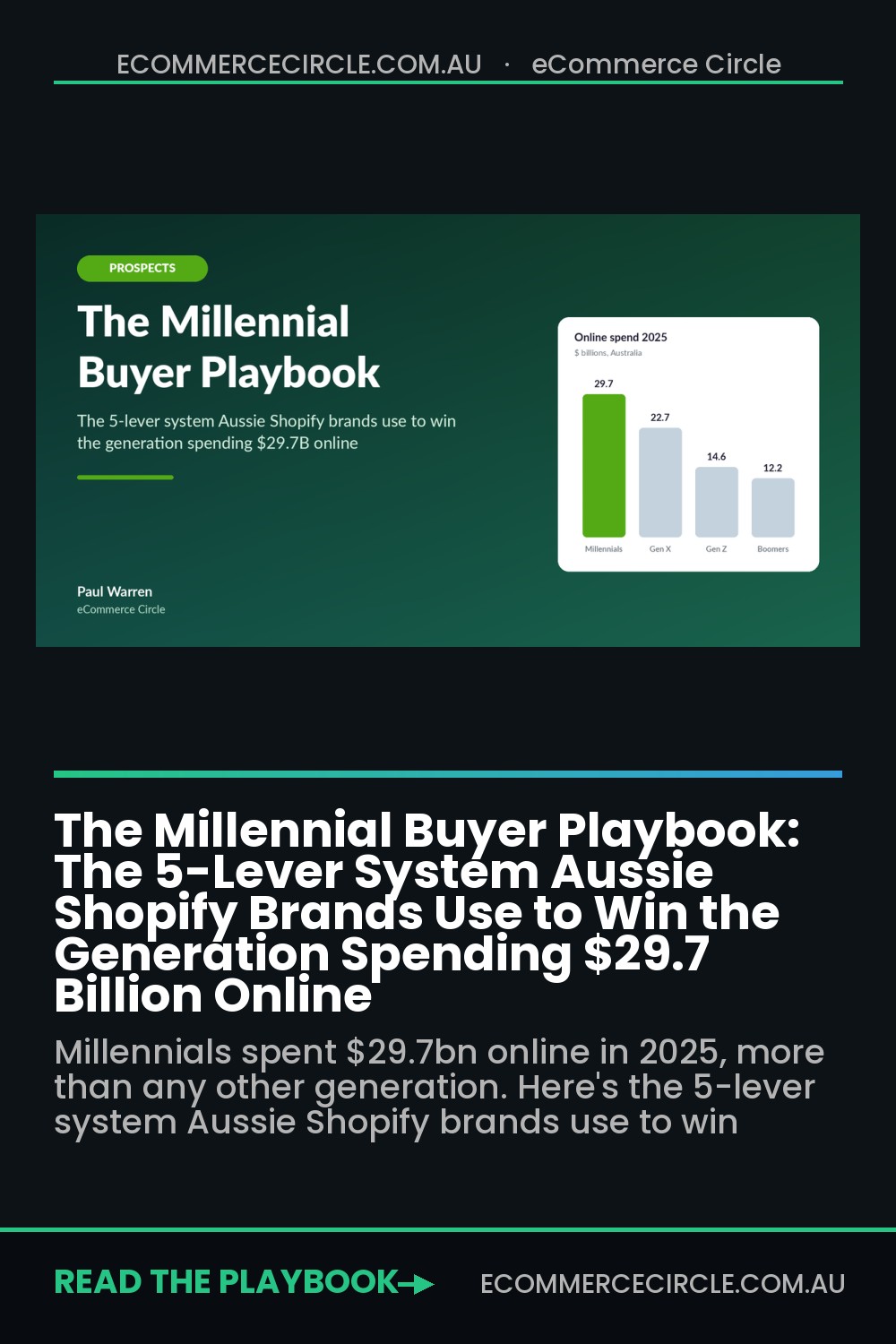
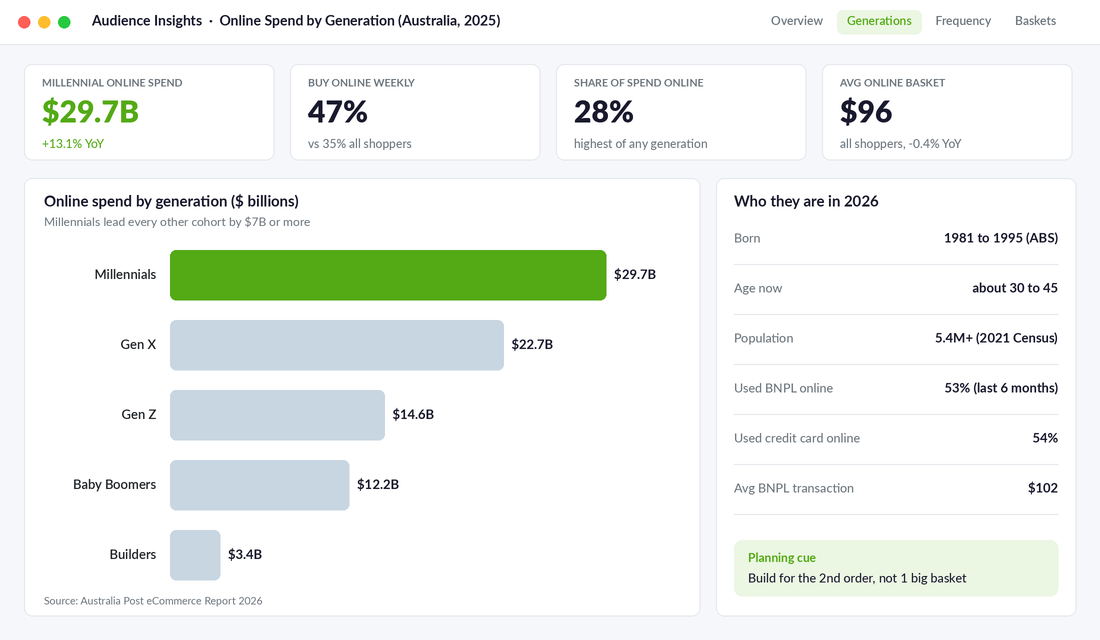
Here is the number that should change how you plan the next quarter. According to the Australia Post eCommerce Report 2026, Millennials spent $29.7 billion online in 2025, up 13.1% year on year. That is more than Gen X ($22.7 billion) and Gen Z ($14.6 billion), and it makes Millennials the single biggest online-spending generation in the country. 47% of them buy online every week, against 35% across all shoppers.
The brands winning this generation are not the ones with the trendiest TikToks. They are the ones who have built for frequency, flexibility and life stage. This playbook gives you the 5-lever system to do the same, plus a checklist you can run against your own store this week.
Who the Aussie Millennial Buyer Actually Is in 2026
The ABS defines Millennials as people born between 1981 and 1995. In the 2021 Census they drew level with Baby Boomers as the largest generation in Australia, with over 5.4 million people each and just 5,662 more Boomers than Millennials on Census night. Millennials rose from 20.4% of the population in 2011 to 21.5% in 2021.
In 2026, that cohort is roughly 30 to 45 years old. That age range matters more than the label. It means your Millennial customer is not a uni student with a side hustle. She is a 38-year-old with a mortgage or a rent bill, possibly two kids under ten, a full-time job and a phone that is the main way she shops.
Three things define how this buyer behaves online:
- High frequency, smaller baskets. Australia Post found the average online basket fell to $96 in 2025 while purchase frequency went up. Millennials lead that shift, with 28% of all their spending now online, the highest of any generation.
- Payment flexibility is standard, not a niche. The PayPal eCommerce Index 2025 found 53% of Millennials used BNPL for online purchases in the past six months, almost level with the 54% who used credit cards.
- Life-stage purchases, not age-based ones. A Millennial renter and a Millennial first-home buyer are the same age but want completely different things from your store.
If you have already read our Gen X Buyer Playbook, you will notice the contrast. Gen X rewards trust and consistency with bigger baskets. Millennials reward speed and convenience with more orders. You win them by making the next order easy.
Lever 1: Build for Frequency, Not One Big Basket
Most brands chase average order value first. With Millennials, that is the wrong starting point. When nearly half of a generation shops online every week, the brands that win are the ones that get into the weekly rhythm, not the ones that force a $250 cart once a year.
Start by pulling your days between first and second order from Shopify. In Analytics, build a customer cohort report and look at how many first-time buyers come back within 30, 60 and 90 days. If your 90-day repeat rate sits under 20%, frequency is your biggest lever with this buyer.
Then build the store around the second order:
- Replenishment timing. If your product runs out (skincare, coffee, supplements, pet food, cleaning), set a Klaviyo flow triggered on “Placed Order” with a time delay matched to the real usage window. A 30-day serum should get its reminder on day 24, not day 30.
- One-tap reorder. Put a “Buy it again” link in every post-purchase email and in the customer account page. Millennials will not hunt for a product they already bought.
- Small, frequent add-ons. Build a $15 to $30 “top-up” range that ships free with a repeat order. It fits the smaller-basket pattern instead of fighting it.
- Delivery speed as a feature. Weekly shoppers notice a five-day wait. Show a clear delivery estimate on the product page, not just at checkout.
Koala is a good example of building for this buyer. The Sydney brand, founded in 2015 and listed on the ASX in March 2026, offers same-day delivery on in-stock mattresses and furniture in Sydney, Melbourne, Brisbane, Perth and Adelaide when you order by 3pm on a weekday, plus a 120-night trial. It removed the two biggest reasons a busy 35-year-old delays a big purchase: waiting, and the fear of getting it wrong. If you are weighing up faster delivery yourself, our Same-Day Delivery Playbook walks through the maths to test whether it pays.
Lever 2: Offer Payment Flexibility Without Leaking Margin
This is where a lot of founders get stuck. They know BNPL helps conversion, but they hate the merchant fee. So they either skip it, or switch it on and bury it at checkout where it does half the job.
The data is clear on the upside. The PayPal eCommerce Index 2025, a national study of 1,022 Australians, found shoppers were 82% more likely to buy from a site offering BNPL than one that does not. Millennials averaged $102 per BNPL transaction, and 52% of Millennial BNPL users who switched to PayPal Pay in 4 did so because it charges no late fees. This buyer is budgeting, not splurging.
Here is how to set BNPL up so it earns its fee:
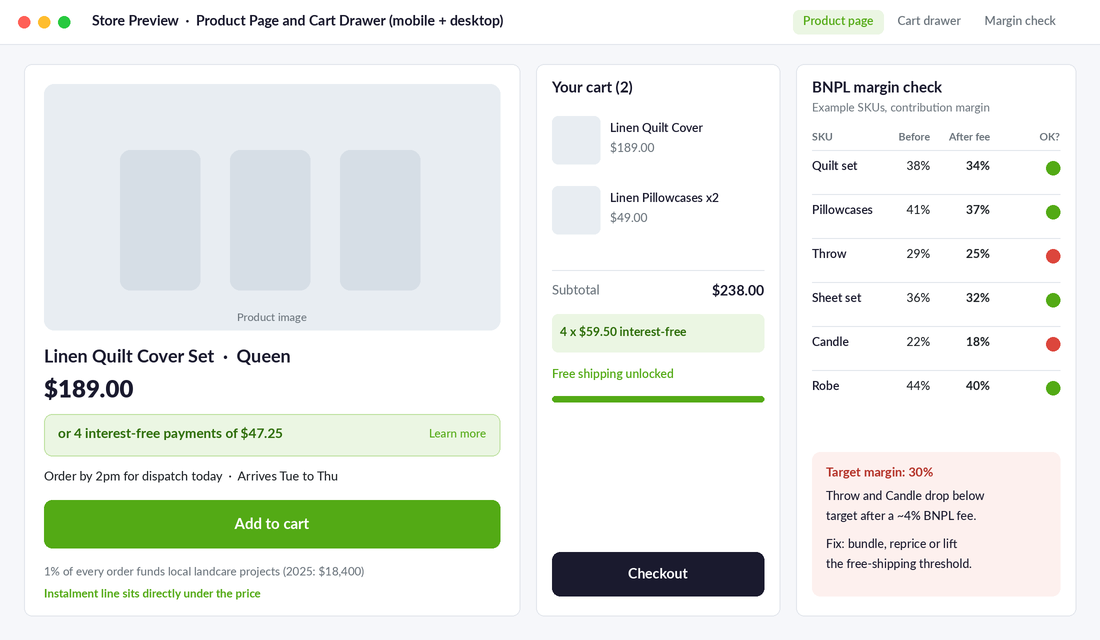
- Show the instalment on the product page. Install your BNPL provider’s on-site messaging (Afterpay, PayPal Pay in 4 or Zip all have Shopify integrations) and place it directly under the price. “4 payments of $24.75” does more work there than at checkout.
- Repeat it in the cart drawer. The cart is where Millennials check the total against the budget. Show the instalment figure next to the subtotal.
- Use it in ads for higher-priced items only. For products over $150, test ad copy that leads with the instalment. For a $35 product, it adds nothing.
- Check the fee against your contribution margin. If BNPL fees push a SKU below your target margin, adjust the price or the free-shipping threshold before you promote it.
Before you scale this, run the numbers. Our BNPL Margin Test shows you exactly how to work out whether the conversion lift covers the fee on each product line.
Lever 3: Segment by Life Stage, Not Birth Year
“Millennial” is a useful planning label. It is a terrible email segment. A 31-year-old renting in Brunswick and a 44-year-old with a house and three kids in Baulkham Hills are both Millennials, and they will ignore each other’s emails.
The better move is to capture life stage directly and segment on it. In our experience, four life stages cover most Millennial buyers:
- Renters and sharers. Smaller spaces, portable products, value per dollar. They respond to “fits a rental” and “no tools needed”.
- First-home buyers and new homeowners. Setting up rooms from scratch. Bundles, room kits and “everything you need” collections work well.
- Parents of young kids. Time-poor and practical. Speed, safety and bundled convenience beat novelty. Our Parent Buyer Playbook covers this group in depth.
- Established professionals. Higher income, less time, willing to pay for quality and service. Premium ranges and subscriptions land here.
Real purchase data backs this up. Afterpay’s Afterpaid 2025 report, built on anonymised transactions from 4.1 million customers, found Millennials made 49% of all robot vacuum purchases. That is not an age thing. It is a “busy household that values time” thing.
How to Set Up Life-Stage Segments in Klaviyo
Here is the setup we recommend. It takes about 30 minutes:
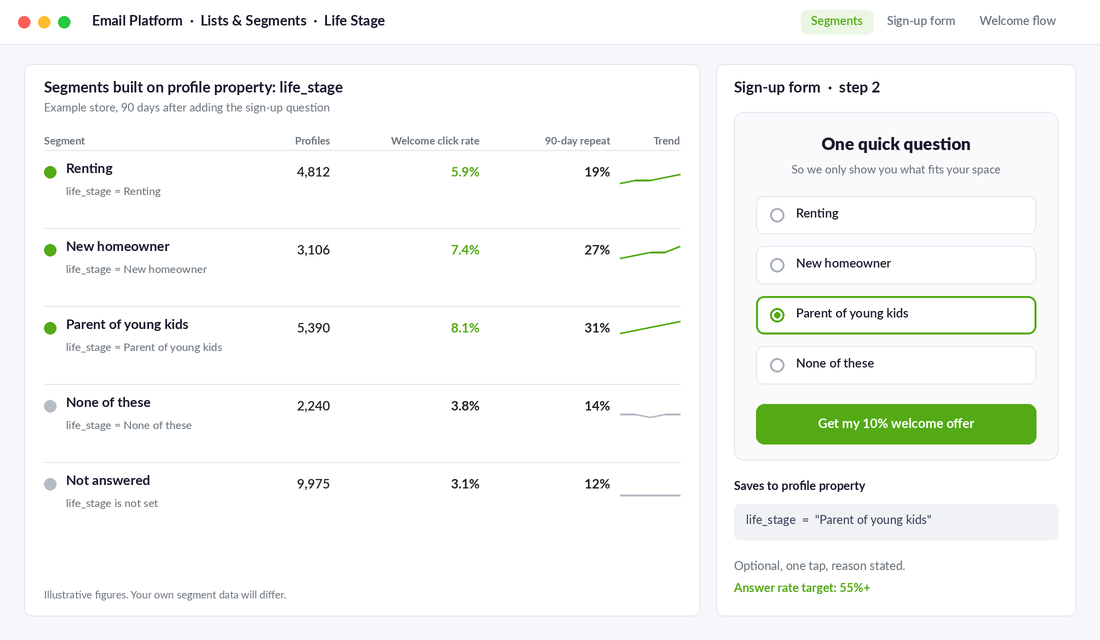
- Add one question to your sign-up form. In Klaviyo, go to Sign-up forms, open your main pop-up and add a radio-button field on step two: “What best describes you right now?” Options: Renting, New homeowner, Parent of young kids, None of these.
- Save it as a profile property. Set the field to save to a custom property called
life_stage. Every answer now lands on the subscriber’s profile. - Build the segments. Go to Lists & Segments, create a segment, and use the condition “Properties about someone”,
life_stageequals “Renting”. Repeat for each option. - Backfill existing customers. Send a one-question email to your list with the same four options as buttons, each linking to a Klaviyo-tagged URL that sets the property.
- Change one thing per segment. Start small: a different hero image and product order in your welcome flow for each life stage. Measure click rate by segment after 30 days.
Keep the question optional and the reason obvious (“so we only show you what fits your space”). Millennials will share information when the value exchange is clear.
Lever 4: Show Your Values With Proof, Not Adjectives
Every brand says it is “sustainable”, “ethical” and “community-driven”. Millennials grew up with that language and have learned to skip it. What cuts through is a specific, checkable commitment.
Who Gives A Crap is the standard example. The Melbourne brand launched in July 2012 with an Indiegogo campaign where co-founder Simon Griffiths sat on a toilet in a warehouse for 50 hours until $50,000 was raised. Its core promise is not “we care”. It is 50% of profits donated to clean water and sanitation charities. That number does the persuading for them, and it is repeated on the box, in the emails and on the site.
Koala does something similar with its WWF-Australia partnership, running since 2017 and focused on koala and Great Barrier Reef turtle conservation. It is specific, long-running and easy to verify.
To apply this in your store:
- Replace one adjective with one number. “Eco-friendly packaging” becomes “100% plastic-free packaging, made in Victoria”. If you cannot put a number or a place on it, do not claim it.
- Put the proof where the decision happens. A short line under the Add to Cart button beats a whole “Our Values” page nobody visits.
- Keep it legal. The ACCC takes greenwashing seriously. Every environmental or ethical claim needs evidence you could hand over tomorrow.
- Show real customers. Reviews with photos from people at the same life stage do more than any brand statement. A 35-year-old parent trusts another parent’s photo of the product in a real living room.
Lever 5: Make Subscription and Reorder the Default
If Lever 1 is about getting the second order, Lever 5 is about removing the need to decide at all. For a time-poor 38-year-old, the best purchase is the one they do not have to remember.
Who Gives A Crap has built subscriptions into the model from day one. According to a Recharge case study, the brand grew its subscription program by 250% over two years by tailoring its subscription messaging to each local market. That is a replenishment product people used to buy at the supermarket without thinking, now bought online on autopilot.
Not every product suits a subscription. Use this quick test. A product is a subscription candidate if:
- It is used up in a predictable window (2 to 12 weeks is ideal).
- At least 15% of your buyers reorder it within 90 days without a prompt.
- Running out is annoying (coffee, pet food, nappies, skincare, cleaning products).
- Your margin can absorb a 10% to 15% subscriber discount and still hit your target contribution margin.
If a product passes, set up subscriptions with an app like Recharge, Appstle or Shopify Subscriptions. Three settings matter most with Millennial buyers:
- Easy skip and swap. Let subscribers skip a delivery or swap a flavour in two taps from an email link. The fear of getting locked in is the number one reason people do not subscribe.
- Flexible frequency. Offer 2, 4, 6 and 8-week options. Life-stage shifts (a new baby, a move) change usage fast.
- A clear, honest cancel path. Hiding the cancel button is a short-term win and a long-term reputation problem. It also sits badly with Australian consumer law expectations around subscription traps.
For non-consumable products, use the same thinking with “complete the set” flows. Someone who bought a sofa is a candidate for cushions at day 21, a throw at day 45 and a rug at day 90.
The 4 Mistakes Aussie Brands Make With Millennial Buyers
We see the same four problems again and again when we audit stores selling to this generation:
- Marketing to the stereotype. Avocado toast jokes and “adulting” copy land badly with a 40-year-old who has been adulting for two decades. Talk to their life stage, not a 2015 meme.
- Treating mobile as the secondary experience. Test your store on a phone with one thumb while holding something in the other hand. If checkout takes more than a minute, you are losing weekly shoppers to brands that take 30 seconds.
- Discounting to win them. Millennials are value-driven, but value is not the same as cheap. Free shipping over a clear threshold, a real guarantee and BNPL usually beat a 20% code, and they do not train your customers to wait for a sale.
- Stopping after the first order. With a generation that buys weekly, a store with no post-purchase flow, no replenishment reminder and no reorder link is leaving its biggest customer group to someone else.
The Compound Effect: How the 5 Levers Work Together
Each lever helps on its own. The real payoff comes when they stack.
Life-stage segmentation (Lever 3) tells you which product a customer actually needs. Values proof (Lever 4) gets them over the line on the first order. Payment flexibility (Lever 2) removes the budget hesitation on the bigger item. Frequency design (Lever 1) brings them back within 30 days. Subscription and reorder (Lever 5) turns that second order into a predictable monthly one.
Here is what that looks like on real numbers. Say you have 1,000 Millennial first-time buyers a month at an $85 average order. If your 90-day repeat rate moves from 18% to 28% and 10% of repeat buyers convert to a monthly subscription, you add around 100 extra repeat orders a month from the same acquisition spend, plus a subscriber base that keeps building every month. That is the difference between a store that has to buy every order and a store where customer acquisition cost gets cheaper over time.
It also protects you going into Black Friday and Christmas. The brands that enter peak season with a warm, segmented Millennial list spend less to reach the same revenue target, because a big share of their orders come from people who already buy from them every month.
Your Millennial Buyer Checklist
Run your store against this list this week. Give yourself one point for every “yes”. Under 8 means Millennial buyers are leaking out of your store. Over 12 means you are ready to scale spend on this audience.
Frequency
- You know your 30, 60 and 90-day repeat rate for first-time buyers.
- Replenishment emails fire before the product runs out, based on real usage.
- Every post-purchase email and the account page has a one-tap reorder link.
- A delivery estimate shows on the product page, not only at checkout.
Payment Flexibility
- BNPL instalment messaging sits directly under the price on product pages.
- The instalment figure repeats in the cart drawer.
- You have checked BNPL fees against contribution margin for your top 10 SKUs.
Life Stage
- Your sign-up form captures life stage as a profile property.
- You have at least three life-stage segments in Klaviyo.
- Your welcome flow shows different hero products by segment.
Values and Proof
- Every values claim on your site has a number, place or partner attached.
- A one-line proof point sits near the Add to Cart button.
- Photo reviews show the product in real homes and real lives.
Subscription and Reorder
- You have tested which products pass the subscription candidate test.
- Subscribers can skip, swap or change frequency in two taps.
- Non-consumable buyers get a “complete the set” flow at day 21, 45 and 90.
Where to Start This Week
Do not try to pull all five levers at once. Pick the one with the biggest gap and give it 30 days:
- Week 1: Pull your repeat-rate numbers and score yourself on the checklist above.
- Week 2: Add the life-stage question to your sign-up form and move BNPL messaging under the price.
- Week 3: Build or fix your replenishment and reorder emails.
- Week 4: Rewrite your top three values claims with proof, then review the results by segment.
Millennials are already spending more online than any other generation in Australia. The only question is whether that spend lands with you or with the brand that made the next order easier.
Inside eCommerce Circle, understanding your prospects is one of the core pillars we work on with every member. If you want to see exactly where your store is being capped, take the free More Orders Scorecard. It takes two minutes and shows you which of the 10 P’s to fix first.