If you have searched for Shopify Protect and landed on a page that says “free chargeback protection for fraud,” you have probably done the same thing most Aussie founders do next: you looked for the switch in your admin. You will not find one. For an Australian store, Shopify Protect is not available, and the sooner you stop waiting for it, the sooner you can build the cover that actually works here.
What’s in This Article
That is not a reason to panic. Australian card fraud is real, though: AusPayNet counted about $854 million of fraud on Australian-issued cards in the 12 months to June 2025, and roughly $746 million of that was card-not-present, which is the type your store lives or dies on. A single fraud chargeback on a $120 order can cost you close to $100 in cash once the goods, the freight and the fee are counted. Let a handful through every month and it adds up faster than most founders expect.
This guide gives you the straight answer on availability, what Protect would and would not have covered even if you could switch it on, and a five-rule standard you can run yourself so an Australian store ends up with Protect-grade discipline without waiting for Shopify to expand it.
Is Shopify Protect Available in Australia?
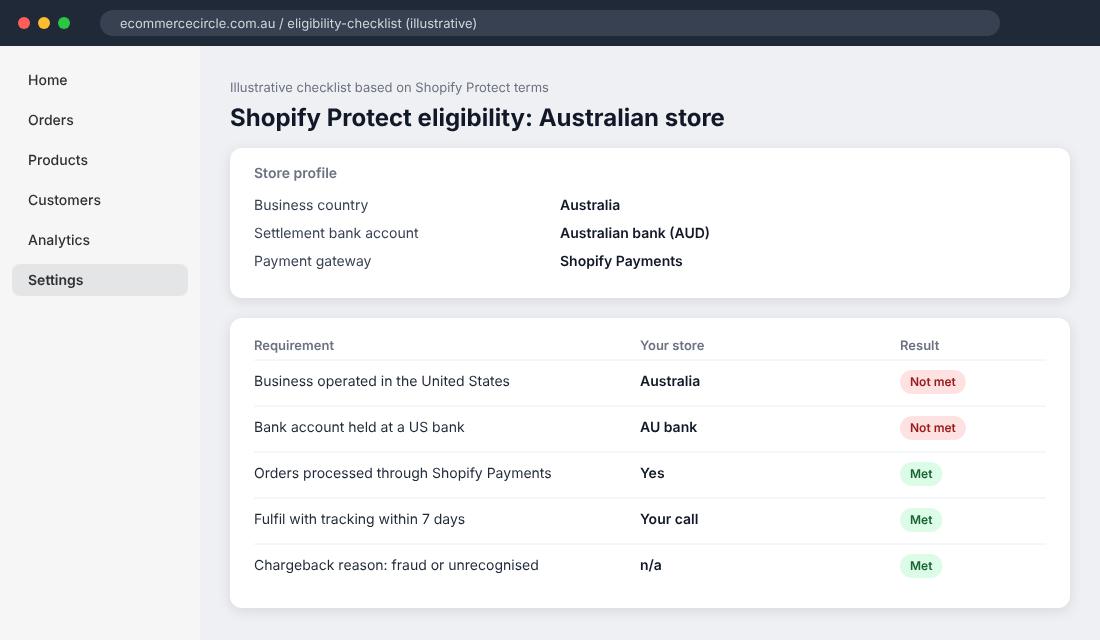
No. Shopify’s own help centre says eligibility requires that “your business must be based in the United States and must use Shopify Payments.” The legal terms go further: you must operate a business in the United States and your bank account must be held at a US bank. The help page also states that you can no longer activate Fraud Protect for Shopify Payments on a Shopify store, and it does not mention Australia anywhere.
So there are two separate hurdles, and both fail for an Aussie merchant. First, the location test (US business, US bank). Second, the programme itself has been closed to new activations. If you read an article or watched a video that makes it sound like a toggle you can flip in Settings, check its date. Most of that content was written for American merchants.
The graphic below shows how the eligibility test reads for a typical Australian store. The two red lines are not fixable with a setting. You cannot make an Australian company a US business.
Two practical consequences follow from this:
- Do not budget for it. If a supplier, agency or app listing tells you “Shopify Protect covers you,” treat that as wrong for an Australian store until Shopify tells you otherwise in writing.
- Do not assume Shopify Payments is covering you either. Shopify Payments in Australia gives you access to fraud analysis and dispute tools, but a chargeback that hits your account is still your cost unless you win the dispute.
If you want the wider picture of how fraud, chargebacks and card testing fit together, our Shopify chargeback fraud protection guide is the longer read. This article stays focused on the Protect question and what to do instead.
What Shopify Protect Actually Covers (and Why It Is Narrower Than the Headline)
Even for the US merchants who could use it, Protect was never a blanket guarantee. Once you read the terms, it is a warranty with strings attached. Understanding those strings is useful, because they are a very good template for how you should run your own operation.
According to the Shopify Protect terms, a chargeback is covered only when all of these are true:
- The order was assessed as eligible by Shopify and showed a protection notice in the admin.
- You fulfilled it with a supported tracking number within seven days of the order being placed.
- The carrier marked it as in transit within ten days.
- The chargeback is a fraud reason code: either “transaction not recognised” or “fraudulent, cardholder says they did not authorise it.”
- You can show proof of delivery to the shipping address on the order, if Shopify asks.
- The chargeback notice arrives within twelve months of the order date.
Shopify also states plainly that Protect “does not constitute insurance.” A merchant who is in a card-network chargeback monitoring programme is paused from Protect until they exit it. And third-party analysis of the programme notes that it does not cover the most common non-fraud disputes: item not received, duplicate charge, credit not processed, or product not as described. Chargebacks911 also points out that protected chargebacks still count toward your chargeback ratio, which matters in the next section.
Here is the part most founders miss. When Shopify Protect works, it does not work because Shopify is magic. It works because the conditions force a merchant to ship fast, ship trackable and keep a clean paper trail. That is something you can do for yourself, today, in Australia, for free.
The Real Cost of a Chargeback for an Australian Store
Before deciding what is “worth it,” get the maths straight. A chargeback is not just the order value. Here is a worked example for a store with a $120 average order, $55 cost of goods and $10 outbound freight.
- The sale reverses. The $120 is pulled back from your payout.
- The goods are gone. You are out $55 in product.
- The freight is gone. Another $10 you will not get back.
- The dispute fee lands. One third-party summary lists Shopify’s chargeback fee at $25 AUD on an AUD settlement account. The Shopify help centre says it might refund the fee on a win depending on your country, so confirm the exact amount and refund rule in your own admin.
Add it up and a fraud chargeback on that order costs you roughly $90 to $95 in real cash, and the $120 you thought you banked is gone. At a 0.4% fraud dispute rate on 500 orders a month, that is two chargebacks a month, about $190 a month or roughly $2,300 a year. Let the rate drift to 1% and you are at five a month and nearly $5,700 a year, before you count the hours spent gathering evidence.
The bigger risk is not the cash. It is the ratio. Stripe’s guidance for Australian businesses is that a chargeback rate above 1% can mark you as high-risk with processors and card networks, and Mastercard’s monitoring programme starts hitting merchants at 1.5% or higher. Visa’s VAMP programme counts both fraud reports and disputes against your settled transactions. Chargeflow’s summary puts the “excessive” merchant level at 1.5% with at least 1,500 counted events in Asia Pacific from April 2026, and it notes that winning a dispute does not remove it from the count. Thresholds shift, so confirm the current numbers with Shopify Payments or your acquirer rather than trusting a blog post, including this one.
A small store will rarely hit 1,500 events. But a processor can still act on a handful of bad weeks, and a payout hold in peak season is a cash-flow event, not just a fraud one. We cover that scenario in our payout freeze guide.
So Is Shopify Protect “Worth It”? The Honest Verdict
For an Australian store: it is not available, so the question is moot. For the sake of making a good decision, though, here is how I would think about it if it were.
It would be worth it for a store with a clean fulfilment rhythm (everything shipped with tracking inside a week), high-risk fraud exposure on card-not-present orders and no time to manage disputes. A fee waiver plus reimbursement on fraud-coded chargebacks is genuinely good value.
It would not be worth relying on for a store with slow fulfilment, lots of “item not received” disputes, subscription or digital products, or heavy use of non-Shopify-Payments gateways. In those cases the conditions would void most of the cover, and you would still be fighting disputes yourself.
Here is the useful conclusion: the stores that benefit most from Protect are the stores that need it least, because they already ship fast and track everything. The stores that need help most (slow shippers, messy evidence, no screening) are exactly the ones the terms exclude. So the work is the same for you as it would be for a US merchant: fix the operation, then add tools where the operation cannot reach.
The DIY Protect Standard: Five Rules That Copy the Conditions
Take the conditions Shopify sets for Protect and make them house rules. Here is the standard I put in front of every store owner who asks about this.
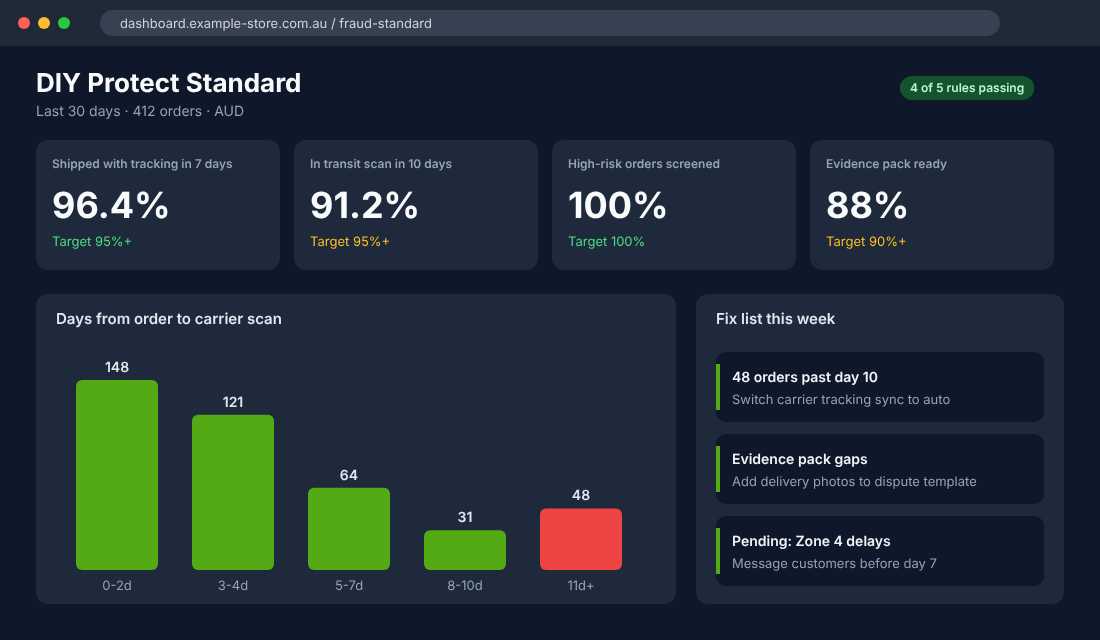
Rule 1: Fulfil with tracking inside seven days (aim for 48 hours)
This is the first Protect condition and the single most useful habit for dispute defence. A tracking number, a carrier scan and a delivery confirmation make up most of an evidence pack. Set a Shopify Flow or 3PL SLA for same or next-day dispatch and flag anything open for more than three days.
If you are on Australia Post or Sendle, make sure tracking syncs to the order automatically, so the customer sees movement and your records show it. For a 3PL, build “tracking uploaded within 24 hours of dispatch” into the service agreement.
Rule 2: Get an in-transit scan inside ten days
This is the second condition, and it catches the orders that sit in a depot. Run a weekly report of orders more than six days old without a carrier scan. Those orders are where “item not received” disputes are born. Contact the customer before they contact their bank.
Rule 3: Screen every medium and high-risk order before you ship
Shopify fraud analysis rates eligible orders as low, medium or high risk, and shows guidance: fulfil, confirm with the customer, or consider cancelling. Fraud recommendations need the Grow plan or higher, or Shopify Payments. The rule is simple: no medium or high-risk order leaves the building without a human check.
The checks that catch most of the problems are boring and fast:
- Does the billing country match the shipping country, and does either look odd for your product?
- Is it a first order with an unusually high value, express freight and a freight forwarder address?
- Has the same email, device or address tried multiple cards in a short window?
- Is it a gift card order paid for by a brand-new account?
If anything looks wrong, email the customer and ask for something only the real cardholder can provide, such as a recent order reference or a quick confirmation of the billing suburb. Honest customers reply within hours. Fraudsters usually vanish.
Rule 4: Keep a dispute evidence pack ready before you need it
When a chargeback lands, you typically have a short window to respond, and a late or thin reply is an automatic loss. Build one template that pulls in: order confirmation, IP and device information, tracking and delivery confirmation, customer communications, your refund policy and a delivery photo if your carrier provides one.
You can assemble these by hand in Shopify, which is how most small stores start. If you are getting more than a few disputes a month, an app that drafts the response for you earns its fee quickly. More on that in the tools section.
Rule 5: Watch your ratio monthly with a trip-wire at 0.5%
Set a personal alarm well below the networks’ thresholds. I use 0.5% as the point where we stop and investigate, because by the time you reach 1% you are already negotiating with your processor. Track disputes received divided by orders for the month, and annotate every spike with the cause, as in the chart below.
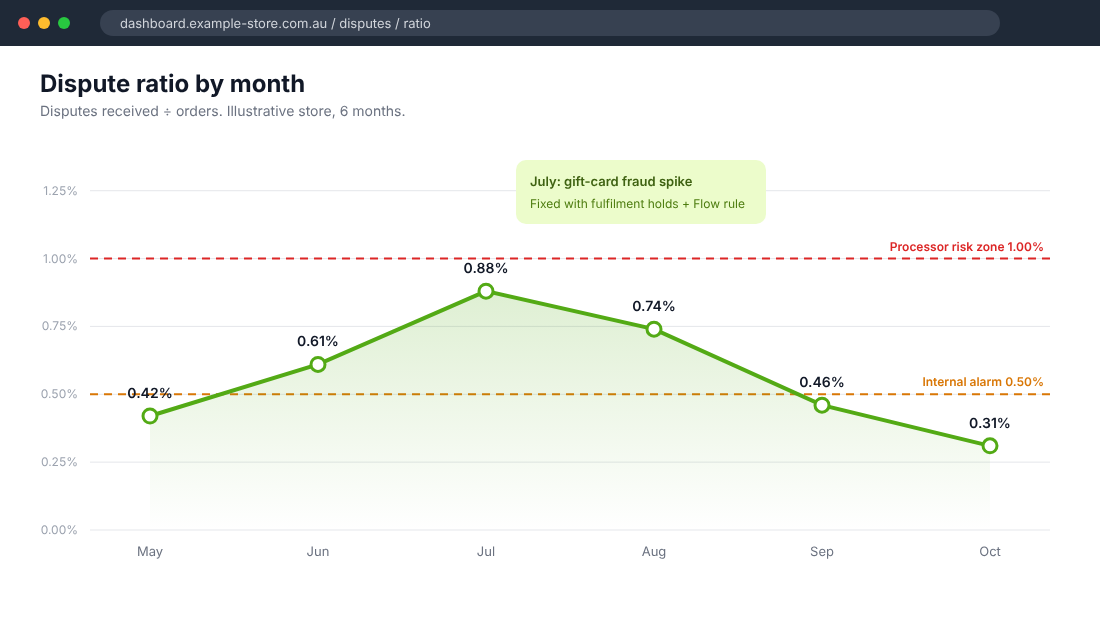
The “annotate every spike” habit matters more than it sounds. In the example, a July spike was traced to gift card fraud and fixed with fulfilment holds and one Flow rule. Without the note, the next person who looks at the chart sees a bump and no lesson.
Tools That Do the Job Protect Would Have Done
You do not need an expensive stack. For most Australian stores under about $2 million a year, this three-layer setup is enough.
Layer 1: Shopify’s built-in fraud analysis plus Shopify Flow (free). Use fraud analysis to rate orders, then use Flow to act on the result. Here is the setup, in about 15 minutes:
- Open the Flow app and create a new workflow. Choose the “Order risk analyzed” trigger.
- Add a condition: risk level is high (and a second branch for medium).
- Add actions: tag the order “fraud-review,” put a fulfilment hold on it, and send an internal email or Slack message to whoever packs orders.
- Create a second workflow on “Order created” that tags orders over your threshold (for example $500 AUD for a store with a $120 average) with “high-value-check.”
- Write a one-page rule for your team: what to check, who decides, and the 24-hour deadline to either release or cancel.
Shopify Flow is available at no extra cost, and it is the closest thing to Protect’s screening that you can set up yourself.
Layer 2: A dispute-response app. Once disputes are more than an occasional annoyance, an app that builds the evidence pack for you saves hours. One Australian-built option is ChargebackAU, listed on the Shopify App Store by Merchant Assistant (Victoria). It pulls order details, fulfilment data and your refund policy and drafts an evidence response you can submit in one click. At the time of writing it lists a free test plan and paid plans at US$39, US$89 and US$179 a month, launched in June 2026 and with no reviews yet, so treat it as an early-stage option and trial it on real disputes before committing. Chargeflow is another popular name in this space. Whatever you pick, check how it prices (flat monthly versus a percentage of recovered revenue) and whether it covers your payment gateway.
Layer 3: A guaranteed-fraud service, only if volume justifies it. Services such as Riskified and Signifyd decide on each order and reimburse approved orders that later charge back. They suit stores with big card-not-present volume, not a $30,000-a-month brand. Two real examples show what the model can achieve at scale:
- Kogan (Australia). Per eCommerceNews Australia on 27 July 2026, Kogan adopted Riskified’s chargeback guarantee and identity tools across its 3.5 million-plus customer base, lifted approval rates above 98% and identified $1.5 million a year in savings from catching policy abuse and promotion misuse. That is a high-volume, online-only retailer, so do not copy the tool, copy the thinking: they measure fraud and abuse together, not separately.
- Rainbow Shops (US, on Shopify). A Signifyd case study reports a 51% reduction in chargebacks, a 50% chargeback win rate and a 99.5% order approval rate after moving to guaranteed fraud protection while re-platforming to Shopify. Again, it is a large retailer. The lesson for a smaller store is the approval rate: good screening does not have to mean turning away real customers.
If you cannot justify layer 3, do not stress. Layers 1 and 2 plus the five rules cover the great majority of what Protect was designed to handle.
The Gaps Nobody Talks About: Non-Fraud Disputes and Local Payment Methods
Protect was built around fraud-coded chargebacks. But a large share of disputes in a small Australian store are not fraud at all. They are “I never got it,” “it is not what I expected,” or “I returned it and have not been refunded.” These cost you the same, and no Protect-style programme covers them. Here is how to reduce each.
- Item not received. Fix with tracking, delivery confirmation and proactive messages when a parcel stalls. Our chargeback prevention guide walks through the evidence pack for this one.
- Not as described. Fix with honest product pages, real photos and a clear returns policy. A customer who knows how returns work picks up the phone before they pick up their banking app.
- Credit not processed. Fix by refunding returns within the time you promise and sending a confirmation email each time. A refund that sits for two weeks is a chargeback waiting to happen.
- Unrecognised charge. Fix by making your billing descriptor match your store name so customers recognise the line on their statement.
Buy now, pay later is its own category. Providers such as Afterpay and Zip typically take on the credit and fraud decision themselves under their merchant agreements, which can lower your fraud exposure on those orders. Check your own agreement for the specifics, and do not use that as a reason to skip screening on card orders.
Card testing deserves a mention as well. Bots that run hundreds of tiny transactions through your checkout can spike your dispute and fraud counts without a single real sale. If your dashboard shows a flood of small failed payments, read our card testing defence guide and switch on bot protection before anything else.
What About Insurance?
Some founders hear “Protect isn’t available” and jump straight to insurance. Be careful here: standard business insurance policies generally cover things like public liability, product liability and stock, and they are not designed to reimburse chargebacks. If you want to read up on what cover is typical for an Australian online store, see our guide to ecommerce insurance in Australia. For chargebacks specifically, the closest equivalent is the guaranteed-fraud services in layer 3 above, which are priced and contracted separately.
Your 30-Day Rollout Checklist
Copy this into your project tool and assign owners.
Week 1: Measure
- Pull the last 90 days of disputes and sort by reason code.
- Calculate your monthly dispute ratio and set a 0.5% alarm.
- Check how many orders took longer than 7 days to ship, and longer than 10 days to get a first carrier scan.
Week 2: Screen
- Build the Flow workflows for medium and high-risk orders and your high-value threshold.
- Write the one-page review rule and train whoever packs orders.
- Check your billing descriptor matches your store name.
Week 3: Defend
- Build the evidence pack template (order, tracking, delivery proof, communications, policy).
- Trial a dispute-response app if you have more than a few disputes a month.
- Confirm your current chargeback fee and refund rules with Shopify Payments.
Week 4: Review
- Re-run the ratio, annotate any spikes and compare to the 0.5% alarm.
- Decide whether volume justifies a guaranteed-fraud quote from Riskified or Signifyd.
- Put a recurring 15-minute monthly fraud review in the calendar.
How the Pieces Compound
Individually, each rule looks small. Together they behave like a system. Fast, tracked fulfilment stops “item not received” disputes and builds the evidence pack at the same time. Screening removes the orders most likely to become fraud disputes before you spend a cent on freight. The evidence pack turns the disputes that do arrive into winnable ones. The monthly ratio check catches drift early, so you fix a process in week three instead of explaining a spike to your processor in week twelve.
That is exactly what Shopify Protect rewards for the merchants who can use it: fast shipping, clean tracking and a clean record. You do not need Shopify’s permission to run the same standard in Australia. You just need to decide that it is a house rule and measure it every month.
Inside eCommerce Circle, protecting margin and cash flow is one of the core pillars we work on with every member. If you want to see exactly where your store is being capped, take the free More Orders Scorecard. It takes two minutes and shows you which of the 10 P’s to fix first.