Your Shopify returns policy needs to do two jobs at once: tell customers what you will do when they change their mind, and stay inside the Australian Consumer Law (ACL) when something is faulty. Most Aussie stores get the first job half right and the second one dangerously wrong.
In April 2025 the ACCC reviewed more than 2,000 Australian retail websites to check whether their return policies complied with the ACL. The most common offender was a blanket line like “No refunds or returns”. If that sentence sits in your footer today, it can be read as telling customers their legal rights do not exist. That is the sort of wording that attracts regulator attention, not just angry emails.
The fix is not a wall of legalese. It is a short, structured policy that separates change of mind returns (your rules) from faulty goods (the law’s rules), written in plain English and wired into Shopify properly. This guide gives you the exact structure, a copy and paste template, the tools worth paying for, and the numbers to decide how generous to be.
Why your returns policy is a profit lever, not just paperwork
Founders treat the returns page like a legal chore. The data says it is a conversion and margin lever. The US National Retail Federation reported that 15.8% of annual retail sales were returned in 2025, rising to 19.3% for online sales, and that around 9% of returns were fraudulent (NRF, October 2025). Closer to home, a 2025 benchmark by Eightx put the Australian apparel return rate at around 31%, and found 41% of Australian online shoppers returned at least one item that year.
Shoppers read your policy before they buy. A case study from Refundid cites about 65% of shoppers reading the refund policy before purchasing. A vague or hostile policy costs you the sale before you ever see a return. A clear, fair one removes the hesitation that stops first-time buyers.
Then there is the cost side. Here is what one refunded return can look like on a A$120 order for a typical Aussie store. Use your own freight rates, but the shape holds.
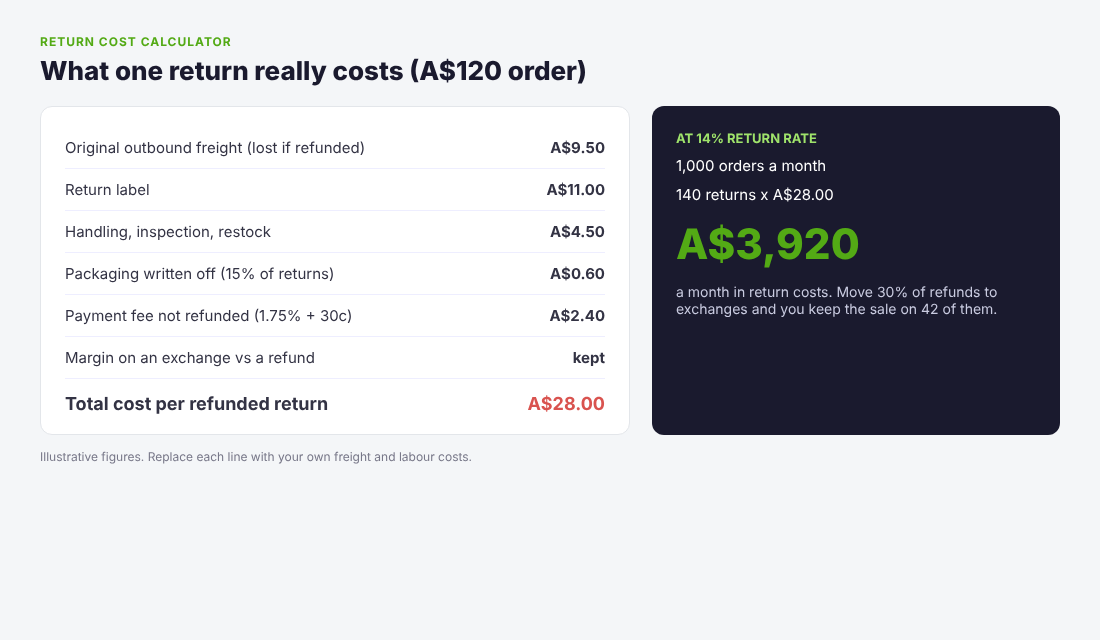
At a 14% return rate and 1,000 orders a month, that is roughly A$3,920 a month leaking out of margin. This is why the structure of your policy matters. Exchanges keep the revenue. Store credit keeps the cash. Refunds keep nobody happy except the customer. The short version: design the policy so the default outcome is an exchange.
What Australian Consumer Law actually requires
You do not need a law degree, but you do need to know where the line sits. Here is the plain English version, based on guidance from the ACCC and the NSW Small Business Commissioner.
Change of mind returns: your rules
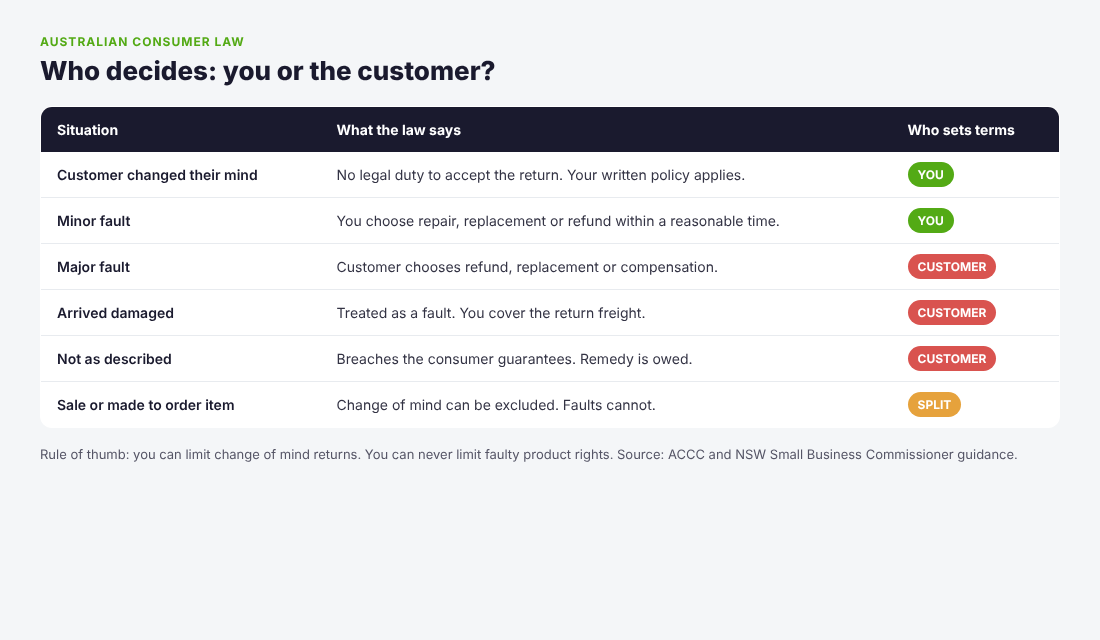
You are not required to accept returns because someone changed their mind, picked the wrong size or found it cheaper elsewhere. If you do offer them, the NSW Small Business Commissioner is clear that you should state the conditions upfront, including time limits, packaging and condition requirements, and whether the customer receives a refund, exchange or store credit. You can exclude sale items from change of mind returns, require tags attached, and charge return freight, as long as you say so clearly before purchase.
Faulty goods: the law’s rules
If a product is faulty, does not match its description or does not do what you said it would, the consumer guarantees apply no matter what your policy says. A minor problem lets you choose between repair, replacement or refund within a reasonable time. A major problem (the item is unsafe, unfit for purpose, significantly different to what you promised, or the customer would not have bought it had they known) gives the customer the choice, including a refund. These rights apply to sale items and online orders too.
The wording the ACCC flagged
The regulator’s 2025 sweep called out specific phrases as misleading. Check your site for every one of these:
- “No refunds or returns” as a blanket statement.
- “Sale items cannot be returned, exchanged or refunded” with no carve-out for faulty items.
- “Made to order products cannot be returned” with no mention of faults.
- “Opened or used items cannot be refunded”, because a fault is often only discovered after opening.
- A time limit such as “faults must be reported within 30 days”. Faults have no fixed window, only what is reasonable for the product.
- Restocking fees or non-refundable delivery on faulty items.
- Requiring original packaging for a faulty product.
- Telling customers faults can only be claimed through the manufacturer’s warranty.
Notice the pattern. You can restrict change of mind. You cannot restrict statutory rights, and you cannot imply that you can. If your policy was copied from an overseas brand or a generic Shopify template, it almost certainly contains at least one of these lines. This is also covered in our legal essentials for Australian Shopify stores.
How Australian brands set the bar
The brands customers talk about do not hide their policies. They use them as a selling point.
- Adore Beauty accepts returns within 130 days of purchase and refunds instantly for change of heart, wrong item sent or foundation shade mismatches. That window is nearly four times the typical 30 days, and it removes the biggest barrier to buying makeup online without testing it.
- Culture Kings handled around 60% of its revenue online and, after customers waited up to six weeks for refunds in 2020, moved to instant refunds. An A/B test showed customers who received instant refunds were more likely to buy again and spent more on their next order.
- AQUILA offers free return shipping to members of its Aquila+ loyalty programme, which turns a cost into a reason to join.
The lesson is not “be generous”. It is “be specific and fast”. Adore Beauty’s long window works because beauty has low per-item cost and high purchase anxiety. A heavy furniture brand cannot copy it. Match the policy to your product, your margin and your category return rate.
Set your numbers before you write a word
Before drafting, decide five things. Each one belongs in your policy as a plain statement.
- Return window. 14, 30 or 60 days from delivery (not from order date). Most Australian stores land on 30 days. Longer windows suit low-ticket, high-hesitation categories like beauty.
- Who pays return freight for change of mind. Free returns lift conversion but eat margin. A common middle path is a flat A$7 to A$10 deduction, or free returns for exchanges only.
- Refund method. Original payment, store credit, or exchange first. Offering a small bonus for store credit (say 10%) shifts a big share of refunds into retained revenue.
- Condition rules. Unworn, tags on, original packaging for change of mind only. Hygiene exclusions (underwear, earrings, opened skincare) are allowed if stated.
- Refund timing. Commit to a number of business days from when you receive the item, and hit it.
Pull your actual return rate from Shopify before choosing. Analytics lets you see returns by product, and Orders lets you filter by return status. Eightx’s Australian benchmark puts typical rates at roughly 31% for apparel, 17 to 25% for footwear, 19% for homewares, 12% for beauty, 11% for electronics and 4% for jewellery. If you sit well above your category, the problem is usually the product page, not the policy.
The copy and paste Shopify returns policy template
Here is the structure we use with eCommerce Circle members. Replace the brackets, keep the headings, and have a lawyer review it if you sell high-risk categories such as supplements, children’s products or electrical goods.
1. Our promise. If something is wrong with your order, we will fix it. Your rights under the Australian Consumer Law are never limited by this policy.
2. Faulty, damaged or incorrect items. If your item arrives damaged, is faulty, does not match its description or is not what you ordered, contact us at [email] with your order number and a photo. We will offer a repair, replacement or refund as the law requires, and we pay the return postage. Our goods come with guarantees that cannot be excluded under the Australian Consumer Law. You are entitled to a replacement or refund for a major failure and compensation for any other reasonably foreseeable loss or damage.
3. Changed your mind. You can return unused items in original condition within [30] days of delivery for an exchange, store credit or refund to your original payment method. [Return postage is paid by the customer / We deduct A$[8] for the return label.] Sale items are [eligible for exchange or store credit only / not eligible for change of mind returns]. This does not affect your rights for faulty items.
4. How to return. Start your return at [portal link] or email [email]. We will send a label or instructions within [1] business day.
5. Refund timing. We process refunds within [3] business days of receiving your item. Your bank may take up to [5] further business days to show it.
6. Items we cannot accept for change of mind. [Underwear, opened skincare, personalised or made to order items.] If these are faulty, we will always fix the problem.
7. Gifts. Gift recipients can exchange or receive store credit with an order number. See our gift returns playbook for how to handle this at scale.
Two details make this template work. First, section 2 comes before section 3, so the legal obligations are the first thing customers read, not buried. Second, every exclusion carries a line reminding readers that faults are different. That sentence is your protection if a regulator or customer ever challenges the page.
How to set it up inside Shopify
Writing the policy is half the job. Shopify has to enforce it, otherwise your team will make exceptions by hand.
- Add the policy. In Shopify admin go to Settings, then Policies, and paste the refund policy. Shopify links it in the checkout footer automatically. Also publish it as a page so you can link it from the product page and header.
- Turn on self-serve returns. Shopify’s native returns let customers submit requests from the order status page, and you can set return rules that control which items are eligible and for how long. Start here before paying for anything else.
- Add return rules by product. Mark final sale, hygiene items and made to order products as ineligible for change of mind only, and keep a manual path for faults.
- Attach labels. Native returns support optional return shipping labels and tracking. Use them to cut the “where is my parcel” emails.
- Link the policy in three places. Product page (under the add to cart button), cart drawer and the order confirmation email.
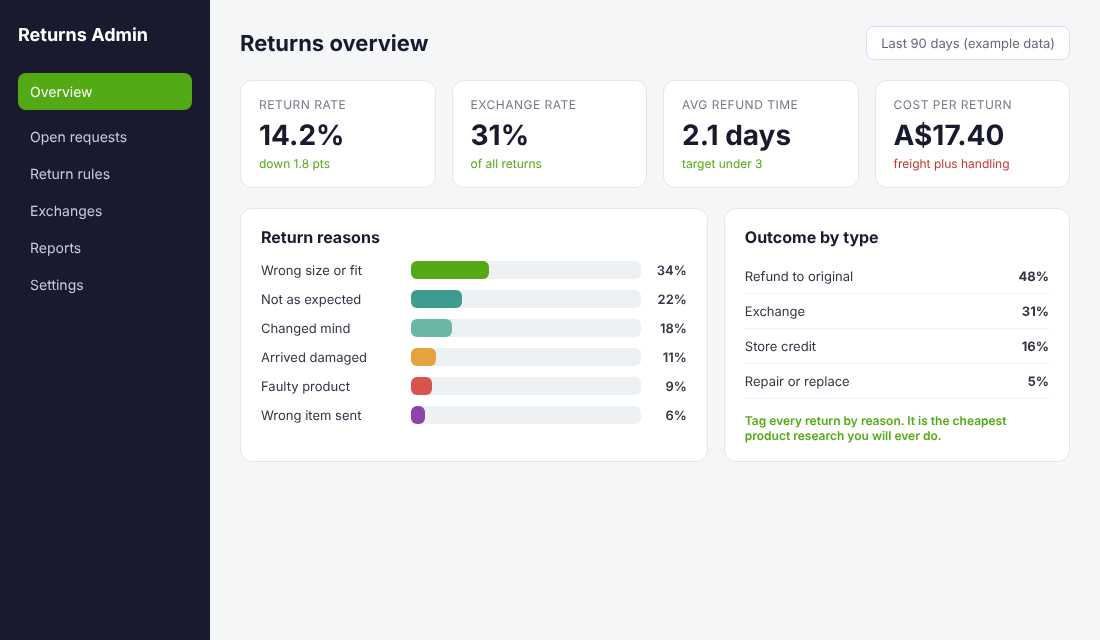
The dashboard above is example data, but the report is the one you want. Every return needs a reason tag. If 34% of your returns say wrong size or fit, add a size guide and fit notes rather than tightening the policy. If 11% arrive damaged, your packaging or carrier is the culprit. Your returns data is the cheapest product research you will ever collect.
Tools worth paying for (and when)
Native Shopify returns are free and enough for most stores under a few hundred orders a month. Once returns volume or exchange requests grow, an app earns its fee when it turns refunds into exchanges. Based on current published pricing (USD):
- AfterShip Returns: Free plan available, Essentials at US$9 per month, Pro at US$49 per month with auto-approval, 3 carriers and QR codes, Premium at US$199 per month with workflows and fraud prevention. Good value for small stores.
- Return Prime: Free for 5 return requests, Grow at US$19.99 per month. Branded portal and auto-approve rules.
- ReturnGO: Starter from US$23 per month with 20 returns included, and US$1.25 per extra return. Strong exchange-first flow and options that shift return costs to the shopper.
- Loop Returns: Essential at US$155 per month and Advanced at US$272 per month. Built for brands doing thousands of orders a month where exchange revenue pays for it.
Setup steps for the cheapest path (AfterShip Returns): install from the Shopify App Store, connect your carriers, set your return window and reasons to match the template above, switch on exchange as the first option on the portal, then paste the portal link into your policy page and order emails. Test it with a dummy order before launch.
Check pricing on each vendor’s site before you commit, as plans change often. Pick the cheapest tool that can auto-approve small returns and offer exchange first. Everything else is a nice-to-have.
Reduce returns without making customers angry
A good policy sits on top of a good product page. The stores with the lowest return rates fix the cause rather than punish the symptom.
- Fit and size content. Model height and size worn, a measuring guide, and “runs small” notes pulled from your own return reasons.
- Photos and video that match reality. If “not as expected” is your second biggest reason, your photos are overselling. Add true colour shots in natural light and a scale reference.
- Packaging. Damage claims often trace to a single weak box or an under-protected product. Test it with a drop from waist height.
- Post-purchase expectations. A delivery email with care and fit tips cuts avoidable returns.
- Exchange nudges. Show “Exchange for a different size” ahead of “Refund” in the portal.
- Fraud checks. NRF puts about 9% of returns as fraudulent. Watch for serial returners, wardrobing and empty-box claims, and see our high risk order guide for flagging risky orders before they ship.
When a return does happen, treat it as a retention moment. A quick, friendly resolution is cheaper than a lost customer. Our service recovery playbook shows how to turn a bad experience into a repeat purchase.
Your returns policy compound effect
None of these moves is dramatic alone. Together they compound. A clear policy lifts first-order conversion because shoppers trust you. Fit content and honest photos cut the return rate. Exchange-first flows keep revenue on the books. Fast refunds raise repeat purchase rates, as Culture Kings found. And because the wording stays inside the ACL, you remove the legal risk that quietly sits behind most Aussie store footers.
Run the maths on a store doing 1,000 orders a month. Drop returns from 14% to 11% through better product pages, and move 30% of the remaining refunds to exchanges. Using the A$28 cost per refunded return from earlier, that saves roughly A$840 a month in return costs and keeps about 33 sales a month that would have been refunded. Over a year that is five figures, from a page most founders write once and never revisit.
Returns policy checklist (use this today)
- Search your site for “no refunds”, “final sale”, “opened”, “within 30 days” and “restocking fee”. Rewrite every line that touches faulty goods.
- Put the faulty goods section above change of mind.
- Choose a return window, return freight rule and refund method, based on your category rate.
- Publish the policy at Settings, Policies and as a standalone page.
- Enable native Shopify self-serve returns and set return rules.
- Link the policy on the product page, cart and order confirmation.
- Tag every return by reason and review the top three reasons monthly.
- Offer exchange first, store credit second, refund third.
- Set a refund time target and measure it.
- Review the policy every six months and before Black Friday, when return volumes spike. Our Shopify shipping policy template pairs with this one.
This is general information, not legal advice. For categories with extra rules (electrical, children’s products, supplements) have an Australian lawyer review the final wording.
Inside eCommerce Circle, protecting your margin and your reputation through clear policies is one of the core pillars we work on with every member. If you want to see exactly where your store is being capped, take the free More Orders Scorecard. It takes two minutes and shows you which of the 10 P’s to fix first.