A shipping policy is the page that tells a customer what happens between clicking pay and opening the door. Most Australian Shopify stores either paste in Shopify’s default text and never look at it again, or copy a competitor’s page that was written for a different warehouse, a different carrier and a different customer. Both approaches fail at the worst moment, which is when a parcel is late and someone is angry.
Here is the short answer. A good Shopify shipping policy states your dispatch time and cut-off, your delivery estimates by region, what you charge and when shipping is free, what you do when a parcel is lost or damaged, and where you do not ship. It sits under Settings, then Policies in your Shopify admin, and it takes about an hour to do properly. The template further down gives you the wording.
This matters more than it looks. Baymard Institute’s checkout research, as summarised by OptinMonster, found that around 70% of carts are abandoned and that 47% of shoppers who abandon cite extra costs such as shipping, tax and fees. Another 24% cite delivery that is too slow, and 16% point to a returns policy they are not happy with. Your shipping policy is where all three of those objections are either answered or ignored.
Why your shipping policy is a sales page, not a legal chore
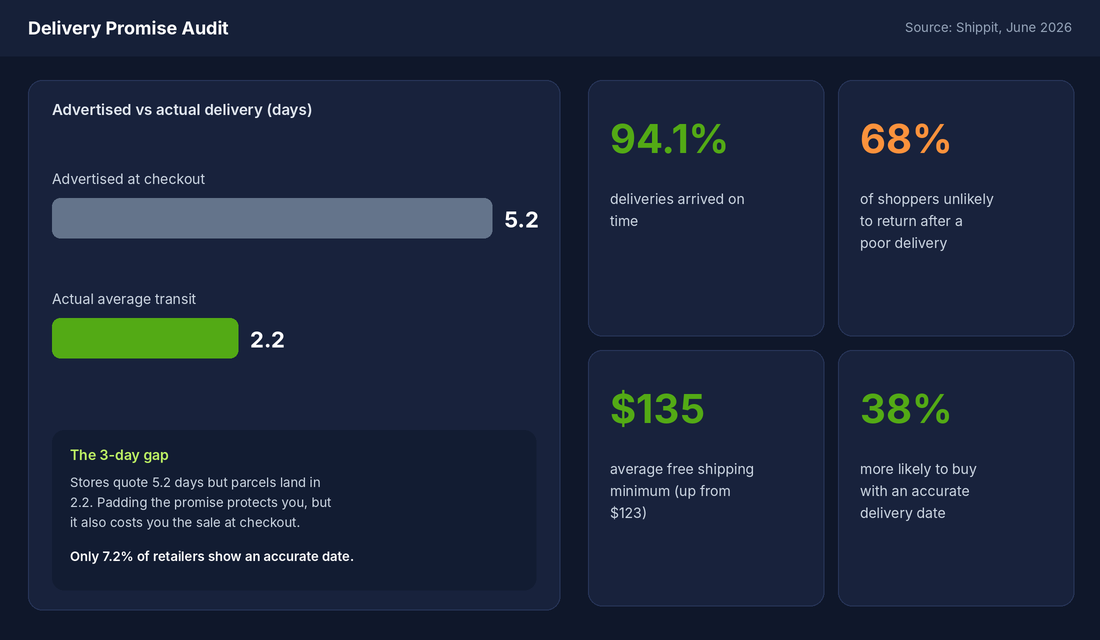
Treat the policy as the answer sheet for every shipping question a customer has before and after they buy. Shippit’s 2026 retailer research, reported by eCommerceNews Australia in June 2026, makes the cost of vagueness clear. Two in three shoppers say an accurate delivery date before purchase is essential or very important, and 38% say it makes them more likely to buy. Yet only 7.2% of retailers show an accurate estimate at checkout.
The same research found that 68% of shoppers are unlikely to return after a poor delivery experience, up from 64% a year earlier. One bad parcel does not just cost you a refund. It costs you the second order, which is where the profit sits. If you want the maths on that, our piece on why your second sale matters more than your first breaks it down.
There is also a gap most stores never measure. Shippit found retailers advertise an average of 5.2 days of delivery at checkout, while actual average transit is 2.2 days. That is a three-day gap. Padding your promise feels safe, but you are asking customers to wait longer than they need to, and the competitor who quotes honestly gets the sale.
So the first job of your policy is not to protect you. It is to make an honest promise you can keep, then show it clearly enough that a nervous buyer reads it and carries on to checkout.
What Australian law expects from your delivery promise
I am a coach, not a lawyer, so treat this section as orientation and check your specifics with a legal professional. What I can tell you is what the regulators say publicly, because it shapes how you write the policy.
According to WA Consumer Protection, products ordered online must arrive within a reasonable timeframe, or the timeframe the seller has indicated. If an item does not turn up when expected, the customer can ask for a written explanation, and if you still do not deliver they are entitled to a refund. The same page states that the seller is responsible for resolving issues with Australia Post or the courier used. It also notes that sellers must not take payment if they know they cannot deliver on time.
Read that last point twice if you run pre-orders or made-to-order products. Your policy needs to state the real lead time, not the optimistic one. The pre-order playbook covers how to word this for products that are not in stock yet.
Two practical consequences follow. First, a line like “we are not responsible for courier delays” does not work the way store owners hope. You chose the carrier, so you own the outcome. Second, your policy should explain how you resolve a problem, not try to avoid one. Our legal essentials guide for Australian Shopify stores covers the wider set of policies, and your shipping page should line up with your refund and returns wording.
The 8 sections every Shopify shipping policy needs
Here is the structure I use with coaching clients. Each section answers a question customers actually ask your support inbox. If a section does not map to a real question, cut it.
1. Dispatch time and cut-off
Say exactly how long you take to pack an order and what time orders must be placed to ship the same day. “Orders placed by 2:00 pm AEST on a business day ship the same day” beats “we ship quickly” every time. Define business days, and say what happens on weekends and public holidays. Adore Beauty does this well for its same-day service. Orders must be placed before 4:00 pm AEST, delivery lands between 6:00 pm and 9:00 pm, and it is limited to selected Melbourne postcodes at $10.95.
Bellroy takes a different approach. It states that it usually dispatches within 2 working days, and that regular post can take 3 to 28 working days depending on the address, with express generally 1 to 3 working days for Australia, the US and the UK. The range is honest, but notice how wide it is. A customer in Sydney cannot tell if they are waiting three days or three weeks. Your policy should narrow that by region.
2. Delivery estimates by region
Break your estimates into metro, regional and remote, and list Western Australia, Tasmania and the Northern Territory separately if your warehouse is on the east coast. Always count from dispatch, not from order, and say so. Australia Post notes that parcels from South Australia, Tasmania and the Northern Territory route through another state first, and advises adding two business days for Express and five for Standard and Economy. If you ship from those states, build that into your numbers.
| Region | Typical promise to write | What to check |
|---|---|---|
| Metro (Sydney, Melbourne, Brisbane, Adelaide, Perth) | 2 to 5 business days after dispatch | Your carrier’s own service times, plus your last 90 days of tracking data |
| Regional | 4 to 8 business days after dispatch | Longest 10% of your real deliveries, not the average |
| Remote, WA, NT, Tasmania | 6 to 12 business days after dispatch | Extra routing days, and any surcharge your carrier adds |
| New Zealand and international | State a range and say customs times are outside your control | Duties and taxes: who pays, and when |
Those ranges are starting points, not promises. Pull your actual delivery times from your carrier or from Shopify’s shipping reports and replace them. Shippit found that 94.1% of Australian deliveries arrived on time and average transit sat at 2.2 days, so most stores have room to quote tighter numbers than they currently do.
3. Shipping costs and free shipping
List your rates in a small table, and state the free shipping threshold in dollars. The Shippit research puts the average Australian free shipping minimum at $135, up from $123, with standard delivery averaging $11.30 and express $15.50. Only 8.8% of retailers offer free shipping with no minimum. Adore Beauty offers free Standard delivery on orders over $75 and free Express over $125. If you are still setting your own threshold, work through the numbers in our free shipping threshold playbook before you publish a figure you cannot afford.
4. Where you ship, and where you do not
Name the countries, and list the exclusions. Flammable items, batteries, aerosols and liquids often cannot go by air. Adore Beauty restricts orders containing flammable items to Standard Shipping outside Victoria, and puts that in writing. If you sell anything similar, state the restriction in the policy and on the product page, because the first time a customer learns about it should not be at checkout.
5. Tracking and delivery updates
Tell the customer when they get a tracking number, how, and what the first scan means. Bellroy mentions tracking only for express, which is a fair thing to disclose, but it leaves a gap for standard customers. If you offer tracking on every order, say so, because it is a selling point. If your tracking page lives on your own domain, link it.
6. Lost, delayed and damaged parcels
This is the section most stores skip, and it is the one that stops disputes. Spell out the steps. How long after the estimated date should the customer wait before contacting you? What do you need from them, such as a photo of damage or the packaging? What will you do, and how fast? Resend, refund or store credit?
Bellroy’s page, for example, covers address errors in detail but does not address lost parcels at all. That is a common pattern. If you copy it, you inherit the hole. For chargeback risk in particular, the returns, refunds and chargebacks framework shows how clear parcel wording protects you when a card dispute lands.
7. Address errors and failed deliveries
Say who pays if a parcel is returned to sender because of a wrong address, and give a window for the customer to correct an address before dispatch. Be specific. “Contact us within 2 hours of ordering at hello@yourstore.com.au” works. “Contact us as soon as possible” does not.
8. Peak periods and holiday cut-offs
Put your Black Friday, Cyber Monday and Christmas dates in the policy or link a dated banner to it. Australia Post delivered over 111 million parcels in November and December last year, its busiest peak yet, so delays are a fair expectation, not a surprise. Our Christmas cut-off playbook covers the full seasonal plan. Here is the headline data to build from.
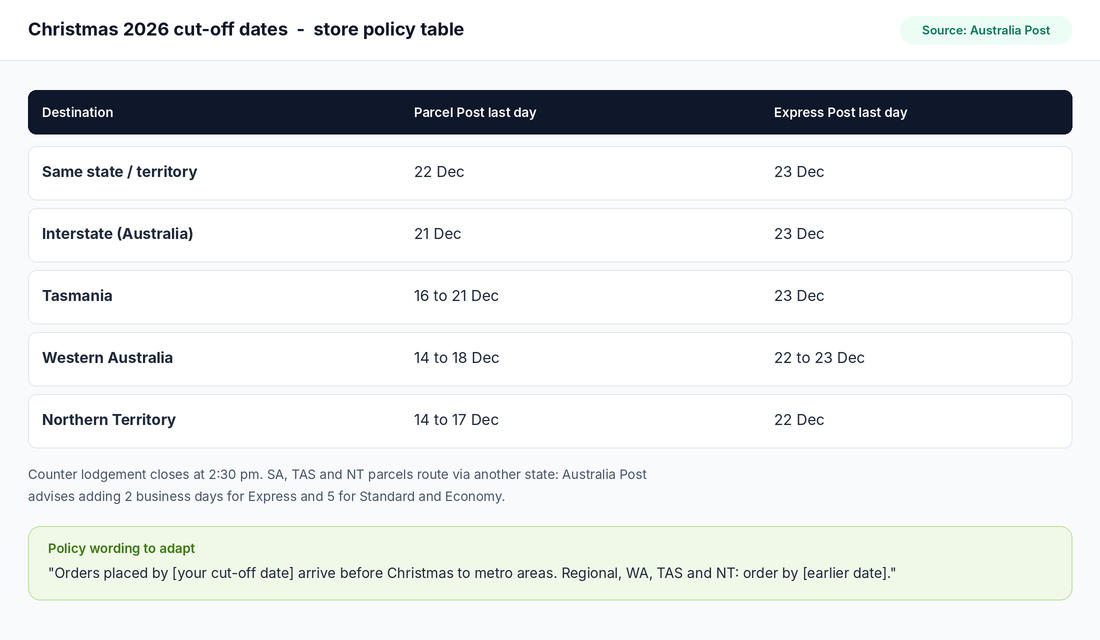
Per SBS’s reporting of the Australia Post announcement, last-sending dates for Parcel Post run from 14 to 18 December for Western Australia, 14 to 17 December for the Northern Territory, 16 to 21 December for Tasmania and 21 December interstate. Express Post runs to 23 December for most destinations. Counter lodgement closes at 2:30 pm. The SBS article is inconsistent on the same-state Parcel Post date, giving 22 December in the text and 21 December in the chart, so check auspost.com.au before you publish a date. Your own cut-off should sit well before these, because you also need pick and pack time.
Rule of thumb
Work backwards. Take the carrier’s last-sending date for the slowest region you serve, subtract your processing days, then subtract two more days as a buffer. That is the date you put on the banner, not the carrier’s date.
The Shopify shipping policy template for Australian stores
Copy this into Settings, then Policies, then Shipping policy. Replace everything in square brackets. Edit anything that does not match how you actually operate, because a policy you do not follow is worse than no policy.
Shipping policy template (copy and adapt)
Processing time. Orders placed by [2:00 pm AEST] on a business day are packed and dispatched the same day. Orders placed after that, or on weekends and public holidays, are dispatched the next business day. Business days are Monday to Friday, excluding [state] public holidays.
Delivery estimates. Times start from dispatch, not from the order date. Metro areas: [2 to 5] business days. Regional areas: [4 to 8] business days. Remote areas, WA, NT and Tasmania: [6 to 12] business days. You will see an estimated date at checkout before you pay.
Shipping rates. Standard shipping is $[X] and Express is $[Y]. Orders over $[Z] ship free with Standard shipping within Australia.
Where we ship. We ship to all Australian addresses including PO boxes where the carrier allows it, and to [New Zealand and other countries]. We cannot ship [restricted items] to [locations].
Tracking. You will receive a tracking number by email within [24 hours] of dispatch.
Lost, delayed or damaged parcels. If your order has not arrived [5] business days after the latest estimated date, email [support address] with your order number. We will contact the carrier and give you an update within [2] business days. If the parcel cannot be found, we will resend or refund your order. If your order arrives damaged, send a photo of the item and packaging within [7] days and we will arrange a replacement or refund.
Address errors. Email [support address] within [2 hours] of ordering to change your address. If a parcel is returned to us because of an incorrect address, we can resend it once the delivery cost is covered.
Peak periods. During Black Friday, Cyber Monday and Christmas, carriers are busier and delivery can take longer. Our last order dates for Christmas delivery are published on our site each November.
Note the lost parcel clause. It commits you to a response time, not a specific outcome, which lets you handle each case sensibly while still giving the customer certainty. It also reflects the consumer law position that you, not the courier, own the problem.
How to set it up in Shopify, step by step
Shopify’s own help documentation lays out the process. You can start from its automated template, which pulls your processing time from your delivery settings and your destinations from your shipping zones, or write your own. I recommend starting with the template, then rewriting it with the wording above.
- In your Shopify admin go to Settings, then Policies, and click Shipping policy under Written policies.
- Turn on Use automated policy to see the generated text, or turn it off and click Insert template to edit your own. Paste in the template above.
- Check Settings, then Shipping and delivery, then Estimated delivery dates. Set this to Manual or Automated so a processing time appears in the policy and at checkout.
- Click Save. The policy publishes at /policies/shipping-policy on your domain and links automatically in your checkout footer.
- Go to Content, then Menus, add the policy to your footer menu, and link to it from product pages and your FAQ.
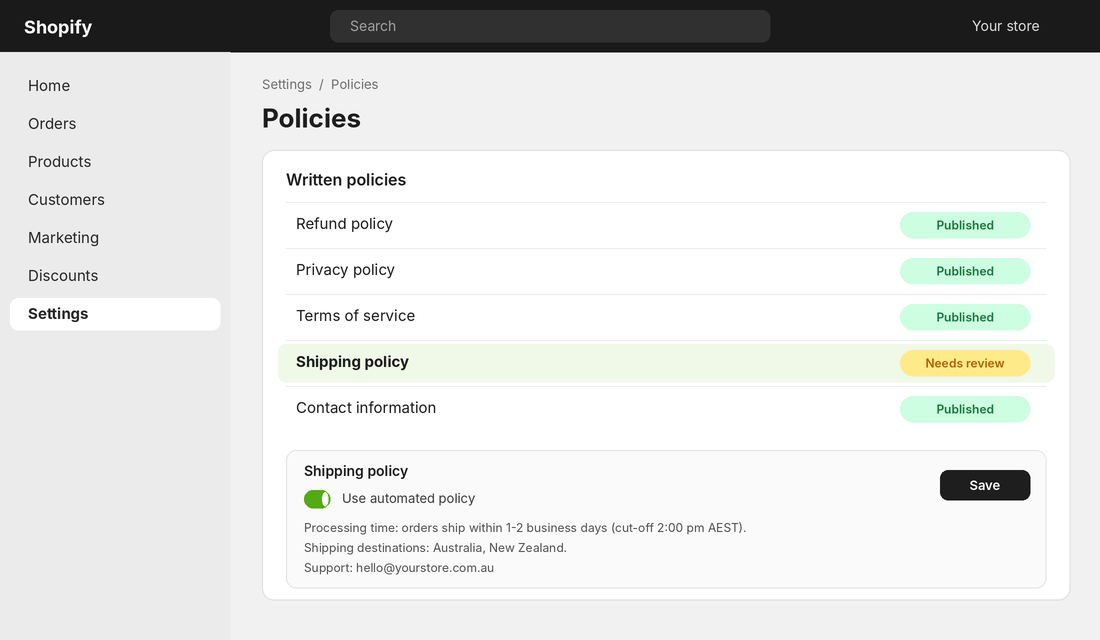
The automated policy is a decent first draft, but it knows nothing about your cut-offs, your lost parcel process or your peak-season rules. That is where you add value. If you are checking the rest of your policy stack at the same time, the Protection section of the Scorecard flags where wording gaps are most likely to cost you.
A tool that does the heavy lifting: Shippit or similar delivery-date apps
A policy page states ranges. A checkout that shows a real date is better. Shippit’s research found only 7.2% of retailers do this, which makes it one of the easiest ways to stand out. Shippit is an Australian delivery platform that connects Shopify to multiple carriers, and Shopify itself supports estimated delivery dates in its shipping settings. Whichever route you take, the setup is similar.
- Install your delivery platform from the Shopify App Store and connect your carrier accounts.
- Set your handling time, cut-off time and warehouse postcode so the calculation starts from the right place.
- Map each service level, such as Standard and Express, to the carrier product you actually use.
- Turn on estimated delivery dates at checkout and on the product page.
- Place a test order to a metro, a regional and a WA postcode, and compare the dates with your policy. They must match.
The test order in step five is where most stores find the mismatch. If your policy says 2 to 5 days and checkout says 4 to 9, one of them is wrong, and customers will believe the one at checkout.
Five mistakes that turn a shipping policy into a liability
- Copying a competitor’s page. Their warehouse, carrier and cut-off are not yours. Customers hold you to the words on your page.
- Promising “fast shipping” with no number. Fast to you may be slow to the customer, and a vague promise is hard to defend in a dispute.
- Setting delivery estimates from the order date. Count from dispatch, state the processing time separately, and show the total at checkout.
- Ignoring regional and remote customers. They are the ones who write angry emails when a parcel takes three weeks, and they were never warned.
- Never updating it. Carrier timeframes, your threshold and your peak dates all change. Put a quarterly review in your calendar.
Most of these come from treating the policy as a one-off task. A policy is a living document, and it works best when it is tied to a routine. Pair it with a monthly look at your late parcel rate and your support tickets about shipping, and update whichever section generates the questions.
The one-hour shipping policy audit
If you already have a policy, do not start from scratch. Run this audit and fix only what fails.
Shipping policy audit checklist
- Dispatch time and cut-off are stated with a time and a time zone.
- Delivery estimates count from dispatch and are split by metro, regional and remote.
- WA, NT and Tasmania are listed separately if you ship from the east coast.
- Rates and the free shipping threshold match what checkout actually charges.
- Exclusions and restricted items are named.
- Tracking is explained: when it arrives and where to use it.
- The lost, delayed and damaged process has response times and outcomes.
- Address change window and re-delivery cost are stated.
- Peak-period and Christmas cut-offs are dated for 2026.
- The policy is linked in the footer, cart, product pages and FAQ.
- A test order at checkout matches the policy dates.
- A review date is in your calendar.
Score yourself out of twelve. Under eight, the policy is probably costing you sales and creating support tickets. Eleven or twelve means you are ahead of most Australian stores, and your next lever is showing a real delivery date at checkout.
Putting it together
A shipping policy works as a system with three parts. The honest promise brings in the sale, because the customer knows what to expect. The clear process for problems protects your reputation, because the angry email gets a fast, defined answer. And the regular review keeps both accurate, which protects your margin when carriers change their rates or timeframes.
When you connect those parts, shipping stops being a cost line and becomes part of how you compete. You are not the cheapest option against Amazon, Temu and Shein, which Shippit forecasts will take 36% of Australian ecommerce this year. You win on being clear, accurate and easy to deal with. Do it this week, before the November rush makes every gap in your policy expensive.
Inside eCommerce Circle, protecting the customer promise is one of the core pillars we work on with every member, because a policy like this keeps the second order coming. If you want to see exactly where your store is being capped, take the free More Orders Scorecard. It takes two minutes and shows you which of the 10 P’s to fix first.
Sources: Shopify Help Center (Policies), WA Consumer Protection, SBS News on Australia Post 2026 Christmas dates, eCommerceNews Australia reporting of Shippit’s 2026 research, OptinMonster’s summary of Baymard Institute data, and the public shipping pages of Adore Beauty and Bellroy. This article is general information, not legal advice.