Affiliate marketing is one of the most cost-effective acquisition channels available to Shopify brands – and one of the most misunderstood. You only pay when a sale happens. There is no upfront ad spend, no wasted impressions, no guessing whether the campaign worked. An affiliate promotes your product, a customer buys through their link, and you pay a commission on the sale. Pure performance marketing.
What’s in This Article
Yet most Shopify stores either do not have an affiliate program or run one so poorly that nobody wants to participate. The brands generating 10-20% of revenue through affiliates have built programs that attract, activate, and retain high-quality partners. Here is how to do it right.
How Affiliate Marketing Works for Shopify
The mechanics are straightforward. You set up an affiliate program that gives partners a unique tracking link or discount code. When they promote your products on their blog, social media, email list, or YouTube channel and someone buys through that link, the affiliate earns a commission – typically 10-20% of the sale value.
For Shopify stores, the technology is handled by affiliate apps that integrate directly with your store: Refersion, UpPromote, and GoAffPro are the most popular. These apps handle tracking, attribution, commission calculation, and payout – so you can focus on recruiting and supporting affiliates rather than managing the technical infrastructure.
The key advantage over other channels: you pay nothing until a sale happens. Meta Ads charge you for clicks. Google Ads charge you for impressions. Affiliates only get paid when they deliver a paying customer. This makes affiliate marketing effectively risk-free from a cash flow perspective.
Setting Your Commission Structure
Your commission rate needs to be attractive enough to motivate affiliates while maintaining healthy margins for your business. Here are the common structures:
- Percentage of sale (most common). 10-20% of the order value. For Shopify stores with 55-65% gross margins, a 15% commission leaves plenty of room for profit. Higher commissions (18-20%) attract better affiliates but eat into margins – use these for hero products you want pushed hardest.
- Flat fee per sale. $10-25 per order regardless of order value. This works well when your AOV is consistent and simplifies commission calculations. It is also more predictable for budgeting.
- Tiered commissions. 10% for the first 10 sales per month, 15% for 11-50 sales, 20% for 50+ sales. Tiered structures motivate affiliates to push harder as they approach the next tier. Your top performers get rewarded while casual affiliates still earn a fair rate.
- First sale bonus. Standard commission plus a $20-50 bonus for each new customer the affiliate brings in. This incentivises affiliates to drive genuinely new customers rather than capturing sales from people who would have bought anyway.
Set a 30-60 day cookie window. If someone clicks an affiliate link but does not buy for 14 days, the affiliate should still get credit. A longer window is more attractive to affiliates because it captures the natural consideration period for higher-priced products.
Recruiting High-Quality Affiliates
The biggest mistake is signing up everyone who applies and hoping some of them promote your products. Most will not. You need a targeted recruitment strategy:
- Convert your customers into affiliates. Your best customers are already talking about your products. Invite them to earn commissions for referrals they are already making organically. In your post-purchase email flow, add an affiliate recruitment email: “Love our products? Earn commissions by sharing them with your audience.”
- Recruit niche bloggers and content creators. Search for blogs, YouTube channels, and Instagram accounts in your niche. Reach out personally: “We love your content on [topic]. We think our [product] would be a great fit for your audience. Would you be interested in our affiliate program? We offer 15% commission on every sale.” Personal outreach converts at 5-10x the rate of generic signup pages.
- Partner with complementary brands. Find non-competing brands that sell to the same audience. A fitness brand might partner with a healthy snack brand, a yoga mat company, or an activewear brand. Cross-promote each other’s products through affiliate links – both brands benefit from access to each other’s audience.
- Use affiliate networks. Platforms like ShareASale, Commission Junction, and Impact connect you with thousands of established affiliates looking for products to promote. The network takes a fee, but the reach is significantly broader than running your own program alone.
Activating and Supporting Your Affiliates
Recruiting affiliates is only half the job. The bigger challenge is getting them to actually promote your products. Most affiliate programs have a 80/20 problem: 80% of affiliates sign up and never make a single referral. Here is how to activate the inactive majority:
- Provide ready-made marketing assets. Create a resource pack with product images, lifestyle photos, banner ads, email templates, and social media captions. Affiliates are much more likely to promote when you hand them the content – rather than expecting them to create their own.
- Send monthly affiliate newsletters. Keep affiliates engaged with monthly updates: new products, upcoming promotions, seasonal opportunities, top-performing products, and inspiration from successful affiliates. This keeps your brand top-of-mind and gives affiliates fresh reasons to promote.
- Offer exclusive affiliate promotions. Give affiliates a unique discount code their audience cannot get anywhere else: “Use code PARTNER15 for 15% off – exclusive to [affiliate name]’s audience.” This exclusivity gives affiliates a compelling reason to promote and makes their audience feel special.
- Pay reliably and on time. Nothing kills affiliate motivation faster than late or missed payments. Set a clear payment schedule (monthly, net 30) and stick to it without exception. Consider offering weekly payouts for top performers – faster payment cycles motivate faster promotion.
Measuring Affiliate Program Success
Track these metrics monthly to ensure your affiliate program is healthy and growing:
- Active affiliate rate. What percentage of your affiliates made at least one referral this month? Benchmark: 15-25%. Below 10% means your activation and support need improvement.
- Revenue per affiliate. Total affiliate revenue divided by number of active affiliates. This tells you whether you have a few superstars carrying the program or a healthy distribution of productive partners.
- Effective CPA. Total commissions paid divided by number of new customers acquired. Compare this to your Meta and Google CPA. Affiliate CPA should be significantly lower because you only pay on completed sales.
- Customer quality. Track the LTV and repeat purchase rate of affiliate-acquired customers. If affiliate customers have lower LTV than other channels, the affiliates might be attracting discount-seekers rather than genuine brand fans.
The Three Affiliate Traps That Quietly Eat Your Margin
An affiliate program that looks healthy on the dashboard can still leak money underneath it. When we audit member programs inside eCommerce Circle, the same three traps show up again and again.
- Coupon poachers. Coupon and cashback sites position themselves at the checkout, so a buyer who was already paying full price opens a new tab, grabs a code, and that site claims the commission. On unmanaged programs, 15 to 30% of “affiliate” revenue is really last-click coupon interception. Cap coupon sites at 1 to 2% commission or remove them entirely, and issue unique codes per affiliate instead of sitewide ones.
- Cookie stuffing and self-referrals. If an affiliate is converting at 10% while your site average sits at 2 to 3%, dig into where those clicks come from before you pay out. Keep your cookie window at a standard 30 days, void commissions on refunded or cancelled orders automatically, and audit your top five earners every month.
- Paying commission on customers you already own. Exclude branded-search bidding and existing-customer promos from your program, or you will pay 10% for orders that would have happened anyway. Watch each affiliate’s new-versus-returning split: a genuinely valuable affiliate should send you at least 60% new customers.
Before you lock in final rates, sanity-check them against your customer lifetime value. A 10% commission on a $90 AOV product with a 40% contribution margin costs you $9 of your $36 margin. If those customers reorder twice over the next year, the real cost of acquisition drops to under 10% of 12-month value, which is a trade you take every single time.
Imagine you run an $80k a month skincare brand in Melbourne with 40 active affiliates. Odds are a dozen of them drive 90% of the revenue, because the top 10% of affiliates typically produce 70 to 90% of program sales. One member in exactly that position trimmed six coupon poachers, reallocated their commission budget to the top creators, and lifted program contribution margin 22% on flat revenue inside a quarter.
The Compound Effect of Affiliate Marketing
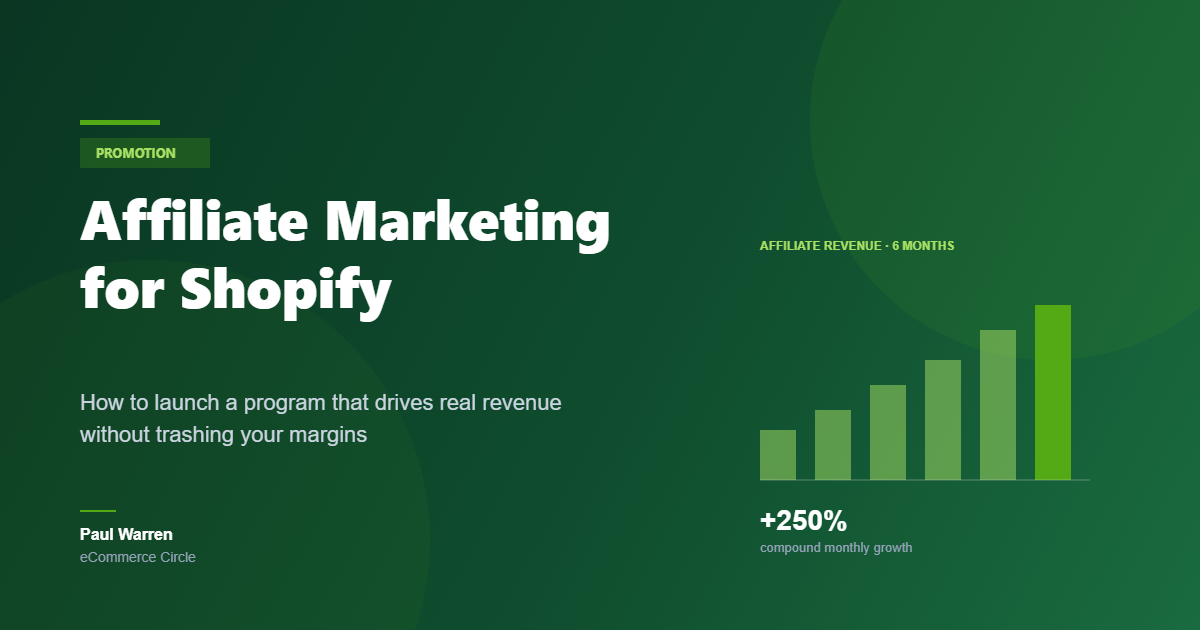
Affiliate marketing compounds in two ways. First, as you recruit more affiliates and activate existing ones, the program generates more revenue with minimal additional management. Second, affiliate content (blog posts, YouTube reviews, social posts) lives on the internet permanently, driving traffic and sales for months or years after publication.
One eCommerce Circle member launched an affiliate program with 25 carefully recruited partners. Within six months, the program grew to 80 active affiliates generating $14,000 per month in revenue at an effective CPA of $18 (vs. $42 for Meta Ads). The best part: several affiliate blog posts now rank on Google’s first page for product-related keywords, driving organic traffic that costs nothing beyond the original commission.
Affiliate marketing is the closest thing to a free sales team. Build it right, and it compounds indefinitely.
The Tools That Actually Run Your Affiliate Program
You do not run an affiliate program out of a spreadsheet past your first five partners. Tracking, attribution, and payouts get messy fast, and messy is how you end up paying commission on sales that were never affiliate-driven. Pick a purpose-built Shopify app early.
UpPromote is the most popular starting point – free to install, around US$29.99/mo once you scale, and it handles referral links, coupon tracking, and automated payouts. Refersion (from roughly US$99/mo) is the step up when you want cleaner reporting and first-party tracking. Social Snowball is built for turning customers and creators into affiliates with instant payouts, GoAffPro has a genuinely usable free tier, and LeadDyno sits in the middle. Whichever you choose, connect it to GA4 so affiliate revenue shows up next to your paid and organic channels instead of hiding in a silo.
The rule: your tool should track by both unique link and coupon code. Plenty of buyers copy a code and never touch the link, and if you only track links you will underpay your best partners – then lose them to a brand that pays properly.
The Affiliate Numbers Worth Benchmarking Against
Numbers keep you honest. These are the ones that decide whether your program is a profit centre or a slow leak.
- Commission usually lands between 10% and 20% of the sale. High-margin or digital products can stretch to 25-30%; anything under 40% gross margin should stay near 10%.
- The Pareto rule hits hard here – roughly the top 20% of your affiliates will drive about 80% of affiliate revenue. Find them fast and treat them like VIPs.
- A mature affiliate channel settles at 5-15% of total revenue. If it is still under 3% after six months, your commission or your recruiting is too weak.
- Set your attribution window to 30-60 days. Shorter robs affiliates of slow-converting traffic; longer and you overpay for sales they barely touched.
- Rank affiliates by EPC (earnings per click), not raw sales. A partner sending 200 buying clicks beats one sending 2,000 tyre-kickers.
Pay monthly on net-30 terms. That gap covers your returns and chargeback window, so you are never clawing back commission after a refund clears.
Where Affiliates Fit Alongside Your Other Channels
Affiliate marketing is not a standalone growth plan – it is one profit-safe lane in a wider mix, and it works best stacked with channels that share its DNA. Your affiliate recruiting list and your creator list overlap heavily, so run your program right next to your influencer marketing system instead of treating them as separate worlds.
It also pairs naturally with your referral program: affiliates are motivated strangers, referrers are motivated customers, and the same tracking discipline powers both. And once you know your true blended cost of acquisition – affiliate payouts included – you can decide how hard to push paid. If your Google Shopping campaigns run at a 3x return and affiliates deliver an effective 6-8x, you have a clear signal about where the next dollar goes.
Imagine you run a $120k/month Aussie apparel store. Ten active affiliates on 15% commission driving 8% of revenue is roughly $9,600/month in sales for about $1,440 in commission – paid only after the sale clears. That is the kind of maths that makes affiliates the easiest yes in your acquisition stack.
Know Your Affiliate Numbers Before You Launch
Run the maths before you recruit a single affiliate. Most ecommerce programs pay 10-20% commission, with a 30-day cookie window as the common default. If your gross margin is 50% and you pay 15%, you still keep 35% before ad spend and fulfilment. If it is 30%, a 15% commission leaves almost nothing.
Track three numbers monthly: affiliate-attributed revenue as a share of total (a healthy early target is 5-10%), average order value of affiliate customers versus everyone else, and refund rate by affiliate. A handful of partners often drive most of the revenue, so treat your top five like wholesale accounts.
For tooling, UpPromote, Refersion and Social Snowball all connect to Shopify and handle tracking links, payouts and discount codes. Pick one and run a 60-day pilot with 5-10 hand-picked affiliates before scaling.
Imagine you sell pet products in Brisbane and recruit ten local vet nurses and dog trainers. Give each a code, a 12% commission and a product pack. Ten engaged micro-creators almost always beat a hundred cold applicants. If you want to compare affiliate cost against other channels, our SMS marketing guide shows what a retention channel typically returns.
Launch Your Program This Month
Install an affiliate app (UpPromote is a great starting point for Shopify), set your commission at 15%, create a basic marketing asset pack, and recruit your first 10 affiliates from your existing customer base. That is enough to get the flywheel spinning. Expand recruitment and optimise as you learn what works.
Inside the eCommerce Circle, affiliate marketing is part of our Promotion framework. We help members design, launch, and scale affiliate programs that create an army of brand advocates generating sales on autopilot – because the best growth comes from people who genuinely believe in your product.
Pay for results, not promises. That is the affiliate advantage.
Inside eCommerce Circle, building profit-safe acquisition channels like affiliates is one of the core pillars we work on with every member. If you want a second opinion on yours, let’s talk.