Your Meta Ads account is bleeding money and you can feel it. The CTR is sliding. The CPM is climbing. The same hero video that printed sales six weeks ago now feels stale, and the polished studio shoot you spent $4,000 on is converting worse than a phone-shot review your customer sent you for free.
What’s in This Article
Most Aussie Shopify brands respond to this exactly wrong. They book another expensive shoot. They brief an agency for a glossy “brand video.” They wait three weeks for delivery and burn another $5K hoping the next polished asset saves them.
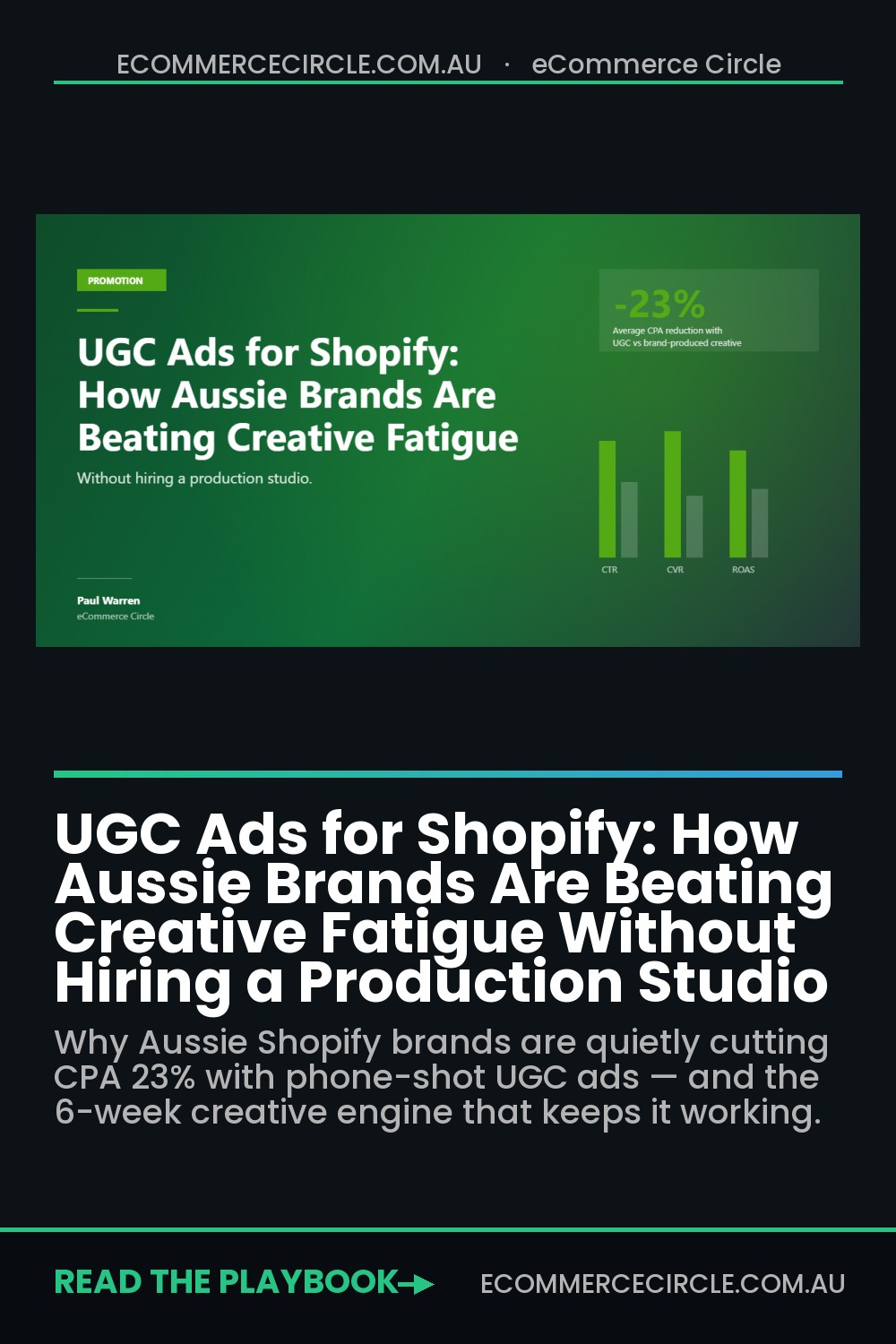
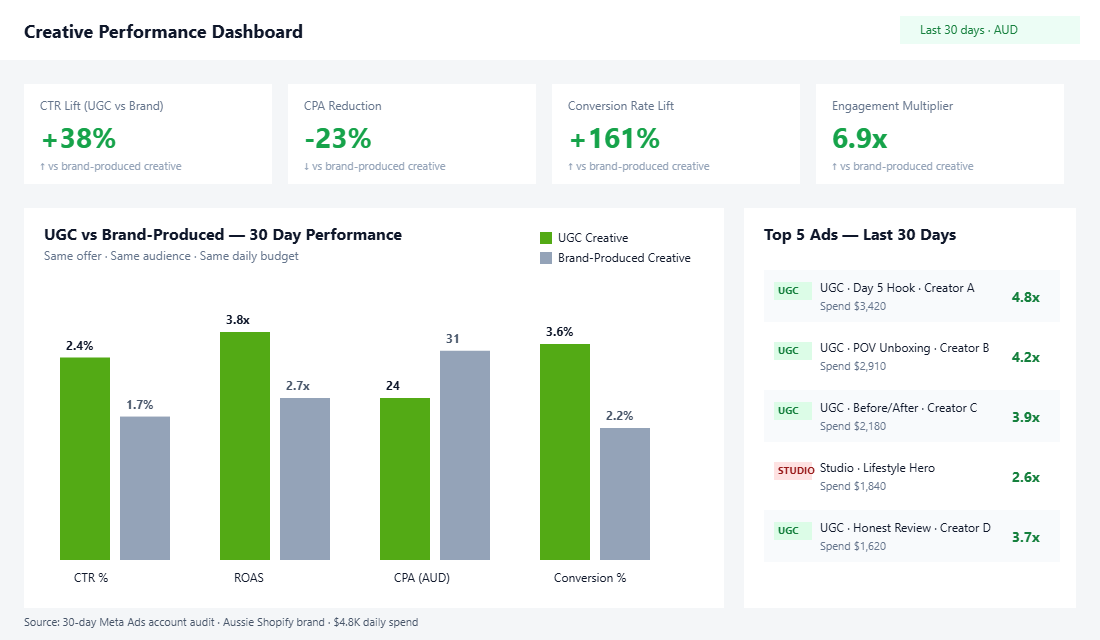
The brands actually scaling past $100K a month on Meta in 2026 are doing the opposite. They are running phone-shot, customer-style UGC ads at volume, refreshing creative every two to four weeks, and treating their ad account like a content factory rather than an art gallery. UGC ads now reduce CPA by 23% on average, drive a 4x higher CTR than brand-produced content, and influence purchasing decisions for 84.3% of consumers globally. That is not a small edge. That is the gap between a profitable account and a dying one.
This is the playbook for building a UGC ad engine for your Shopify store. Not a one-off campaign. A system that produces fresh, conversion-focused creative every single week without you hiring a production studio.
Why UGC Beats the Studio Shoot Every Time (The Data)
You already feel this in your bones, but the numbers make it impossible to argue with. The performance gap between UGC and polished brand content is now the single biggest lever you have in your Meta Ads account.
Here are the benchmarks every Shopify owner should have on their wall:
- UGC-style video ads outperform professional creative by 30-40% in CTR across most ecommerce niches because they don’t pattern-match as ads in the feed.
- UGC ads cut average CPA by 23% compared to brand-produced creative running the same offer to the same audience.
- Product pages featuring UGC convert at rates 74-161% higher than identical pages without customer content.
- UGC posts achieve 6.9x higher engagement than content produced by brands themselves.
- 80% of consumers trust UGC more than traditional advertising, and 84.3% say UGC influences their purchase decisions.
- DTC brands saw 38% higher ROAS using UGC overlaid with clear benefit-first text (e.g., “Day 5 of using this serum, results 👀”) versus plain talking-head UGC.
The reason is simple. Your customer doesn’t open Instagram looking for a brand. They open it looking for entertainment, validation, and a quick scroll. Anything that looks like a polished ad triggers the skip reflex inside the first 1.2 seconds. A real person holding the product in their bathroom, on their kitchen bench, or in their car bypasses that filter entirely. That is the entire game.
This is why brands like Frank Body generated over $20 million in revenue with minimal paid media spend, almost entirely on the back of customer-generated photos and videos showcasing their coffee scrub. They did not out-shoot their competitors. They out-organised them. They built a system to capture, license, and run UGC at volume before “UGC” was even the term we used for it.
The 5 UGC Ad Formats That Actually Print Money
Most brands run “UGC” and stop there. That is the mistake. UGC is a category, not a creative concept. Inside that category, five specific formats consistently win on Meta and TikTok for Shopify stores. If your account isn’t running at least three of these every month, you have an obvious next move.
- The Problem-Solution Hook. Creator opens with a pain point (“I tried six tanning mousses and they all turned me orange”), then introduces the product as the fix. Best for higher-consideration purchases over $80 AUD.
- The Day-In-The-Life Demo. Creator integrates the product into a real routine — morning skincare, school drop-off, gym session — and narrates as they go. Excellent for category education and TOF prospecting.
- The Honest Review. Creator films the unboxing, first impression, and 7-day result with no script. Feels like a friend’s recommendation. Best for retargeting and warm audiences who already know the brand.
- The Before-and-After Transformation. Visual proof of the result over time. Bondi Sands has built an entire creator pipeline around this format on TikTok, generating up to 100,000 views per reel and converting that into Shopify sales the same day.
- The “POV” or Reaction Format. Creator films a moment of genuine surprise — opening the box, smelling the product, seeing the result. Hooks attention in the first 0.8 seconds, which is the only window that matters in 2026.
Aussie haircare and skincare brands are leaning hardest into formats one and four. Apparel and homewares are winning with two and three. Food, supplements, and wellness brands are crushing it with five. Pick the two that fit your category and run them in parallel until the data tells you otherwise.
One critical detail: every UGC ad needs benefit-first text overlay in the first 3 seconds. “Day 5 — my skin is glowing.” “AUD $39 and it lasts a month.” “I cancelled my $200 salon appointment.” Without that overlay, your CTR drops by an average of 38%. The format works because it tells viewers what they’re getting before they decide to scroll.
Where to Find Aussie UGC Creators Without Blowing Your Budget
The biggest myth in UGC is that you need to “find creators.” You don’t. You need to choose a sourcing channel and commit to it for at least 90 days. Switching platforms every fortnight is how brands waste $3K and get nothing useable.
Here are the four sourcing channels Australian Shopify brands are actually using, ranked by speed-to-creative:
- Aussie-first platforms (Creator Flow, Creator Hub, Sticki). These connect you directly with vetted local creators. Briefs go live in 24 hours, applications come in within 48, and you usually have first cuts in 7-10 days. Creator fees in Australia run $150-450 per video for emerging creators and $600-1,500 for proven performers. Best for brands wanting local accents, local seasonality, and Australian-context content.
- Global UGC marketplaces (Influee, JoinBrands, Insense, Collabstr). Larger creator pools, often cheaper rates, and tools like Insense integrate directly with Shopify so you can ship product without manual fulfilment. Use these when you need volume — 10+ videos a month — and you’re comfortable with mixed accents.
- Your existing customer base. The cheapest and most underused channel. Run a post-purchase email two weeks after delivery offering a $50 store credit or a free product for a 30-second video. If you have 500 monthly orders, even a 4% conversion gets you 20 free pieces of UGC every month. This is exactly how Frank Body built its content moat.
- Micro-influencer seeding. Send free product to 50 Aussie micro-influencers (1K-25K followers) with a clear ask: “Would love your honest take on this if you enjoy it.” Roughly 30-40% will post organically. License the best 5-10 pieces for paid usage. Who Gives A Crap reallocated spend toward sustainability-focused micro-influencers and lowered CAC by an estimated 15-25% versus prior celebrity-led campaigns.
Pick one channel. Run it hard for 12 weeks. Track the cost per usable asset (CPUA) and the cost per winning ad (CPWA). If you’re spending more than $200 AUD per usable asset or you can’t produce a winning ad for under $1,000, the issue is not the platform — it’s the brief.
The UGC Brief That Gets Usable Content Every Time
This is where 80% of brands fail. They send creators a generic brief that says “show the product and talk about how good it is,” and they get back generic content that converts like a wet sponge. Your brief is doing the heavy lifting before a creator ever turns the camera on.
The brief template that works follows a simple structure. Save this and use it for every creator engagement.
- 1. The Customer Avatar. One paragraph describing exactly who this video is for. Age, lifestyle, the specific frustration they’re feeling. Not “women aged 25-44.” Try “an Aussie mum of two who feels like she’s lost herself since the kids, has 12 minutes to do her face in the morning, and is exhausted by skincare that overpromises.”
- 2. The Hook (you write it, not them). Give the creator the exact first line. “Day 5 of using this and my skin is genuinely glowing” works. “Hi guys today I’m going to talk about this amazing product” does not. The hook is the single most important asset in the ad — never delegate it.
- 3. The 3 Talking Points. No more, no fewer. Three benefits to mention in their own words. Not features. Benefits. “Lasts 6 days without reapplying” is a benefit. “Contains hyaluronic acid” is a feature only chemists care about.
- 4. The Setting. Be specific. “Filmed in your bathroom, natural light, vertical 9:16, phone propped on something stable, no ring light.” Production cues drive consistency.
- 5. The Objection Handling Line. One sentence the creator should naturally drop in to address the most common reason customers don’t buy. “I was worried it would feel sticky but honestly it sinks straight in.” Pure conversion gold.
- 6. The CTA. Tell them exactly what to say at the end. “If you’ve been on the fence, the link is in the bio — they’re doing AUD $20 off your first order this week.”
- 7. The Deliverables. Three takes of the hook, one full-length 30-second version, and 3-5 B-roll clips of the product. This gives your editor the raw material to cut multiple ads from a single brief.
A brief like this takes you 20 minutes to write and 4x’s the usable asset rate from your creators. That is the actual ROI on UGC briefing — not the per-video cost.
How to Spot Creative Fatigue Before It Eats Your ROAS
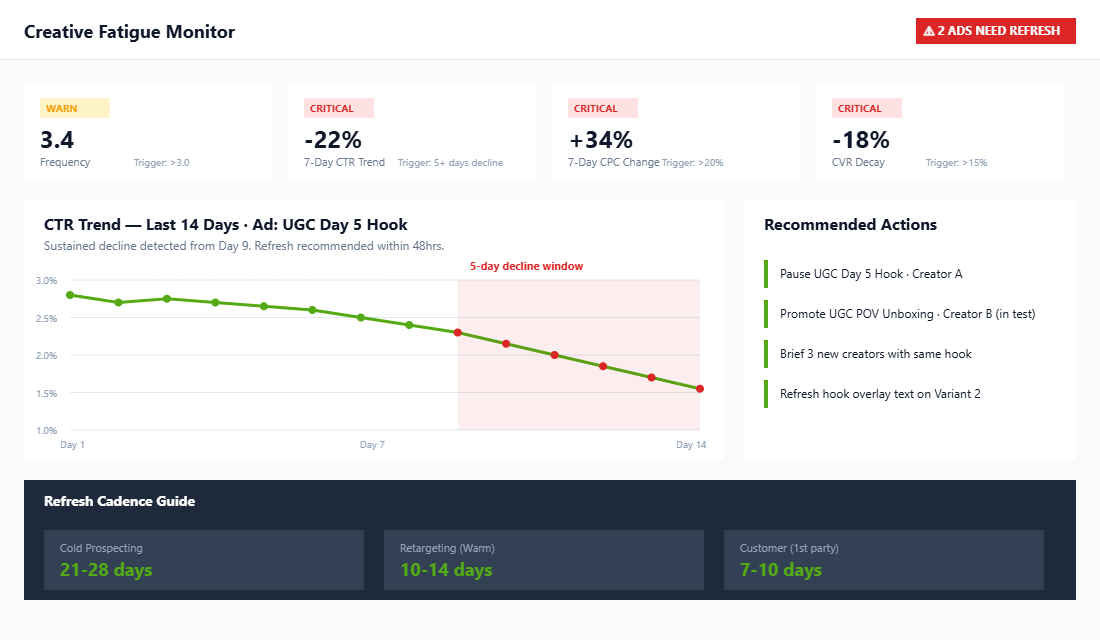
UGC fatigues faster in 2026 because more brands run it, audiences pattern-recognise it quicker, and Meta accelerates spend toward early winners (which means a winning ad gets seen by your audience three times faster than it used to). The window between “this ad is crushing” and “this ad is dead” has shrunk to about 10-14 days for retargeting and 21-28 days for cold prospecting.
Here are the four signals to watch in your Meta Ads Manager every Monday morning:
- Frequency above 3. If your ad’s frequency hits 3 in a 7-day window for a cold audience or 5 for a retargeting audience, the curve is about to roll over. Refresh now.
- CTR declining for 5+ consecutive days. A small drop is noise. Five days of consistent decline is the audience telling you they’ve seen enough.
- CPC rising 20%+ over 7 days. Auction signal that the algorithm is having to push harder to find people who will click. Fatigue is already hitting.
- Conversion rate decay greater than 15%. Even if CTR holds, a falling conversion rate means the audience clicking is now lower-quality. The ad is fishing for the bottom of the audience pond.
The fix is not to “boost the budget” or “duplicate the campaign.” It is to ship new creative. This is why your UGC system has to produce 4-8 fresh assets every month minimum. If you have one or two winning ads carrying your account, you’re 30 days away from a CPA spike that will catch you flat-footed.
One tactical layer: rotate the same hook across three different creators rather than three different hooks from one creator. The audience fatigues on the face, not just the message. Three different Aussie creators saying “Day 5, results 👀” will outperform three different scripts from the same creator nine times out of ten.
The Creative Testing Framework: 3 Layers, 6 Weeks, Real Winners
Most Shopify brands “test creative” by uploading 12 different ads to one ad set and hoping Meta picks the winner. That’s not testing. That’s gambling.
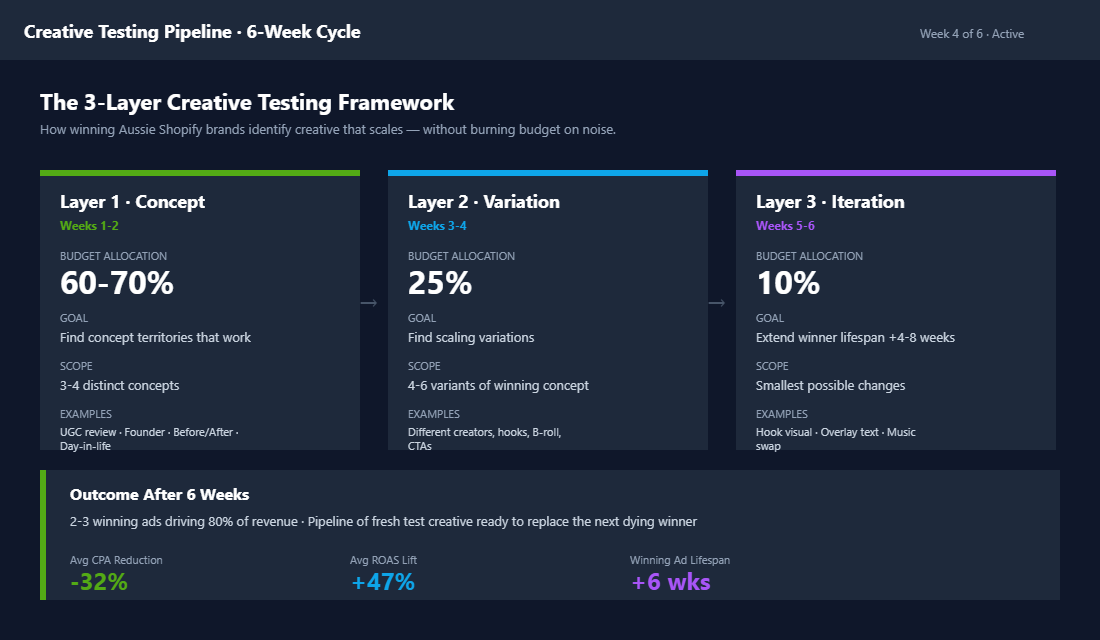
The framework that actually identifies winners runs in three structured layers over a six-week cycle:
- Layer 1 — Concept Testing (Weeks 1-2). Test 3-4 fundamentally different creative concepts. UGC review vs. founder story vs. before-and-after vs. day-in-the-life. Same offer, same audience, different creative angles entirely. 60-70% of your testing budget lives here. Goal: identify the 2-3 concept territories that work for your brand.
- Layer 2 — Variation Testing (Weeks 3-4). Take your winning concept and run 4-6 variations. Different creators, different hooks, different B-roll, different CTAs. Same concept territory. 25% of your budget. Goal: find the specific variations that win at scale.
- Layer 3 — Iteration Testing (Weeks 5-6). Take the proven variation and test the smallest possible changes. Same hook, different opening visual. Same script, different overlay text. 10% of budget. Goal: extend the lifespan of a winning ad by 4-8 weeks.
The brands that scale on Meta past $100K AUD a month are not running 50 different ads. They are running 2-3 winners that drive 80% of revenue, plus a constant 6-week test pipeline that keeps the next winner ready to take over. A/B testing your store is half the equation. Testing your creative is the other half — and most brands neglect it entirely.
The Compound Effect: Building a UGC Engine, Not Just Running Ads
Here is where most coaching content stops. We’re not stopping there. The reason UGC ads work for some brands and not others isn’t the platform, the creator, or the brief. It’s whether the brand has built a repeatable engine — or whether they’re treating UGC like a one-off project.
An engine has four moving parts running every single month, on a calendar, regardless of how busy you are:
- Sourcing. Every month, you brief 6-10 new creators or activate 5-10 customer videos. This is non-negotiable. Block the first Monday of every month to send the briefs.
- Editing. Every fortnight, raw creator footage gets cut into 3-5 edited ad variations by a $25/hour video editor (you can hire on Upwork, Fiverr, or onlinejobs.ph). One brief = 5 ads, not 1.
- Launching. Every Monday, fresh creative is uploaded into your testing campaign in Meta Ads Manager. Old creative gets archived. Performance gets reviewed. Decisions get made.
- Capturing. Every order ships with a card or follow-up email asking customers for a 30-second video review in exchange for a $50 store credit. This builds your free, perpetual UGC pipeline.
When all four parts run together, the compound effect kicks in around month three. Your cost per usable asset drops below $80. Your winning ads compound on each other because you can iterate on patterns. Your customer-sourced UGC starts to outperform paid creators because customers don’t sound scripted. And your CPA on Meta drops 20-35% — not from a hack or a new audience, but from a fundamentally better creative pipeline than anyone else in your category.
This is the same operating principle that makes a winning email funnel work, that makes a great Meta Ads account structure compound, and that separates the brands that grow from the brands that plateau. You don’t need a hack. You need a system that runs whether you’re paying attention to it or not.
The Usage Rights Clause That Stops a ,000 Mistake
Here’s the scenario that catches Aussie brands out. You pay a creator $400 for three videos. One of them takes off, and nine months later it’s still your best performer at 4.1x ROAS. Then the creator’s agent emails asking for a licensing fee for continued use, because your original agreement said “organic use” and never mentioned paid.
That negotiation is expensive and it always happens at the worst time — when the ad is working and you can’t afford to switch it off. Get it right at the brief stage instead. Every creator agreement needs four things spelled out:
- Paid media rights, explicitly. The words “paid social advertising” must appear. “Social media use” is not the same thing and a creator’s agent will tell you so.
- A term of at least 12 months, ideally perpetual. Perpetual usage typically adds 30-50% to the base rate. On a $400 video that’s $150 to never have this conversation again. Pay it.
- Whitelisting rights if you plan to run the ad from the creator’s handle. Partnership Ads consistently outperform brand-handle ads on cold traffic, often by 15-25% on CTR, but you need their explicit permission and a Meta partnership code.
- Territory and edit rights. You want the right to cut, re-caption, add subtitles, and change the hook without going back for approval each time. Otherwise your iteration loop dies.
One more clause worth adding: the creator confirms any music, footage or third-party product in the video is cleared. A trending sound that’s fine on organic TikTok can get your ad rejected or, worse, generate a copyright claim once it’s behind paid spend.
Where Else to Run the Creative You’ve Already Paid For
Most brands buy UGC for Meta and stop there, which means you’re getting maybe 30% of the value out of an asset you already own. Once you have perpetual paid rights, that same video should be working in at least five places.
On the product page. A 15-second UGC clip embedded above the fold lifts conversion rate on most Shopify stores — we typically see 5-12% on product pages that had static imagery only. It’s the cheapest CRO test available to you because the asset is already paid for.
In your abandoned cart flow. Swap the generic product shot in email two for the UGC still frame with a play icon. Klaviyo can’t autoplay video in most inboxes, but a linked GIF or thumbnail lifts click rate meaningfully against a static hero image.
As TikTok and Reels organic. Post the creator’s raw cut natively, not the version with your ad captions burned in. Organic reach on this costs nothing and occasionally gives you a free winner.
In Google Performance Max asset groups. Vertical video assets are chronically under-supplied in most Aussie PMax accounts. Feeding four to six UGC videos in gives the algorithm placements it otherwise can’t fill.
On the collection page and in post-purchase. Social proof works hardest at the two moments a customer is deciding — before they add to cart, and right after they buy when you’re trying to prevent buyer’s remorse and a return.
Run the numbers on that. A $400 video that only ever runs in one Meta ad set has a fixed ceiling. The same $400 video working across paid social, PMax, two email flows, your product page and organic is doing the job of five assets. That’s how a UGC budget that looks expensive on the invoice turns out to be the cheapest creative you buy all year.
Your UGC Engine Quick-Start Checklist
If you want to put this into action this week, here’s exactly where to start. Print this. Stick it on the wall. Run it.
- Pick one of the five UGC ad formats that fits your category and commit to it for 90 days.
- Choose one sourcing channel (Aussie platform, global marketplace, customer base, or seeding) — only one.
- Write the 7-part brief template and save it as your default. Never send a brief without it again.
- Brief 6 creators this month. Budget AUD $1,500-3,000 total. That’s 6 hooks, 6 angles, 6 chances at a winner.
- Set up your weekly Monday review: frequency, CTR trend, CPC trend, conversion rate. Every Monday. No exceptions.
- Add a post-purchase email asking for a video review in exchange for store credit. Send to every customer 14 days after delivery.
- Hire a $25/hour editor on Upwork to cut every brief into 5 ad variations. One brief becomes five ads.
- Run the 6-week creative testing cycle (Concept → Variation → Iteration) and don’t deviate.
Do this for 90 days and your CPA will not be the same. Your account will not be the same. And your business will be running on a creative pipeline that quietly compounds while every competitor in your category is still booking another expensive shoot.
Where eCommerce Circle Comes In
Inside the eCommerce Circle, building your UGC creative engine is one of the core pillars we work on with every member running paid social. We sit down, audit the current ad account, build the briefing template specific to your brand, map the sourcing pipeline, and lock in the weekly cadence so it actually runs. Most brands we work with cut their CPA by 20-35% inside 90 days — not because we found a hack, but because we built the system they should have had two years ago.
If creative fatigue is bleeding your account dry and you want a coach who’s helped hundreds of Aussie Shopify brands fix exactly this, let’s talk. We’ll look at your account, your offer, and your current creative pipeline, and tell you exactly where the money is leaking and how to plug it.
Related reading: the TikTok Shop Australia playbook.