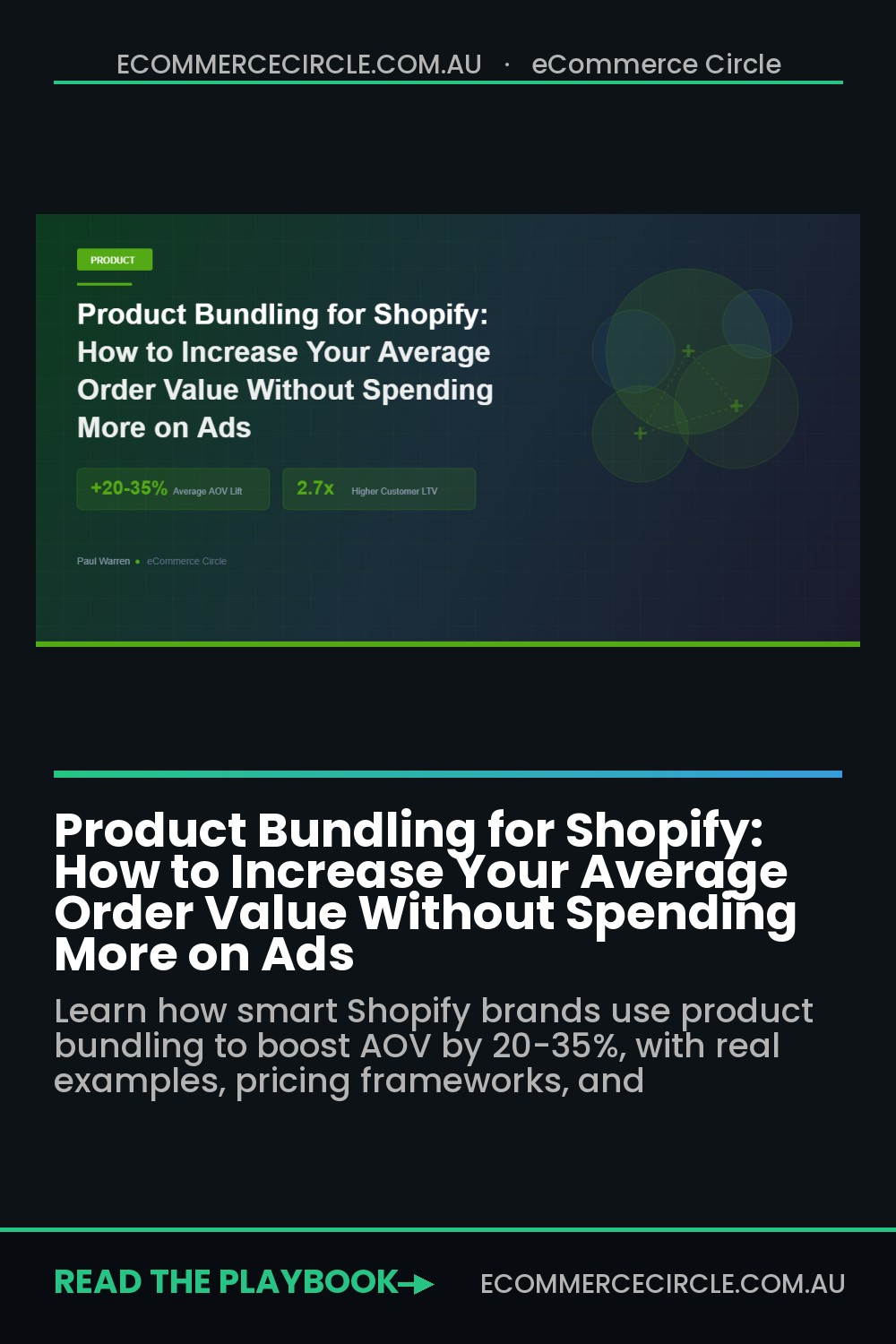
You’re spending thousands on Meta ads and Google Shopping to get new customers through the door. But here’s the uncomfortable truth: most Shopify stores are leaving 20-35% of their potential revenue sitting on the table — not because they can’t get traffic, but because they’re selling one product at a time.
What’s in This Article
The average Shopify store has an AOV (average order value) somewhere between $80 and $120 AUD. Meanwhile, the stores that are genuinely scaling — the ones doing $50K, $100K, $200K months — almost always have one thing in common: they’ve figured out product bundling.
Bundling isn’t a new concept. But the way smart ecommerce brands are using it in 2026 has changed dramatically. It’s no longer about slapping three random products together and offering 10% off. The brands winning with bundles are building strategic product combinations that increase order values, improve margins, and create a better customer experience — all without spending a single extra dollar on acquisition.
Why Bundling Works (And Why Most Brands Get It Wrong)
Let’s start with the numbers, because they tell a compelling story.
According to McKinsey research, brands that implement product bundling strategies see an average 20% increase in sales and a 30% increase in profit. That’s not a rounding error — that’s the difference between a business that’s surviving and one that’s scaling.
Here’s what makes bundling so powerful: it fundamentally changes the buying decision. Instead of asking “Do I want this product?”, your customer is now asking “Do I want the routine?” or “Do I want the complete solution?” That shift in framing is worth real money.
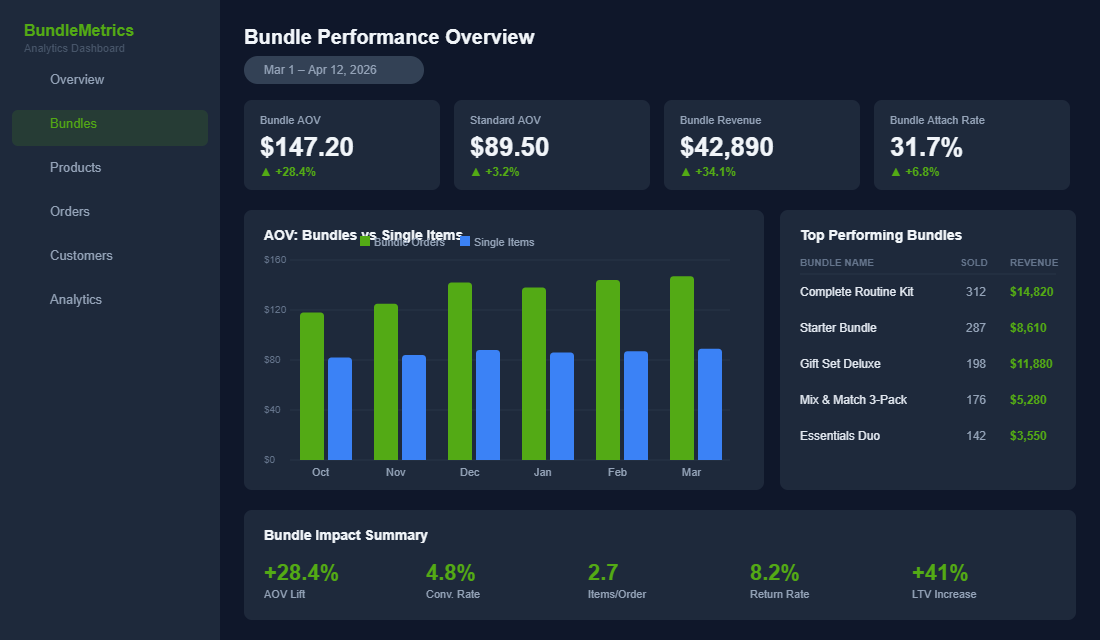
But here’s where most brands mess it up: they bundle based on what they want to shift (usually slow-moving stock) rather than what the customer actually wants to buy together. If your bundle doesn’t make intuitive sense to the person looking at it, it’s not a bundle — it’s a clearance bin with a bow on it.
The other common mistake? Discounting too heavily. A 30% discount on a bundle might move units, but it can destroy your contribution margin. The goal is to find the sweet spot where the customer perceives genuine value while your profit per order actually increases. We’ll cover exactly how to calculate this later.
The 6 Bundle Types Every Shopify Store Should Know
Not all bundles are created equal. The right type depends on your product catalogue, your customer behaviour, and your margin structure. Here are the six core bundle types that work for Shopify brands in 2026:
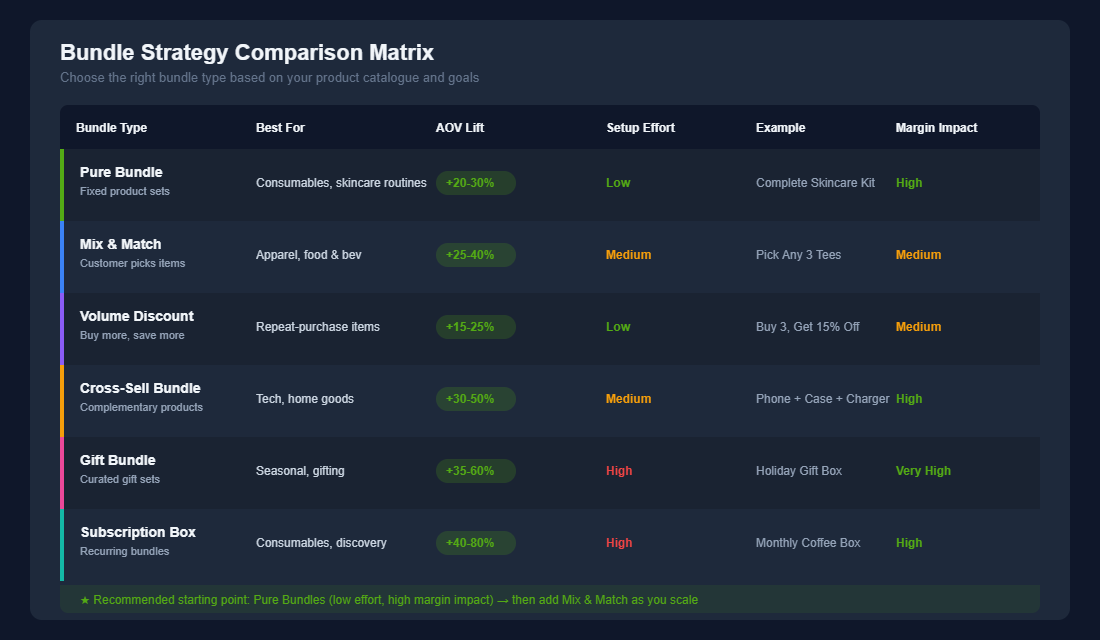
1. Pure Bundles (Fixed Product Sets) — This is the simplest and most effective starting point. You pick 2-4 products that naturally go together and sell them as a single SKU at a slight discount. Think of a skincare brand bundling cleanser + serum + moisturiser as a “Complete Morning Routine.” Australian brand Frank Body does this brilliantly with their skincare kits — their Rosehip Kit and Pore-ifics Kit pair complementary products with savings built in, making the bundle the obvious purchase over individual items.
2. Mix & Match Bundles — The customer picks from a curated selection to build their own bundle. “Choose any 3 tees for $99” or “Pick 5 protein bars for $24.” This works exceptionally well for apparel, food and beverage, and any category where personal preference matters. Research shows that 72% of build-your-own bundle sessions end with items added to cart — that’s a significantly higher engagement rate than standard product pages.
3. Volume Discount Bundles — Buy more, save more. “1 for $25, 2 for $45, 3 for $60.” This is the workhorse bundle for consumable and repeat-purchase products. It nudges the customer to stock up now rather than coming back later (or going to a competitor). The beauty of volume bundles is they’re dead simple to set up and the margin math is straightforward.
4. Cross-Sell Bundles — Pair a primary product with its natural accessories or complements. Phone + case + screen protector. Camera + SD card + carry bag. This is where the biggest AOV jumps happen — cross-sell bundles can drive +30-50% AOV lifts because you’re adding genuinely useful items the customer would have bought anyway (just maybe not today, and maybe not from you).
5. Gift Bundles — Curated sets designed specifically for gifting occasions. Australian men’s grooming brand Beard & Blade excels here — they offer tiered grooming kits from $89 to $199, giving gift buyers a clear value ladder to choose from. After migrating to Shopify Plus and building out their kit strategy, they saw retail sales increase 35% year on year. Gift bundles work because they solve the buyer’s real problem: “I don’t know what to get them.” A well-curated gift set eliminates decision fatigue entirely.
6. Subscription Bundles — Recurring bundles that ship on a schedule. Monthly coffee boxes, quarterly skincare refreshes, or weekly meal kits. These combine the AOV lift of bundling with the predictable revenue of subscriptions. Customers purchasing bundles demonstrate 2.7 times greater lifetime value than single-item buyers — and subscription bundles amplify that even further.
How to Price Your Bundles Without Destroying Your Margins
This is where bundling gets strategic — and where most brands either leave money on the table or accidentally hurt their bottom line. If you haven’t already, take a look at our guide on contribution margin — understanding your true cost per unit is critical before you start discounting anything.
The golden rule of bundle pricing: the customer should perceive at least 15-20% savings, but your actual margin sacrifice should be under 8%.
Here’s how to make that work:
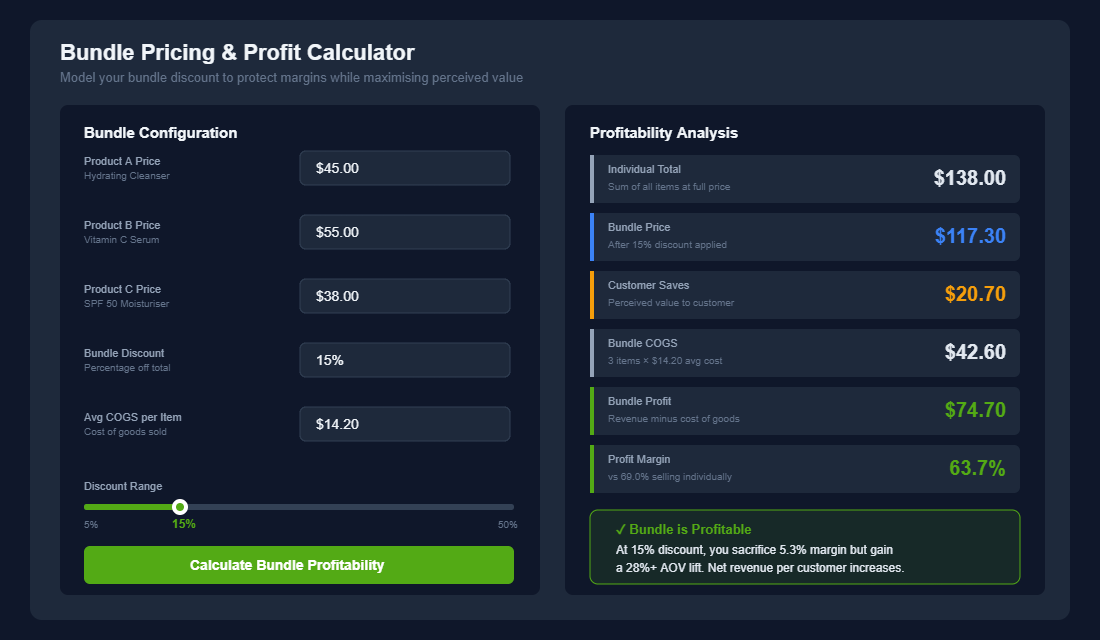
Step 1: Calculate your individual product margins. If Product A sells for $45 with a $14 COGS, Product B for $55 with $16 COGS, and Product C for $38 with $12 COGS, your individual total is $138 with $96 gross profit (69.6% margin).
Step 2: Set your bundle discount between 10-20%. A 15% discount brings your bundle price to $117.30. Your COGS stays at $42, so your bundle profit is $75.30 — a 64.2% margin. You’ve sacrificed 5.4 percentage points of margin but gained a customer who spent $117.30 instead of maybe $45 on a single product.
Step 3: Factor in the behaviour shift. Not every bundle customer would have bought all three products individually. Many would have bought one — or none. So the real comparison isn’t “$138 vs $117.30.” It’s “$45 (one product) vs $117.30 (the bundle).” That’s a 160% increase in revenue from that customer.
Pro tip on pricing psychology: Use percentage discounts for bundles under $100 AUD (“Save 20%”) and dollar-amount discounts for bundles over $100 (“Save $30”). The “Rule of 100” shows that whichever number looks bigger is more persuasive. And if you’re running bundles alongside other promotions, make sure you’re not stacking discounts — check our guide on discount strategy for more on this.
Real Brands, Real Results: Bundling Case Studies
Let’s look at what happens when brands get bundling right.
Rhode Skin — From $948K to $2.53M/Month in Kit Revenue
Hailey Bieber’s skincare brand Rhode is a masterclass in strategic bundling. With just 10 SKUs in their entire product line, they built curated kits that guide customers toward multi-product purchases. The result? Kit revenue grew from $948,000 per month to $2.53 million per month — a 2.7x increase — in just six months during 2025. Rhode’s bundles work because each kit tells a complete skincare story: “This is your morning routine” or “This is your hydration essentials.” They’re not just grouping products; they’re selling outcomes.
Soxy.com — 358% AOV Increase Through Strategic Bundling
Sock retailer Soxy achieved one of the most dramatic AOV lifts in ecommerce history — a 358% increase — by restructuring their entire product presentation around bundles. Instead of selling individual pairs, they led with 3-packs, 6-packs, and themed collections. The insight? For low-cost consumable products, customers actually prefer buying in volume when you make it easy and slightly cheaper. Nobody wants to go through checkout for a single $12 pair of socks.
Frank Body (Australia) — Kits as a Core Revenue Driver
Melbourne-based Frank Body built their entire product strategy around kits from day one. Their Original Coffee Scrub became famous, but it’s their kit strategy — pairing the scrub with complementary body, lip, and face products — that drives their AOV. By framing bundles as “routines” rather than “discounts,” they maintain premium pricing while giving customers a reason to buy three products instead of one.
Setting Up Bundles on Shopify: The Step-by-Step
Shopify has improved its native bundling capabilities, but for most stores, you’ll want a dedicated bundling app to open up the full range of bundle types and customisation options. Here’s how to get started:
Option 1: Shopify’s Native Bundles App (Free)
Shopify now offers a free Bundles app in the app store. It handles basic fixed bundles and multipack bundles. Good for getting started, but limited on customisation, analytics, and advanced bundle types like mix-and-match.
Option 2: Kaching Bundles (Recommended for Growing Stores)
Rated 5.0 stars with nearly 4,000 reviews, Kaching is the most popular dedicated bundling app on Shopify. Here’s how to set it up:
Step 1: Install Kaching Bundle Quantity Breaks from the Shopify App Store. The free plan supports basic bundles; paid plans start at $14.99 USD/month for advanced features.
Step 2: Create your first bundle. Go to the Kaching dashboard, click “Create Bundle,” and select your bundle type (product bundle, quantity break, or mix-and-match). Add your products and set your discount — start with 10-15% for your first bundle to test the waters.
Step 3: Customise the bundle widget to match your theme. Kaching’s widget embeds directly on your product pages, so customers see the bundle offer right where they’re making the buying decision. Adjust colours and text to match your brand.
Step 4: Set up bundle-specific analytics. Track bundle conversion rate, bundle AOV vs standard AOV, and bundle attach rate (what percentage of orders include a bundle). Review weekly and adjust your offers based on what’s actually converting.
If you want your bundles to convert at checkout, make sure your checkout is optimised too — there’s no point building a great bundle if your checkout flow is leaking conversions.
The Bundle Launch Checklist
Before you go live with your first bundle, run through this checklist to make sure you’re set up for success:
Product Selection:
- Products are complementary (used together, not just related)
- At least one product is a proven bestseller (anchors the bundle’s perceived value)
- Bundle makes intuitive sense — a customer would nod and say “yeah, that makes sense together”
- You have sufficient inventory of all products in the bundle (nothing worse than a half-fulfilled bundle order)
Pricing & Margins:
- Bundle discount is between 10-20% (sweet spot for most Shopify stores)
- You’ve calculated contribution margin at the bundle price — it’s still profitable
- Bundle price ends in .95 or .00 — avoid odd-looking totals like $117.30
- Savings amount is clearly displayed (“Save $20.70” or “Save 15%”)
Presentation & Placement:
- Bundle has its own product page with lifestyle photography
- Bundle appears on individual product pages as an upsell (“Complete the routine — save 15%”)
- Bundle is featured in your top navigation or collections page
- Cart page shows bundle savings clearly
Post-Launch Tracking:
- Bundle conversion rate (target: 3-5% of product page visitors)
- Bundle AOV vs store-wide AOV (target: 20%+ lift)
- Bundle attach rate (target: 15-25% of all orders)
- Return rate on bundles vs individual products (should be comparable or lower)
The Bundle Maths: Model It Before You Build It
Most bundles get launched on a hunch. Someone picks three products that feel like they go together, takes 15% off, and hopes. Then AOV goes up, everyone celebrates, and nobody checks whether profit per order went up with it.
Model it first. It takes ten minutes in a spreadsheet and it will kill about half the bundle ideas you have, which is the point.
Take a worked example. You sell three items at $40, $30 and $25 RRP, total $95. Landed cost is $14, $10 and $9, total $33. Sold separately at full price that is $62 gross profit, a 65% margin. Now bundle them at $79, a 17% discount. Your gross profit drops to $46. On the face of it you just gave away $16.
Whether that is a good trade depends entirely on one question: what would that customer have bought otherwise?
- If they would have bought only the $40 item (gross profit $26), the bundle takes you from $26 to $46. That is a $20 gain per order and the bundle is clearly worth running.
- If they would have bought all three anyway, you handed them $16. That is not a bundle, it is a discount with extra steps.
- If it is a mix, and it usually is, you need the split. Look at your order data for the last 90 days and count how many orders already contained all three SKUs together. If that number is above roughly 15% of orders containing the anchor product, your bundle is mostly cannibalising full-price behaviour.
Add one more line before you commit: fulfilment cost. A three item bundle in one carton usually costs less to pick and ship than three separate orders, which is real margin you can bank. But if the bundle pushes the parcel into a higher cubic band with your carrier, you can lose $2 to $4 an order to dimensional weight and never notice. Weigh and measure the packed bundle before launch.
Set a floor and hold it. A useful rule for most Aussie DTC brands: a bundle should never take contribution margin below 45%, and if paid traffic is driving it, never below 50%. Work your numbers through the contribution margin framework before you set the price, not after the first month’s report tells you something went wrong.
How to Kill a Bundle That Is Not Working
Founders are good at launching bundles and terrible at retiring them. Six months later the collection page has eleven bundles, three of them sell, and the other eight are quietly confusing every customer who lands there.
Give every bundle a review date at launch. Thirty days is enough to tell you something, ninety days is enough to be sure. Put it in the calendar the day you publish.
Judge it on four numbers, in this order:
- Attach rate. What percentage of orders that included the anchor product took the bundle? Under 5% and the bundle is not compelling enough or is not visible enough. Over 40% and you have probably priced it too generously.
- Profit per order, not AOV. Compare the bundle’s gross profit per order against the same period’s non-bundle orders. If AOV is up 22% and profit per order is flat, the bundle is buying revenue with margin.
- Return rate. Bundles that include a sizing-sensitive or taste-sensitive item often return at 1.5 to 2x the rate of the same items sold individually, because the customer only wanted one of the three. If returns on the bundle exceed your store average by more than a few points, the mix is wrong.
- Second order rate. The best bundles are trial vehicles. Check whether bundle buyers come back within 90 days at a higher rate than single-item buyers. If they do, a thinner margin on order one is easy to defend.
Then act on it properly. Killing a bundle is not deleting the product, it is unpublishing it from the collection, removing it from your navigation, and redirecting the URL to the closest live collection so you keep whatever link equity it earned. Leaving a dead bundle URL returning a 404 is a small, avoidable SEO cost.
Before you retire one entirely, try the cheaper fix. A bundle that is not selling is often a placement problem rather than a product problem. Test it as a post-purchase offer instead of a collection page item. Shopify’s post-purchase page converts on a warm buyer who has already given you their card, and offers there routinely convert at 5 to 12% against 1 to 3% for the same offer on a product page. The post-purchase upsell playbook covers the setup, and if the issue is that customers do not see the complement at all, the cross-sell playbook is the better starting point.
Run three to five bundles at a time, review them quarterly, and keep the ones that earn their place. A short bundle list that all sells beats a long one that mostly does not.
The Compound Effect: How Bundling Multiplies Across Your Business
Here’s what most guides on bundling miss: the real power isn’t just the AOV lift. It’s how bundling compounds across every other metric in your business.
Your ad spend becomes more efficient. If your cost per acquisition is $35 and your AOV goes from $90 to $120 through bundling, your ROAS jumps from 2.6x to 3.4x — without changing a single thing about your campaigns. That extra $30 per order is pure use on your existing ad spend.
Your customer lifetime value increases. Customers who buy bundles are exposed to more of your product range in their first purchase. They’ve tried three products instead of one, which means three chances to fall in love with something they’ll reorder. Data shows bundle buyers have 2.7x higher lifetime value than single-item purchasers.
Your return rate drops. This sounds counterintuitive, but bundle buyers tend to return less frequently. Why? Because bundles set proper expectations — the customer knows what they’re getting. And when products are designed to work together (like a skincare routine), each product reinforces the value of the others.
Your operations get simpler. Picking and packing a 3-product bundle is faster than processing three separate single-item orders. Your shipping costs per item decrease. And if you’re pre-packing bundles, your warehouse efficiency improves significantly.
When you add all of this up — higher AOV, better ROAS, stronger LTV, lower returns, more efficient ops — you start to see why the best-performing Shopify stores don’t treat bundling as a tactic. They treat it as a core part of their business model.
Start With One Bundle This Week
You don’t need to overhaul your entire catalogue to start seeing results. Pick your best-selling product. Find two complementary items that naturally pair with it. Price the bundle at 15% below the individual total. Put it live on your store this week.
That’s it. One bundle. One week. Track your AOV before and after. The data will tell you everything you need to know about whether to double down.
Most Shopify stores we work with inside the eCommerce Circle see measurable AOV improvements within the first 14 days of launching their first strategic bundle. Product bundling is one of the core growth levers we build into every member’s operating system — because it compounds with everything else you’re doing across your store.
If you want help building a bundling strategy that fits your specific product range and margin structure, let’s talk.