You hired your first real marketing person eighteen months ago. You picked a number that felt fair, added a vague promise about a bonus at the end of the year, and moved on. Now they are asking what the path looks like, your operations coordinator has worked out she is paid less than the person she trains, and you have no idea whether your payroll bill is sensible or dangerous.
What’s in This Article
This is the most common mess I see in Aussie Shopify businesses between $40k and $500k a month. Not a hiring problem. A pay structure problem. The people are good. The numbers underneath them were never designed, they accumulated.
It gets expensive fast. Australian businesses lose the equivalent of 100 to 150 per cent of an employee’s salary every time someone walks, and for specialist roles like a paid media buyer or a developer it stretches to 150 to 200 per cent. On a $105,000 media specialist, one bad exit is a six-figure hole in a business whose median net margin sits somewhere between 3 and 10 per cent. Pay design is not an HR nicety. It is a margin decision.
Why Most Ecommerce Pay Packets Quietly Break the Business
There are three failure patterns, and almost every store I look at has at least one of them.
The negotiated number. Each salary was set in isolation, in the heat of an offer, against whatever the candidate asked for. Two years later there is no logic connecting any of them. The person who negotiated hardest earns the most, which has nothing to do with who creates the most value.
The revenue-linked bonus. Someone gets a percentage of sales. It feels aligned until the discount codes start flying, the ad spend balloons, and revenue goes up while gross profit goes sideways. You end up paying a bonus out of a quarter that made you less money than the one before it.
The promise with no mechanism. A verbal "look after you at the end of the year" that is never defined, never measured, and never quite delivered. This one is the worst, because it costs you the retention benefit of a bonus and the goodwill at the same time.
Fixing it does not require an HR department. It requires five layers, built in order, on a single page. Here they are.
Layer 1: Build the Band Before You Build the Offer
Stop pricing people. Start pricing roles. A band is a floor, a midpoint and a ceiling for a level of responsibility, set before you meet a single candidate. When the offer conversation arrives you are not inventing a number under pressure, you are reading one off a sheet you built calmly three months earlier.
Start with real Australian market data. PayScale puts the average Digital Marketing Manager in Australia at around $92,300, but Sydney-weighted guides put a strong performer at $115,000 to $135,000 base, with senior hires at larger businesses pushing past $150,000. Performance and paid media managers land in a similar $110,000 to $135,000 range. A capable paid media specialist a level below sits closer to $98,000 to $115,000. Those gaps matter, because "marketing manager" means five different jobs depending on who is saying it.
Build five or six bands, not fifteen. Most stores under $10m a year need something like B1 through B5: assistant, coordinator, specialist, manager, head of. Attach every role to a band, then set the midpoint at or slightly above the market midpoint for your city.
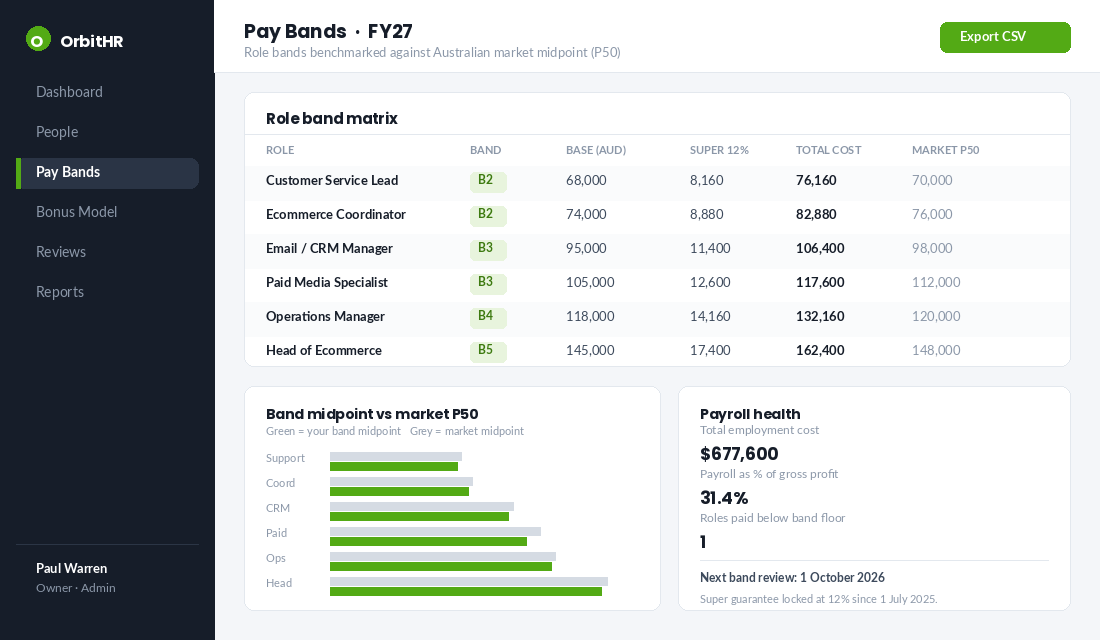
The column that changes the conversation is total employment cost, not base. Superannuation guarantee has been locked at 12 per cent since 1 July 2025, so a $105,000 base is really $117,600 before you count leave loading, workers compensation, software seats or recruitment amortisation. Founders who budget on base consistently run about 12 to 15 per cent over what they planned.
One more 2026 wrinkle worth putting in your cash flow model: Payday Super started on 1 July 2026. Super now has to be paid within seven business days of payday rather than quarterly. If you were quietly using the quarterly super lag as working capital, that lever is gone. Build your bands assuming super leaves the account the same week the wages do.
How to set up bands in Xero in about forty minutes
You do not need a dedicated HR platform to run this properly. If you are already on Xero, which most Aussie ecommerce businesses are, do this:
- Create a tracking category called Function. In Xero go to Accounting, then Advanced, then Tracking categories. Add options for Marketing, Operations, Customer Service, Creative and Admin.
- Tag every employee’s pay template to a Function. Payroll, then Employees, then the Pay Template tab. Assign the tracking option against their earnings line.
- Build a band sheet outside Xero. One row per role: band, floor, midpoint, ceiling, current base, super at 12 per cent, total cost, and the market midpoint you sourced.
- Run the Payroll Employee Summary by tracking category each month. That single report gives you payroll by function, which is the input for every ratio later in this article.
- Diary a band review for the first week of October. Once a year, before the peak season chaos, not during it.
If you want contracts, policy acknowledgements and review cycles in the same place, Employment Hero is the Australian platform most stores in this revenue range graduate to. Start with the spreadsheet and the Xero tracking categories though. Tooling does not fix a structure you have not designed yet.
Layer 2: Split Every Role Into Fixed Pay and Earned Pay
Once the band exists, decide how much of it is guaranteed and how much has to be earned. This split should be driven by one question: how much control does this person genuinely have over the outcome you want to pay them for?
A customer service lead cannot move revenue much. A paid media specialist can move contribution margin a lot. Paying them on the same structure is lazy and it breeds resentment in both directions.
Here is the split I use as a starting point with members, expressed as variable pay at target as a percentage of base:
- Customer service and admin roles: 0 to 5 per cent. Mostly fixed. If you want to reward them, use a small quarterly team pool tied to service quality, not sales.
- Coordinators and specialists: 5 to 10 per cent. Enough to feel real at review time, small enough that a bad quarter does not wreck their household budget.
- Managers with a P&L line: 10 to 20 per cent. Paid media, email and CRM, operations. These people move money.
- Head of ecommerce or GM: 20 to 30 per cent. This is the one role where a genuinely large variable component makes sense, because they influence nearly every input.
- Founder or owner-operator: whatever is left. You are the residual claimant. Pay yourself a real market salary for the job you actually do, then take profit separately.
Two rules make this work. First, the fixed component alone must be a liveable, competitive wage. If someone can only pay rent when the bonus lands, you have not built an incentive, you have built anxiety, and anxious people make conservative decisions. Second, never dangle variable pay in front of a role that cannot influence the metric. That is the fastest way to teach a good employee that your numbers are theatre.
Layer 3: Fund the Bonus From Gross Profit, Never From Revenue
This is the layer that protects the business, and it is the one most stores get wrong.
A revenue-linked bonus pays out when someone discounts 30 per cent into a Black Friday weekend and books a record top line on terrible economics. A gross profit gate does not. The mechanism is simple: pick a quarterly gross profit number the business needs to clear before any pool exists, then fund the pool as a fixed percentage of the gross profit above that gate.
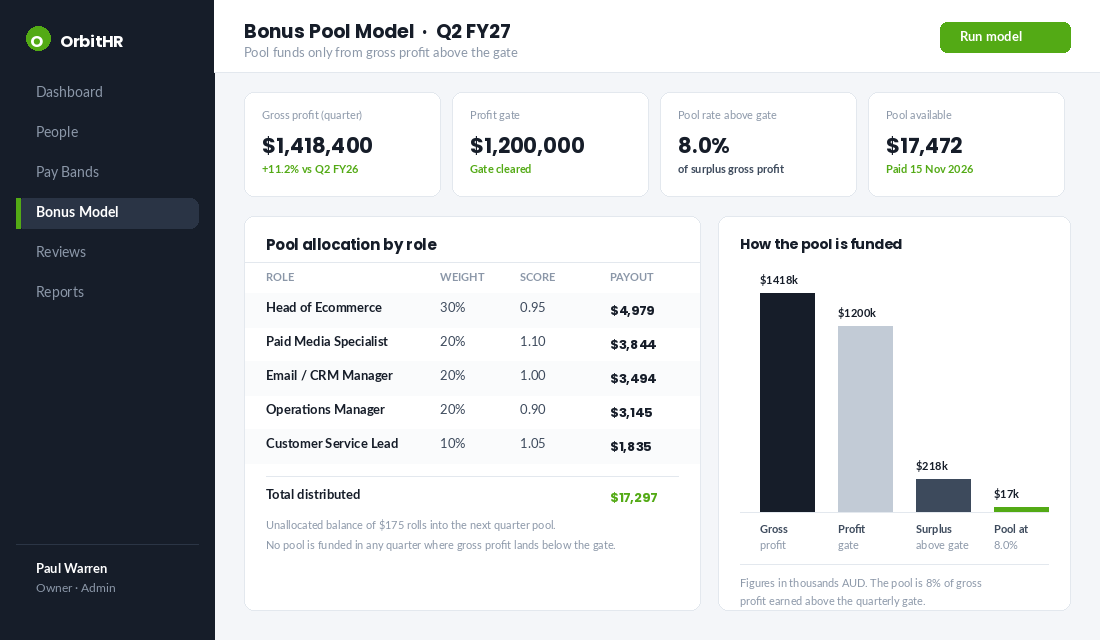
In the model above, the business needs $1.2m of quarterly gross profit before anything is shared. It delivered $1,418,400. Eight per cent of the $218,400 surplus creates a pool of roughly $17,500, which is then split by role weighting and an individual performance score. If gross profit had come in at $1.19m, the pool would be zero and nobody would need to argue about it, because the rule was written down in advance.
Three practical settings to get right:
- Set the gate at last year’s actual, not at your stretch budget. A gate nobody ever clears is worse than no scheme at all. If the team clears it three quarters running, lift it.
- Keep the pool rate between 5 and 10 per cent of surplus gross profit. Broader sales-linked schemes range far wider, but at this size a surplus-share in that band stays affordable in a bad quarter and meaningful in a good one.
- Pay quarterly, not annually. A bonus twelve months away has almost no behavioural pull. A quarterly rhythm also lets you correct a broken metric after three months instead of twelve.
If you have not nailed down what gross profit actually means in your business, do that first. Our breakdown of ecommerce unit economics and true cost per order is the prerequisite. A bonus scheme built on a gross profit figure that ignores freight, payment fees and returns will pay out on profit that does not exist.
The principle is not new and it is not soft. Melbourne-founded Who Gives A Crap built a whole business on the discipline of committing 50 per cent of profits to a defined purpose before anyone gets clever with the money. The mechanic is the same: decide the share of profit, in advance, in writing, then honour it. Temple & Webster, one of the few Australian ecommerce businesses that publishes its remuneration structure, runs long-term incentives against multi-year performance hurdles rather than a single good quarter. Both are gates. Both remove the argument.
Layer 4: Give Every Person One Number They Can Actually Move
The pool decides how much money exists. The metric decides who earned it. Get this wrong and you will pay people for weather.
One number per person. Not a scorecard of nine weighted KPIs that takes you a day to calculate and nobody can recite from memory. One primary number, one guardrail metric so they cannot game it, reviewed in the same monthly meeting every time.
This is what that looks like across a typical Aussie DTC team:
- Paid media specialist. Primary: contribution margin after ad spend. Guardrail: new customer count, so they cannot hit the number by retargeting existing buyers all quarter.
- Email and CRM manager. Primary: revenue from owned channels as a share of total. Guardrail: unsubscribe rate and spam complaint rate.
- Operations manager. Primary: cost to fulfil per order. Guardrail: on-time despatch rate, so they cannot save money by slowing everything down.
- Customer service lead. Primary: first response time. Guardrail: refund rate, so speed does not turn into refunding every awkward ticket.
- Head of ecommerce. Primary: quarterly gross profit. Guardrail: 90-day repeat purchase rate, so growth is not bought entirely from strangers.
Notice that only one person in that list is measured on total gross profit. Everyone else owns a slice they can genuinely influence with their own hands. That is the difference between a metric that motivates and a metric that feels like a lottery.
Review these in a structured monthly one to one rather than a surprise at quarter end. If you have not built that rhythm yet, the performance review and scorecard system is the companion piece to this article. Pay design without a review cadence is just a spreadsheet nobody reads.
Layer 5: Pay the Part That Is Not Cash
You will rarely beat an agency or a listed retailer on base. You can comfortably beat them on everything else, and the research is increasingly clear that you have to. Workload, culture and psychological safety now do as much damage to retention in Australia as pay does.
Price these deliberately instead of offering them ad hoc:
- Genuine flexibility. Not "we are flexible" in the job ad. A written policy: core hours, which days are in the warehouse or studio, and who has authority to approve a change.
- A learning budget with a number on it. $2,000 a year per person, with two paid days to use it, costs you about 1.8 per cent of a specialist salary and is worth far more than that in retention.
- Super above the guarantee. Lifting super from 12 to 14 per cent on a $95,000 base costs $1,900 a year and is one of the cheapest genuine differentiators available to an Australian employer.
- Title and scope clarity. Write down what the next band up requires. People leave because they cannot see the path far more often than because the money is 5 per cent light.
- Phantom equity for your first two or three hires. A defined cash payment on a sale or a defined profit share, documented properly with an accountant. Do not hand out real shares in a business you may want to sell without complications.
Bellroy, the Melbourne accessories brand, is a certified B Corp, which means its worker practices including pay floors are independently assessed and published rather than asserted. You do not need certification to borrow the idea. Write down what you offer, publish it internally, and be consistent. Consistency is the actual benefit.
The Three Numbers That Tell You If the Model Is Working
You cannot manage pay by feel. Three ratios, checked monthly, tell you almost everything.
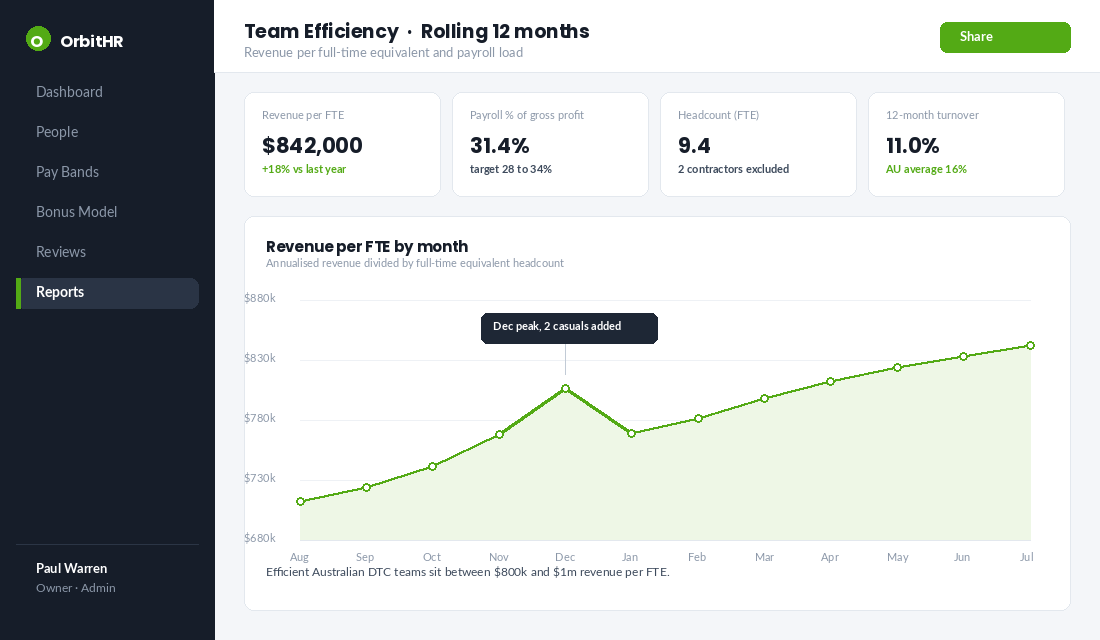
Revenue per full-time equivalent. Efficient DTC brands run between $800,000 and $1m or more per FTE, largely by outsourcing fulfilment, automating a chunk of customer service and keeping creative capacity flexible. If you are under $500,000 per head and not growing quickly, you have a headcount problem dressed up as a revenue problem. Count contractors as fractional FTEs so the number stays honest.
Payroll as a share of gross profit. Gross profit, not revenue, because revenue tells you nothing about whether you can afford the team. Most Australian stores in this range sit somewhere between 28 and 34 per cent. Drift above 40 and every marketing decision starts getting made under pressure.
Rolling twelve-month turnover. The Australian average is around 16 per cent, and one in three businesses now runs above 20 per cent, the highest share on record. Job mobility overall was 7.7 per cent in the year to February 2025. If you are losing people faster than 16 per cent a year, the pay structure is not your only problem, but it is almost certainly part of it.
Track all three on the same monthly sheet as your gross profit. If you already run a monthly business review, add a four-line people block to it. Fifteen minutes a month.
How the Five Layers Compound
Individually these are useful. Stacked, they change how the business behaves.
Bands remove negotiation from hiring, which means you stop overpaying the confident candidate and underpaying the quiet one who has been with you three years. That alone kills the single most common cause of resignation in small teams, which is discovering an internal pay gap that has no justification.
The fixed and variable split means your payroll flexes with your profit instead of sitting rigid through a soft quarter. In a business with a 3 to 10 per cent net margin, having 8 to 12 per cent of total payroll automatically switch off in a bad quarter is genuine downside protection.
The gross profit gate means you can never be forced to pay a bonus out of a quarter that did not earn it. That removes the single most awkward conversation in small business ownership.
One clear metric per person turns your monthly one to ones from status updates into decisions, because everyone already knows their number before they walk in.
And the non-cash layer means when a recruiter calls your operations manager with an extra $8,000, she has something concrete to weigh it against instead of a vague feeling that things are fine here. Given a specialist replacement costs 150 to 200 per cent of salary, keeping one person who was on the fence pays for the entire structure several times over.
None of this requires you to be big. It requires you to write it down once, before the next hire, rather than after the next resignation. If you have not made your first hire yet, start with the first hire playbook and build the band for that role before you write the job ad.
Your One-Page Pay Structure
Copy this into a doc and fill it in this week. It should fit on one page. If it does not, it is too complicated to survive contact with a busy quarter.
- Bands. Five levels. For each: floor, midpoint, ceiling. Midpoint set at or slightly above the Australian market midpoint for your city.
- Role map. Every current person mapped to a band. Flag anyone below their band floor and fix it within one pay cycle.
- Total cost line. Base plus 12 per cent super plus leave and insurance loading. Budget on this number, never on base.
- Variable split. Target variable pay as a percentage of base for each band: 0 to 5, 5 to 10, 10 to 20, 20 to 30.
- Profit gate. The quarterly gross profit figure that must be cleared before any pool exists. Set at last year’s actual for the same quarter.
- Pool rate. 5 to 10 per cent of gross profit above the gate. Written down. Not renegotiated mid-quarter.
- Allocation weights. How the pool splits across roles, totalling 100 per cent.
- One metric per person. Primary number plus guardrail. Reviewed monthly.
- Non-cash schedule. Flexibility policy, learning budget, super above guarantee, promotion criteria for the next band.
- Three ratios. Revenue per FTE, payroll as a share of gross profit, rolling twelve-month turnover. Reviewed on the first Monday of every month.
- Review date. First week of October, annually. Before peak season, never during it.
Do the bands and the gate first. Those two take an afternoon and remove about 80 per cent of the risk. The rest can be layered in over a quarter.
The Compliance Layer: What Australian Law Puts on Top of Your Pay Model
You can design the cleanest five-layer pay structure in the country and still get it wrong, because in Australia the model sits inside a legal framework that does not care how elegant your bonus maths is. This is the layer founders skip, and it is the one that produces back-pay bills.
Start with superannuation. The Super Guarantee rate is 12% of ordinary time earnings. Here is the part that catches people out: commission and most performance bonuses generally count as ordinary time earnings, so they attract super too. If you have budgeted a $15,000 bonus pool, the real cost to the business is closer to $16,800 in AUD. Build super into the pool at the point you size it, not after you have promised it.
Then check whether an award applies. Most ecommerce roles in Australia are covered by something. Warehouse and pick-pack staff commonly sit under the Storage Services and Wholesale Award, retail-adjacent roles under the General Retail Industry Award. Awards set minimum rates, penalty rates, overtime and allowances that override whatever you agreed privately. A salary can absorb those entitlements, but only if it genuinely leaves the employee better off overall, and you need to be able to demonstrate that with a reconciliation, not a feeling.
The four checks to run before your next offer goes out
- Identify the award for every role. Use the Fair Work Ombudsman’s Pay and Conditions Tool. It takes about ten minutes per role and it is free.
- Reconcile salaries against award minimums annually. Award rates typically rise on 1 July. A salary that was comfortably above the minimum two years ago may not be now.
- Write the bonus rules down. Specify the metric, the measurement window, what happens on partial achievement, and what happens if someone resigns mid-period. Verbal bonus arrangements are the single most common source of ecommerce pay disputes.
- Watch the payroll tax threshold. It is a state tax with different thresholds in each state, generally somewhere in the several-hundred-thousand to low-millions range of annual wages. Crossing it as you grow adds a percentage to every dollar of payroll, including bonuses, and it should be modelled before you build the next headcount plan.
None of this is legal advice and none of it replaces your accountant or an employment lawyer. What it does do is stop you from designing a pay model in a spreadsheet that quietly breaks the moment it meets reality.
The founders who handle this well treat compliance as a design input rather than a clean-up job. They size the bonus pool including super, they check the award before they name a number, and they put the rules in the employment agreement. It costs an extra afternoon per hire and it removes an entire category of expensive surprise. If you are about to bring someone on for the first time, read it alongside our first hire playbook.
Inside eCommerce Circle, how you pay your team is one of the core pillars we work on with every member, because it sits right where People and Profit meet. If you want a second opinion on yours before your next hire, let’s talk.