You know the moment. It is 9:40 on a Tuesday night, the kids are finally asleep, and you are on your laptop approving a purchase order, answering a supplier email about a delayed container, and writing the brief for next month’s campaign. None of those three jobs needs a founder. All three are sitting with you because there is nobody else to hand them to.
What’s in This Article
The numbers say you are not alone. Research into Australian small business owners in 2026 found 57% had hit burnout, 76% reported stress or anxiety, and 31.7% had never taken a single week off since starting their business. Among owners working 60 hour weeks, the never-taken-a-week-off figure climbs to 60%.
Here is what most founders get wrong. They keep hiring specialists. A media buyer. A customer service rep. A warehouse casual. Every one of those hires adds another person who reports to you, which means every hire makes your calendar worse, not better. The fix is not another specialist. It is one person who owns the running of the business so you can go back to owning the direction of it. That person is your 2IC, and this is the playbook for hiring one.
Why Most Aussie Founders Hire a 2IC Two Years Too Late
The logic that delays the hire always sounds responsible. “I will hire a senior person once revenue is more stable.” “Nobody will care about this business like I do.” “I cannot justify a six figure salary yet.”
The trap is that the conditions never improve on their own. A founder doing 60 hours a week has no capacity to build the systems that would make the business calmer, so the business stays chaotic, so the founder keeps doing 60 hours. It is a loop, and only a deliberate decision breaks it.
The cost of waiting is measurable. VistaPrint research released in 2026 found that only about 24% of Australian small and medium businesses have a documented succession plan, while 40% of owners had already lived through a sudden or unplanned departure from a previous business due to health, financial pressure or burnout. A business that only runs when you are in it is not an asset. It is a job with inventory risk attached.
The brands that get this right usually start earlier than feels comfortable. When Frank Body’s co-founder and long-time CMO Jess Hatzis stepped back to an advisory role in 2024, the marketing function did not wobble, because her 2IC Candace MacPherson had been global head of marketing since late 2020. Four years of deliberate handover, then a clean transition. That is not luck. That is design.
The Readiness Test: Five Signals You Are Ready, Three That Say Wait
Do not hire on frustration alone. Run this test honestly before you write a job ad.
Five signals you are ready:
- You are the bottleneck on more than five recurring decisions a week. Not big strategic calls. Repeat decisions like restock quantities, refund approvals and campaign sign-offs.
- Revenue is above roughly 250k AUD a month and predictable within 20%. A 2IC needs a business with enough surface area to manage and enough cash to fund the role for at least 12 months.
- You already have three or more people (staff, contractors or agencies) reporting to you. The role only pays for itself if there is a team to run.
- You can name three things you would do with 20 reclaimed hours a week and they are revenue-creating, not admin.
- You have written down how the business actually works. If you have not, start with our SOP library for Shopify brands before you hire.
Three signals that say wait:
- You cannot articulate what the business should look like in 24 months. A 2IC executes a direction. If there is no direction, you will burn a great operator inside six months.
- You have never successfully delegated a whole function. Start smaller. Hand over customer service completely, keep your hands off it for eight weeks, and see what you learn about yourself.
- The role is really “someone to do the bits I hate”. That is an executive assistant or an operations coordinator, and it is a legitimate hire. It is just not this one.
What a 2IC Owns, and What You Never Hand Over
Vague scope is the single biggest reason these hires fail. If the ad reads “support the founder”, you will attract an assistant. If it reads “own the day-to-day operation of a growing Australian DTC brand”, you attract an operator.
The 2IC typically owns: fulfilment and 3PL performance, customer service and the support standards, supplier relationships and purchase orders inside an agreed limit, the team’s weekly rhythm and one-on-ones, the operating scorecard, agency and freelancer management, and the execution of the quarterly plan.
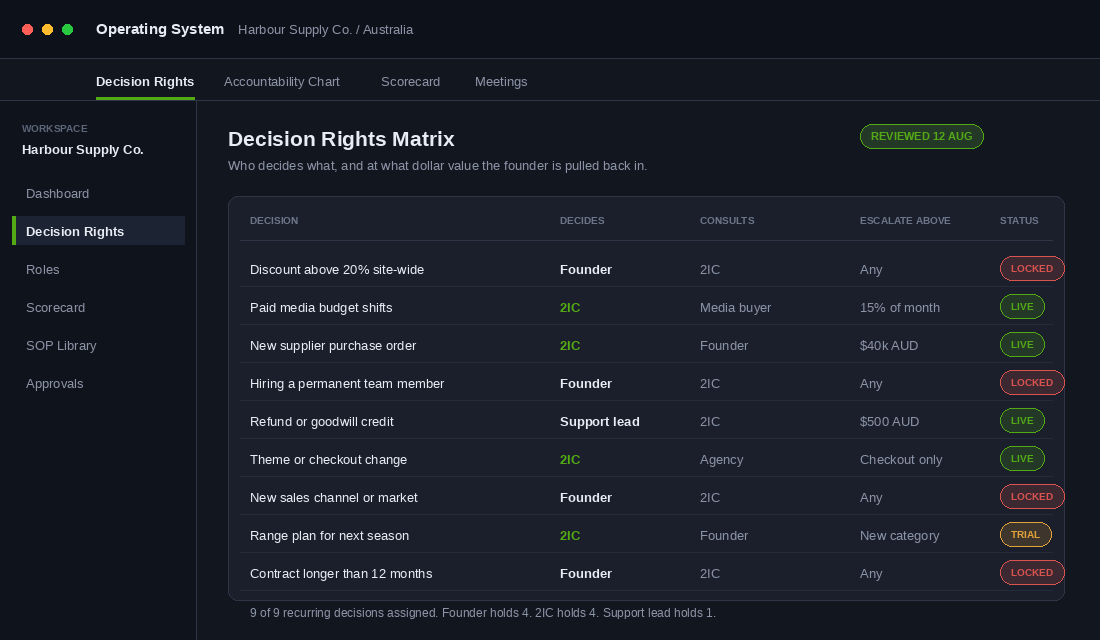
The founder keeps: brand and creative direction, product and range strategy, pricing architecture, hiring and firing of permanent staff, capital decisions and funding, new channels or markets, and any contract that runs longer than twelve months.
Bellroy is a useful reference here. The Melbourne brand runs with a founding team of four and a clearly separated CEO role in Andrew Fallshaw, which lets the other founders stay deep in design and product craft instead of splitting attention across everything. Splitting the founder job into distinct owners is the move, whether that split happens between co-founders or between you and a hire.
Write your version of that split as a table with four columns: decision, who decides, who is consulted, and the threshold above which it comes back to you. Nine to twelve rows is usually enough to cover 90% of a week. Do this before the first interview, because candidates worth hiring will ask.
Pick the Right Shape: General Manager, Operations Lead, or Chief of Staff
“2IC” is a relationship, not a job title. Three shapes work for Australian Shopify brands, and they are priced very differently.
- Operations Lead. Owns fulfilment, service, inventory flow and suppliers. Does not own marketing. Best for product-heavy brands where the pain is physical, not commercial. Australian market rate sits around 95k to 125k AUD.
- General Manager. Owns the whole operating P&L including marketing execution and team leadership. Best when you want to step out of the business entirely for stretches. SEEK puts the Australian general manager average between 160k and 180k AUD, though smaller DTC brands commonly land senior ecommerce operators with real P&L responsibility in the 120k to 160k range.
- Chief of Staff. Owns projects, cadence and follow-through rather than functions. Cheaper, faster to hire, and a good bridge if you are 12 months away from a real GM. Typically 90k to 115k AUD.
Budget the fully loaded cost, not the salary. Add 12% superannuation, payroll tax if you are over the state threshold, workers compensation, software seats and a performance component. A 130k base is realistically a 155k to 165k annual commitment. If that number makes your stomach drop, the honest answer is either “not yet” or “hire the Chief of Staff shape first”.
The Role Brief That Attracts Operators, Not Applicants
Great operators are rarely actively looking. They are employed, competent and being courted. Your brief has to do the selling.
Six blocks, one page:
- The situation, told honestly. Revenue band, team size, channel mix, what is working and what is broken. Candidates trust specificity. “We do 4.2m AUD a year across Shopify and wholesale, with a team of nine, and our fulfilment accuracy is our weakest number” beats any amount of culture language.
- The outcome in twelve months. Three measurable results, not a duties list. For example: same-day dispatch above 98%, founder escalations under five a week, and a documented quarterly planning cycle running without you.
- The decisions they will own. Lift this straight from your decision rights table. This is the single most attractive part of the ad for a real operator.
- What stays with the founder. Being upfront filters out people who want your job and reassures the ones who do not.
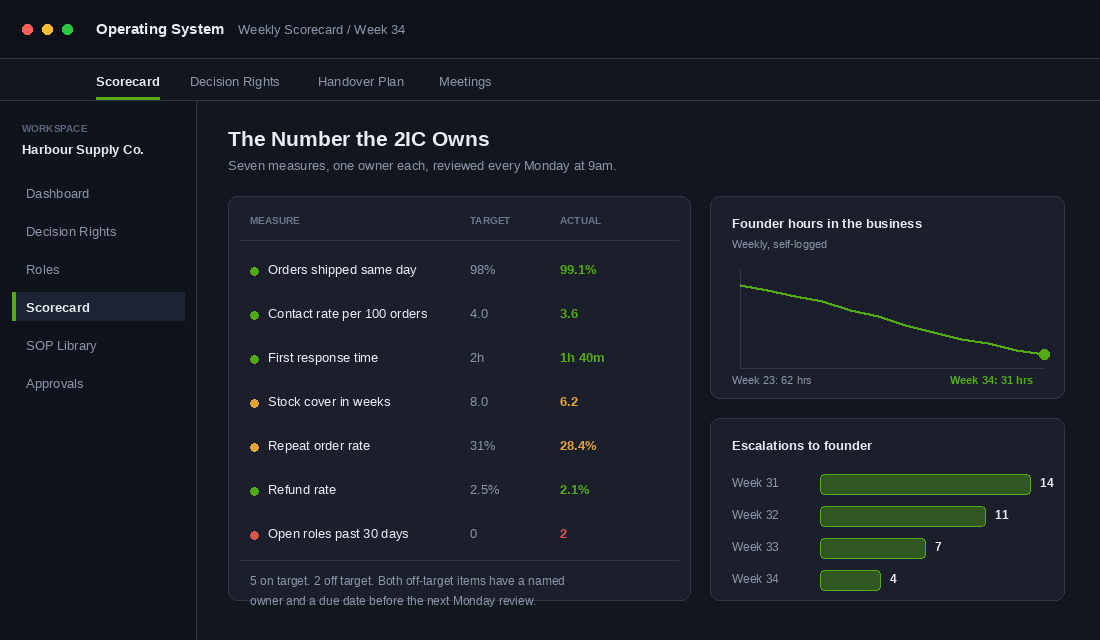
- The measures. The five to seven numbers they will be held to weekly.
- The package, stated. Range, super, bonus structure and flexibility. Australian candidates increasingly skip ads with no range, and hiding it wastes everyone’s first call.
The Five-Stage Hiring Process (Including a Paid Work Sample)
Getting this wrong is expensive. The US Department of Labor puts the direct cost of a bad hire at up to 30% of first year salary, while SHRM frames full replacement cost at 50% to 200% of annual salary, with senior roles at the top of that range. On a 140k role, a mistake is a six figure event once you count lost momentum.
- Stage 1: Screening call, 20 minutes. One question does most of the work: “Walk me through a business you ran the operations of, and tell me what the numbers looked like when you started and when you left.” Vague answers end here.
- Stage 2: Structured interview, 60 minutes. Score against defined competencies rather than gut feel. Our Shopify hiring scorecard gives you the format.
- Stage 3: Paid work sample, four to six hours at their day rate. Give them real, de-identified data: three months of fulfilment performance, your support inbox categories, and last quarter’s stock position. Ask for a one page diagnosis and a 90 day plan. This stage separates people who talk about operations from people who do them.
- Stage 4: Team meeting. Two of your existing people meet them without you in the room. Ask your team one question afterwards: “Would you be comfortable if this person made a call you disagreed with?”
- Stage 5: Reference calls you make yourself. Two former direct reports, not just former managers. Ask: “What did they take off their leader’s plate, and what did they hand back?”
Run the whole process in three weeks. Senior operators have options, and a six week process signals a business that cannot decide.
The 90-Day Handover Ladder
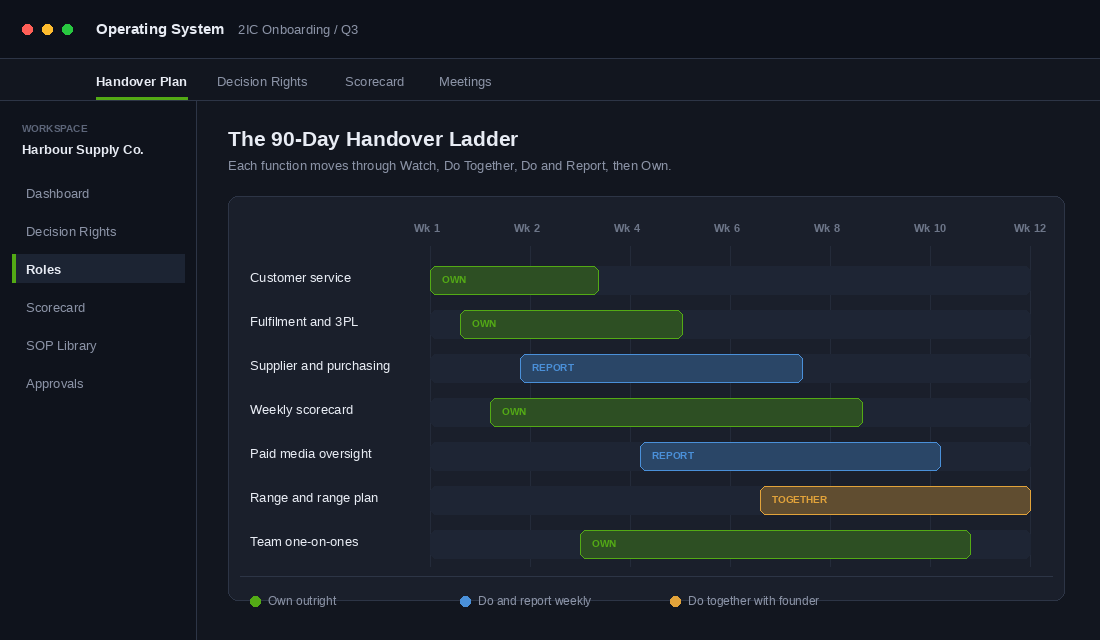
Most handovers fail because the founder swings between total control and total abdication. The ladder fixes that by moving every function through four rungs at its own pace.
- Rung 1: Watch. They observe you doing it and write the SOP as they go. One to two weeks per function.
- Rung 2: Do together. They run it, you sit in silently, you debrief after. Two weeks.
- Rung 3: Do and report. They run it alone and report the outcome weekly. You do not intervene unless a threshold is breached. Two to four weeks.
- Rung 4: Own. It appears on their scorecard and disappears from your calendar entirely.
Sequence matters. Move customer service and fulfilment first because they are high volume, low ambiguity and give fast confidence on both sides. Move supplier relationships and range planning last because they carry the most relationship history and the most cash risk. A realistic split is service and fulfilment owned by week 4, scorecard and team rhythm by week 8, purchasing and agency management by week 12, and range planning still shared going into the next season.
Track one number through the whole thing: your own hours in the business, logged weekly and honestly. If it is not falling by week six, the handover is stalling and you are the reason. Our founder time audit gives you the four quadrant view to work out exactly which hours should be moving.
Set Up Access and Approval Guardrails Before Day One
Nothing undermines a new 2IC faster than having to ask you for a password on their third day. Nothing scares a founder faster than handing over the keys without limits. Shopify’s own staff permissions solve both, and setting them up properly takes about 20 minutes.
- Step 1. In Shopify admin, go to Settings, then Users, then Add user. Send the invite to their company email address, never a shared inbox.
- Step 2. Grant full permissions across Orders, Products, Customers, Analytics, Marketing, Discounts and Apps. Withholding order and customer access makes the role impossible.
- Step 3. Leave three boxes unticked at first: Manage settings, Manage plan, and Manage users. These are ownership-level controls, not operating controls, and they can be added at month six.
- Step 4. Require two-step authentication for every staff account under Settings, then Users, then Security. Make it mandatory, not optional.
- Step 5. Build one Shopify Flow automation as your safety net: trigger on Order created, condition where discount amount is greater than your comfort threshold or order value is above a set figure, action send an internal notification to you and the 2IC. You get visibility without approval friction.
- Step 6. Mirror the same logic in Klaviyo, your 3PL portal and Xero, and record every access grant in a single sheet so offboarding takes ten minutes instead of a week.
On the employment side, Australian brands get good mileage out of Employment Hero or a similar local platform for the contract, super, leave and policy paperwork, which keeps you compliant with Fair Work obligations without a HR hire.
The Weekly Rhythm That Keeps a 2IC Accountable
Autonomy without cadence turns into drift. Three meetings hold the whole relationship together.
- Monday scorecard, 30 minutes. Seven measures, actual against target, with a named owner and a due date on anything off track. No discussion of items that are on target.
- Thursday one-on-one, 45 minutes. Their agenda, not yours. Decisions they need from you, blockers, and one thing they want to change.
- Monthly business review, 90 minutes. Full profit and loss, cash position, inventory cover, and the quarterly plan status. This is where you stay connected to the numbers without being in the daily work.
If you want the full cadence including the team-wide meetings, we have mapped it in the weekly operating rhythm.
One rule protects everything: never reverse your 2IC’s decision in front of the team. If they made a call you disagree with, back it publicly, then correct the decision rights privately so the same call goes differently next time. Undermine them once and you have paid a senior salary for a very expensive assistant.
The 120-Day Honest Check
Book a two hour review in the diary on day 120 before they even start. Answer four questions in writing, on your own, before you meet.
- Are my hours down by at least 25%? If not, the problem is usually the founder taking work back, not the 2IC failing to take it.
- Have escalations halved? Count them. Most founders guess wrong in both directions.
- Has the team started going to them first? This is the truest signal of a working handover, and you will notice it before any metric moves.
- Would I hire them again today, knowing what I now know? If the answer is no, act in month five, not month fourteen. Every month you delay is a month of compounding damage to the team’s trust in your judgement.
The 2IC Package: Base, Bonus and the Equity Question
Salary gets an operator to the first interview. The structure of the package is what gets them to stay for three years and behave like an owner. Three parts to get right.
- Base. Pay the market rate for the shape you chose, and do not try to save $15K here. A GM you underpay by 10% will be poached inside 18 months, and the replacement cost is 50 to 200% of salary. Review it annually against SEEK and Hays data, not against what you paid your last hire.
- Bonus: 10 to 20% of base, tied to three scorecard numbers. Pick measures the 2IC actually controls: contribution margin against budget, same-day dispatch rate, and team retention are a common trio. Pay it half-yearly, not annually, so the feedback loop is short. Never tie it to top-line revenue alone, or you have just paid someone to discount.
- Equity or phantom equity. For a business you intend to sell, a small real equity stake (2 to 5%) with a four-year vest and a one-year cliff is powerful. Australia’s employee share scheme rules include a start-up concession that can make this tax-efficient if the business qualifies, so get advice from an accountant who has done it. For a business you intend to keep, a phantom equity or profit-share plan gives the same behaviour without the cap table complexity: a fixed percentage of EBITDA above a hurdle, paid annually.
Whatever you choose, write the measures into the weekly scorecard from day one, so the bonus conversation in six months is a reading of numbers you have both been looking at every Monday. And model the fully loaded package in the annual budget before you make the offer, including the bonus at target. A $130K base with a 15% bonus, super and on-costs is closer to $180K, and the budget should say so.
A Worked Example: The First 90 Days of a General Manager at a 3.5M Brand
Picture a Gold Coast supplements brand doing $3.5M a year, a team of eight, and a founder logging 58 hours a week. They hire a GM at $145K base plus a 15% bonus in the second week of February. Here is what the ladder looks like when it works.
- Weeks 1 to 4. The GM shadows customer service and fulfilment, rewrites four SOPs from the SOP playbook as she goes, and takes both functions to rung 4. Founder hours drop to 51. Escalations fall from 22 a week to 14, mostly because the 3PL now calls her.
- Weeks 5 to 8. She owns the Monday scorecard and runs the one-on-ones with the six people below her. The founder attends the scorecard meeting as a participant, not the chair. Hours: 44. Escalations: 9.
- Weeks 9 to 12. Purchasing inside a $40K limit and the agency relationship move across. She catches a supplier price increase buried in a PO that the founder had been rubber-stamping for a year, worth $27K annually. Hours: 36. Escalations: 5.
- Day 120 check. Founder hours down 38%, escalations down 77%, and the team went to her first on 9 of the last 10 issues. The founder used the reclaimed 20 hours to rebuild the range plan and open a wholesale channel, which was the actual reason for the hire.
The one thing that nearly derailed it was week six, when the founder took a supplier call back “just this once” and the GM found out from the supplier. They fixed it in the Thursday one-on-one by adding a row to the decision rights table. That is the pattern in almost every successful handover: the risk is rarely the operator, it is the founder’s reflexes. If you want the full structure for the first 30, 60 and 90 days, the onboarding playbook lays it out week by week.
How the Pieces Compound
Individually, none of these steps is dramatic. Together they change what your business is.
The decision rights table means the same call gets made the same way whether you are in the country or not. The handover ladder means functions transfer without anything being dropped. The scorecard means performance is visible rather than felt. The weekly rhythm means problems surface on Monday instead of at 11pm on a Sunday. The access guardrails mean you sleep.
The end state is a business that runs to a standard rather than to your presence, and that is the difference between a store and a sellable asset. With only around a quarter of Australian small businesses holding a documented succession plan, having one capable operator who can run the place is not just a lifestyle upgrade. It is the thing that makes a future sale, a genuine holiday, or a health scare survivable.
Your 2IC Hiring Checklist
Work through this in order. Do not skip to the job ad.
- Run the readiness test. Five signals present, none of the three blockers.
- Write the decision rights table. Nine to twelve rows, with thresholds in AUD.
- Pick the shape: Operations Lead, General Manager, or Chief of Staff.
- Cost it fully loaded, including super, payroll tax and bonus, then confirm 12 months of runway.
- Write the one page role brief with the twelve month outcomes stated as numbers.
- Run the five stage process in three weeks, with a paid work sample at stage three.
- Build the 90 day handover ladder before day one, function by function.
- Set up Shopify staff permissions, two-step authentication and one Flow alert.
- Lock in the Monday scorecard, Thursday one-on-one and monthly business review.
- Log your own hours weekly from day one, and book the 120 day review now.
Print it. Tick items off. A hire this significant deserves more rigour than a phone call with someone a mate recommended.
Inside eCommerce Circle, building the team layer above the founder is one of the core pillars we work on with every member, because it is the constraint that quietly caps most Australian brands somewhere between one and five million. If you want a second opinion on whether you are ready and what the role should look like in your business, let’s talk.