Here is the shipping dilemma every Australian Shopify store owner faces: your customers expect free shipping (87% of Australian online shoppers say free shipping influences their purchase decision), but your margins cannot afford to absorb $8-12 per order in delivery costs.
What’s in This Article
The brands that solve this equation profitably do not just eat the cost or pass it on. They use shipping strategically — as a conversion lever, an AOV driver, and a competitive advantage. Here is how to do it without destroying your margins.
Most Australian Shopify stores are underestimating their true shipping costs by 15-25%. Once you factor in packaging materials, zone-based pricing variations, return shipping, and the occasional express upgrade, the real number is usually much higher than what shows up as “shipping” in Shopify Analytics.
Know Your Real Shipping Costs (Not Just What the Carrier Charges)
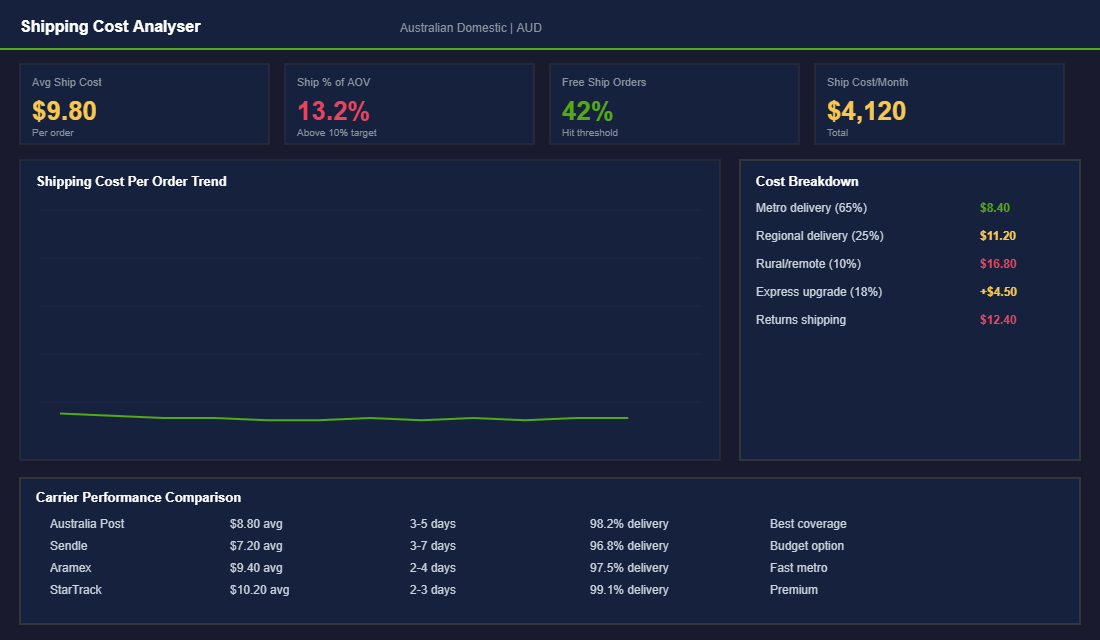
Before you set any shipping strategy, you need to know your actual all-in shipping cost per order. This includes:
- Carrier charges. The base delivery fee, which varies by weight, dimensions, and destination zone. Metro Sydney is very different from rural Queensland.
- Packaging costs. Boxes, mailers, tissue paper, inserts, tape. For a typical small-to-medium product, budget $1.50-3.00 per order in packaging materials.
- Labour time. If you are self-fulfilling, count the time spent picking, packing, and lodging parcels. At a reasonable hourly value of $30/hour, a 10-minute pack job costs $5 in your time.
- Return shipping. Budget for a percentage of orders being returned. If your return rate is 7% and return shipping costs $12, that adds roughly $0.84 to every order on average.
- Insurance and tracking. For higher-value items, parcel insurance and signature-on-delivery add $2-5 per order but prevent expensive lost-parcel claims.
The Free Shipping Threshold: Your Most Powerful AOV Lever
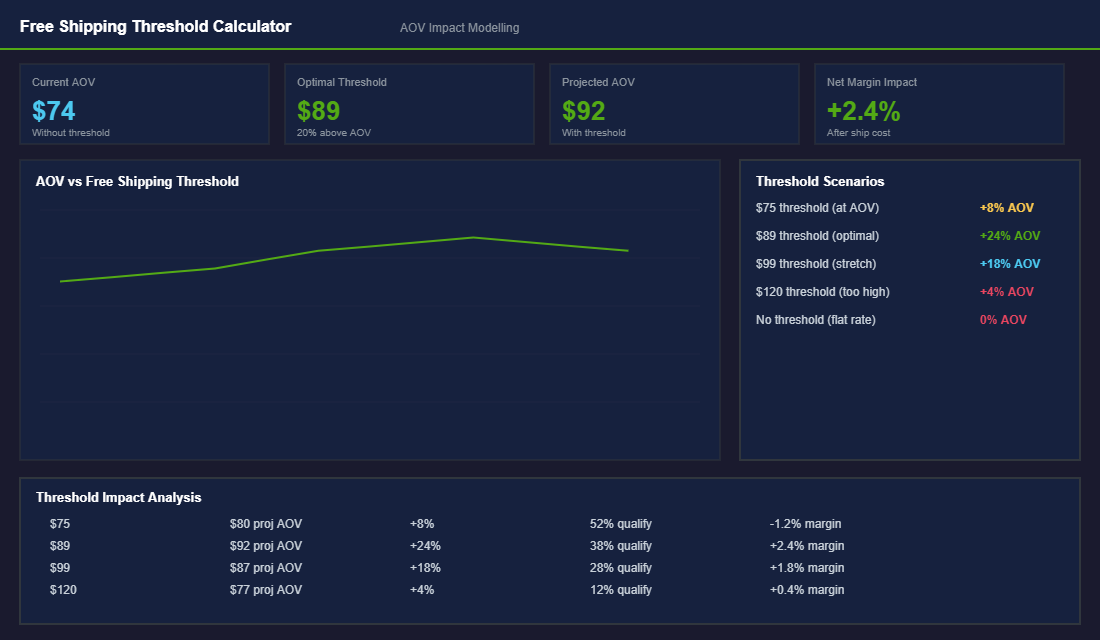
A free shipping threshold is the single most effective way to offer free shipping without losing money. The concept is simple: customers get free shipping when their order exceeds a certain amount. But the psychology behind it is powerful — shoppers will add extra items to their cart to “earn” free shipping, increasing your AOV and often more than covering the shipping cost.
The optimal threshold is typically 20-30% above your current AOV. If your average order is $74, set free shipping at $89-95. This is achievable enough that customers will add an item, but high enough that the increased AOV more than covers your shipping cost.
- Display the threshold prominently. Add a progress bar to your cart page: “You are $18 away from free shipping!” This creates urgency and gives the customer a clear target.
- Suggest products that hit the threshold. Below the progress bar, show 2-3 products priced to perfectly bridge the gap. If someone needs $18 more, show them a $19 add-on.
- Test different thresholds quarterly. As your AOV changes, your threshold should too. A/B test different amounts and track the impact on both AOV and conversion rate.
Carrier Strategy: Do Not Put All Your Parcels in One Basket
Using a single carrier for all your shipments is leaving money on the table. Different carriers have different strengths depending on parcel size, destination, and speed requirements.
- Australia Post has the best coverage for regional and rural areas and offers the MyPost Business program with discounted rates once you hit volume. Best for: broad national coverage.
- Sendle offers flat-rate pricing starting from $6.95 for small parcels. No pickup fees, carbon-neutral delivery. Best for: small, light items where cost matters most.
- Aramex (formerly Fastway) is competitive on metro deliveries with fast transit times. Best for: metro-heavy customer bases where speed matters.
- StarTrack (owned by Aus Post) offers premium same-day and next-day options. Best for: time-sensitive or high-value orders where reliability justifies the premium.
The smart move is to use a multi-carrier shipping app like Shippit, ShipStation, or Starshipit that automatically selects the cheapest or fastest carrier for each order based on destination and weight. This can save 10-20% on shipping costs without any manual effort.
When to Move from Self-Fulfilment to a 3PL
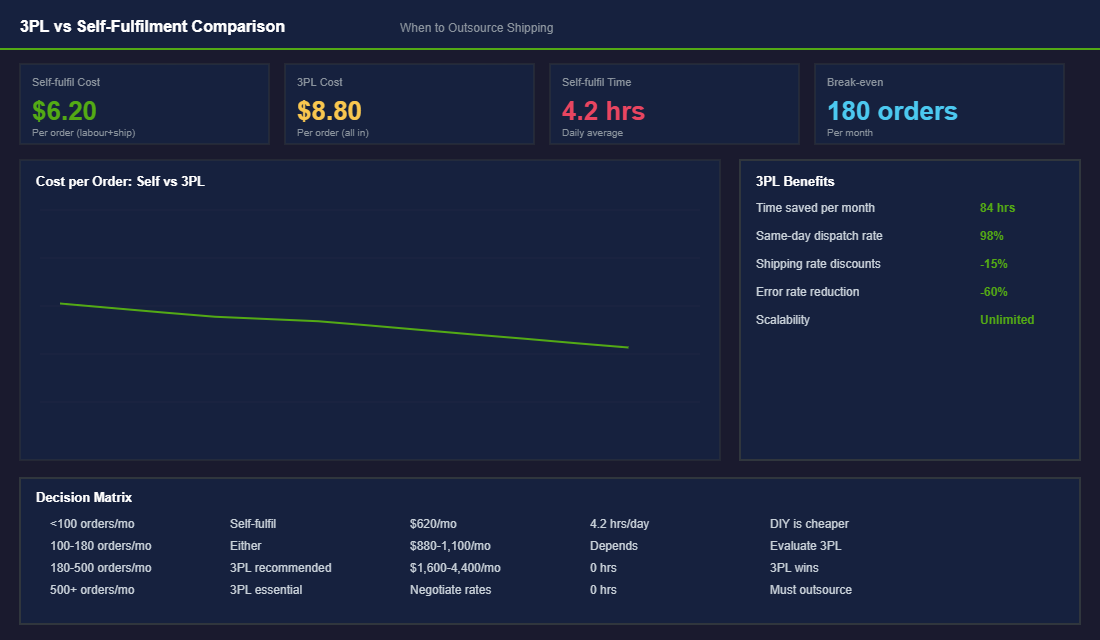
Self-fulfilment makes sense when you are doing fewer than 100-150 orders per month. Above that, the time cost starts to outweigh the savings. If you are spending 3-4 hours a day packing orders, that is 60-80 hours a month you are not spending on growth.
A good Australian 3PL (third-party logistics provider) will charge $3-6 per order for pick, pack, and dispatch, plus the actual carrier cost. Popular options for Shopify stores include ShipBob (if they have AU warehousing), Selazar, eStore Logistics, and 3PL in a Box.
The break-even point is typically around 150-200 orders per month. Below that, self-fulfilment is usually cheaper. Above that, a 3PL saves you time, reduces errors, and often gets better carrier rates than you can negotiate individually.
The Compound Effect: Shipping as a Growth Lever
When your shipping strategy is dialled in, it stops being a cost centre and starts being a growth lever. A well-set free shipping threshold lifts AOV. Fast, reliable delivery drives positive reviews and repeat purchases. Efficient fulfilment frees up your time for high-value activities. Together, these create a meaningful competitive advantage in the Australian ecommerce market.
What Your Checkout Should Actually Show at the Shipping Step
Most Aussie stores treat the shipping step as an admin screen. It is not. It is the single highest-drop-off moment in your funnel. Roughly 70% of carts are abandoned overall, and unexpected shipping cost is consistently the number one stated reason. The fix is rarely cheaper postage. It is better presentation of the postage you already offer.
Show three tiers, never more. A standard option, an express option, and free shipping above your threshold. When shoppers see five rate options they stall and start comparing instead of buying. Three is enough to feel like a choice without triggering decision fatigue.
Name your rates in outcomes, not carrier codes. “Australia Post Parcel Post” means nothing to a shopper. “Standard delivery, 3 to 5 business days, $9.95” means everything. Rename every rate in Shopify Settings, Shipping and Delivery so each one states the promise and the price in plain English.
Then surface the gap to free shipping in the cart drawer. A simple progress bar reading “You are $18 away from free shipping” typically lifts AOV 8 to 15% on its own, and it costs you nothing but a theme change. If you have not set your threshold with real margin data yet, work through the free shipping threshold playbook before you turn the bar on, because a badly set threshold just gives away margin faster.
Your Delivery Promise Is a Conversion Lever, Not a Disclaimer
Here is the thing most operators miss. Shoppers are not comparing your shipping price to your competitor’s shipping price. They are comparing your delivery certainty to Amazon’s. You cannot win on speed. You can absolutely win on clarity.
Put an estimated delivery date on the product page, not just in the cart. “Order in the next 4 hours to get it by Friday 25 July” outperforms “Ships in 1 to 2 business days” because it removes the mental maths. Apps like Delivery Estimate or Zapiet do this natively, and most Shopify themes can render it with a small snippet if you would rather not add another subscription.
Then protect the promise after checkout. Branded tracking through a tool like AfterShip or Shippit typically cuts “where is my order” tickets by 30 to 50%, and those WISMO tickets are usually the single largest category in an Aussie store’s support inbox. Every ticket you prevent is roughly 5 to 8 minutes of someone’s day returned to you. That is the same principle covered in the 3PL playbook: the win is rarely the postage rate, it is the operational drag you remove around it.
The Five Shipping Numbers to Review Every Month
You cannot fix what you do not measure, and “postage” as a single line in your P and L is not measurement. Pull these five numbers on the first Monday of every month. It takes twenty minutes and it will change what you argue about with your 3PL.
- Shipping cost as a percentage of revenue. Healthy Aussie DTC sits between 8 and 12%. Above 15% and your threshold, packaging, or carrier mix is wrong.
- Net shipping recovery. What you charged customers divided by what you paid carriers. Most stores recover 40 to 60%. If you are under 30%, your free shipping threshold is too low.
- Average cost per parcel, split by state. WA and NT parcels routinely cost 2 to 3 times a Melbourne to Sydney run. If interstate orders are quietly unprofitable, you want to know before you scale ads into those postcodes.
- Dimensional weight failures. The share of parcels billed above your quoted weight. Anything over 10% means your packaging is oversized and you are paying for air.
- WISMO ticket rate. Support tickets about delivery divided by orders shipped. Under 3% is good. Over 8% means your tracking communication is broken, not your carrier.
Imagine you run a 40k a month homewares store shipping 600 parcels. Trimming average parcel cost by $1.40 through right-sized satchels and a second carrier is $840 a month, or roughly $10,000 a year, straight to the bottom line. No new traffic, no new ads, no new products. That is the kind of margin recovery we work through in the profit margins guide.
The Return Leg Nobody Budgets For
Every shipping model you build has a second leg you probably have not costed: the parcel coming back. Australian DTC return rates run 8 to 12% for homewares and consumables, and 20 to 30% for apparel and footwear where size is a variable. If you are in apparel and you have modelled shipping at one leg per order, your real cost per order is out by 25% or more.
Cost it honestly. A returned parcel is the inbound postage, the pick and pack you already paid, the inspection time, the restock, and often a discount to move a slightly worn item. Call it $18 to $25 all-in on a $90 apparel order. Two returns wipes the margin on a third full-price sale.
The lever is prevention, not cheaper return postage. Better size guides, more on-model photography, and a post-purchase survey asking why an item came back will move your return rate further than any carrier negotiation. Tools like Loop or AfterShip Returns will also push exchanges ahead of refunds, which keeps the revenue in the business. Work through the returns policy framework and set your shipping model on the round trip, not the one-way.
Need Help With Your Shipping Strategy?
Shipping is one of the fastest places to find margin in an Australian Shopify store, because most operators have never audited it properly. Inside eCommerce Circle, shipping strategy is one of the core pillars we work on with every member: the real landed cost per parcel, the right free shipping threshold, the carrier mix, and the call on when a 3PL actually pays for itself. If shipping is quietly eating your margin, let us talk.