For most Aussie Shopify founders, the end of financial year means one thing: a folder of receipts, a slightly stressed email to the accountant, and a quiet hope that the numbers come out alright. You treat 30 June as an admin deadline. You get the BAS sorted, you let the bookkeeper reconcile, and you get back to running ads.
What’s in This Article
That is the wrong way to think about it. EOFY is the one moment in the year where you are forced to look at the whole machine: revenue, costs, stock, tax, cash. Used properly, it is not a compliance chore. It is the single best profit review you will run all year.
Here is the number that should focus your attention. After every variable and fixed cost is paid, the median direct-to-consumer brand nets just 3 to 10% of revenue. So a store doing $1m a year is often keeping $30k to $100k. The founders who break out of that band are not the ones running more sale events. They are the ones who treat EOFY as a reset, find the leaks, and walk into the new financial year with sharper numbers. This is that review, in six parts.
Part 1: Find Your Real Net Margin, Not Your Shopify Revenue Line
Open your Shopify dashboard and the first thing you see is total sales. It is the most flattering number in your business and the least useful for decisions. Revenue tells you how busy you were. It says nothing about whether the work was worth doing.
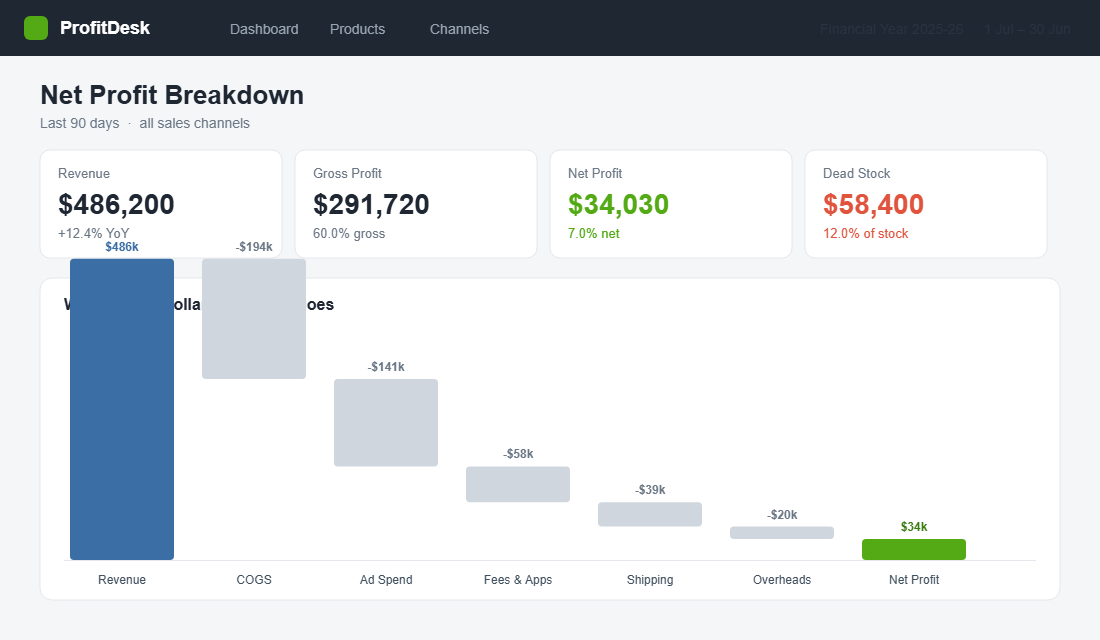
The gap is brutal once you map it. The average ecommerce gross margin sits between 50 and 65%, and most healthy DTC brands run 55 to 70% gross. That feels comfortable. Then ad spend, transaction fees, app subscriptions, shipping, returns and overheads come out, and the median brand is left with that 3 to 10% net. A store can post a record sales month and go backwards on cash in the same period.
Your EOFY job is to know three numbers cold, for the full year:
- Gross margin. Revenue minus cost of goods, divided by revenue. This is the ceiling on everything else.
- Contribution margin. What is left after the costs that scale with each order: COGS, shipping, payment fees, pick-and-pack. This is the dollar figure that actually pays for your ads and your salary.
- Net margin. What lands in the bank after every cost, including the ones you forget. This is the only number that compounds.
If you cannot say those three numbers right now, that is not a knock on you. It is the most common gap we see in the businesses that come through eCommerce Circle. Fixing it is the highest-leverage hour you will spend this year.
Part 2: Clear the Dead Stock Before It Clears Your Cash
Stock is where profit quietly goes to die. At any given time, up to 30% of the inventory a retailer holds is dead or slow-moving. A healthy dead stock ratio sits below 5%. Anything above 10% is a flashing warning light, and most founders are well past it without knowing, because the stock is sitting in a 3PL they never visit.
That stock is not free to hold. Inventory carrying cost runs 20 to 30% of the value of the goods per year once you count storage, capital, insurance and shrinkage. Put a real figure on it: carry $50,000 of dead stock at a 25% holding cost and you are burning $12,500 a year to store products that generate nothing. That is a full-time VA you could have hired instead.
EOFY is the natural moment to act, for two reasons. First, you are doing a stocktake anyway. Second, the new financial year is the cleanest time to write down or clear obsolete stock with your accountant, rather than carrying a fiction on the books into FY26. Speak to your accountant about the right treatment for your situation, then move the stock.
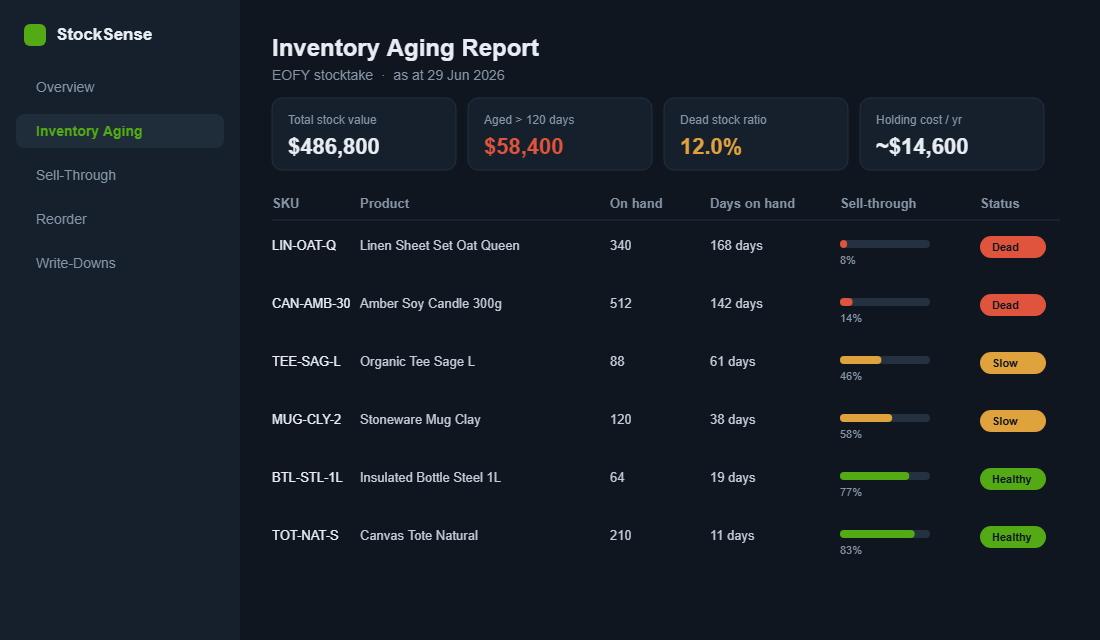
Run the report below on your own catalogue. Sort every SKU by days on hand and sell-through rate, then act on the tail:
- Dead (120+ days, low sell-through). Bundle it, discount it hard in the EOFY sale, or liquidate it. Recovering 40 cents in the dollar of cash beats holding 100 cents of a product nobody wants.
- Slow movers. Pair them with your heroes as a bundle to lift average order value without a straight markdown.
- Healthy stock. Protect it. Do not discount your best sellers just because a sale is on.
Part 3: Hunt the Cost Creep Hiding in Your P&L
Costs do not blow up in one dramatic decision. They creep. A $19 app here, a shipping rate that quietly rose, a payment plan you never renegotiated, a freelancer still on a monthly retainer for a project that finished in October. None of it hurts on its own. Together it is the difference between a 7% and an 11% net margin.
Pull twelve months of expenses and go line by line. Be ruthless. For every recurring cost, ask one question: did this earn its keep this year? Pay particular attention to four areas where Aussie stores leak the most:
- Your app stack. The average Shopify store runs six or more paid apps and forgets half of them. Audit every subscription. If you cannot name what an app does for revenue, uninstall it.
- Payment and transaction fees. On a seven-figure store these run into the tens of thousands. It is worth a call to review your rate and your gateway mix.
- Shipping and fulfilment. Carrier rates drift up. Re-benchmark your 3PL and your courier rates at least once a year, and EOFY is the prompt.
- People and contractors. Retainers outlive the work they were hired for. If you are weighing up where headcount actually pays off, our first hire playbook walks through the maths of when a role returns its cost.
A founder who trims $2,000 a month of dead cost has done more for net profit than a campaign that lifts revenue 5%, and it took an afternoon instead of a quarter.
Part 4: Run an EOFY Sale That Protects Margin Instead of Torching It
The demand is real. Seventy-one percent of Australians planned to shop the 2025 EOFY sales, up from 38% the year before, and the Australian Retailers Association put total EOFY spend at an estimated $10.5 billion. Online is expected to take 44% of that. Your customers are in a buying window. The question is whether you sell to them profitably or just train them to wait for your next discount.
The lazy EOFY sale is a flat 30% off the whole store. It works on revenue and quietly destroys net profit, because you are discounting your best sellers to people who would have paid full price anyway. The disciplined version protects margin with structure:
- Lead with the dead stock. Put your steepest discounts on the aged SKUs from Part 2. You want that cash back, not the stock.
- Use a threshold, not a blanket. A spend-based offer lifts average order value while controlling how deep the discount really goes. Our free shipping threshold playbook shows how to set that bar so it adds margin rather than giving it away.
- Bundle, do not blanket-cut. Pair slow movers with heroes. The shopper feels the value, your margin on the hero stays intact.
- Make the choice easy. Shoppers in a sale are comparing fast. Clear, confident product pages convert that urgency, which is exactly what our product comparison playbook is built for.
With 85% of Australians saying they are more price-conscious than they were five years ago, the brands that win EOFY are not the cheapest. They are the clearest about why the product is worth it.
Part 5: Build Profit Visibility So FY26 Is Never a Guess
The reason most founders cannot recite their net margin is not laziness. It is that the data lives in five places: Shopify for sales, Meta and Google for ad spend, a supplier sheet for COGS, the bank for fees, a 3PL invoice for shipping. Nobody has time to reconcile that weekly, so it gets done once a year at EOFY and never informs a live decision.
The fix is to put net profit on autopilot. A dedicated profit analytics app pulls every cost into one live dashboard so you can see true profit by day, by product and by ad. TrueProfit is the one we point Aussie founders to most often. It starts around $25 a month, which pays for itself the first time it catches an unprofitable product. Here is the setup, end to end:
- Install and connect Shopify. Add TrueProfit from the Shopify App Store. It syncs your order and revenue history automatically on connect.
- Enter your COGS. Import cost per product via CSV or type it in per SKU. This is the input that makes every other number real, so get it right.
- Link your ad accounts. Connect Meta, Google and TikTok. Spend now flows in automatically instead of being keyed in by hand.
- Add the rest of your costs. Set your payment and transaction fees, shipping costs, app subscriptions and any custom or fixed overheads.
- Read the dashboard daily. You now have net profit, net margin and contribution per order live. Sort products by net profit and you will find SKUs you are losing money on inside the first week.
Set this up before 1 July and FY26 starts with a profit number you can see every morning, not one you discover next June.
Part 6: Reset Your Numbers for the New Financial Year
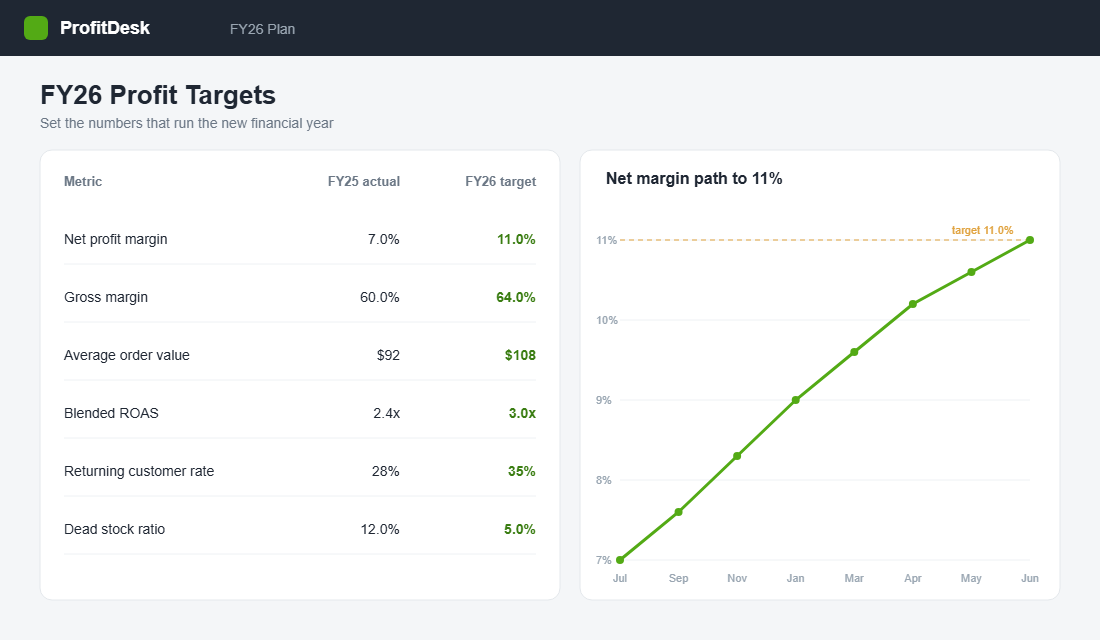
A review with no decision is just bookkeeping. The point of all five steps above is to set the targets that run FY26. Do not pick them out of the air. Take your FY25 actuals and move each one a deliberate notch:
- Net profit margin. If you ran 7%, target 11%. The cost cuts and stock clear-out from this review fund most of that move on their own.
- Gross margin. Identify the price rises or supplier renegotiations that lift it two to four points. Small moves here flow straight to the bottom line.
- Average order value. Set a target and back it with bundles and thresholds, not blanket discounts.
- Dead stock ratio. Commit to dragging it under 5% and review it quarterly, not annually, so it never builds up again.
Write the targets down where you will see them. A target you set at EOFY and forget by August is not a target. It is a wish. The founders who hit theirs put the numbers on the wall and check them every month.
What the Aussie Brands Getting This Right Do Differently
The brands that quietly win are not the ones with the loudest sales. They are the ones built so margin is protected by design, which makes EOFY a tune-up rather than a rescue. Two Australian examples make the point.
Who Gives A Crap, the Melbourne-founded toilet paper brand, built its whole model around subscription. That one structural choice does the heavy lifting that discounting never can. Predictable repeat orders smooth out cash flow, lower the cost of acquiring each new customer over their lifetime, and reduce the temptation to chase revenue with margin-killing promotions. When your base reorders on autopilot, you are not betting the year on a single EOFY weekend. The lesson for your store is to ask where recurring or repeat revenue could live, because retention defends margin in a way a sale never will.
July, the Australian premium luggage brand, sits at the other end and teaches a different lesson. It rarely competes on being cheapest. It competes on a clearly premium product, sharp photography and confident product pages, so that even during sale periods the brand is selling value, not just a lower price. That is the discipline behind Part 4. A price-conscious shopper, and 85% of Australians now say they are more price-conscious than five years ago, still pays for something they believe is worth it. The brands that hold margin through EOFY are the ones that made the case for the product long before the discount appeared.
Neither brand treats EOFY as the event that saves the year. The structure they built the rest of the year is what carries them through it. That is the mindset shift: stop asking how big a sale you can run, and start asking how little your profit depends on the sale at all.
The Compound Effect: Why This Beats Another Sale
Look at the six parts as one system and the power becomes obvious. Knowing your real net margin tells you where the leaks are. Clearing dead stock frees the cash. Cutting cost creep lifts the margin directly. A disciplined EOFY sale recovers cash without training discount addicts. Profit visibility keeps it honest all year. Resetting your targets points the whole machine at a bigger number.
Each one is worth a point or two of net margin. Stacked together, they are the difference between a brand that nets 7% and one that nets 12% on the same revenue. On a $1m store that is roughly $50,000 more in your pocket, and you found it without spending an extra dollar on ads. That is why the operators we work with treat EOFY as the most valuable fortnight of their year, not a tax headache to outsource.
None of this is tax advice, and your accountant is the right person to sign off on write-downs and treatment. But the strategy, the stock decisions and the targets are yours to own. EOFY is the prompt. The reset is the work.
Your EOFY Profit Reset Checklist
Block two hours before 30 June and work straight down this list. Tick each one off:
- 1. Net margin. Calculate gross, contribution and net margin for the full year. Write the three numbers down.
- 2. Dead stock. Run an inventory aging report. Flag every SKU over 120 days on hand and decide: bundle, discount, or clear.
- 3. Cost creep. Audit twelve months of expenses line by line. Cancel every app, retainer and subscription that did not earn its keep.
- 4. EOFY sale. Build the offer around dead stock and a spend threshold. Protect your hero products.
- 5. Profit visibility. Install a profit analytics app, load COGS and costs, connect ad accounts. Go live before 1 July.
- 6. FY26 targets. Set net margin, gross margin, AOV and dead stock targets. Put them on the wall.
Inside eCommerce Circle, the Profit pillar is one of the core areas we work on with every member, because it is the one that quietly decides whether all the marketing was worth it. If you want a second opinion on your numbers before the new financial year, let’s talk.