Most Aussie Shopify founders launch products the same way. They build what they think customers want, run a few ads, watch sales come in flat, then blame the algorithm. The product, the copy, the offer, all of it gets shipped on a hunch.
What’s in This Article
Here is the uncomfortable truth. Studies put new product failure rates between 35% and 75% across industries, with some sources citing as high as 95% for consumer goods. In ecommerce specifically, 80 to 90% of stores fail in the first one to two years, and the single biggest cause is lack of product-market fit. You did not run out of money. You ran out of customers who actually wanted what you sold.
The brands that win do not skip this step. Aussie skincare brand Fluff has founder Erika Geraertz on video calls with customers every single week, asking what they like, what other brands they buy from, and what they wish was different. Asphalte built a $30M+ clothing business by literally only making products their pre-order survey customers said they wanted. The pattern is consistent. The founders growing fastest spend the most time talking to actual buyers.
This is the founder-led customer interview playbook we run inside eCommerce Circle with members doing $40k to $500k a month. Nine questions, three rules, one synthesis system. Steal it.
Why Most Customer Interviews Generate Garbage Data
The reason most founder-led research fails has nothing to do with question count or sample size. It is the questions themselves.
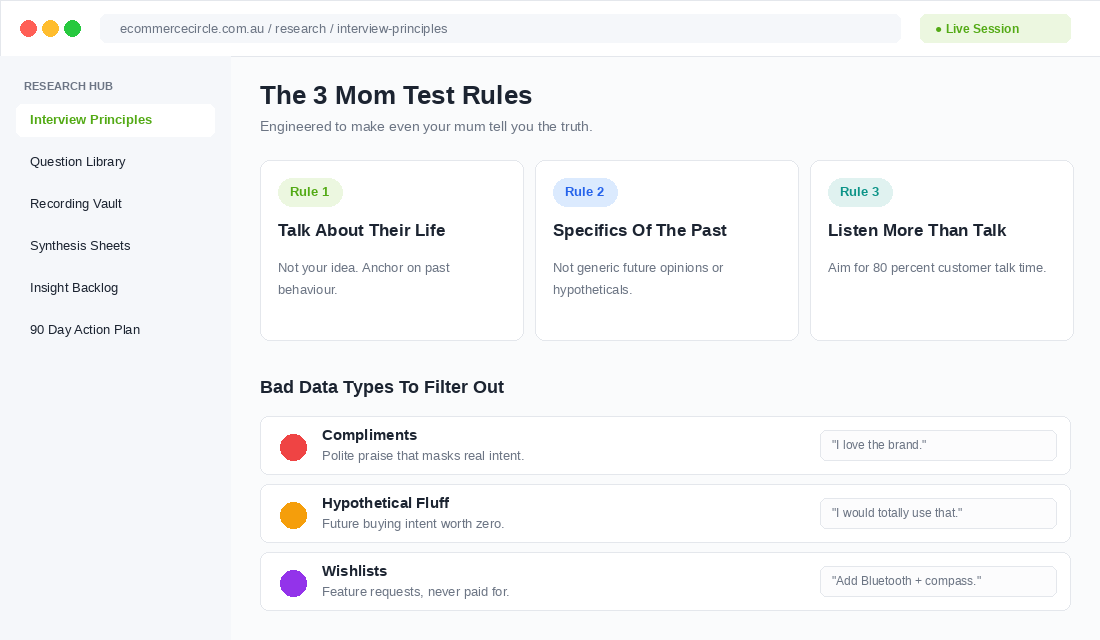
Rob Fitzpatrick wrote a small book called The Mom Test that should be required reading for every Shopify founder. His core insight: if you ask people whether your idea is good, they will lie to be polite. Even your mum will lie. The job of a good interview is to ask questions that even your mum cannot answer with a kind fib.
Three types of bad data show up in nearly every founder-run interview:
- Compliments. “I love the brand, it is beautiful.” Compliments feel good and tell you nothing about whether they would actually buy at $89 with $15 shipping.
- Hypothetical fluff. “I would totally use that.” Future-tense intent is worth approximately zero. Most people who say “I would buy that” never click a buy button.
- Wishlists. “It would be great if it had a built-in compass and Bluetooth and lasted ten years.” Customers are not product designers. They are great at describing pain. They are terrible at designing solutions.
The fix is structural. You design questions that get at past behaviour, not future opinion. You ask about their life and their problem, not your product. And you let them do most of the talking. Get those three things right and the same 30 minute conversation that used to produce vague enthusiasm starts producing actual revenue clues.
Who to Interview (The 4 Tiers of Customer)
The next mistake is interviewing the wrong people. Most founders default to their happiest, loudest customers, the ones who reply to email and leave five-star reviews. Those people are useful for testimonials, not strategy. They are already converted. You need to hear from the people deciding whether to convert, the people who almost bought and bailed, and the people who bought once and never came back.
Here is the four-tier list we use inside eCommerce Circle for any structured interview round:
- Tier 1: Recent first-time buyers (last 30 days). The memory of the buying decision is fresh. They can describe the trigger, the alternatives they considered, and what almost stopped them. Aim for 5 to 8 of these.
- Tier 2: Repeat buyers (2 or more orders). These people prove your retention story. Ask why they came back, what nearly stopped them the second time, and what other brands they buy from in the category. Aim for 3 to 5.
- Tier 3: Abandoned cart non-buyers. The hardest to reach and the most valuable. Filter Klaviyo by “added to cart but did not purchase in the last 14 days” and offer a $25 gift card for a 20 minute call. Aim for 3 to 5.
- Tier 4: Lapsed customers (no order in 90+ days). The retention diagnostic. Why did they stop. What did they buy instead. What would bring them back. Aim for 3 to 5.
The full target is 14 to 23 interviews across the four tiers. Most founders fight this number. They think 5 is enough. The research backs up that the magic zone for solid pattern recognition is 20 to 30, with strong signals appearing around 10 to 15. Fewer than 10 and you are still chasing one loud voice. Push past 15 and you start hearing the same phrases over and over. That repetition is the signal you are looking for.
The 9-Question Founder-Led Interview Script
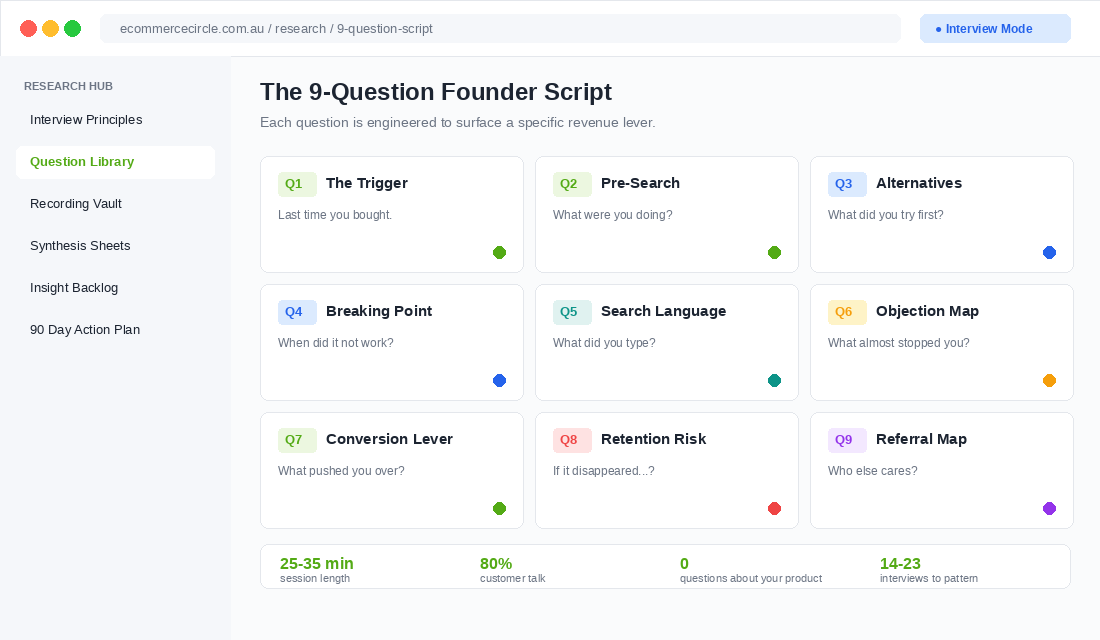
The script below works for almost any consumer ecommerce category. Steal it, then tweak the language to match your brand. Each question is engineered to surface something specific. Run it in order. Resist the urge to skip ahead.
- Q1. Walk me through the last time you bought a [product category]. What happened that day. This is the warmup. You are anchoring them in a real past event, not asking them to predict the future. Listen for the trigger event. Was it a birthday, a season change, running out of the last one, a friend’s recommendation. The trigger is the moment ad creative has to mimic.
- Q2. What were you doing right before you started looking. The pre-search moment is where almost all founders are flying blind. Were they on Instagram. Were they on TikTok scrolling. Were they searching Google after seeing a friend’s product. This tells you which top-of-funnel channels actually drive consideration in your category.
- Q3. What did you try first to solve the problem. This surfaces the alternatives. Often the real competitor is not the brand you think. It is a cheap supermarket version, a friend’s leftover product, or doing nothing at all. If most people say “I did nothing for ages first,” your ads need to attack inertia, not the competitor brand.
- Q4. When did you decide that approach was not working. The breaking point question. The moment they decided to actually open their wallet. The trigger to spend is almost never the same as the trigger to start looking. This single answer rewrites most landing page hero sections.
- Q5. What did you type into Google, or what did you search on Instagram or TikTok. Direct customer language for your SEO and your ads. Aussie founders consistently underestimate how much value sits in this question. The exact phrase a buyer types is rarely the phrase the founder uses in their copy.
- Q6. What almost made you not buy. The objection map. Price, shipping cost, sizing fear, not enough reviews, ingredients, country of origin, returns policy, dodgy website. Whatever they say came up multiple times, your PDP and checkout need to answer directly, above the fold.
- Q7. What pushed you over the line in the end. The conversion lever. A specific testimonial, a free shipping threshold, a money-back guarantee, a quiz result, a friend who already owned it. This is the social proof or risk reversal that converted them. Make it the loudest element on the page.
- Q8. If this product disappeared tomorrow, what would you replace it with. The retention question. If they say “I would go back to the supermarket one” you have a defection risk. If they say “honestly nothing else is like it” you have a moat. Either way you know where you stand.
- Q9. Who else in your life would care about this. The referral question. Customers will name their best friend, their sister, their gym buddy. That tells you the actual community they live inside. It also tells you what referral incentive to design.
Nine questions, 25 to 35 minutes, zero leading. Notice what is missing. Nothing about your product, your brand, your packaging, your hero image. Nothing about pricing opinion. Nothing about feature requests. Every question is about the buyer’s past behaviour, their world, and the problem they were solving. The Mom Test rules in action.
How to Run the Conversation (The 3 Rules)
Good questions ruined by a clumsy interviewer still produce garbage data. Three rules separate the founders who get clean insight from the ones who get a 30 minute hug.
- Rule 1. Shut up. The customer should be talking 80% of the time. If you find yourself explaining the brand or selling the product, stop. Ask the question. Wait. Count to four in your head if you need to. Most insight lives in the awkward silence after the first answer, when the customer keeps talking to fill the gap.
- Rule 2. Always ask “tell me more about that.” Whenever the customer says something specific (“I almost did not buy because the shipping was confusing”), do not move on. Say “tell me more about that.” The first answer is usually the headline. The real gold sits two layers down.
- Rule 3. Record and transcribe. Use Riverside, Otter, or even a Zoom recording. Your memory of the conversation is unreliable and biased toward whatever you wanted to hear. The transcript is the source of truth. Re-reading transcripts is where 80% of the synthesis insight actually comes from.
One more thing. Never pitch the product. Not even at the end. The moment you start selling, the conversation stops being honest. If they ask what your product does, deflect with “I will tell you at the end if there is time, but I want to keep this about your experience.” Then never circle back. The interview was the prize.
The Insight Synthesis System (Where the Money Hides)
You finished 15 interviews. You have 15 transcripts. Now what. This is the step most founders blow. They read the transcripts, feel inspired, write a few notes in a Google Doc, and then ship the same ads they were already running.
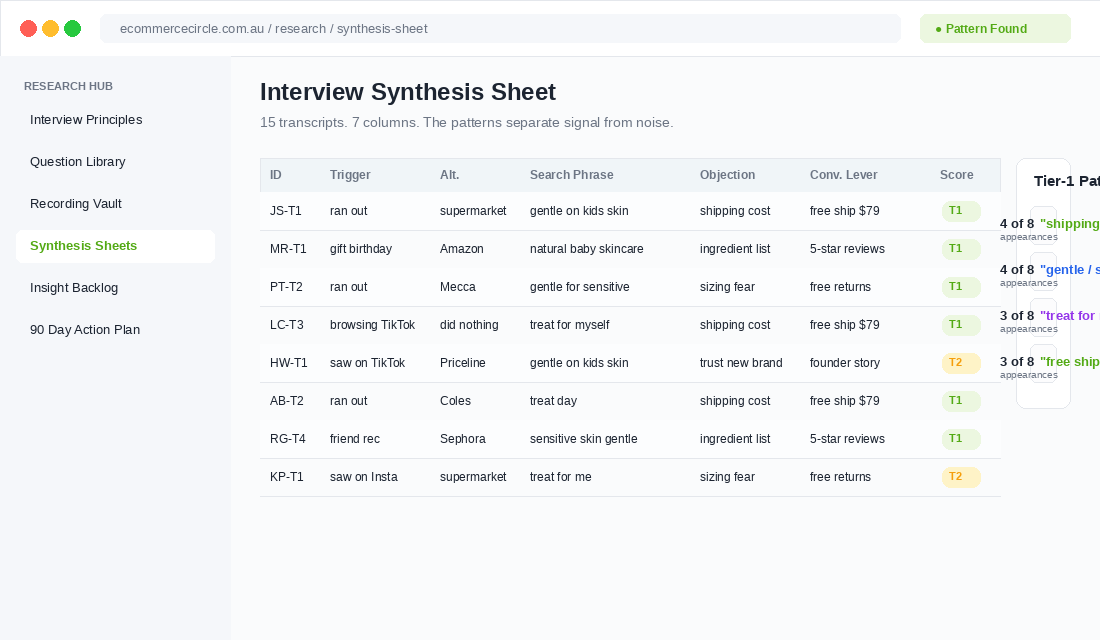
The synthesis system uses a single spreadsheet with seven columns:
- Customer ID (initials and tier, e.g. “JS-T1”)
- Trigger event (the answer to Q1 and Q2 in a sentence)
- Alternative considered (Q3)
- Search language (their exact words from Q5)
- Objection (Q6)
- Conversion lever (Q7)
- Notable quote (one verbatim sentence worth stealing)
One row per interview. By interview 8 or 9, patterns start to form. By interview 15, the same three objections, the same two trigger events, and the same handful of conversion levers are showing up over and over. That repetition is the signal. Anything that shows up four or more times is a tier-one insight worth acting on. Anything that shows up once is a curiosity, not a strategy.
One brand we worked with realised every single buyer used the word “treat” when describing why they bought. They had never used the word in any of their copy. They changed three headlines and one ad concept to centre the word “treat.” Conversion rate went from 1.8% to 2.6% inside three weeks. That is the kind of edge the synthesis sheet finds. A SaaS case study made the rounds where a brand swapped “add-ons” for “expansion packs” based on customer language, and conversions jumped 33%. Same language move, same impact.
How to Turn Insights Into Product, Copy, and Ad Decisions
Synthesis without action is therapy. The whole point of the interview round is to ship changes. Inside the More Orders Operating System we map every tier-one insight to one of four buckets, and every bucket has a clear next move.
- Product insights. “Three of 15 said they wished there was a smaller starter size.” Action: brief the supplier on a trial pack SKU. Add to the next product roadmap review.
- Copy insights. “Eight of 15 used the phrase ‘gentle enough for my kids’.” Action: rewrite the PDP H1 and at least two ad headlines using their exact language. Re-test inside Klaviyo subject lines.
- Conversion insights. “Six of 15 said shipping cost made them hesitate.” Action: test a free shipping threshold bar, run the maths on a $79 threshold, build the cart drawer message around it. The Shopify cart drawer 8-element framework covers the exact mechanic.
- Channel insights. “Nine of 15 said they first saw the category on TikTok.” Action: shift 20% of the Meta budget to TikTok creative tests, brief two new UGC angles based on their exact search phrases.
You are not going to act on all 30 insights at once. Pick three. Ship them in the next two weeks. Measure conversion rate, AOV, and creative CTR before and after. Then run the next interview round and start again. That is the loop that compounds.
The 14-Day Interview Sprint (Copy This Schedule)
Most Aussie founders never get this off the ground because it feels like a six-month research project. It is not. The whole thing fits inside two weeks if you commit a few hours a day.
- Day 1. Build the four-tier outreach list inside Klaviyo. Export 60 candidates across the four tiers. Write the recruit email (subject: “Quick 20 minute chat, $25 gift card on us”).
- Days 2 to 3. Send the outreach in batches of 15. Use a Calendly link with two 30 minute slots a day. Expect 20% to 30% to book.
- Days 4 to 11. Run two interviews a day. Use Zoom or Riverside. Record everything. Drop the auto-transcript into your synthesis sheet within 24 hours.
- Days 12 to 13. Synthesis. Read every transcript twice. Highlight every phrase that hits the seven-column model. Cluster patterns.
- Day 14. Pick three actions. Write the briefs for product, copy, ads. Schedule the shipping date for each. Book the next interview round in 90 days.
Total time for the founder: roughly 18 to 22 hours over the fortnight. Total cost including gift cards: under $500. The output is typically four to six tier-one insights, each of which has historically lifted store-wide conversion by 0.3 to 0.8 percentage points when acted on. On a $1M store doing 2.0% conversion, that is the difference between $1M and $1.4M revenue at the same traffic level.
The Compound Effect (Why This Beats Any A/B Test)
Every other optimisation play, A/B tests on PDPs, new hero images, fresh ad creative, only moves the needle on a guess you already had. Customer interviews change the guesses themselves.
Stack one round on top of another and three things compound. Your ad creative starts mirroring real customer language, which lifts top-of-funnel CTR. Your PDP hero answers the real objection, which lifts conversion. Your retention emails stop sounding like marketing and start sounding like the customer’s own internal monologue, which lifts repeat rate. Each round you run, the entire funnel gets cleaner because every layer is built on the same shared truth.
This is also where customer interviews link into the wider research stack. The interview round produces the language and the patterns. A structured 5-channel voice of customer system running continuously feeds the next round. The jobs to be done framework turns the language into a structural map of why people hire your product. None of them work as one-off projects. They work as a system, and the founder-led interview is the entry point.
The Most Common Mistake (And the Fix)
The single biggest failure mode for founder interviews is delegation. Founders hand the script to a VA, a customer service lead, or worse, a generalist agency. The data comes back useless. Not because the assistant did a bad job, but because the founder is no longer in the room when the customer says something that contradicts everything they believed.
The breakthrough moments in these interviews are almost always emotional. The customer says one sentence that detonates an assumption you had been carrying for two years. You cannot outsource that. The fix is simple. The founder runs the first 8 interviews personally. After that, a trained team member can run the rest, but the founder still listens to every recording. No exceptions. That is the cost of admission for owning a brand at this stage.
Inside eCommerce Circle, this is one of the first systems we install with every member, and it is the one that consistently produces the largest one-quarter revenue lifts. The customers are already in your Klaviyo list. The conversations are already there for the taking. You just have to schedule them, run them, and listen.
If you want a second pair of eyes on your customer interview system, your synthesis sheet, or what to do with the insights you already have, let’s talk. Customer research is one of the core pillars we work on with every Circle member, and the founders who run it consistently are the ones who stop guessing.