Short answer: yes, you almost certainly need business insurance, even if every parcel leaves your spare room. A standard home and contents policy is written for a household, not a trading store. The stock on your shelves, the laptop you pack orders beside and the customer who gets hurt by your product are usually outside it.
That gap catches a lot of founders. Around 1.3 million “household” businesses were recorded by the ABS in FY25 (BizCover), and most of them started the way yours did: a few boxes of stock, a Shopify store and a home insurance policy that was never told about either.
Most founders do one of two things. They assume Shopify covers them, or they assume the home policy stretches to fit. Neither is true. The stores that sleep well do something simpler: they tell their home insurer, buy a small business policy matched to what they sell, and write down what the stock is worth. This guide shows you exactly how, with real Australian cost figures and a checklist to run this week.
One note before we start. I am a coach, not a licensed insurance adviser. This is general information, so read the Product Disclosure Statement (PDS) for any policy and talk to a broker before you buy.
What a Home and Contents Policy Actually Leaves Out
Home and contents insurance covers your house and your personal belongings against fire, storm and theft. Business activity sits on the other side of a line the insurer draws. Here is what the major Australian insurers say about that line.
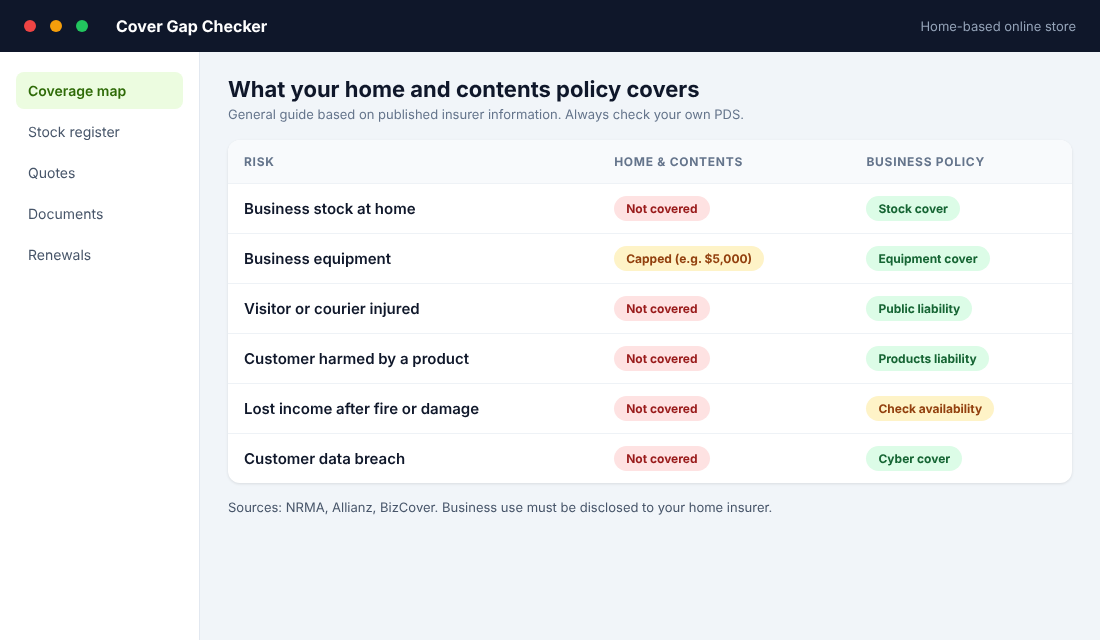
- Stock. NRMA states that stock kept at home for a business is not covered if it is damaged, destroyed or stolen (NRMA).
- Public liability. If a courier driver, a supplier or a customer collecting an order is injured at your home, the home policy generally will not respond.
- Product liability. If something you sold hurts someone, that is a business risk. NRMA lists it as excluded from home cover.
- Business interruption. A burst pipe that wrecks your packing area and stops sales for three weeks is a lost-income problem. Home policies do not pay for it.
- Equipment, with a cap. Allianz, for example, covers business computers and software under contents up to a total of $5,000, and business money is not covered (Allianz). That limit is one insurer’s, so check yours.
Now the part most people miss. The home policy can be the problem even if you never claim for the business. NRMA says customers must tell the insurer about any business run from the home, and that failing to do so can lead to a claim being refused or reduced, the policy being cancelled, or both. BizCover also warns that a business-related claim can put the home policy itself at risk.
Picture a founder with $30,000 of stock in a spare room and a home policy that never heard about it. A kitchen fire reaches the room. The household claim might be paid. The stock claim is the part that gets declined, and the disclosure gap gives the insurer a reason to look hard at the rest.
This is why the first move is not buying anything. It is a phone call to your home insurer. We will get to the exact questions in the checklist below.
Does Shopify, Etsy or Your Marketplace Cover You?
No. This is the second assumption that gets founders into trouble, so it is worth a section of its own.
Upcover puts it plainly for sellers: when you run a store on Shopify or your own website, the platform runs the shop but you remain responsible for the product, the stock, customer service and data (Upcover). Etsy’s own Australian terms describe Purchase Protection as “not an insurance policy, warranty or guarantee”. Amazon leaves product responsibility with the seller, and some sellers in some categories must hold liability cover. eBay’s protections mainly address the transaction, and postage cover is not products liability.
There is one more catch. A standard business policy generally will not pay out because a platform suspended your account. If your income depends on one Meta ad account or one marketplace listing, that is a business continuity problem, not an insurance problem.
What about Shopify’s own protection tools? We unpacked that in Shopify Protect Australia: Is It Available and Worth It?. Short version: fraud and chargeback tools protect your payments, they do not replace liability or stock cover.
Treat the platform as your shopfront and the insurance as your own responsibility. If a customer has an allergic reaction to your skincare, or a candle you sold starts a house fire, the claim lands on you, not on Shopify.
The Three Covers That Matter for a Home-Based Store
You do not need every product on an insurer’s menu. For a home-based Shopify store, three covers do almost all the work. Everything else is optional until you grow.
1. Public and products liability
This pays legal costs and compensation if someone says your business injured them or damaged their property. In Australia, public and products liability are usually sold together as one policy. It covers the courier who trips over your stock pile and the customer who is harmed by something you sold.
It is also the cheapest and the one that matters most. If you sell anything that touches skin, food, children, electricals or heat, treat this as non-negotiable. Product liability is the policy that stands between a single bad review turned legal claim and your savings.
2. Stock and equipment cover
This replaces your inventory and kit after theft, fire or damage. Upcover notes that stock cover applies to goods kept at home or in a shed, which is exactly the situation you are in. Allianz calls its version General Property for portable tools and equipment.
Two details decide whether it is worth anything. First, how it is valued. Insure stock at what it costs you to replace (landed cost including freight and duty), not at retail price. Second, whether stock in transit is included. If you import, ask about marine cargo cover for goods moving from your supplier to your door.
3. Cyber and privacy cover
You hold customer names, addresses and order histories. That makes you a target even at $200,000 a year in revenue. The Australian Signals Directorate’s Annual Cyber Threat Report for 2024-25 recorded more than 84,700 cybercrime reports, about one every six minutes, and an average self-reported cost of $56,600 for small business, up 14% (ASD).
Business email compromise was among the most common business cybercrimes, which is relevant if you pay suppliers by bank transfer from the same inbox you use for customer service. Cyber cover is the one most home-based founders skip, and the one that costs the most when you need it.
Two other things to know. If you employ anyone, including casual packers, workers compensation is compulsory. And if you hold stock worth more than your home policy limits, ask the insurer whether a combined business pack is cheaper than buying the covers one at a time.
What It Costs: Real Australian Premium Figures
Founders put off insurance because they expect a four-figure bill for a business that makes a few thousand dollars a month. The data says it is often far less.
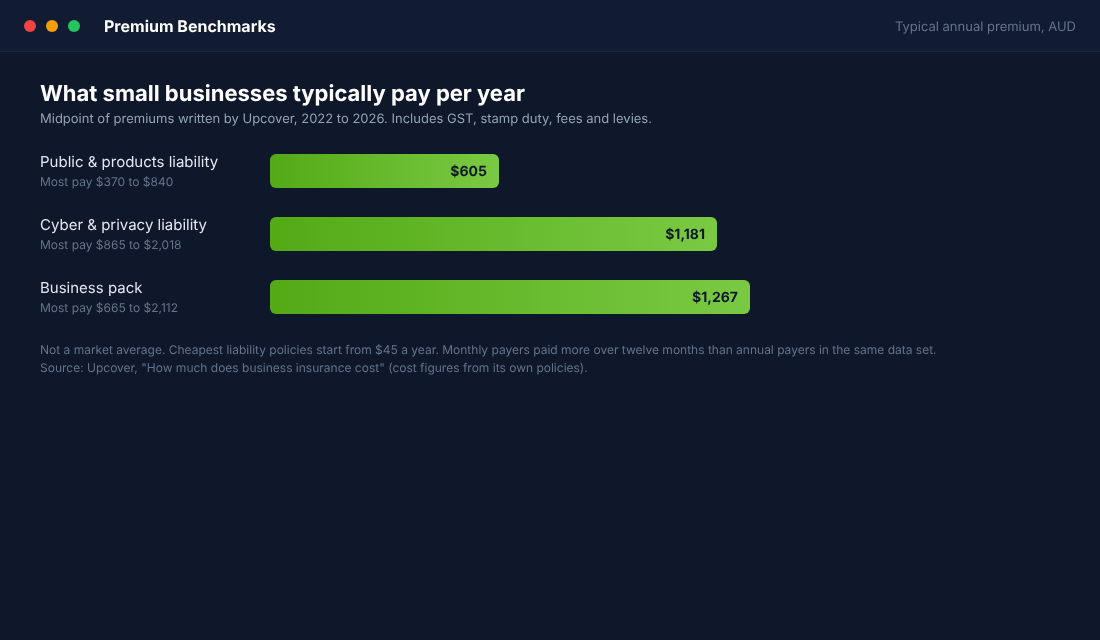
Upcover published premiums from its own policies written between 2022 and 2026. These are not a market average, but they are a useful guide to the scale of the cost (Upcover).
- Public and products liability: typical premium about $605 a year (roughly $46 a month). Most businesses pay between $370 and $840, and the cheapest policies start from $45.
- Business pack: typical premium about $1,267 a year when paid annually. Most pay between $665 and $2,112.
- Cyber and privacy liability: typical premium about $1,181 a year, with most paying between $865 and $2,018.
All figures include GST, stamp duty, fees and levies. Upcover notes that monthly payers paid more over the year than annual payers in its data, though those are different groups of businesses.
So a home-based store with liability and stock cover might land near the business pack figure, around $1,267 a year or roughly $105 a month. For a store doing $15,000 a month in sales, that is well under 1% of revenue.
What moves your price? Upcover lists the factors in order: what you sell, whether children use the product, where the stock is kept, whether you import, where you sell (overseas buyers can raise the price) and whether you sell at markets. Candles, skincare and baby products cost more than prints or stationery. Some specialist insurers exclude toys, plush, teethers and dummy clips entirely, so ask early if you sell in those categories.
The Profit angle matters here too. Insurance is a fixed cost, so it belongs in your monthly numbers. The Profit section of the Scorecard checks exactly this kind of line item: costs that sit outside your ad spend and COGS but still decide your take-home.
We have covered pricing for different store types in Ecommerce Insurance Quotes: What Aussie Stores Pay, and the product risk side in Product Liability Insurance for Online Stores: AU Guide.
Two Aussie Brands That Started at Home (and What They Teach You)
Home is where plenty of big Australian online brands began. Their stories show why the home-versus-business line matters as you grow.
Adore Beauty. Kate Morris started the business in her garage in Murrumbeena, using $12,000 borrowed from her boyfriend’s parents to buy a basic website and some stock, according to SmartCompany. Growth plateaued at $2 million in 2010. In 2012 she moved to a larger warehouse, replatformed the website and re-mortgaged her home to fund the expansion. By the second half of 2015, turnover was about $14 million.
The lesson: the day she re-mortgaged the house to fund growth, her home and her business became financially tied together. A home-based founder in that position needs the stock, liability and interruption risks written down and insured. Otherwise one bad event is a personal event, not a business one.
Showpo. Jane Lu quit her corporate finance job in June 2010 after running a pop-up business called Fat Boye Group, whose supplies were stored in her parents’ garage. Showpo made its first sale within a week of its first photoshoot in September 2010. She started with roughly $60,000 of debt and no marketing budget, and, two years after buying out her partner in December 2011, reached a $1 million run rate (CNBC Make It).
The lesson: when you are already carrying debt, a single uninsured stock loss can end the business before it starts. Lu got through her early years on social media, not luck, and she had to be careful with every dollar. Cover is cheap when it protects the stock you paid for with borrowed money.
Neither founder’s story tells us what insurance they held at the time, and we should not guess. The point is the pattern: home-based stores grow fast, and the risks grow faster than the paperwork.
The Home Store Insurance Audit (Do This in One Afternoon)
Here is a framework you can run this week. It takes about two hours and one phone call. You end with a documented position instead of a guess.
Step 1: Value what you have
Open a spreadsheet. List three numbers:
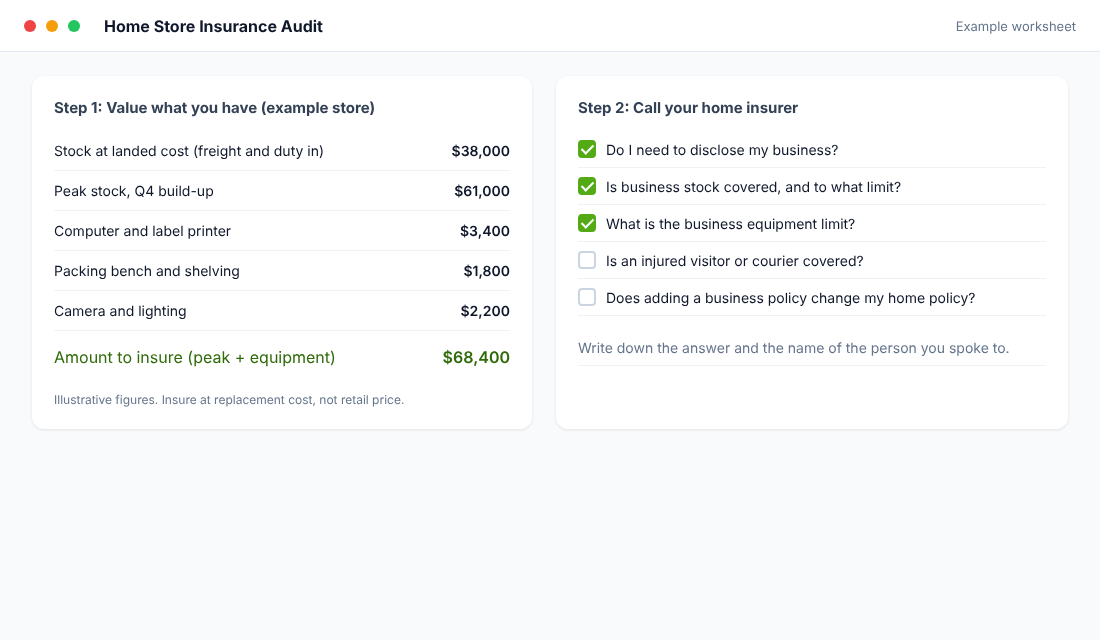
- Stock at landed cost. What you paid per unit, including freight, duty and prep, multiplied by units on hand. Pull this from Shopify under Products, Inventory, and add your cost per item.
- Equipment. Computer, label printer, packing bench, camera, shelving. Use replacement cost.
- Peak stock. Your highest stock value in the year (Black Friday build-up, Christmas). Insure for the peak, not the quiet month.
Step 2: Ring your home insurer
Ask these five questions and write down the answer and the name of the person you spoke to.
- Do I need to tell you I run a business from home, and what do you class as a home office?
- Is business stock covered at all, and what is the limit?
- What is the limit on business equipment (for example, Allianz states $5,000 total)?
- Does it cover a visitor who is injured, such as a courier or customer?
- If I add a business policy elsewhere, does that change my home policy?
Upcover’s guidance is the same: the five questions include whether you need to disclose the business at all, and not disclosing can affect a later claim. Some insurers can add limited business items to a home policy, though many cannot.
Step 3: Get at least three quotes
Tools: Upcover, BizCover and your home insurer’s business arm (Allianz, NRMA and others sell business policies). All quote online in minutes. Here is the setup:
- Pick your business type as online retailer or the closest match, and state that you work from home.
- Enter your real annual turnover and stock value from Step 1. Understating either can weaken a claim.
- Say where stock is kept (home, shed, garage) and whether you import.
- Add public and products liability first, then stock cover, then price cyber separately.
- Compare the excess, the stock limit and exclusions in the PDS, not just the premium.
Step 4: Document the setup
BizCover suggests keeping records of equipment, stock and client visits, and keeping business and personal assets separate. Photograph your stock area and packing station with the date visible, and save your supplier invoices in one folder. If you ever claim, this folder is the difference between a fast payout and a long argument.
Step 5: Put the renewal in your calendar
Insurance is not one and done. Review every 12 months, and any time stock levels jump, you hire help, add a new product category or start importing. A store that doubled its stock for Black Friday and insured for last year’s number is underinsured by definition.
When You Need More Than the Basics
The three covers above fit a store run by one person from a spare room. Some triggers mean you need to add more.
- You hire staff. Workers compensation is compulsory if you employ anyone, including casual staff. Ask about it before the first shift, not after.
- You import. Add marine cargo cover for stock in transit. Our ecommerce insurance guide for Australian stores goes deeper on the wider range of covers.
- Customers or contractors visit. If you run pick-ups, photographers or a part-time packer from home, liability matters even more.
- You move to a warehouse or 3PL. Your home policy no longer matters for stock, but the stock is now in someone else’s building. Check what their policy covers and what yours still has to.
- Your structure changes. A move from sole trader to a company changes who owns the policy and the assets.
There is also the question of what insurance does not do. It does not protect you from a platform suspending your account, a supplier going bust or a demand drop. Those are business continuity risks, handled with backup suppliers, a second sales channel and a cash buffer. Protection in the 10 P’s is wider than insurance, and insurance is the part you can solve in an afternoon.
The Compound Effect: Cover, Records and Cash Buffer
Each piece of this works alone. Together they give you something more valuable than a policy: the ability to keep trading after a bad day.
The disclosure call to your home insurer keeps your household policy intact. The business policy covers the stock, the liability and the data. The photos, invoices and stock valuation make any claim quick. And the annual review keeps the whole thing matched to a store that is growing. At roughly $105 a month for a typical pack, you are paying for the right to treat a fire, a break-in or a customer claim as an annoying week and not a closing-down event.
Notice what we did not suggest: waiting until you are bigger. Adore Beauty and Showpo both reached eight-figure revenue after starting in garage-sized spaces, and the founders who get there are the ones who protect what they have built at each stage.
Your Home Store Insurance Checklist
Copy this into your notes and tick it off.
- ☐ Stock valued at landed cost, with a peak figure for Q4
- ☐ Equipment list with replacement values
- ☐ Home insurer called, answers and name recorded
- ☐ Business disclosed to home insurer in writing
- ☐ Public and products liability quoted from three sources
- ☐ Stock and equipment cover quoted, with limit at least equal to peak stock
- ☐ Cyber cover priced separately and decision recorded
- ☐ Workers compensation checked if anyone is paid to help
- ☐ Photos of stock area and packing station saved with dates
- ☐ Supplier invoices stored in one folder
- ☐ Renewal date in the calendar, plus triggers for stock jumps and hires
If you can only do three things today: ring your home insurer, value your stock, and request a liability quote. The rest follows from those.
Inside eCommerce Circle, protection is one of the core pillars we work on with every member, because a store that cannot survive a bad month will not get to a good year. If you want to see exactly where your store is exposed and what is capping your orders, take the free More Orders Scorecard. It takes two minutes and shows you which of the 10 P’s to fix first.