Most store owners start an insurance quote the same way. They type “how much is ecommerce insurance” into Google, get a range wide enough to drive a B-double through, and then fill in a broker form with guesses. Turnover rounded up. Stock value pulled from memory. “Not sure” on where the products come from.
What’s in This Article
Then they pick the cheapest quote and move on. Six months later a customer claims a product hurt them, or a supplier account gets hacked, and the claim is knocked back because the policy excluded exactly what went wrong.
Here is the problem. A quote is only comparable if every insurer is pricing the same risk, at the same limits, with the same exclusions. Most store owners never set that up, so they compare premiums that are not comparable. This guide shows you what Australian online stores typically pay, what drives the price, and the exact pack to send so three quotes tell you something real.
One note before we start. This is general information from an ecommerce coach, not personal insurance advice. Use it to walk into the conversation prepared, then confirm your cover with a licensed broker.
What Aussie Online Stores Actually Pay for Insurance
There is no official price list, and anyone who gives you one number is guessing. What you can do is build a realistic range from published broker and aggregator data, then expect your own quote to land somewhere inside it.
Here are the indicative annual ranges from Australian sources, in AUD:
- Public liability: about $480 to $2,160 a year on the widest range, with most small retailers at $500 to $900 for a $10M limit (NameTheCost, 2026).
- Cyber liability: about $540 to $1,800 a year for small businesses (NameTheCost). Upcover’s data across 700+ policies puts a typical small business at around $1,200, with most between $900 and $2,100.
- Online store package (public and product liability bundled): about $50 to $110 a month, or $600 to $1,320 a year.
- Full business pack with contents, stock and business interruption: about $960 to $4,200 or more a year, depending on stock value and turnover.
Product liability rarely gets its own price. In most Australian quotes it sits inside the public liability policy or gets bundled with it, which is why you will struggle to find a standalone figure. BizCover says product liability is typically part of a public liability policy. That is good news for pricing and bad news for comparison, because “included” can mean very different limits and exclusions.
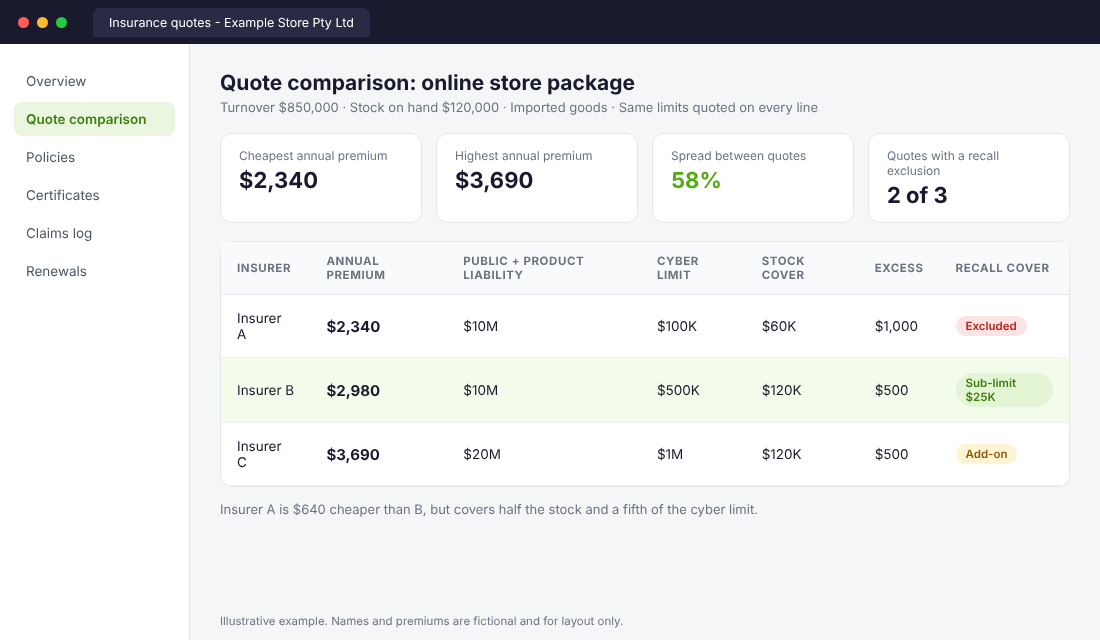
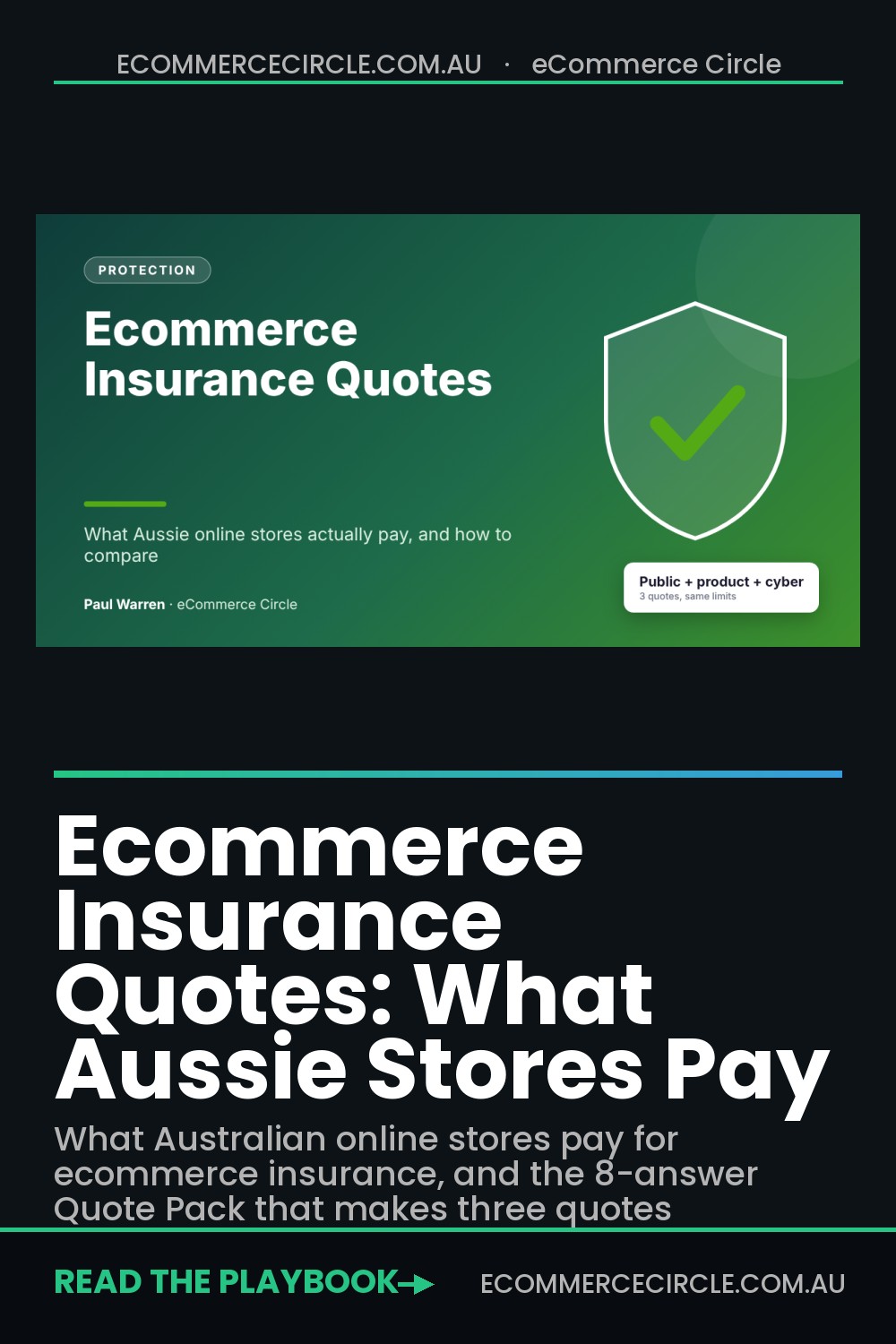
The screenshot above shows what a properly built comparison looks like. Same turnover, same stock value, same limits requested on every line. Notice the cheapest quote is 58% below the dearest, but it covers half the stock and a fifth of the cyber limit. That is not a saving. It is a different product.
Treat any published range as a sanity check, not a quote. If a broker quotes you $400 for a store turning over $1M with imported stock, something has been left out. If a quote lands at $8,000, ask what they have loaded onto it.
What Moves Your Premium Up or Down
Insurers price on a handful of inputs. Knowing them lets you decide which ones you can change before you ask for a quote.
- Turnover and stock value. Both are core pricing inputs. Contents cover runs at about $1 to $1.50 per $1,000 insured, and business interruption typically costs 0.5% to 2% of the insured sum.
- Product category. Skin and body products, anything ingested, children’s items, and electrical goods all price higher than a candle or a tote bag. Say what you sell in plain terms, because an insurer who finds out later that you sell supplements can decline a claim.
- Where the product comes from. If you import under your own brand or bring in stock from overseas, the legal weight lands on you. We will cover that in the next section.
- Claims history. Insurers usually look back three to five years. A clean record can earn a 10% to 25% no-claim discount.
- Excess. Lifting your voluntary excess from $500 to $1,000 can cut the monthly premium by roughly 10% to 15%.
- How you pay. Paying annually instead of monthly avoids around 5% to 9% in financing and direct debit costs.
- Location. Postcode risk ratings matter. Coastal Queensland and Northern Territory addresses can carry a 25% to 50% loading on property cover.
Notice what is missing from that list: the platform you sell on. Shopify, WooCommerce or marketplace, the insurer cares about what you sell, who it could hurt, and what data you hold.
The Quote Pack: 8 Answers to Prepare Before You Ask Anyone
This is the single biggest lever in the whole article. Prepare these eight answers once, put them in one document, and send the same pack to every broker. Your quotes will then compare like for like.
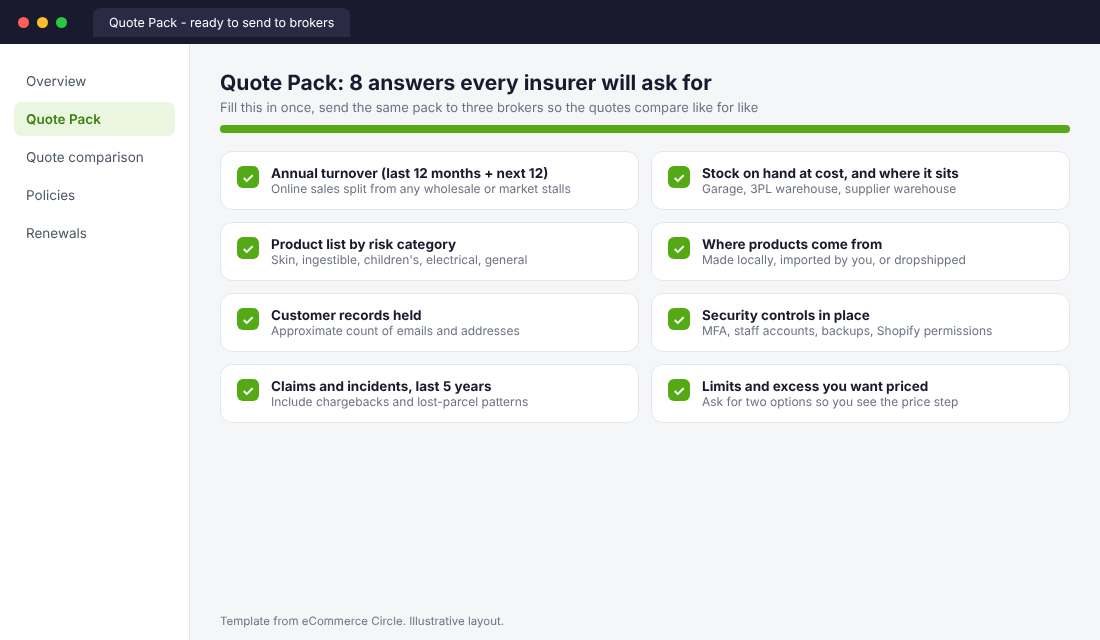
- Annual turnover. Last 12 months and your forecast for the next 12. If you are about to run a big BFCM or launch a new range, say so. Underestimating turnover is how you end up underinsured.
- Stock on hand at cost, and where it sits. Garage, spare room, 3PL, or supplier warehouse. Stock held by a 3PL may be covered by their policy or yours, and you need to know which.
- Product list by risk category. Group SKUs into skin, ingestible, children’s, electrical and general. One page is plenty.
- Where products come from. Made locally, imported by you, or dropshipped. Be exact.
- Customer records held. An approximate count of emails and addresses. Cyber insurers price on volume of records and card data.
- Security controls. Multi-factor authentication on Shopify, email and your ad accounts, staff accounts with limited permissions, tested backups, and an app audit. Upcover lists these as the controls that lower cyber premiums.
- Claims and incidents, last five years. Include repeat chargebacks and lost-parcel patterns. Insurers respect honesty far more than a surprise.
- Limits and excess you want priced. Ask for two options, for example $10M and $20M public liability, so you can see how little the price rises as the limit climbs.
BizCover notes that cost does not rise at the same rate as cover level. Moving up a limit is often cheap. Moving down to save money often saves very little.
Quick win: if you cannot answer item two or item four today, that is the first job. Pull a stock report from Shopify, then email your suppliers to confirm who the importer of record is for each range.
Public and Product Liability: Where Importers Get Caught
Many store owners assume liability sits with the manufacturer. Under the Australian Consumer Law, importers and distributors can carry manufacturer-level exposure. If you bring in goods under your own brand, the claim can land at your door.
The consequences can be very large. In December 2025 the Federal Court set a $14M penalty against City Beach (trading company Fewstone) for selling products that failed button battery safety and information standards. Over the period from June 2022 to October 2024 the company admitted more than 54,000 sales of products that failed the safety standard and over 56,000 that failed the information standard. Those were regulatory penalties, and insurance does not generally pay fines. The lesson for a smaller store is not the number. It is that compliance and cover are two separate jobs, and you need both.
Here is what to check on a product liability quote:
- Limit. $5M, $10M and $20M are the common public liability limits. Many store owners choose $10M, and some wholesale customers and landlords will ask to see a certificate of currency before they deal with you.
- Imported and third-party goods. Confirm in writing that products sourced from overseas suppliers are covered, not just goods you make.
- Defence costs. Check legal defence costs sit in addition to the settlement limit, not inside it.
- Recall costs. Public liability typically does not cover product recall costs. If you sell anything that could be recalled, ask for a recall extension or a separate recall policy.
- Retroactive date. If the policy is claims-made, a later start date can leave earlier sales uncovered.
Before you buy, run the compliance side as well. Our product compliance check walks through the six checks to run before a new SKU goes live, and the supplier agreement playbook covers the indemnity wording that lets you pass some risk back up the chain.
Cyber Cover: Price It Against the Cost of One Bad Day
Cyber is the policy most store owners skip, and it is the one with the clearest numbers.
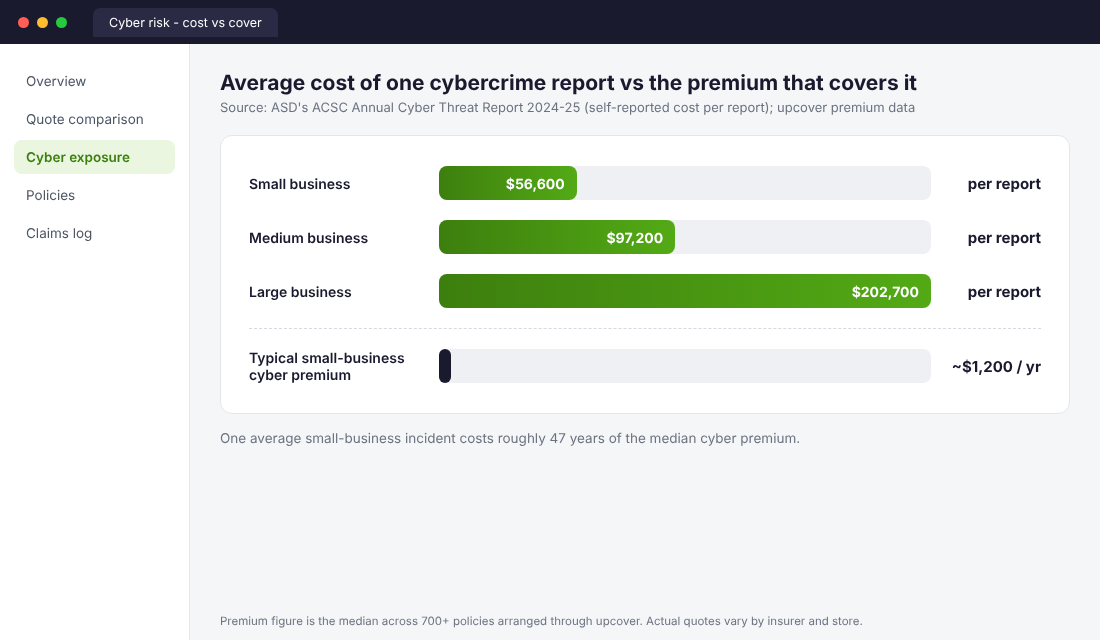
The Australian Signals Directorate’s ACSC reported in its 2024-25 Annual Cyber Threat Report that the average self-reported cost of a cybercrime report was $56,600 for small businesses, up 14%. For medium businesses it was $97,200, up 55%. It also received over 84,700 cybercrime reports in the year, roughly one every six minutes.
Put that next to a typical cyber premium of around $1,200 a year and the maths is not subtle.
The most reported crimes by businesses were email compromise with no financial loss (19%), business email compromise fraud with financial loss (15%) and identity fraud (11%). For a Shopify store, that translates into a hijacked email inbox, a fake invoice from a “supplier”, or a staff login that does not belong to staff. We cover the supplier version in our supplier payment fraud defence guide.
Data breach rules apply to you too. The OAIC recorded 1,205 notifiable data breaches in 2025, the highest since the scheme began in 2018, up 8% from 1,112 in 2024. Of those, 716 came from malicious or criminal activity. And customers care: 82% of Australians say they are concerned about data breaches.
A real example of how this plays out for a retailer is Dymocks. The bookseller found unauthorised access to customer records in September 2023 after a third party alerted it. Names, addresses, birth dates, email addresses and loyalty membership details may have been exposed, and Have I Been Pwned counted roughly 1.2 million stolen records covering more than 800,000 unique email addresses. Dymocks says no financial information was involved because it does not store it. Even then, the company had to investigate, notify and manage the fallout in public.
When you request cyber quotes, ask for these items to be spelled out:
- Limit options. BizCover lists $100K or $2M. Cover limits generally range from $100K to $5M.
- What is included. Breach notification, forensic investigation, legal costs, ransomware response and business interruption during recovery.
- Social engineering and invoice fraud. Many policies exclude or sub-limit funds-transfer fraud. If a fake supplier invoice is your biggest worry, ask directly.
- Security conditions. Some insurers require MFA before they bind the policy. Switch it on first.
How to Compare Three Quotes Without Getting Fooled
Once the quotes arrive, resist the urge to sort by price. Build a simple comparison grid and fill it in line by line. It takes about 30 minutes and it is the highest value half hour in this whole process.
Use these columns:
- Annual premium and payment option. Annual and monthly prices, so you can see the financing cost.
- Public and product liability limit. And whether product liability is included or an add-on.
- Cyber limit and sub-limits. Especially for funds-transfer fraud and business interruption.
- Stock and contents cover. Sum insured, and whether stock at a 3PL or in transit is included.
- Excess. Per claim, per policy section.
- Key exclusions. Recall, contractual liability, professional negligence, and anything specific to your category.
- Claims basis. Occurrence or claims-made.
In the example earlier, Insurer A looks like a $640 saving against Insurer B. But A covers $60K of a $120K stock holding, a $100K cyber limit and excludes recall. One bad week and the “saving” disappears. That is why we price from the pack, not from the premium.
Ask for the policy wording, not just the quote summary. A summary shows the headline. The wording shows the exclusions. Search the PDF for “exclusion”, “recall”, “contractual” and “territory”.
The Tool: Compare Quotes in One Sitting with BizCover or Savvy
You do not need to ring a dozen brokers. Online comparison platforms like BizCover and Savvy let you request quotes from multiple Australian insurers in a single form. Savvy describes its process as a quick quote form, a side-by-side comparison, and then purchase.
Here is the setup, step by step:
- Open your Quote Pack and keep it beside the form so you answer every question the same way you will answer a direct broker.
- Enter your occupation as an online retailer, and tick public and product liability, cyber, and contents or stock if you hold stock.
- Enter turnover and stock values from the pack, not from memory.
- Request two limit options, for example $10M and $20M public liability, and $100K versus $1M cyber.
- Download the product disclosure statement for each quote and check exclusions for recall, contractual liability and imported goods.
- Before you buy, ring one broker with your pack and ask them to beat the best online price on like-for-like terms. A broker can often place cover that comparison sites do not show, and for odd categories like supplements or electricals you will want a human to read the wording.
Online prices on these platforms are indicative until you complete underwriting. Treat the first number as a starting point and expect adjustments once you disclose product categories and claims history.
Seven Ways to Cut the Premium Without Cutting the Cover
- Pay annually. Saves around 5% to 9% in financing costs.
- Lift the excess to $1,000 if your cash buffer can absorb it. Roughly 10% to 15% off.
- Switch on MFA everywhere before you request cyber quotes. Insurers see it as a clear sign of lower risk.
- Bundle policies into a business pack rather than buying three separate policies.
- Be accurate about stock. Over-insuring costs you every year. Under-insuring costs you at claim time. Update the number quarterly before peak season.
- Keep a clean claims log. A clean three to five years can earn a 10% to 25% discount.
- Compare at renewal, every year. Loyalty rarely gets a discount. A fresh comparison gets you a market price.
If shipping losses are your biggest worry, add that to your plan separately. Our shipping insurance playbook covers the six layers of package protection. Your public liability and cyber policies will not pay for a lost parcel.
The Quote Comparison Template
Copy this into a spreadsheet. Score each quote out of 5 on each line and add up the total. Price is one line out of ten, not the whole decision.
- 1. Premium (annual). Lowest gets 5, highest gets 1.
- 2. Public and product liability limit. $5M = 2, $10M = 4, $20M = 5.
- 3. Imported and third-party goods confirmed in writing. Yes = 5, unclear = 2, no = 0.
- 4. Cyber limit. $100K = 2, $500K = 3, $1M or more = 5.
- 5. Funds-transfer fraud covered. Yes = 5, sub-limited = 3, no = 0.
- 6. Stock cover matches stock at cost. Full = 5, 50% = 2.
- 7. Recall cover. Included = 5, add-on = 3, excluded = 0.
- 8. Excess you can absorb in one hit. Comfortable = 5, painful = 2.
- 9. Claims basis and retroactive date. Occurrence or full retro = 5, restricted = 2.
- 10. Insurer or broker responsiveness. Answered your questions in writing within two days = 5.
Any quote scoring a zero on lines 3, 5 or 7 needs a conversation before you buy, regardless of the total.
How It All Works Together
Each piece above does a different job. The Quote Pack makes the quotes comparable. The comparison grid shows you what the premium is actually buying. The scoring template stops price from winning by default. And the annual renewal habit keeps the market honest.
Together they turn insurance from a guess into a decision you can defend. You know your numbers, you know your exclusions, and when the claim comes, you know the policy covers the thing that actually went wrong.
Run this process once a year, a few weeks before renewal and well before BFCM. Your stock value is at its highest going into peak season, and that is the number that needs to be right.
Inside eCommerce Circle, protecting the business is one of the core pillars we work on with every member. If you want to see exactly where your store is being capped, take the free More Orders Scorecard. It takes two minutes and shows you which of the 10 P’s to fix first. For the wider picture on cover types, read our guide to ecommerce insurance in Australia, and for the legal side see legal essentials for Australian Shopify stores.
Sources: NameTheCost (Australian retail and small business insurance cost guides, 2026), upcover (cyber insurance cost data), BizCover and Savvy (published quote ranges and processes), ASD’s ACSC Annual Cyber Threat Report 2024-25, OAIC Notifiable Data Breaches statistics 2025, The Lawyer Magazine (City Beach penalty), SecurityWeek (Dymocks). Figures are indicative and not a quote.