You message a creator with 40,000 followers. She sends back a rate card: A$900 for a Reel, A$400 for three Stories, usage rights “on request”. You have no idea whether that is a bargain or a rip-off, so you either pay it and hope, or you go quiet and never reply.
Most Aussie store owners price influencer marketing like this: by gut feel, one quote at a time, with no number to measure the quote against. That is how you end up paying A$2,000 for a post that sells four units, while the brand next to you pays A$250 for a video that sells out a colour.
The stores that do well here do the opposite. They know what creators actually get paid, they budget for the costs nobody quotes you upfront, and they work out how many orders a post has to sell before they say yes. This guide gives you all three: current Australian rates by creator tier and platform, the hidden extras that usually double your spend, and a simple deal sheet you can use on your next quote.
Influencer Marketing Cost in Australia: The Short Answer
There is no official rate card in Australia. What you can do is triangulate from the sources that publish real numbers, then sense-check every quote against them.
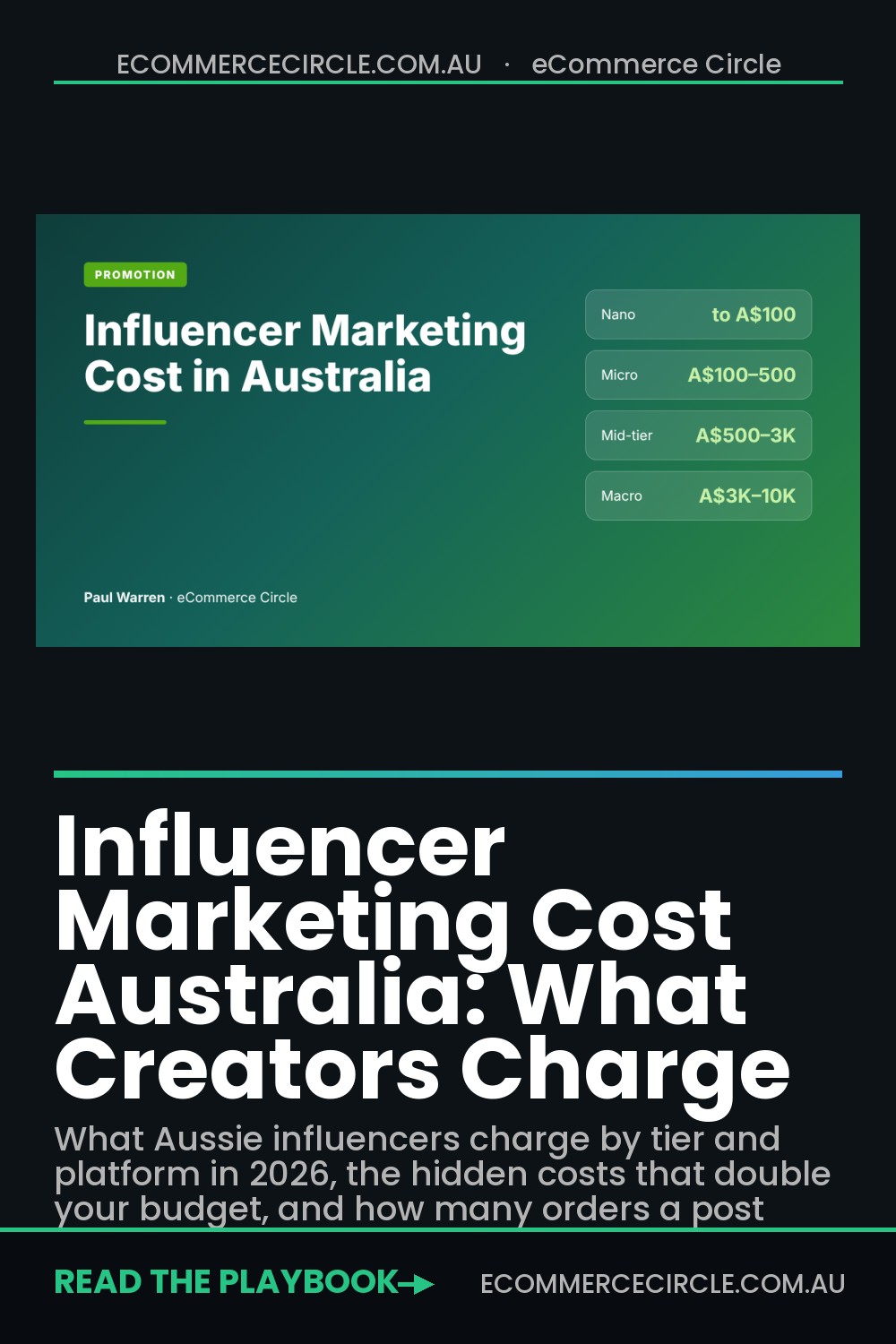
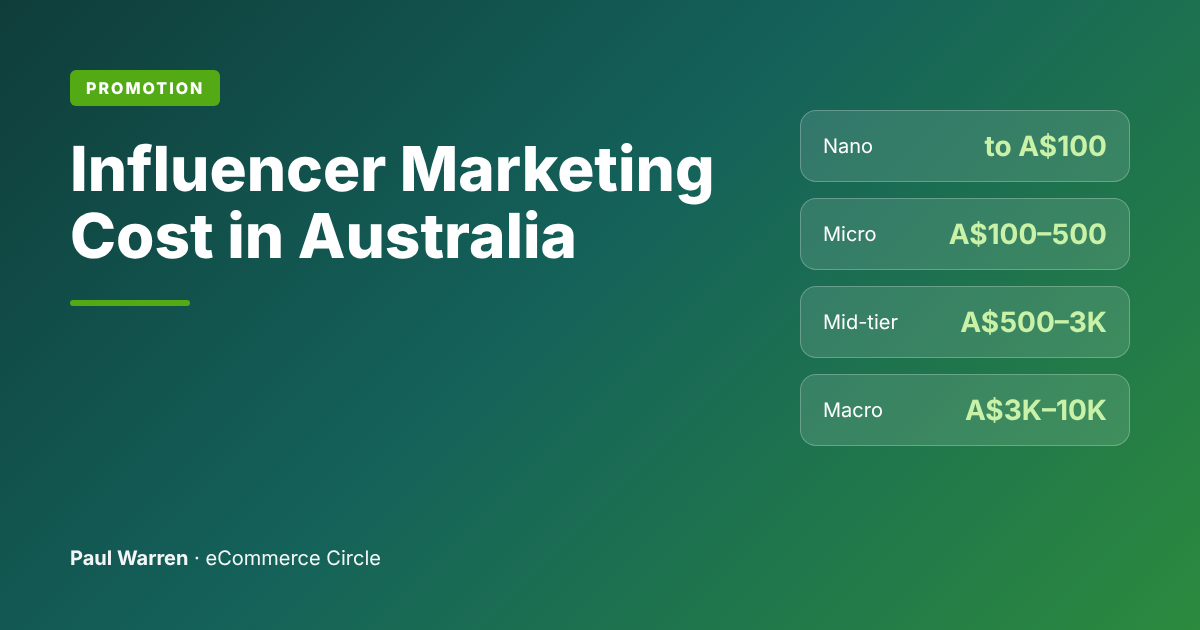
Here is the clearest Australian tier guide published this year, from GoodFirms’ October 2026 analysis of Australian micro and macro creators. All figures are per post, in Australian dollars, and usually quoted excluding GST.
| Creator tier | Typical followers | Typical price per post (AUD, ex GST) |
|---|---|---|
| Nano | 1,000 to 10,000 | Free product to about A$100 |
| Micro | 10,000 to 100,000 | A$100 to A$500 |
| Mid-tier | 100,000 to 500,000 | A$500 to A$3,000 |
| Macro | 500,000 to 1 million | A$3,000 to A$10,000 |
| Celebrity | 1 million+ | Up to about A$20,000 a post, often far more for campaigns |
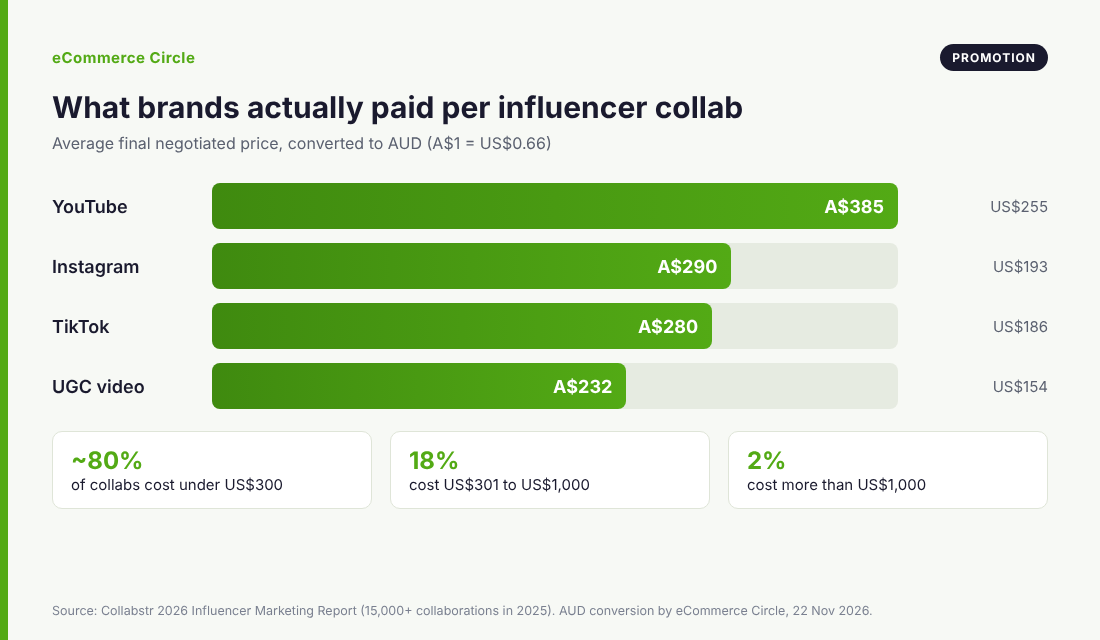
Now compare that with what brands actually pay. Collabstr analysed more than 15,000 collaborations on its marketplace for its 2026 Influencer Marketing Report. The average paid price (not the asking price) was US$193 on Instagram, US$186 on TikTok and US$255 on YouTube. At today’s rate of roughly A$1 = US$0.66, that is about A$290 for an Instagram collab, A$280 for TikTok and A$385 for YouTube.
The other number worth remembering from that report: nearly 80% of collaborations cost under US$300, 18% cost between US$301 and US$1,000, and only 2% cost more than US$1,000. If you are a store doing under A$2 million a year, you live in that 80% band. Most of your creator deals should be priced in the low hundreds, not the low thousands.
One caution on these numbers. Collabstr is a US-based marketplace, so its averages lean American. Creators in Australia often charge a little more than global averages for the same audience size, because our market is smaller and brand demand is concentrated. Use the averages as a floor for negotiation, not a ceiling.
What Drives the Price a Creator Quotes You
Two creators with the same follower count can quote you wildly different prices. That is not random. Every quote is built from the same handful of levers, and once you know them you can push on the right ones.
- Engagement, not followers. A micro creator with an engaged audience is worth more than a bigger account with a dead comments section. GoodFirms puts Instagram engagement at about 3.7% for creators with 10,000 to 100,000 followers, against 3.5% for 100,000 to 500,000. On TikTok the gap widens to roughly 4% to 8% for micro versus 1% to 3% for macro.
- Format. Video costs more than a static post because it takes longer to make. In Collabstr’s 2025 data, creators asked about 32% more for an Instagram Reel (US$288) than a TikTok video (US$217).
- Niche. Beauty, lifestyle and family creators charge a premium because their audiences buy. A pet or homewares creator with a tight local following can be much cheaper and convert just as well.
- Season. Rates rise 20% to 30% around Black Friday, Christmas and back-to-school, according to Collabstr. If you book your November creators in September, you lock in pre-peak pricing.
- Usage rights, exclusivity and whitelisting. These are the add-ons that turn a A$400 post into a A$900 invoice. More on these in the next section, because they are where most budgets blow out.
A quick engagement check before you even ask for a rate: add up the likes and comments on a creator’s last 10 posts, divide by 10, then divide by their follower count. A 20,000-follower account averaging 500 interactions a post has a 2.5% engagement rate. Afterpay’s guide for Australian retailers uses that exact example. Below 1% on Instagram, ask hard questions before you pay a cent.
The Hidden Costs That Double Your Influencer Budget
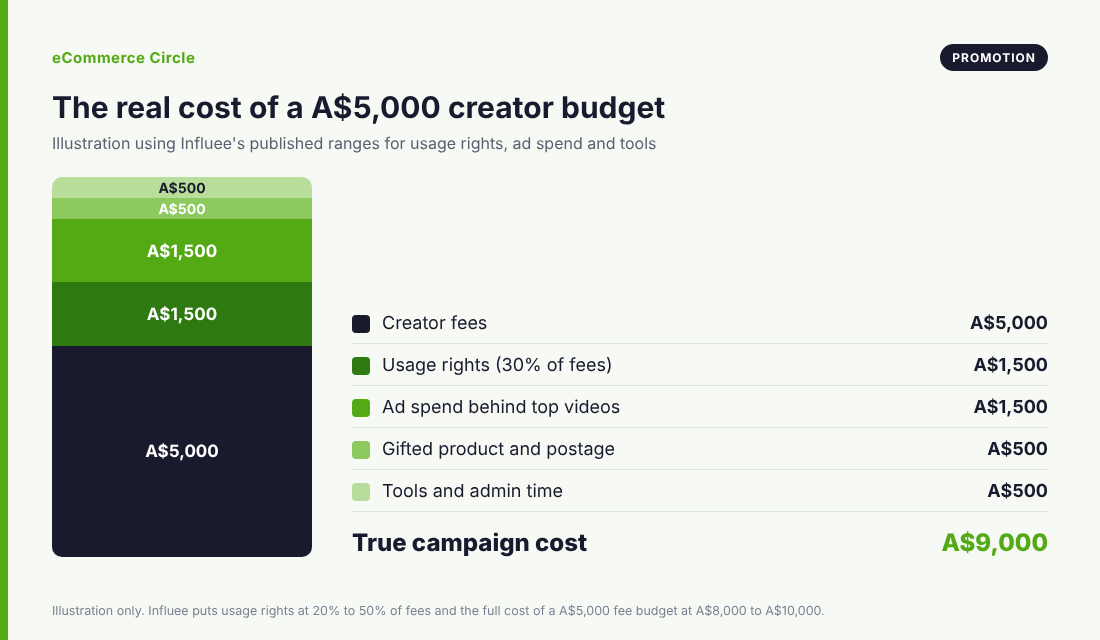
The creator’s fee is rarely the full cost. Influee, a creator platform that publishes AUD pricing, says a A$5,000 influencer fee budget usually becomes A$8,000 to A$10,000 once the extras are added. Here is where that money goes.
Usage rights
The fee buys the post on the creator’s own feed. If you want to run that video as an ad, put it on your product page or use it in email, you need a licence. Influee puts usage rights at 20% to 50% on top of the base fee. Skip it upfront and you either lose your best content or get a surprise invoice when the video takes off. We cover how to write these clauses properly in our guide to content rights for Shopify brands.
Exclusivity
Asking a creator not to work with competitors for a set period costs extra, often 30% to 100% above the base rate. Only pay for exclusivity when the creator is genuinely driving sales. For a first test post, it is wasted money.
Whitelisting and ad spend
The creator posts are just the start. Brands seeing the best returns put 30% to 50% of their creator budget behind the top-performing content as Partnership Ads (Meta) or Spark Ads (TikTok), according to Influee. Our creator whitelisting guide walks through the access you need and how to set it up.
Product, shipping and GST
Gifted stock is a real cost, so count it at landed cost plus postage. If the creator is registered for GST, add 10% to every invoice. Many micro creators are under the A$75,000 registration threshold and are not registered, so ask before you assume.
Your time, tools or an agency
Finding, briefing, chasing and paying creators takes hours every week. Influencer discovery and management platforms run around A$200 to A$1,000 a month, and agencies typically charge 15% to 30% of campaign spend or a monthly retainer (all figures from Influee). If you would rather hand the whole thing off, it is worth comparing against the cost of a social media manager in Australia, because the same person can often run creators too.
Paid, Gifted or Commission: Which Model Fits Your Store
You do not have to pay every creator a flat fee. There are four common models, and most Aussie Shopify stores end up using a mix.
| Model | What you pay | Best for | Watch out for |
|---|---|---|---|
| Flat fee | A set price per post or package | Proven creators, launches, peak season | You carry all the risk if it flops |
| Gifting | Product only, no cash | Nano and small micro creators, seeding new products | Still legally an ad in Australia (see below) |
| Commission | A % of sales via their link or code | Ongoing ambassadors, high-margin products | Good creators rarely accept commission only |
| Hybrid | Lower flat fee plus commission | Testing new creators without overpaying | Needs clean tracking from day one |
Our default advice for stores under A$1 million a year: start with gifting plus commission for nano creators, and a small flat fee plus commission for micro creators. That keeps your cash risk low while giving the creator a reason to keep posting after the first video. If you want a full system for gifting at scale, our creator gifting playbook covers selection, outreach and follow-up.
Whichever model you use, measure it. Influencer Marketing Hub’s 2026 benchmark survey found promo or discount codes were the most used way to track creator results (45.9% of respondents who answered), followed by affiliate links (26.0%). Give every creator their own code and their own link, every time.
How Many Orders Does a Post Need to Sell?
This is the question most store owners skip, and it is the only one that matters. Before you accept a quote, work out the break-even number of orders.
The formula is simple:
Break-even orders = total creator cost ÷ contribution per order
Contribution per order is what you keep after product cost, shipping, payment fees and the creator’s discount. Here is a worked example. The numbers are an illustration, not a benchmark, so plug in your own.
| Line item | Amount |
|---|---|
| Creator fee (micro, one Reel) | A$400 |
| Usage rights for 90 days of ads (30%) | A$120 |
| Gifted product at landed cost plus postage | A$45 |
| Total cost of the deal | A$565 |
| Average order value | A$95 |
| Contribution per order after COGS, shipping, fees and a 15% creator code | A$32 |
| Orders needed to break even | 18 orders (565 ÷ 32 = 17.7) |
Now look at the creator’s numbers. If her Reels average 15,000 views, she needs about 1 in every 830 viewers to buy just to break even. That is achievable for a strong product-creator fit. If her Reels average 3,000 views, she needs 1 in 170 to buy, which is unlikely on a first post.
Two things make this maths far kinder. First, repeat customers: if your customers buy twice in a year, the creator only has to win half as many new customers for the deal to pay back. Second, usage rights: the same video run as a Partnership Ad keeps selling long after the organic post has faded. That is why you budget for both upfront.
Be realistic about payback, too. In Influencer Marketing Hub’s survey, 65.9% of marketers who answered expected creator spend to pay back within a month. That expectation is why so many brands give up after one post. Judge a creator on three posts and 60 days, not one post and one week.
The Australian Rules: Disclosure, the ACCC and Gifted Product
This is the part of influencer marketing that can cost you far more than a creator fee. In Australia, gifted product counts as payment. If you give a creator something for free and they post about it, that post is an ad and must be disclosed clearly.
The ACCC is enforcing this. In March 2026, online retailer PhotobookShop paid A$39,600 in penalties after the ACCC issued two infringement notices. According to the ACCC, the business instructed influencers on 107 occasions not to disclose that they had been paid in free products worth around A$50 to A$400. It also edited one creator’s video review to cut out her criticism of the product. It was the first penalty of its kind, and it came from an influencer reporting the brand.
It is not an isolated issue. In the ACCC’s 2023 influencer sweep, 81% of the 118 influencers reviewed were making posts that raised concerns under the Australian Consumer Law. In fashion it was 96%. The most common problem was simply not disclosing the brand relationship.
What this means for your store:
- Never ask a creator to hide the deal. Put the opposite in writing: every post must be clearly labelled, for example with “Ad” or Paid Partnership at the start of the caption, not buried in hashtags.
- Do not edit reviews to remove criticism. If a creator says something negative, you can choose not to repost it. You cannot cut it out and present the rest as their honest opinion.
- Keep records. Save the brief, the agreement and screenshots of each live post. If a creator ever forgets to disclose, you can show you required it.
The AANA Code of Ethics also requires advertising to be clearly distinguishable as advertising, and the Australian Influencer Marketing Council publishes a Code of Practice for brands and creators. This is general information, not legal advice. If you are running a large program, have your creator agreement reviewed by a lawyer.
Real Australian Example: How Frank Body Used Creators to Build a Brand
Melbourne skincare brand Frank Body is the classic Australian case of building a store on creator content. Co-founders Jess Hatzis and Bree Johnson launched a coffee body scrub and went straight to Instagram, because that was where their customer, women in their early twenties, spent her time. According to NAB’s profile of the founders, the business turned over A$20 million in 2017 and was stocked in Mecca Maxima and Ulta Beauty in the US.
What made it work was not a celebrity budget. It was volume and consistency: a product that looked good on camera, a clear brand voice, and a steady stream of everyday customers and creators posting their “coffee scrub” photos. That is the micro and nano playbook in its purest form, and it is far more achievable for a small store than chasing one big name.
Compare that with PhotobookShop above. Both brands leaned heavily on creators. One built trust and scale; the other paid a penalty and a reputational cost. The difference was not budget. It was honesty in how the content was made and labelled.
Set Up Shopify Collabs to Track and Pay Creators
If you sell on Shopify, the simplest way to run gifting and commission deals is Shopify Collabs, Shopify’s own affiliate app. It is free to install, available on every Shopify plan except Starter and Retail, and it ties every sale back to the creator using their unique link or code. Here is how to get it running.
- Install the app. Search for Shopify Collabs in the Shopify App Store and add it to your store. There is no monthly fee.
- Create your first program. Set a commission rate (we usually suggest 10% to 20% for physical products), a discount for the creator’s audience, and any gift products you want to send.
- Turn on an application page. Collabs can add a page to your online store where creators apply to join your program. Link to it from your footer and your Instagram bio.
- Invite your shortlist. Send direct invites to the creators you have vetted, each with their own link and code, and send gifts through Shopify so shipping is tracked.
- Set your holding period. Commissions sit in a holding period before they are paid, so refunded and cancelled orders are removed automatically. The default is 30 days and you can set anywhere from 1 to 90 days. Match it to your returns window.
- Budget for the processing fee. Commissions are added to your Shopify bill and paid out automatically. Shopify charges a 2.9% processing fee on each commission payment, and payouts are handled in US dollars, so currency conversion fees may apply.
Fee and holding-period details are from Shopify’s help centre, checked November 2026. If you already run a bigger affiliate program, our Shopify affiliate marketing playbook covers when to step up to a dedicated platform.
The Creator Deal Sheet: Price Any Quote in 10 Minutes
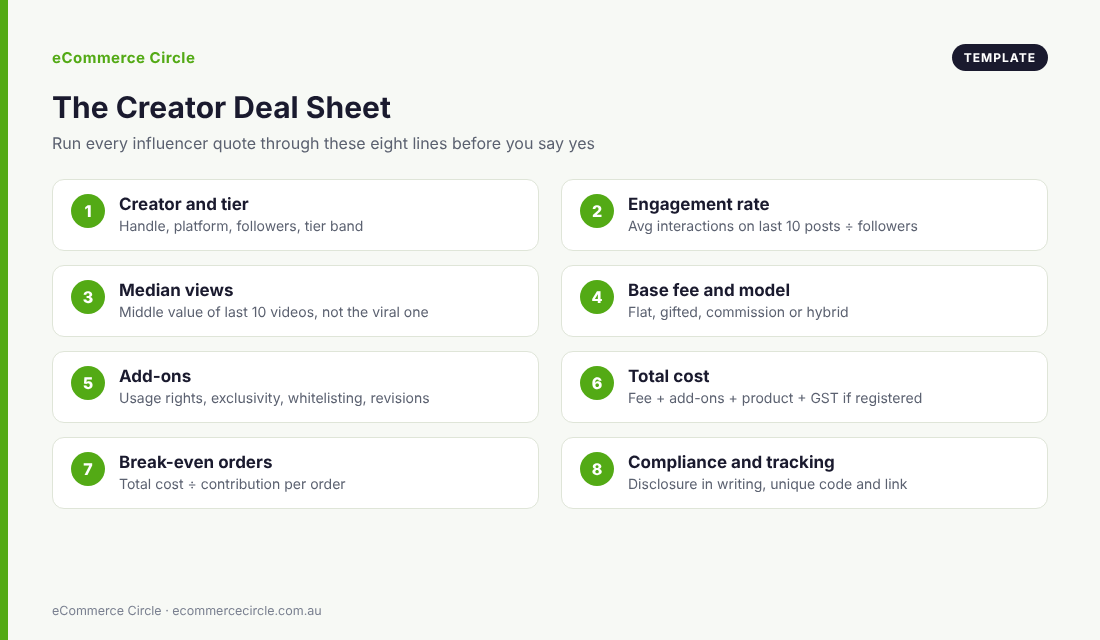
Copy this into a spreadsheet and fill it in for every creator you consider. If a deal cannot get through all eight lines, do not book it.
- Creator and tier. Handle, platform, follower count, and the tier band from the table above.
- Engagement rate. Average interactions on the last 10 posts ÷ followers. Flag anything under 1% on Instagram.
- Median views. For video, the middle value of the last 10 videos. Ignore the one viral outlier.
- Base fee and model. Flat, gifted, commission or hybrid. Compare the fee with the tier band and the Collabstr averages.
- Add-ons. Usage rights (and for how long), exclusivity, whitelisting access, number of revisions. Get each one priced separately.
- Total cost. Fee plus add-ons plus product at landed cost plus GST if the creator is registered.
- Break-even orders. Total cost ÷ your contribution per order. Then ask: what conversion rate from median views does that need?
- Compliance and tracking. Disclosure wording agreed in writing, unique code and link issued, posting date locked in.
Then use the deal sheet to negotiate. If the break-even number looks too high, you have three levers: lower the fee, swap part of the fee for commission, or ask for usage rights to be included so the content keeps working as an ad.
How It All Adds Up: A Starter Budget for an Aussie Store
Here is how the pieces work together. Say you have A$3,000 for your first 60-day creator test.
- About A$1,200 for five micro creators at roughly A$240 each, priced from the tier band and the paid averages, on a small fee plus 10% commission.
- About A$300 in gifted product to 10 nano creators through Shopify Collabs, on commission only.
- About A$400 for usage rights on the micro creators’ videos, so you can run the winners as ads.
- About A$1,100 in ad spend behind the two or three best-performing videos as Partnership or Spark Ads.
This split is an illustration, not a rule, but it shows the logic. Fifteen creators give you 15 pieces of content and 15 sets of data. The deal sheet stops you overpaying. Collabs tracks every order. The ad budget takes the winners and turns them into a repeatable channel. And clear disclosure keeps the whole thing on the right side of the ACCC.
You are not alone in spending here. Australian brands spent A$830 million on influencer marketing in the past 12 months, up 13.5%, and spend is projected to pass A$1 billion in 2026, according to the Meltwater and We Are Social Digital 2026 report as summarised by Sprout Social. The stores that get a return from that spend are the ones that price every deal against real numbers.
Influencer Marketing Cost FAQs
How much does a micro influencer cost in Australia?
Most Australian micro creators (10,000 to 100,000 followers) charge about A$100 to A$500 per post excluding GST, according to GoodFirms. Video, usage rights and exclusivity all push the price up.
Do I have to pay influencers, or can I just send free product?
You can gift product, and many nano creators accept that. But in Australia, gifted product is still payment, so the post must be clearly disclosed as an ad.
How much should a small store budget for influencer marketing?
A focused first test of A$3,000 to A$10,000 over 60 days is enough to learn what works, which matches Influee’s guidance for brands starting from zero. Judge each creator over several posts, not one.
Are influencer rates quoted with GST?
Usually not. Most Australian rates are quoted excluding GST. If the creator is registered for GST, add 10%.
Inside eCommerce Circle, Promotion is one of the core pillars we work on with every member, and creator marketing only works when the numbers behind it are clear. If you want to see exactly where your store is being capped, take the free More Orders Scorecard. It takes two minutes and shows you which of the 10 P’s to fix first.