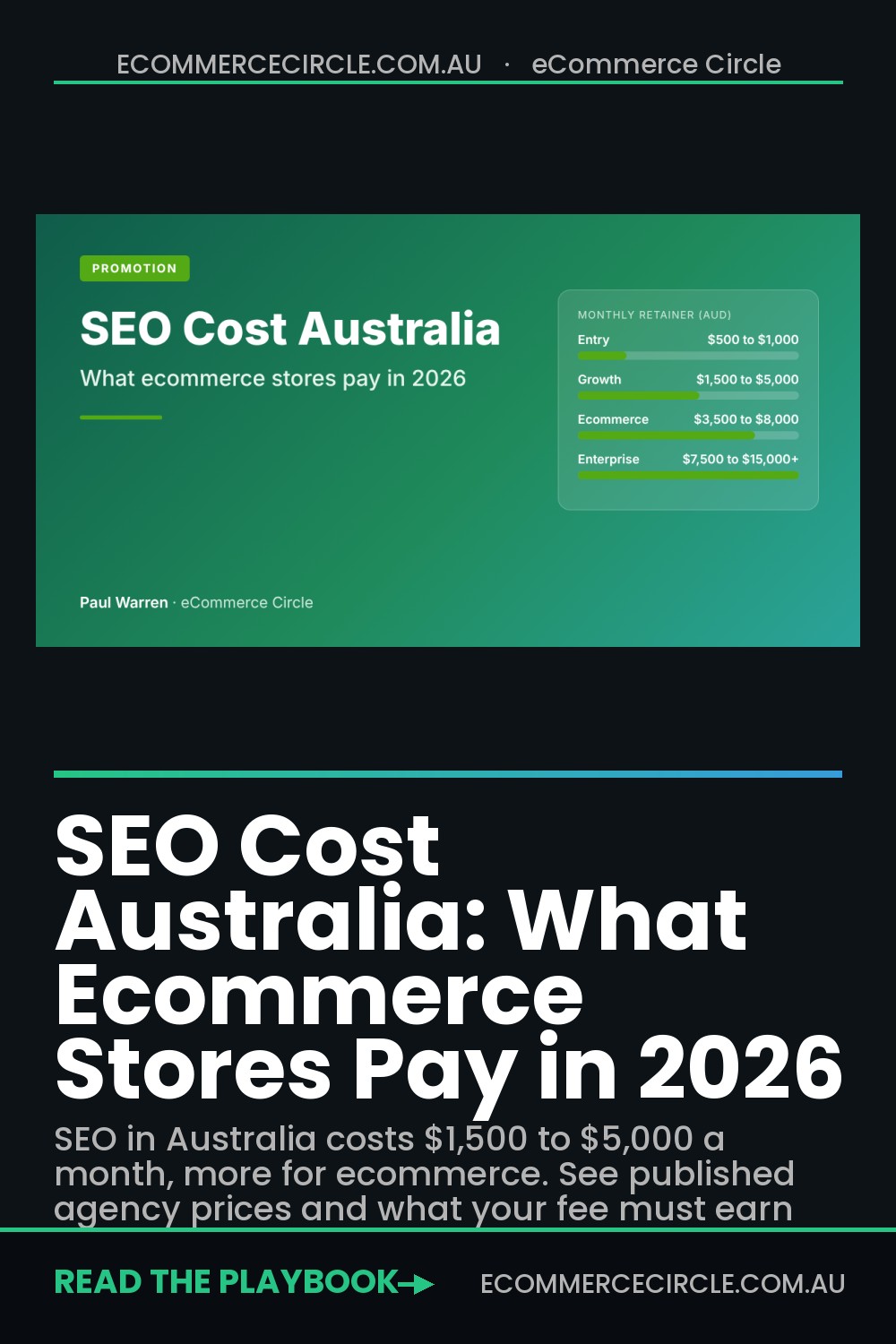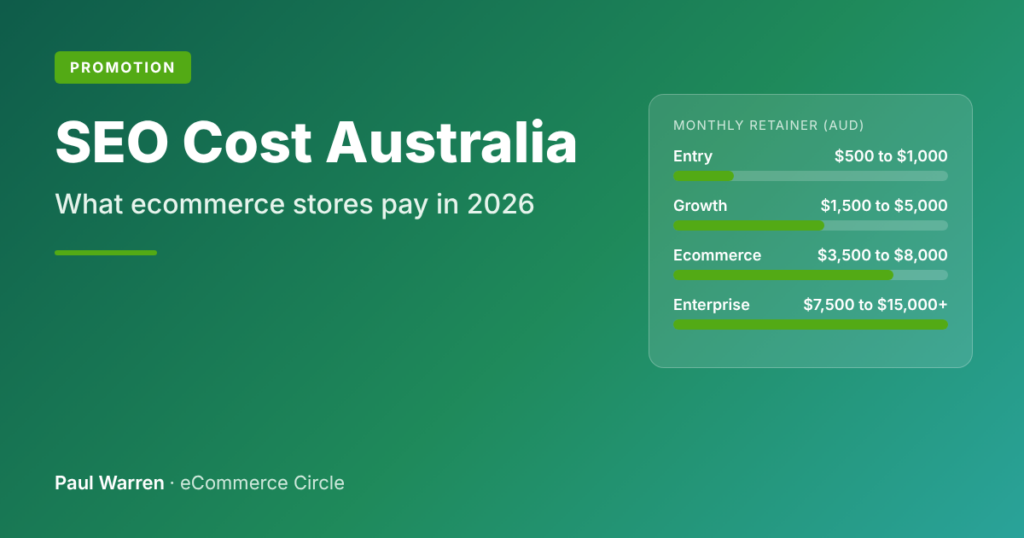
SEO in Australia costs most businesses between $1,500 and $5,000 a month on a retainer, and ecommerce stores usually land higher, at $3,500 to $8,000 a month. Hourly work runs $150 to $300, and a one-off audit runs $2,000 to $5,000. Those are the ranges Australian agencies publish themselves, and every figure below names the agency it came from.
Most store owners get this wrong in the same way. They collect three quotes, see $900, $3,200 and $6,500, and pick the middle one because it feels safe. Nobody asks how many hours each quote buys, or how many extra orders the fee has to bring in before it pays for itself.
The stores that do well with SEO work backwards. They know what an organic order is worth to them, they know what their fee has to earn, and they buy a scope of work, not a monthly number. One Australian agency reports its ecommerce clients spend an average of $5,157 plus GST a month. That’s about $62,000 a year before GST, so it deserves the same maths you’d put into any other hire.
This is general information, not financial advice. Prices were checked on 20 November 2026 and are in Australian dollars unless marked.
SEO Cost in Australia at a Glance
Here’s the short version. The ranges come from the pricing guides published by StudioHawk, Impressive, Prosperity Media, First Page and Shout Digital, which line up closely with each other.
| What you buy | Typical published price | Who it suits |
|---|---|---|
| Entry retainer | $500 to $1,000 a month | Local businesses in quiet markets. Rarely enough for a store selling nationally. |
| Growth retainer | $1,500 to $5,000 a month | Most small and mid-sized businesses. |
| Ecommerce or national retainer | $3,500 to $8,000 a month and up | Stores with hundreds of product and collection pages. |
| Enterprise retainer | $7,500 to $15,000 a month and up | Large catalogues, several domains, international. |
| Hourly consulting | $150 to $300 an hour | Training, second opinions, short jobs. |
| Site audit | $2,000 to $5,000 once | Stores that want a fix list before committing. |
| Platform migration | $3,000 to $10,000 once | Moving to Shopify without losing rankings. |
Most of these prices are quoted before GST. If you’re registered for GST you claim it back, but your cash goes out at the higher figure, so check which one is on the proposal.
For a global reference point, Ahrefs polled 439 SEO providers and found an average retainer of US$2,917 a month, with agencies averaging US$3,209 and freelancers US$1,348. The average hourly rate was US$111, and 78.2% of providers bill by monthly retainer. That survey is worldwide and was last updated in August 2024, so use it as context, not as an Australian price list.
What Seven Australian Agencies Publish
A market average is only useful if you can see what’s behind it. So here are the published tiers, agency by agency. None of these are quotes for your store. They’re what each firm says on its own website.
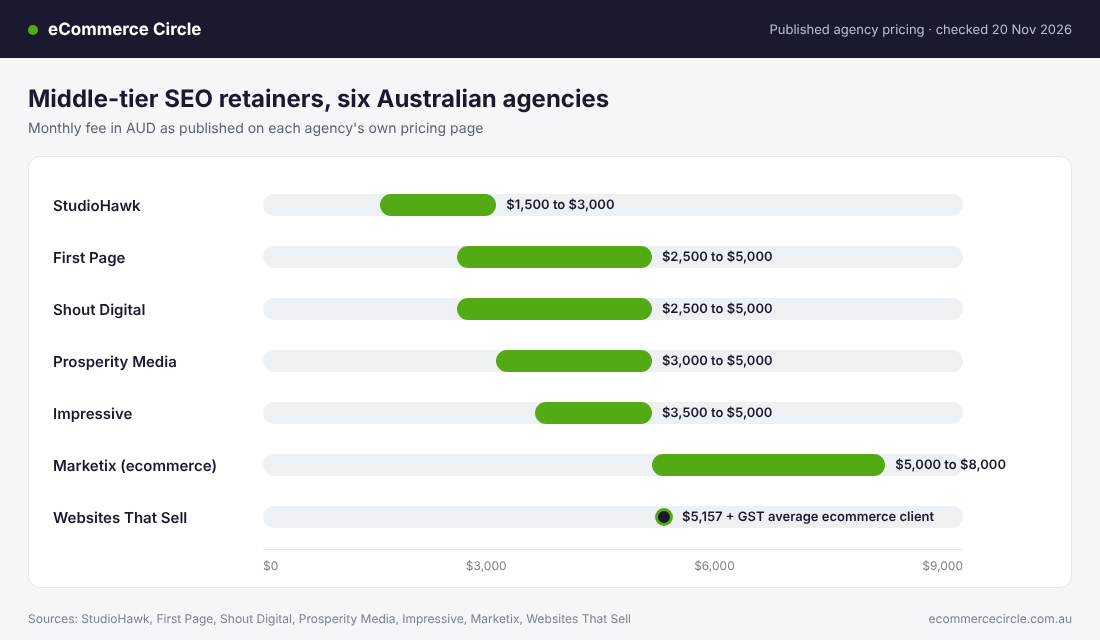
| Agency | Lower tier | Middle tier | Top tier |
|---|---|---|---|
| StudioHawk | $500 to $1,000 | $1,500 to $3,000 | $5,000+ (national or ecommerce) |
| Impressive | $1,500 to $3,000 | $3,500 to $5,000 | $5,500+ |
| Prosperity Media | $1,500 to $2,500+ | $3,000 to $5,000+ | $5,000 to $10,000+ |
| First Page | $1,000 to $2,500 | $2,500 to $5,000 | $5,000 to $15,000+ (enterprise or ecommerce) |
| Shout Digital | $1,000 to $2,500 | $2,500 to $5,000 | $5,000 to $10,000 |
| Marketix (ecommerce only) | $3,500 to $4,000+ | $5,000 to $8,000+ | $8,000 to $15,000+ |
| Websites That Sell (plus GST) | $3,000 minimum | $5,157 average ecommerce client | $11,000 largest national campaign |
Three things stand out.
- The middle tier is remarkably consistent. Five of the seven put their main tier somewhere between $1,500 and $5,000 a month.
- Ecommerce is priced above the middle. StudioHawk and First Page both put ecommerce in their top bracket at $5,000 a month and up, Impressive says ecommerce campaigns typically land at $5,500 and up, and Marketix’s ecommerce-only pricing starts at $3,500.
- Minimums are rising. Websites That Sell says it has legacy clients on budgets as low as $880 a month, but its minimum for a new client in 2026 is $3,000 plus GST. Prosperity Media says its own pricing starts from $5,000 a month.
Websites That Sell also publishes average client spend by city: $3,710 plus GST in Sydney and $4,699 plus GST in Brisbane. Those are one agency’s client lists, not a census. If you sell Australia-wide, your city has little to do with what you’ll pay anyway.
What Ecommerce SEO Costs and Why It Runs Higher
If you run a Shopify store, expect quotes of $3,500 to $8,000 a month from an established Australian agency. Marketix says most Australian ecommerce businesses investing seriously sit in exactly that band. Websites That Sell’s $5,157 average falls in the middle of it.
The higher price isn’t a store-owner tax. An online store has more pages that matter, and each type needs different work:
- Collection pages. These carry most of your non-brand search demand (“linen sheets queen”, “kids gumboots”). Each one needs copy, internal links and sensible filters.
- Product pages. Titles, structured data, reviews and variant handling across hundreds of URLs.
- Technical clean-up. Duplicate URLs from tags and filters, out-of-stock and retired products, redirects after a theme change.
- Content and links. Buying guides and digital PR. StudioHawk prices digital PR campaigns from $4,000 each when bought separately.
A plumber needs to rank for a handful of phrases in a handful of suburbs. You might need to rank for 300 product searches nationwide. More pages means more hours, and hours are what you’re buying.
AI search is now turning up as a line item too. Shout Digital says most Australian agencies fold the basics into a mid-tier retainer, while a standalone AI search engagement runs $2,500 to $8,000 a month. Before you pay extra for it, read our AI search visibility playbook and check how much of that work overlaps with ordinary SEO. A lot of it does.
Retainer, Project or Hourly: What Each Dollar Buys
There are three ways you’ll be billed, and the cheapest-looking one is often the most expensive per hour of real work.
- Monthly retainer. A fixed fee for ongoing work. The agency spreads a set number of hours across technical fixes, content, links and reporting. This is how most SEO is sold.
- Fixed project. One scope, one price. Audits at $2,000 to $5,000, migrations at $3,000 to $10,000, content audits at $2,000 to $6,000 (StudioHawk and Impressive publish the same ranges).
- Hourly. $150 to $300 an hour from a consultant. Websites That Sell lists its 2026 standard rate at $150 plus GST an hour. Shout Digital puts reputable agencies at $140 to $280.
The hours test
Here’s the check most store owners skip. Divide the monthly fee by the hourly rate, and you get the most hours anyone could spend on your store.
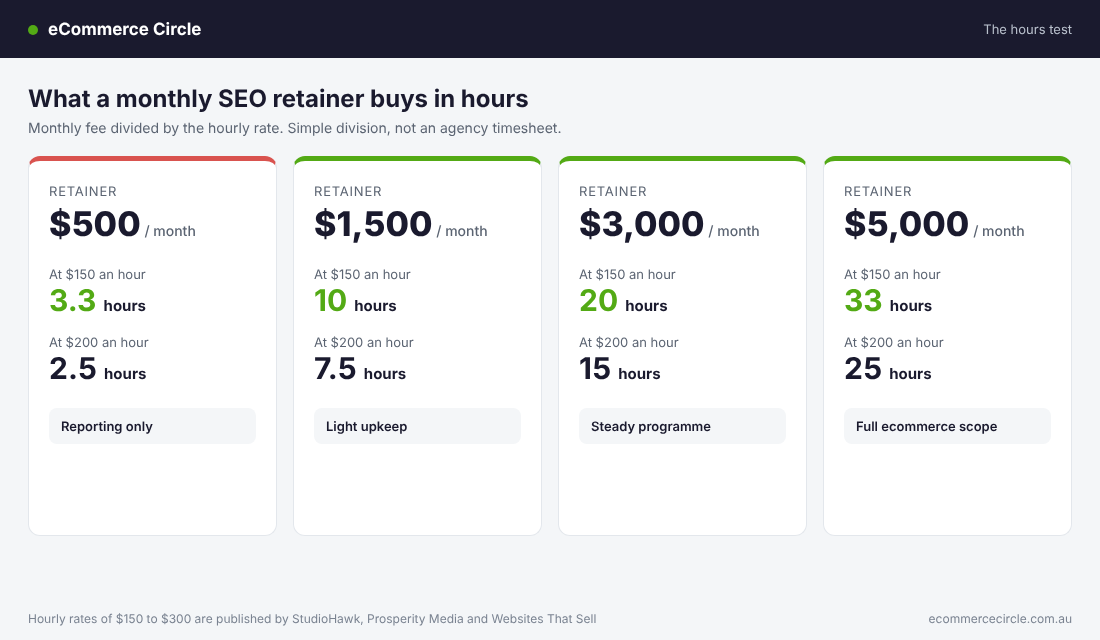
| Monthly retainer | Hours at $150 an hour | Hours at $200 an hour |
|---|---|---|
| $500 | About 3 | 2.5 |
| $1,500 | 10 | 7.5 |
| $3,000 | 20 | 15 |
| $5,000 | About 33 | 25 |
That’s simple division, not an agency’s timesheet. But it shows the problem with a $500 retainer. Three hours a month has to cover the account manager’s emails, the monthly report and any actual work. For a store with 200 products, there’s nothing left after the report is written.
So ask every agency the same question: “How many hours a month is this, and who does them?” A firm that won’t answer is selling you a subscription, not a service.
My view: if you’ve never had SEO work done, start with a fixed-price audit and implementation project. You get a prioritised fix list you own, you find out how the agency works, and you’re not locked in for twelve months. Move to a retainer once the fixes are in and the numbers support it.
Hiring In-House or Doing It Yourself
An agency isn’t the only way to buy SEO. Price the other two before you sign.
An in-house SEO specialist
SEEK puts the average salary for an SEO specialist in Australia at $80,000 to $95,000 a year. Add the 12% super guarantee and you’re at $89,600 to $106,400, or roughly $7,470 to $8,870 a month, before software, leave and someone to manage them.
That’s more than most ecommerce retainers, and one person rarely covers technical SEO, writing and link building equally well. In-house starts to make sense when you’d otherwise be paying an agency $8,000 a month or more, or when content is your main growth channel.
Doing it yourself
The cash cost is close to zero. Google Search Console is free. A paid research tool is optional: Ahrefs lists its Lite plan at US$129 a month and Semrush lists its entry plan at US$139 a month, both billed in US dollars, so confirm the Australian total at checkout.
The real cost is your time. Five hours a week is 260 hours a year. If your time is worth $100 an hour to the business, that’s $26,000 a year, which is about the same as a $2,200 a month retainer. DIY is the right call when the store is small and you’re learning what works. It stops being cheap the moment it pulls you away from buying, product and cash flow.
If you’re going down this path, our guide to ecommerce SEO in Australia covers which jobs to keep and which to hand off.
What Your SEO Fee Has to Earn Back
This is the number that matters, and no agency pricing page will work it out for you.
Break-even orders per month = monthly fee ÷ contribution margin per order.
Contribution margin per order is what’s left from an average order after product cost, shipping, packaging and payment fees. Take a store with a $110 average order value and a 35% contribution margin. Each order contributes $38.50. Assume organic visitors convert at 1.8%. These are illustration figures, so swap in your own.
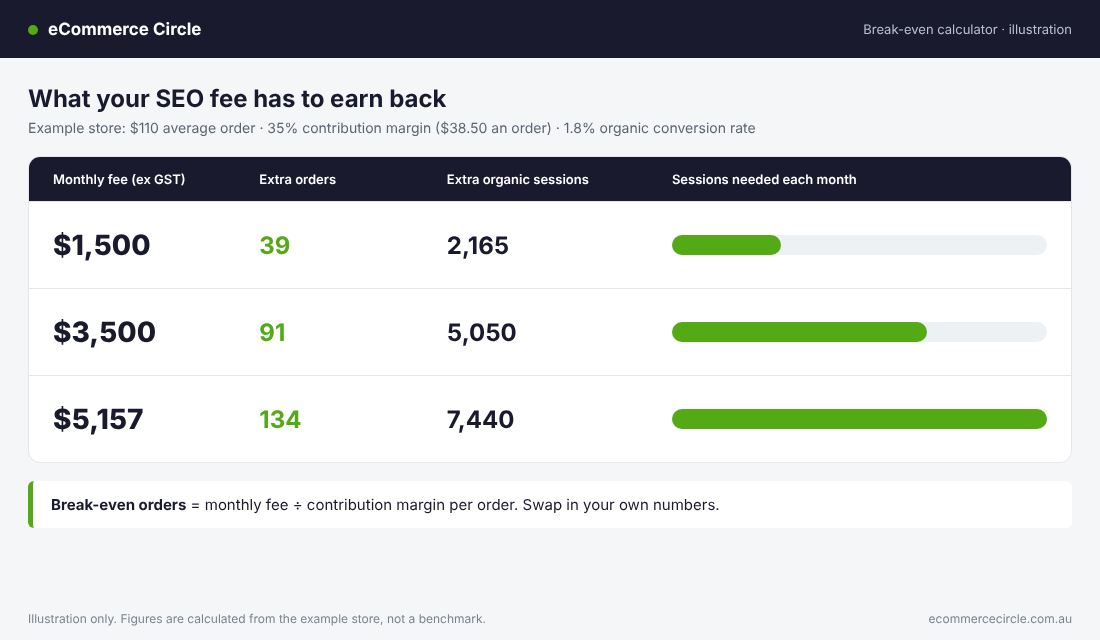
| Monthly fee (ex GST) | Extra orders to break even | Extra organic sessions needed |
|---|---|---|
| $1,500 | 39 a month | About 2,165 a month |
| $3,500 | 91 a month | About 5,050 a month |
| $5,157 | 134 a month | About 7,440 a month |
Now compare that with where you are. If your store gets 3,000 organic sessions a month today, a $3,500 retainer has to add more than 5,000 on top just to break even. That means nearly tripling your organic traffic. Possible over two or three years. Unlikely in one.
If you already get 40,000 organic sessions a month, the same fee needs a lift of about 13%. That’s a very different bet.
The same fee can be a bargain for one store and a slow leak for another. It depends on your margin, your order value and how much organic traffic you start with. The Profit section of the Scorecard checks your margin for exactly this reason: without it, you can’t judge any marketing fee.
Repeat purchases help the maths. If a customer won through search buys twice more in a year, each first order is worth more than $38.50. Just be honest about your real repeat rate before you lean on it.
How Long Before SEO Pays for Itself
SEO fees start on day one. Results don’t. Budget for that gap or you’ll cancel right before it works.
Ahrefs tracked a sample of one million new pages and found that only 1.74% reached Google’s top 10 within a year. The average page ranking number one was five years old, and 72.9% of top 10 pages were more than three years old.
That sounds grim, but most of those million pages had no plan behind them. The useful lesson is that established pages win. For a store, that means improving the collection pages you already have usually pays back faster than publishing new ones.
Position matters as much as presence. Backlinko analysed four million search results and found the first result gets 27.6% of clicks and the top three get 54.4% between them. Only 0.63% of searchers clicked anything on page two. Moving a collection page from position eight to position three is worth far more than getting a new page to position fifteen.
Impressive says returns at its higher tiers typically show within six to twelve months. Treat that as an agency’s own estimate. A sensible plan is to hold six months of fees in reserve and set a review point at month six with numbers agreed up front.
One rule has no exceptions. Google says it plainly in its guide to hiring an SEO: no one can guarantee a number one ranking. If a proposal guarantees page one, bin it.
Two Australian Stores and What They Got
Case studies come from agencies, and agencies publish their best results. Read them for what work was done, not as a promise.
Cozy Corner Quilts. This Australian quilting retailer runs on Shopify. First Page’s case study says the store’s collection pages had thin content and an outdated theme was blocking basic SEO work. The agency added breadcrumbs, a mega menu, reviews on product and collection pages, and a content field at the bottom of collections. Reported results: 39% more keywords on page one, 18% more organic traffic and 19% more organic revenue year on year.
Notice the scale. Nineteen per cent more organic revenue is a solid result for an established store, and it’s a long way from the “10x your traffic” pitch. Run the break-even table with a 19% lift and see what fee your store could support.
Footgear and Cake Decorating Central. Melbourne agency Optimising lists headline results for its ecommerce clients, including 89% year-on-year organic revenue growth for Footgear and 434% revenue growth for Cake Decorating Central, which it names among its recent Shopify clients. The page gives headline figures only, without the timeframe or the fee.
That gap is the point. When an agency shows you a big percentage, ask what the starting number was, how long it took and what the client paid. A 434% lift from a small base can be fewer dollars than a 19% lift on an established store.
Set Up Search Console Before You Ask for a Quote
You can’t judge a quote without your own numbers. Google Search Console is free and takes about fifteen minutes to set up. Do it before you talk to anyone.
- Add your store. In Search Console, open the property dropdown and select Add property. Choose Domain and enter your domain.
- Verify ownership. Google gives you a TXT record. Add it in your domain’s DNS settings (for a domain bought through Shopify, that’s under Settings, then Domains), then click Verify.
- Wait a few days. Google says data should begin to appear in a few days.
- Find your non-brand clicks. Open the Performance report, add a query filter and exclude queries containing your brand name. What’s left is the traffic SEO work can grow.
- Write down three numbers. Non-brand clicks in the last three months, your top ten collection pages by clicks, and their average position.
- Give agencies read access only. Under Settings, then Users and permissions, add them as a Restricted user. Google’s own advice is to grant read access for an audit and hold back write access at that stage.
Now you have a baseline that belongs to you. Any agency that quotes without asking for it is guessing. Our Search Console playbook shows what to do with the data once it’s flowing.
The SEO Quote Checklist
Copy this and send it to every agency on your shortlist. Put the answers side by side in a spreadsheet.
- What is the monthly fee, and is it before or after GST?
- How many hours a month does it cover, and who does them? Ask for names and seniority.
- What gets delivered in the first 90 days? You want a list: audit, number of collection pages rewritten, technical fixes.
- Who implements the changes in Shopify? Some agencies only send recommendations. Developer time is then an extra cost.
- Is content writing included, and how many pages a month?
- Where do links come from? If the answer is vague, or it’s a fixed number of links a month, be careful.
- What’s the contract term and notice period? Twelve-month lock-ins with no exit are a red flag.
- Do I own the content, the accounts and the reports if we part ways?
- What will you report on each month? Non-brand clicks and organic revenue, not a list of rankings.
- What result at month six would make you recommend we stop? A good agency has an answer.
Then add your own line at the bottom: break-even orders per month at this fee. If the agency’s 12-month forecast doesn’t clear that line, the price is wrong for your store, however fair it is for the market.
Once you’ve hired someone, the agency management playbook covers how to run the relationship month to month.
How the Pieces Fit Together
Each piece on its own is easy to get wrong. A price without hours tells you nothing. Hours without a break-even number don’t tell you if the work can pay. A break-even number without a baseline gives you nothing to measure against.
Put them in order and the decision gets simple:
- Baseline first. Search Console tells you how much non-brand traffic you have today.
- Break-even second. Your margin and order value tell you what any fee has to earn.
- Scope third. The hours test and the checklist tell you what each quote really contains.
- Price last. Now $3,500 a month is either clearly worth testing or clearly too much for your store right now.
It also keeps SEO honest against your other channels. If you’re weighing it against paid search, our breakdown of Google Ads costs in Australia gives you the per-click figures to compare. Ads stop when you stop paying. Good SEO work keeps earning, but only if the fee was one your margins could carry long enough to get there.
Frequently Asked Questions
How much does SEO cost per month in Australia?
Most published Australian agency pricing puts a standard retainer at $1,500 to $5,000 a month. Ecommerce stores are usually quoted $3,500 to $8,000 a month, and enterprise campaigns run $7,500 to $15,000 or more.
Is 500 dollars a month enough for SEO?
Rarely, for an online store. At $150 an hour that’s about three hours a month. StudioHawk describes the $500 to $1,000 tier as suited to small local businesses and says it rarely recommends staying there for long. Impressive and Shout Digital both warn that very cheap retainers can’t fund real work.
Do SEO prices include GST?
Usually not. Websites That Sell quotes every figure as “plus GST”, and most proposals follow the same convention. Always ask. For how GST applies to your business, speak to your accountant.
How much does an SEO audit cost?
StudioHawk and Impressive both list site audits at $2,000 to $5,000. Shout Digital’s range goes to $10,000 for large sites.
Is it cheaper to hire an SEO freelancer?
Generally, yes. In Ahrefs’ global survey, agencies charged 138% more than freelancers on average. A good freelancer is strong value for a small store. The trade-off is that one person may be excellent at technical work and average at content, or the reverse.
How long should I give SEO before judging it?
Set a review at six months with agreed numbers, and expect the full picture at twelve. Ahrefs’ ranking study shows new pages take a long time to reach the top 10, so early gains usually come from improving pages that already rank.
Before You Sign Anything
SEO in Australia isn’t overpriced, and it isn’t a bargain. It’s a fee that either fits your margins or doesn’t. Know your baseline, run the break-even maths, and buy hours and outcomes, not a monthly number.
Inside eCommerce Circle, Promotion is one of the core pillars we work on with every member, and it’s always tied back to Profit. If you want to see exactly where your store is being capped, take the free More Orders Scorecard. It takes two minutes and shows you which of the 10 P’s to fix first.