The Slack message lands on a Tuesday afternoon. “Hey, got ten minutes?” You already know what it is. Your paid media buyer, the one who has run your Meta account for two years and is the only person on earth who understands why the product feed is structured the way it is, is about to resign.
What’s in This Article
Most founders then spend the next hour thinking about entirely the wrong problem. Where do I find another Sam. What do I have to pay now. How long will recruitment take. Meanwhile the real risk is compounding somewhere else completely: in the nine SOPs that were never written, in the Meta Business Manager account where Sam is still the only admin, and in the supplier reorder points that live in a spreadsheet on Sam’s laptop.
Replacing an employee costs somewhere between 50% and 200% of their annual salary once you count recruitment, lost productivity and onboarding lag, and for management-level roles it sits closer to that upper figure. That is the visible cost. The expensive part is what walks out the door inside someone’s head, and 71% of organisations have no formal offboarding process at all. Which means for most stores, that knowledge leaves by default rather than by decision.
This is the playbook we run with members when a key person resigns. Five phases, in order, starting the moment the conversation ends. It will not make the departure painless. It will stop it becoming a three-month hole in your P&L.
Key Person Risk Is a Structural Problem, Not a People Problem
People leave. That is not a failure of your culture, it is arithmetic. Average employee turnover across Australian organisations ran at roughly 15% for the twelve months to June 2025, and in retail and hospitality about 40% of businesses now sit above a 20% turnover rate. Small businesses do better, averaging around 11% a year in the 2 to 19 employee bracket, but “better” still means someone in a six-person team is likely to resign within the next eighteen months.
So the question is not whether you lose someone. It is whether losing them takes down a function.
Engineers call this the bus factor: how many people would have to be hit by a bus before the work stops. In a store doing $80k a month with four staff, the bus factor for most roles is one. One person knows the ad account. One person knows the pick-and-pack sequence. One person has the supplier’s mobile number and knows which of the two contacts actually answers.
Who Gives A Crap runs a fully distributed team spread across four continents. When your people are in four timezones, you physically cannot walk over and tap someone on the shoulder to ask how something works. Documentation stops being an admin chore and becomes the only way the business functions. That constraint is a gift, and you can give it to yourself deliberately without going remote-first.
Here is the uncomfortable version: if a resignation creates a crisis in your store, the resignation did not cause the crisis. It revealed one that was already there.
Phase 1: Contain (The First 48 Hours)
Containment is not about distrust. It is about the fact that access sprawl is real and nobody has a complete map of it in their head. Roughly a quarter of former employees can still get into company systems after they leave, and over 30% of organisations take more than three days to revoke everything. Some accounts are simply never closed.
There is also a less comfortable statistic worth knowing: around 70% of intellectual property theft happens in the 90 days surrounding a resignation announcement. In ecommerce that usually is not malice, it is a departing staffer downloading “their” creative folder or customer list because they think of it as portfolio work. Clear, calm process prevents it far better than suspicion does.
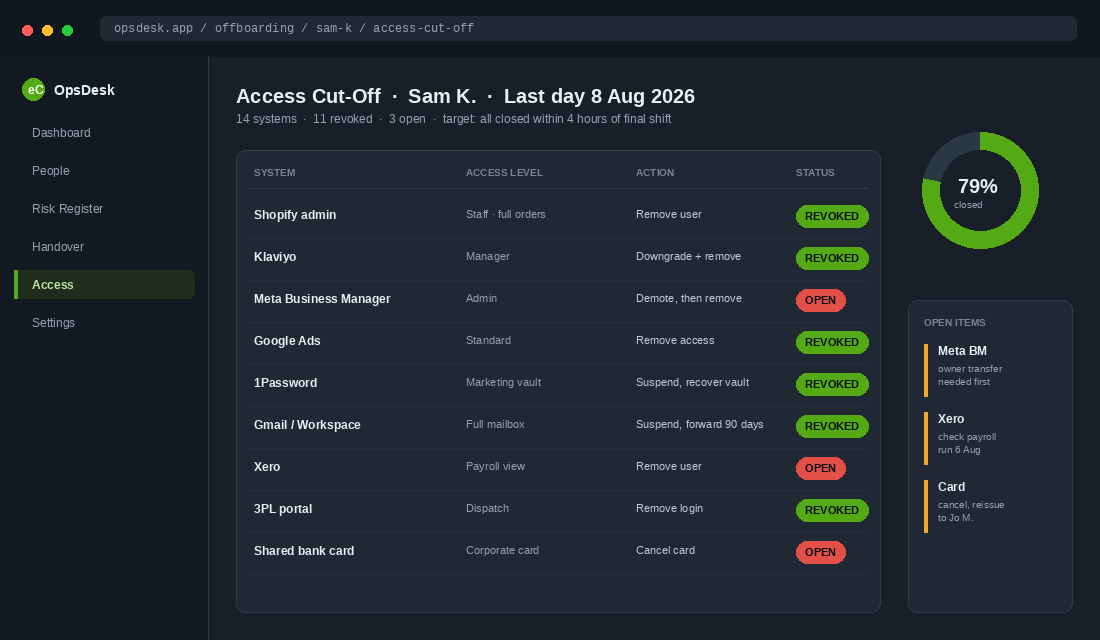
Build the access map first, before you touch anything. Sit down with a blank document and list every system the person has touched in the last six months. Not the systems you gave them on day one. The ones they actually use.
- Shopify admin. Settings then Users. Note their permission set before you change anything, because you will want to hand the same set to whoever picks up the work. Worth knowing your plan limits here: the standard Shopify plan allows 5 staff accounts, Advanced allows 15, and Plus is unlimited. Collaborator accounts for your agency or freelance developer do not count against that limit, which is usually the cheapest fix if you are capped.
- Ad platforms. Meta Business Manager is the one that bites. If your departing staffer is the only admin on the business portfolio, you must promote someone else to admin before you remove them, or you can lock yourself out of your own ad account. Same logic for Google Ads and TikTok Ads Manager.
- Email and SMS. Klaviyo, Attentive, whatever you run. Downgrade to view-only first, remove on the last day.
- Money. Xero, Stripe, your corporate card, PayPal, any BNPL merchant portal. Cards get cancelled and reissued, not just reassigned.
- Operations. 3PL portal, Australia Post or Sendle account, supplier portals, freight forwarder logins.
- The quiet ones. Domain registrar, DNS, the Google Analytics property, Search Console, the ABN-linked myGovID authorisations, and any personal mobile that receives two-factor codes for a shared account.
The tool that makes this survivable: 1Password Business
If your team shares credentials over Slack or a Google Sheet, a departure means rotating dozens of passwords manually and hoping you got them all. A shared password manager turns that into a fifteen-minute job. Here is the actual offboarding sequence in 1Password Business:
- Before the last day, ask them to move work items out of their Employee vault into a shared vault. Do not delete their account until this is done, because private vault contents are not visible to you by default.
- On the final day, suspend rather than delete. Sign in as Owner or Administrator, select People in the sidebar, open their details page, then More Actions and Suspend. They are logged out of every device immediately.
- If they left without transferring anything, use account recovery. Someone with recovery permission and access to the departing person’s work email can generate a new Secret Key and account password, sign in, and move work items into a shared vault.
- Rotate every credential they had sight of and save the new one straight back into the shared vault so nobody is locked out on Monday morning.
- Delete the account once the vault is clean and you have confirmed nothing is orphaned.
One practical warning: if the person is offline when you suspend them, their vault items stay readable on their device until the next time the app connects to the internet. Rotation is what actually protects you, not suspension.
Phase 2: Capture (Get It Out of Their Head While You Are Still Paying Them)
This is the phase founders consistently underinvest in, and it is the one with the highest return. You have a fixed, non-renewable window: the notice period. Every hour of it is an hour you are paying for knowledge you are about to lose forever.
Most handovers fail because they are done as a conversation. Someone talks for ninety minutes, the other person nods and takes notes, and six weeks later nobody can remember what the rule was for pausing an underperforming ad set. A handover is not complete when it has been explained. It is complete when someone else has done it unaided.
Use a four-stage gate for every task. Nothing moves forward until the stage before it is genuinely finished.
- Stage 1: Written. A short SOP in plain language. Trigger, steps, decision rules, what “done” looks like, who to escalate to.
- Stage 2: Recorded. A screen recording of them doing it live, narrating the judgement calls. Loom or a Google Meet recording is fine. Ten minutes of someone’s screen beats three pages of prose for anything visual.
- Stage 3: Shadowed. The person taking over watches it happen once in real conditions and asks questions.
- Stage 4: Solo. The new owner does it themselves, with the departing person available but silent, and signs off that they can repeat it.
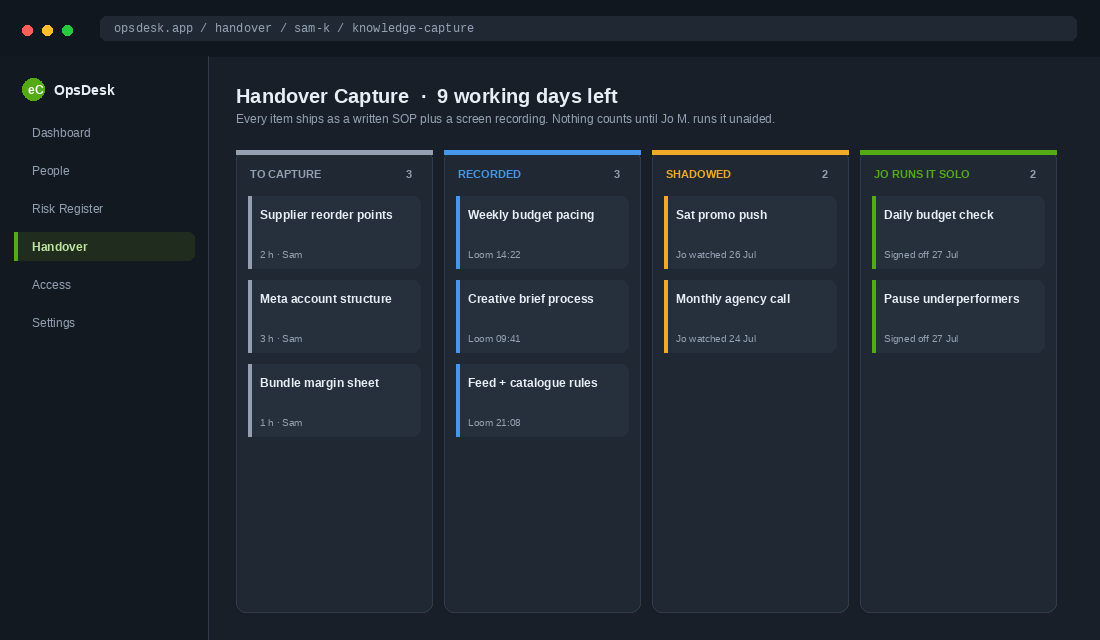
Prioritise ruthlessly, because you will not capture everything. Score each task on two axes: how often it happens, and how bad it is if it goes wrong. Daily and high-consequence goes first. Annual and low-consequence you can rebuild from scratch later. A weekly budget pacing check beats documenting the Christmas gift-wrap process in August, even though the Christmas one feels more urgent.
If you already have a documentation habit, this phase is a top-up rather than a scramble. If you do not, our SOP playbook covers how to build the library before you need it, which is the only sensible time to build it.
Phase 3: Cover (Decide Who Actually Does the Work on Monday)
The instinct is to open a job ad the same week. Resist it for at least seven days. A resignation is one of the few moments you get an honest look at whether the role should exist in its current shape, and hiring a carbon copy is how stores end up carrying a headcount they outgrew two years ago.
Split the departing role into its actual components, then place each one deliberately. In practice there are four homes for any given task.
- Absorb. Someone on the team takes it permanently, ideally with a title and pay conversation attached. This is the best outcome for tasks that were undersized for a full role anyway.
- Automate or delete. Every departure surfaces two or three tasks that exist only because one person started doing them in 2023. Kill them and see if anyone notices.
- Outsource temporarily. A specialist agency or contractor holds the function for 60 to 90 days while you hire properly. More expensive per hour, dramatically cheaper than a rushed hire you exit in four months.
- Backfill. Genuinely needs a person. Now write the job description from what the role actually is today, not from the ad you posted when you hired the last one.
Whatever you decide, name a single owner for every orphaned task before the last day, in writing, with a date. “Jo will pick that up” is not an owner. “Jo owns daily budget pacing from 11 August, checked at 9am” is.
If the departing person was covering work you should never have handed to one individual in the first place, the fix is structural rather than a hire. Our delegation playbook walks through how to break founder-dependent work into pieces that survive a handover.
Phase 4: Close Out (Fair Work, Final Pay and a Clean Exit)
Getting the paperwork wrong is how a routine departure becomes a Fair Work claim. None of this is complicated, but it does have deadlines.
- Notice period. There is no fixed statutory notice period that an employee must give you when they resign. It comes from their employment contract, an applicable award or an enterprise agreement. Check the document, do not assume four weeks because that is what you would give them.
- Ending notice early. You can tell someone they do not need to work out their notice, but you still have to pay them for that period. Deciding to send someone home on the spot is a payment decision, not a free option.
- Final pay timing. Most modern awards require final pay within 7 days of the employment ending, or on the next regular pay cycle, whichever comes first. Diarise it the day the resignation lands.
- What goes in it. Outstanding wages, accrued and unused annual leave, any leave loading that applies, plus long service leave if they qualify under your state’s rules. Superannuation on the relevant components still applies.
- Deductions. Some awards and agreements allow withholding when an employee does not give the minimum notice. Read yours before you do it, because getting this wrong is expensive.
- Records. Keep the resignation in writing, the handover sign-offs and the final pay calculation together in one place. If you are ever asked to reconstruct it two years later, you will be very glad you did.
None of the above is legal advice, and awards vary a lot by industry. If the departure is contested, or the person is on a contract you did not write, spend the few hundred dollars on an employment lawyer. It is the cheapest insurance in the whole process.
Phase 5: Correct (The Exit Conversation That Actually Changes Something)
Most exit interviews are theatre. The founder asks “so what could we have done better”, the departing person says something diplomatic about wanting a new challenge, everyone shakes hands, and nothing changes. Then eight months later the replacement leaves for the identical unspoken reason.
Two changes make the conversation useful. First, do not run it yourself if you can avoid it. People will not tell the person who signs their payslip that the real problem was the person who signs their payslip. Second, ask specific questions instead of open ones.
- “When did you first start thinking about leaving, and what was happening that week?” This gets you a date and a trigger instead of a sentiment. The date is almost always months earlier than you assumed.
- “What did you spend time on that you thought was pointless?” The fastest process audit you will ever get, delivered by someone with nothing left to lose.
- “What would have made you stay, and would you have taken it six months ago?” The second half matters. Plenty of things that would have worked in March are worthless in July.
Then use it. The real goal of Phase 5 is to move detection earlier. Showpo founder Jane Lu runs monthly one-on-one catch-ups with her exec team and people leaders, has introduced 360-degree feedback, and takes every new starter out to lunch to talk about them personally. None of that is a retention programme with a budget line. It is a cadence that means bad news reaches the founder while it is still fixable rather than at the resignation meeting.
If you are a six-person team, a fortnightly fifteen-minute one-on-one with each person, where you talk about them rather than about tasks, will surface almost every resignation two to three months before it happens.
The Key Person Risk Audit: Run This Before Anyone Resigns
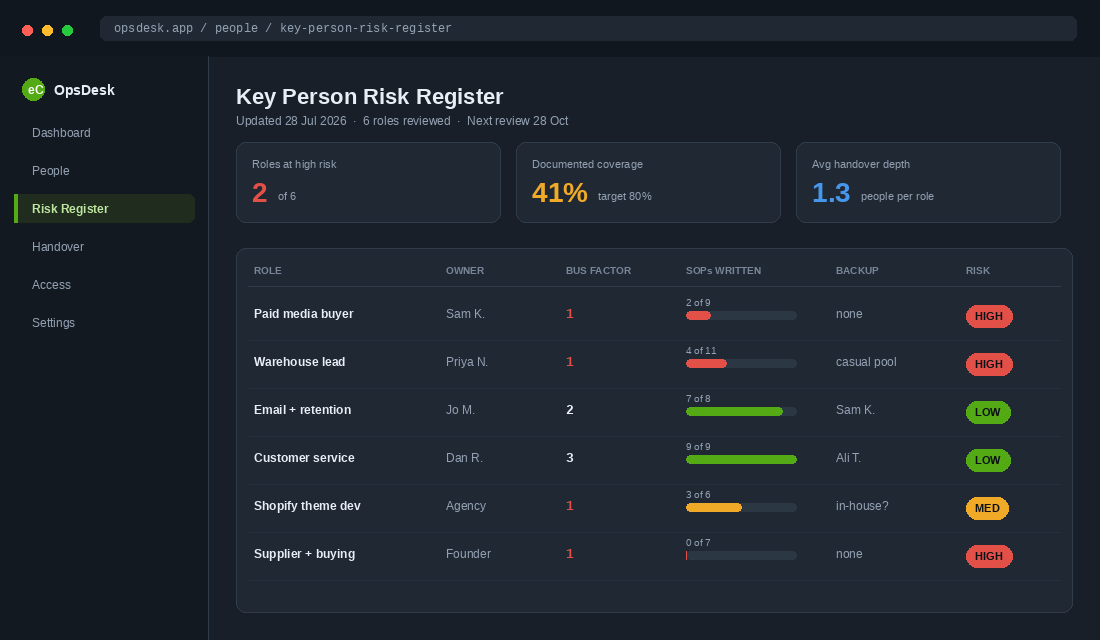
Here is the whole thing as a takeaway. Block ninety minutes this quarter, open a spreadsheet, and build one row per function in your business. Not per person, per function, because that is how you spot the roles quietly stacked onto one individual.
Columns:
- Function. Paid media, email and retention, warehouse and dispatch, customer service, buying and supplier, theme and site, finance.
- Current owner. The person who actually does it, not the org chart answer.
- Bus factor. How many people could run this to an acceptable standard tomorrow. Be honest. Most answers are 1.
- SOPs written. Documented tasks out of total tasks. A fraction, not a feeling.
- Named backup. A person’s name, or the word “none”. “The agency” is not a backup unless there is a contract that says so.
- Access single point. Yes or no. Are they the sole admin on anything you cannot afford to lose.
- Risk rating. High if bus factor is 1 and SOP coverage is under 50%. Medium if one of those two is true. Low if neither.
Then apply three rules. Any function marked high gets one SOP written per fortnight until it drops to medium. No individual is ever the sole admin on Shopify, Meta Business Manager, your domain registrar or your bank, without a documented second. And every quarter, the person with the highest-risk function takes a full week of annual leave without a laptop, which is the only genuine test of whether the documentation works.
That last one is deliberately uncomfortable. It is also the single highest-value week your business will spend all year, because it converts theoretical coverage into proven coverage while the stakes are still low.
Why This Compounds: Departures Stop Being Emergencies
Run the five phases once and you get through a resignation without a revenue dip. Run the audit quarterly and something more interesting happens.
Your documentation stops being a project and becomes a by-product of normal operations. Onboarding time for new hires drops, because the SOPs already exist. You can take annual leave without checking Slack from a beach in Noosa. You can hire more junior and train up, rather than paying a premium for someone who can operate without instructions, because you now have instructions. Delegation gets easier because the thing that made it scary, the fear that only one person knows how, is gone.
And it shows up in what the business is worth. Buyers and investors discount hard for key person risk, and a founder who is the sole holder of supplier relationships and ad account knowledge is a discount, not an asset. If a sale is anywhere on your horizon, this work is one of the highest-return things you can do, and our exit readiness playbook covers how acquirers actually assess it.
The founders who handle departures well are not the ones with better retention. They are the ones who decided, on an ordinary Tuesday when nobody was resigning, that no single person would ever be the only one who knows.
Inside eCommerce Circle, key person risk is one of the first things we map with every member, because it quietly caps how fast a store can grow. If you want a second opinion on where yours sits, let’s talk.