You started your Shopify store alone. You built the website, wrote the product descriptions, packed the orders, replied to every customer email, and somehow found time to run ads between midnight and 2am. It worked — until it didn’t.
What’s in This Article
Here’s the reality most ecommerce founders won’t admit: the thing that got you to $20K per month is the exact thing holding you back from $100K. You. Specifically, your insistence on doing everything yourself. According to Shopify’s own research, the most common barrier to scaling isn’t capital or product — it’s the founder becoming the bottleneck in their own business.
The brands that break through — the ones pulling $50K, $100K, $500K per month — all have one thing in common. They built a team around their weaknesses early and created systems that let good people do great work. This isn’t a guide about hiring a random VA from a freelancer marketplace. This is the complete roadmap for building an ecommerce team that runs your business better than you ever could alone.
The Revenue Stages: When to Hire (and Who to Hire First)
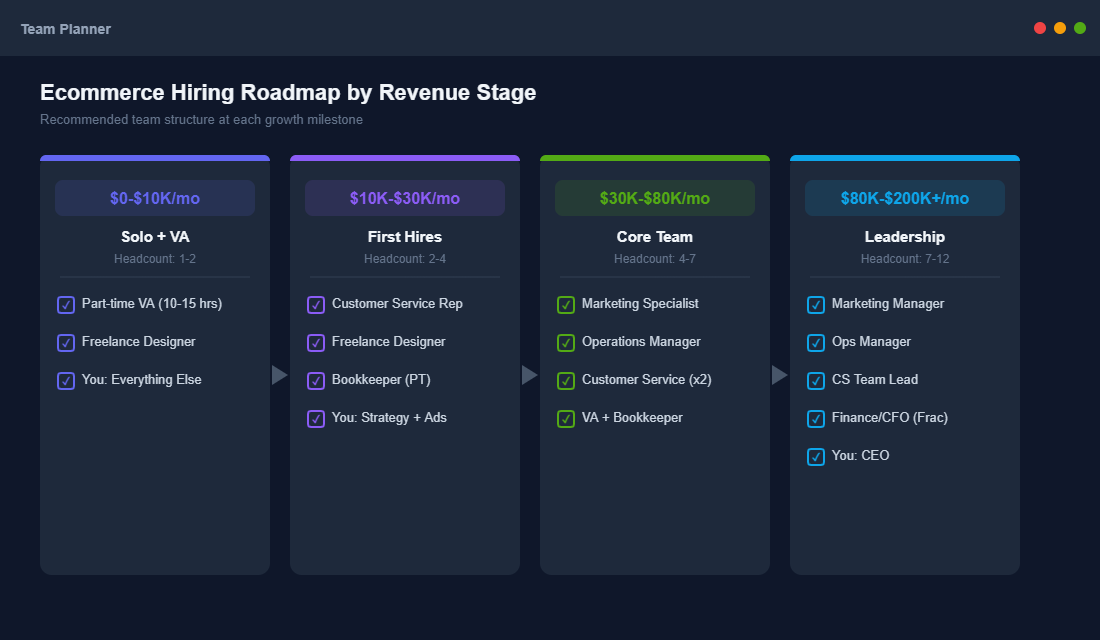
The biggest hiring mistake ecommerce founders make is hiring based on what they think a “real business” should look like, instead of hiring for the specific bottleneck that’s currently costing them money. A $15K/month brand doesn’t need a CMO. A $200K/month brand doesn’t need to be packing its own orders.
Here’s how the smartest Shopify brands approach their hiring at each revenue stage:
$0 – $10K/month (Solo Operator): You’re still wearing every hat, and that’s fine. But you should be documenting everything you do as you do it. Record Loom videos of your processes. Write quick SOPs in Google Docs. The brands that struggle to hire later are the ones who never wrote anything down during this phase. Your first “hire” at this stage should be a part-time virtual assistant handling order processing, basic customer emails, and social media scheduling — roughly 10-15 hours per week.
$10K – $30K/month (First Real Hires): This is where most founders get stuck. Revenue is good enough to feel successful but not enough to feel secure about adding payroll. The move here is a dedicated customer service person (freeing up 10-15 hours of your week) and a freelance graphic designer for your ads and social content. At this stage, nearly 74% of small business employers have made a bad hire at some point, according to CareerBuilder research. The antidote is simple: hire for the role that’s eating most of your time and isn’t in your zone of genius.
$30K – $80K/month (Building the Core Team): Now you need specialists. A dedicated marketing person (or agency) managing your paid ads and email flows. A part-time bookkeeper keeping your numbers clean. And critically, an operations person who owns fulfilment, inventory, and supplier relationships. This is the stage where LSKD, the Brisbane-based activewear brand, started building the team that would eventually scale them into one of Australia’s fastest-growing Shopify brands — by putting systems and people around their founders’ core strengths.
$80K – $200K+/month (Leadership Layer): You’re no longer hiring doers — you’re hiring leaders. A marketing manager who builds and runs their own team. An operations manager who handles your 3PL, inventory forecasting, and customer experience. Maybe a part-time CFO or fractional COO. Your job shifts from working in the business to working on the business.
The True Cost of Getting Hiring Wrong
Before we go deeper into how to hire well, let’s talk about what happens when you get it wrong — because the numbers are brutal.
Research from CareerBuilder shows the average bad hire costs a business around $17,000. But for small ecommerce brands, the real damage goes far beyond the direct cost. A bad hire in a three-person team doesn’t just waste money — they consume 17% of your management time (according to a Robert Half survey of CFOs), slow down your other team members, and damage customer relationships that took months to build.
Factor in lost productivity, retraining, and the opportunity cost of having the wrong person in the seat, and the total impact can reach 30% of that employee’s annual salary. For a $60,000/year marketing hire, that’s $18,000 gone — not counting the campaigns that didn’t run, the revenue that wasn’t generated, and the three months you lost before realising the fit was wrong.
An unfilled position costs roughly $500 per day in lost output, according to workforce analytics from the Society for Human Resource Management. With the average time-to-hire now sitting at 42-44 days, a single vacancy can cost your business over $22,000 before someone even starts. The lesson? Hire carefully, but don’t wait until you’re drowning.
The Hiring Framework: Contractors, Freelancers, or Full-Time?
One of the most common questions I get from Shopify store owners is: “Should I hire someone full-time, or just use freelancers?” The answer depends on three things: consistency of the work, how core it is to your brand, and your current cash flow.
Use freelancers when: The work is project-based (website redesign, product photography), requires specialist skills you don’t need daily (copywriting, video editing), or you’re testing a role before committing to a full-time position. Platforms like Upwork, Fiverr, and for Australian-specific talent, Freelancer.com.au, give you access to vetted professionals without the overhead. The key is treating freelancers like team members — clear briefs, regular check-ins, and consistent feedback.
Use contractors or agencies when: You need ongoing specialist work but not a full 40-hour week. This is particularly effective for paid advertising management, SEO, and email marketing. A good ecommerce agency (like a Shopify-certified partner) brings a team of specialists for less than the cost of one senior full-time hire. According to industry benchmarks, outsourcing your ad management to a competent agency typically costs 10-15% of ad spend or a flat monthly retainer of $2,000-$5,000 — significantly less than a $70K-$90K full-time performance marketer.
Hire full-time when: The role is central to your brand identity and requires deep institutional knowledge. Customer service is a prime example — nobody will understand your products and customers better than someone embedded in your business every day. The same applies to operations roles once you’re processing more than 50-100 orders per day. Full-time employees build culture, compound their knowledge, and make decisions faster because they understand the context.
Building Your Remote Team: The Australian Advantage
If you’re running a Shopify store in Australia, you have a massive advantage that most founders underutilise: the remote talent pool has never been bigger or more accessible.
The numbers tell the story. According to eCommerce News Australia, 86% of Australian businesses plan to hire more employees, and 89% are considering international recruitment. Meanwhile, 53% of Australian employees already work remotely at least part-time, and 69% of employers offer hybrid arrangements. Remote work isn’t a pandemic hangover — it’s the new operating model.
For ecommerce brands specifically, this means you can hire an exceptional customer service rep in regional Australia for significantly less than Sydney or Melbourne rates. You can bring on a Philippines-based VA for $7-$12 AUD per hour who handles your order processing, email triaging, and data entry. And you can work with a specialist Klaviyo email marketer in another timezone who sets up your flows while you sleep.
Frank Body, the Australian skincare brand that scaled globally on Shopify Plus, built much of their early team with a lean, remote-first approach — keeping their core creative and strategy team tight while outsourcing execution to specialists and agencies. The result was a brand that felt premium without the overhead of a 50-person office.
The practical framework for remote hiring as an Aussie brand:
- Customer Service & VA roles: Hire in the Philippines or regionally in Australia. Use platforms like OnlineJobs.ph or Virtual Staff Finder for offshore, and Seek or Indeed for local.
- Marketing & Creative roles: Hire Australian freelancers or small agencies. The quality difference in understanding your market is worth the premium.
- Technical roles (dev, analytics): Go global. Platforms like Toptal and We Work Remotely connect you with world-class talent regardless of location.
- Leadership roles: Keep these close — same timezone, ideally same city. Strategic alignment requires high-bandwidth communication.
The Systems That Make Teams Actually Work
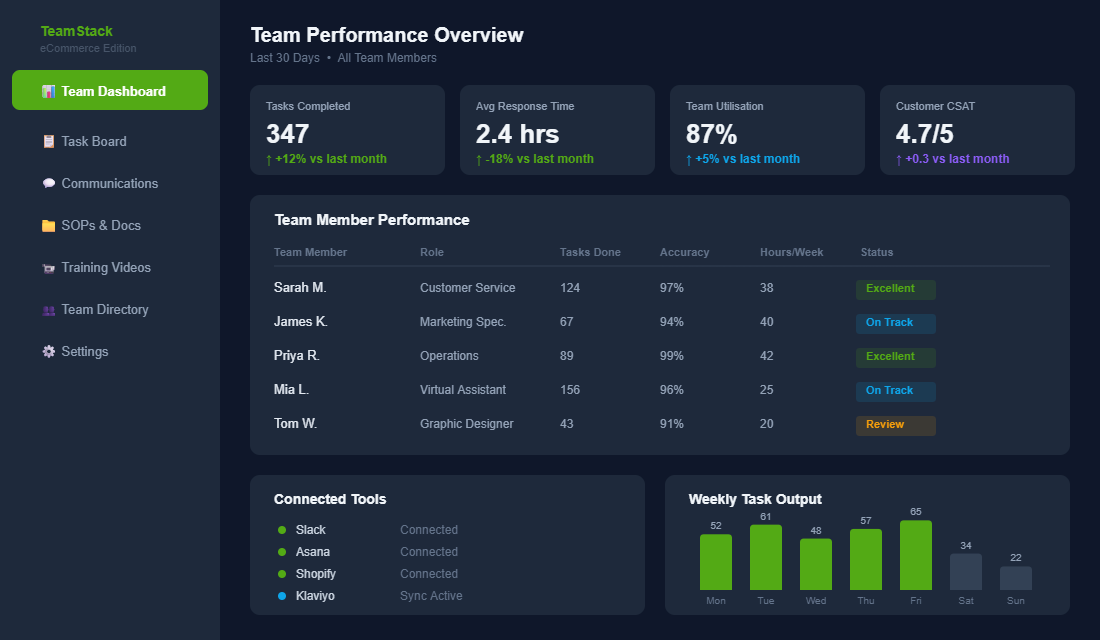
Here’s what separates ecommerce brands where the team runs the business from brands where the founder still runs everything: systems. Specifically, three categories of systems that every scaling Shopify store needs.
1. Communication systems. Slack (or Microsoft Teams) is non-negotiable for remote ecommerce teams. With over 18 million daily active users globally, Slack has become the operating system for team communication. Set up channels by function: #orders, #marketing, #customer-issues, #wins. The rule is simple — if it’s about the business, it goes in Slack. Not in text messages, not in email threads that get buried. Slack’s free plan is generous enough for teams under 10, and paid plans start at around $10 AUD per user per month.
2. Task management systems. Asana, ClickUp, or Monday.com — pick one and commit. Every task needs an owner, a due date, and a clear description of “done.” Asana is particularly popular with ecommerce teams because its project templates map well to recurring ecommerce workflows: product launches, campaign rollouts, seasonal planning. The Starter plan runs $10.99 USD per user per month and handles most growing teams’ needs. The key is making it the single source of truth — if a task isn’t in Asana, it doesn’t exist.
3. Documentation systems. Use Notion, Google Docs, or Trainual to build your SOPs and training materials. Every role should have a “Role Playbook” that a new hire can follow on day one. This includes: daily/weekly responsibilities, how to use each tool, decision-making guidelines, and escalation paths. The brands that scale fastest are the ones where every process lives in a document, not in someone’s head. As we covered in our delegation playbook, you can’t delegate what you haven’t documented.
Setting Up Your Team Toolkit: A Step-by-Step Guide
Let me give you the exact stack I recommend to every ecommerce brand building their first team. This is the setup that gives you maximum visibility and control without over-engineering things.
Step 1: Set up Slack. Create your workspace at slack.com. Add channels for each business function. Integrate your Shopify notifications (new orders, refund requests) directly into a #orders channel using the Shopify app for Slack. This means your customer service team sees every order in real-time without logging into Shopify admin.
Step 2: Configure Asana. Create a workspace and build your first three projects: “Daily Operations” (recurring tasks like checking inventory levels, processing returns), “Marketing Calendar” (campaigns, content, email sends), and “Projects” (one-off initiatives like website updates or product launches). Add every team member and assign owners to everything.
Step 3: Build your Role Playbooks in Notion. For each role, create a page with: the role’s purpose (why this role exists), daily tasks and weekly responsibilities, tools they’ll use and how to access them, decision-making authority (what they can decide vs. what needs approval), and key metrics they’re responsible for. Share these during onboarding and update them quarterly.
Step 4: Set up Loom for async communication. Loom lets you record quick video walkthroughs that replace hour-long meetings. Use it for: weekly updates (record a 5-minute Loom instead of a 30-minute call), process training (show someone how to do something once, they replay it forever), and feedback on creative work (screen-record your comments on ad designs or email drafts). Loom’s free plan gives you 25 videos of up to 5 minutes — more than enough to start.
The 90-Day Onboarding Framework for Ecommerce Hires
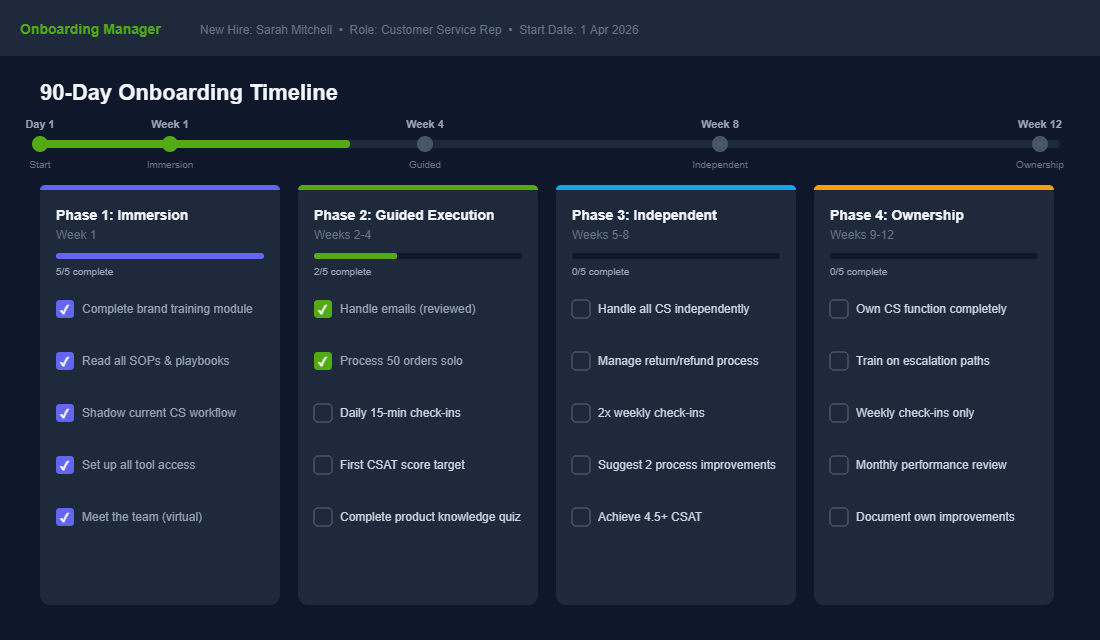
Most ecommerce founders hire someone, give them a vague handover, and then wonder why they’re not performing after two weeks. Great onboarding is the difference between a hire who’s fully productive in 30 days and one who’s still confused after 90.
Week 1 – Immersion: The new hire reads every SOP, watches every Loom, and shadows your current processes. They don’t do anything independently yet — they observe and ask questions. They should complete your brand training (who are your customers, what’s your voice, what do your products solve) and get set up on every tool. By the end of week one, they should be able to explain your business to a stranger.
Weeks 2-4 – Guided Execution: They start doing the work, but with guardrails. Every customer email gets reviewed before sending. Every ad gets approved before going live. Every order process gets checked. You’re building their confidence while catching errors early. Schedule daily 15-minute check-ins during this phase — they feel supported, and you catch issues before they compound.
Weeks 5-8 – Independent Operation: Remove the guardrails one at a time. They handle customer emails without review. They manage the daily order flow. They make small decisions autonomously. Check-ins move to twice per week. You’re looking for: speed improving, error rate dropping, and proactive problem-solving (they fix things before you even know they’re broken).
Weeks 9-12 – Ownership: By now, they should own their area completely. They’re suggesting improvements to the processes, not just following them. They’re training on edge cases and building their own shortcuts. Move to weekly check-ins and a monthly performance review. If someone isn’t at this level by week 12, have an honest conversation about fit — it’s better for both of you.
Measuring Your Team’s Impact: The Numbers That Matter
You track your ROAS, your conversion rate, and your cost per order. You should be tracking your team’s performance with the same rigour.
Here are the KPIs that matter for each common ecommerce role:
Customer Service: First response time (target: under 4 hours during business hours), resolution rate (target: 85%+ resolved without escalation), customer satisfaction score (CSAT target: 4.5+/5), and tickets handled per day. If your customer service system is set up properly, these metrics should improve month over month.
Marketing: Revenue generated vs. cost of the role (they should be generating at least 3-5x their cost), campaigns launched per month, email revenue as a percentage of total revenue (target: 25-40%), and new customer acquisition cost trends.
Operations: Order processing time (click to dispatch), error rate (wrong items, late shipments), inventory accuracy, and cost per order shipped. A good operations person should be reducing your cost per order over time through process improvements and better supplier terms.
Virtual Assistants: Tasks completed per week, accuracy rate, hours logged vs. output delivered, and time saved for the founder (this is the real metric — how many hours did you get back?).
The Compound Effect: When Your Team Becomes Your Competitive Advantage
Here’s what most ecommerce founders don’t realise until they experience it: a great team doesn’t just do the work you were already doing. They do work you never had time for.
Your customer service person notices a pattern in complaints and suggests a product page update that reduces return rates by 15%. Your marketing person spots a trending product angle and launches a campaign that generates $30K in a weekend. Your operations manager renegotiates your 3PL contract and saves you $2,000 per month.
This is the compound effect of building a team. Each hire doesn’t just take work off your plate — they add capabilities you didn’t have before. They see opportunities you’re too busy to notice. They bring skills and perspectives that make the entire business stronger.
The brands that dominate Australian ecommerce in 2026 won’t be the ones with the best products or the biggest ad budgets. They’ll be the ones with the best teams — small, focused groups of people who understand the brand, own their outcomes, and make each other better.
Your product gets you in the game. Your team is what wins it.
The Hire-by-Numbers Framework: When to Hire Who at Each Revenue Stage
The wrong first hire can cost you 6 months of cash flow. The right one buys you back 20 hours a week and opens the next stage of growth. Here are the revenue thresholds and salary bands we use with coaching members so they hire in the right order without overshooting payroll.
$0 – $30K/month: Stay solo or hire one VA. Your only hire here is a part-time virtual assistant ($8-15 AUD/hour, 10-15 hours/week) handling customer service emails, basic order processing, and Shopify product uploads. Total monthly cost: $600-$900 AUD. Do not hire full-time yet — your time is best spent on marketing, supplier relationships, and product development.
$30K – $80K/month: First specialist hire. Hire a part-time marketing coordinator or paid ads contractor before anyone else. A good Australian-based ads freelancer costs $1,500-$3,000 AUD/month and should return at least 3x their fee in additional revenue inside 90 days. Your VA hours expand to 20-25/week. You start delegating email marketing to a Klaviyo specialist (often the same person as your ads contractor, or a $1,500/month Aussie freelancer).
$80K – $200K/month: Operations lead. Now bring on a full-time Operations Manager ($75K-$95K AUD/year + super) to own inventory, fulfilment, supplier relationships, and customer service team. This is the single highest-return hire most founders make — it is the one that finally takes the operational weight off your plate. Marketing remains part-contractor, part-Klaviyo specialist. Add a part-time bookkeeper ($800-$1,500 AUD/month).
$200K – $500K/month: Build the marketing engine. Hire a full-time Marketing Manager ($85K-$110K AUD + super) to own the channel mix, briefs to contractors, and customer acquisition. Add a CX/retention manager ($65K-$80K AUD) to own Klaviyo, loyalty, and reviews. Your contractor stack stays for execution work (creative, ad buying, design). This is the stage where the founder finally stops being in the day-to-day weeds and starts being a real CEO. See our guide on the delegation playbook for how to transition cleanly.
$500K/month and above: You now need a Head of Marketing, Head of Operations, and Head of CX/Retention reporting to you. Each role pays $110K-$160K AUD plus equity or bonus. Below them sits a team of 6-12 specialists and contractors. The founder is now spending most of their time on strategy, partnerships, capital, and culture — not running ads or replying to tickets.
The 4 Hiring Mistakes That Cost Aussie Shopify Founders 6 Figures a Year
We have coached hundreds of Aussie Shopify founders through hires that worked and hires that did not. These four mistakes show up over and over, and every single one costs at least $50K AUD in salary, opportunity cost, and rehiring fees.
Mistake 1: Hiring a generalist when you need a specialist. “I need someone to do a bit of everything” is the most expensive sentence in ecommerce. Generalists are great for the first VA hire and nothing else. From the marketing coordinator onward, hire deep specialists — a paid ads person, a Klaviyo person, a content person — not “marketing all-rounders”. The depth of skill pays for itself in 60 days.
Mistake 2: Skipping the trial project. Before any contractor or full-time hire, run a paid 2-week trial project. Pay them, give them a real piece of work, and judge the output. Resumes lie, interviews lie, references lie — work product does not. We have had members swap out the “perfect interview candidate” because their actual ad creative was 30% worse than the runner-up’s. A $1,500 paid trial saves you a $90K mistake.
Mistake 3: No 90-day scorecard. If you cannot write down on a single page what success looks like at day 30, day 60, and day 90, you should not be hiring this person yet. The scorecard should have 3-5 measurable outcomes (e.g. “Email revenue at $35K/month by day 90”, “Ad CAC under $42 AUD by day 60”). Without it, you will both drift into vague disappointment.
Mistake 4: Hiring before the role is documented. If the SOP, the tools, the reporting cadence, and the decision rights are not written down before you advertise the role, the new hire will spend 3 months figuring out a job description while you pay them $7K-$10K AUD a month. Build the SOP first (even a rough one), then hire someone to own it and improve it.
The Paid Trial Task: How to Test a Hire Before You Bet Six Figures on Them
Interviews test how well someone interviews. That is all. A confident talker with three years of the right job titles can walk through a 45-minute conversation and still be unable to do the actual work. The only reliable signal is watching someone do a scaled-down version of the job, and paying them properly for it.
Run this as your final stage, after a screening call and before an offer. Two to four hours of real work, paid at the role’s market hourly rate, on a task drawn from the job itself. Budget $150 to $400 AUD per finalist. Against a bad hire that costs six to nine months of salary plus the opportunity cost of the role sitting empty, that is the cheapest insurance in your business.
What a Good Trial Task Looks Like by Role
- Customer service. Give them ten real anonymised tickets, including two angry ones and one where the customer is factually wrong. You are reading for tone, judgement on when to escalate, and whether they solve the problem or just acknowledge it.
- Media buyer. Hand over a de-identified 30-day account export and ask for a one-page read: what they would kill, what they would scale, and what they would test next. Anyone who leads with “increase the budget” is out.
- Ops or fulfilment. Give them a messy inventory sheet with genuine errors baked in. You are watching whether they spot the errors unprompted or process the file as given.
- Content or social. Three pieces in your brand voice from a real brief. Look at how closely they read the brief, not how polished the writing is. Polish is teachable. Reading comprehension is not.
Score every finalist on the same rubric before you discuss any of them, and write the scores down before you talk to your co-founder or partner about it. Four criteria, out of five each: quality of output, how they handled ambiguity, communication during the task, and whether they asked clarifying questions before starting. That last one is the highest-signal item on the list. Someone who asks two sharp questions before beginning will need dramatically less management than someone who guesses and delivers the wrong thing confidently.
Be explicit that the work is paid, that you will not use it commercially, and roughly how long it should take. If a candidate spends twelve hours on a three-hour task, that is data too, and not the good kind.
Keeping the People You Hire: The Retention Maths Founders Skip
Founders obsess over the hiring funnel and then lose good people eighteen months later for reasons that were entirely preventable. Replacing a mid-level ecommerce hire costs roughly six to nine months of their salary once you count recruitment, your time, the productivity gap, and the ramp period for whoever comes next. On a $85,000 coordinator, that is a $50,000-plus event that never appears as a line item anywhere in your P&L.
In a small ecommerce team, people almost never leave for the reason they write in the resignation email. The real drivers cluster into four:
- No visible path. In a five-person team there is no promotion ladder, so you have to build one out of scope instead of titles. “In six months you own the entire email channel” is a path. “We’ll see how it goes” is not.
- Whiplash priorities. If Monday’s number one priority is dead by Wednesday, your best people conclude their work does not matter. This is the single most common cause of quiet disengagement in founder-led teams.
- Feedback only when something breaks. If the only time you speak to someone about their performance is when it has gone wrong, they will assume silence means displeasure.
- Pay drift. Salaries move. If you hired at market rate two years ago and never revisited it, you are now paying under market and your team knows it, because they see the job ads too.
Four habits fix most of this, and none of them require a HR platform. Run a genuine 30-minute weekly one-on-one that is not a status update, because the status is already in ClickUp or Asana. Ask what is frustrating and then actually remove one thing. Do a salary review every 12 months whether or not they ask, benchmarked against Seek and Hays data for the role in your city. Give each person one owned metric so their contribution is visible in a number rather than in your opinion of them. And write down the scope of what they own, so nobody spends a year guessing where their job ends.
Watch three simple numbers: 12-month retention (aim for 80% or better on a team under ten), time-to-productive for new hires (60 to 90 days for most ecommerce roles), and how many of your one-on-ones actually happened last quarter versus how many were scheduled. That last one predicts the other two better than anything else. If you want the structure for the first three months, our 30-60-90 day onboarding framework pairs directly with this, and the SOP playbook covers the documentation that makes handover survivable when someone does eventually move on.
Your Team-Building Action Plan
Here’s a framework you can use right now to figure out your next hire and build the systems to support them:
The Next Hire Decision Matrix:
- Track your time for one week. Write down every task you do and how long it takes. Be honest — include the 45 minutes you spent reformatting a spreadsheet.
- Categorise each task. Mark it as: (A) Only I can do this, (B) Someone else could do this with training, or (C) Someone else could do this better than me.
- Calculate the cost. Add up the hours in categories B and C. Multiply by your effective hourly rate (your target annual income divided by 2,000 hours). That’s what your time is worth — and what you’re wasting on tasks someone else should own.
- Identify the cluster. Look at your B and C tasks. Which cluster is biggest? That’s your next hire.
- Write the SOP first. Before you post a job ad, document the top 5 tasks this person will do. Record Loom walkthroughs. Create checklists. This becomes your job ad, your interview test, and your onboarding material all in one.
Inside the eCommerce Circle, building your team is one of the core pillars we work on with every member. From creating your first SOPs to hiring your first specialist, the People pillar of the More Orders Operating System gives you the frameworks, templates, and coaching to build a team that scales — without the expensive trial and error of figuring it out alone.