You are spending $50, $100, maybe $200 a day on Meta Ads and you have no idea whether your creative is actually working. You see ROAS numbers bouncing around, CPAs going up and down, and you are making decisions based on gut feel instead of data. Sound familiar?
What’s in This Article
The problem is not your targeting. With Advantage+ and broad audiences becoming the norm, Meta has gotten pretty good at finding buyers. The real battleground in 2025 is creative. The brands winning on Meta are the ones testing creative systematically — not throwing spaghetti at the wall, but running structured experiments that tell them exactly what hooks, angles, and formats drive sales.
We have seen Shopify stores cut their CPA by 30-50% in 60 days simply by implementing a structured creative testing framework. No budget increase. No fancy agency. Just a disciplined approach to figuring out what resonates with their audience.
Why Most Creative Testing Fails
The biggest mistake Shopify store owners make with creative testing is testing too many variables at once. They change the image, the headline, the copy, and the CTA all in the same test — then have no idea which change actually moved the needle. That is not testing. That is guessing.
The second mistake is killing tests too early. Meta needs 50 conversion events per ad set to exit the learning phase. If you are spending $30 per day on a test with a $40 CPA, you need at least 3-4 days of data before drawing any conclusions. Checking results after 24 hours and panicking is the fastest way to waste your ad budget.
The third mistake is never testing at all. Too many store owners find one creative that works and run it until it dies. Every ad has a fatigue curve, and the brands that scale are the ones with a pipeline of tested winners ready to replace fatiguing creative.
The 3-Layer Creative Testing Framework
This is the framework we use with eCommerce Circle members to systematically find winning creative. It works for any budget from $50 to $5,000 per day.
Layer 1: Concept testing. This is the broadest level of testing. You are testing fundamentally different creative approaches to see which concept resonates most with your audience. Examples of concepts: UGC testimonial vs professional lifestyle photography vs product demo video vs founder story. Run 3-4 completely different concepts with the same offer and targeting. Spend 60-70% of your testing budget here until you have 2-3 winning concepts.
Layer 2: Hook testing. Once you know which concepts work, test different hooks within your winning concept. The hook is the first 3 seconds of video or the dominant visual element of a static ad. For a UGC concept, test different opening lines: “I was so skeptical about this product…” vs “My skin has never looked like this before…” vs “Okay, I need to talk about this brand.” For static ads, test different hero images or headline angles. Run 4-5 hook variations per winning concept.
Layer 3: Execution testing. This is the fine-tuning layer. Take your winning concept + winning hook and test execution details: different CTAs, different body copy, different aspect ratios (1:1 vs 4:5 vs 9:16), different lengths for video, different colour treatments for static. These changes are smaller, but they can improve performance by 10-20% at the margins.
Setting Up Your Testing Campaign Structure
Your testing structure in Ads Manager should be separate from your scaling campaigns. Here is the setup that works for most Shopify stores.
Create a dedicated testing campaign. Use the Advantage Shopping Campaign (ASC) or a manual CBO campaign with broad targeting. Set the budget at 10-20% of your total Meta spend. This is your R&D budget — it funds the creative pipeline that keeps your scaling campaigns performing.
One ad per ad set for clean data. When testing creative, you want Meta to spend evenly across your variations. Using one ad per ad set with equal budgets gives you the cleanest comparison. Dynamic Creative Testing (DCT) is another option — it lets you test multiple elements within a single ad — but it can make it harder to isolate what is working.
Define your winner criteria upfront. Before launching a test, decide what “winning” looks like. For most Shopify stores, a winning creative has a CPA at or below your target, a CTR above 1.5%, and a hook rate (3-second video views / impressions) above 25% for video. Write these benchmarks down and stick to them — emotions have no place in creative testing.
Creative Formats That Work for Shopify in 2026
Not all creative formats are created equal. Here is what we are seeing drive the best results across Australian Shopify stores right now.
UGC-style videos (15-30 seconds). These continue to dominate performance on Meta. The key word is “style” — they should feel authentic but be strategically crafted with a strong hook, clear product demonstration, and explicit CTA. Hire UGC creators on platforms like Billo or Insense for $100-$300 per video. Test 3-5 creators to find voices that resonate with your audience.
Static ads with strong headlines. Do not sleep on static image ads. A well-designed static with a bold headline, clear product image, and social proof element (star rating, review quote) can outperform video — especially for retargeting. Use Canva or Figma to batch-create variations quickly.
Carousel ads with benefit-led slides. Carousels work particularly well for product education and overcoming objections. Lead with your strongest benefit or result, then walk through features, social proof, and a final CTA slide. Average carousel engagement is 20-30% higher than single-image ads because the swipe mechanic keeps people interacting.
Before/after and transformation content. If your product delivers a visible result (skincare, fitness, home improvement, organisation), before/after content is incredibly powerful. Even a simple side-by-side static image showing the transformation can drive CTRs of 3-5% — well above average.
Scaling Winners and Replacing Losers
Testing is only half the equation. The other half is knowing what to do with your results.
- Graduate winners quickly. When a creative meets your winner criteria after sufficient data (50+ conversions or 5-7 days), move it into your scaling campaign immediately. Every day a winner sits in your testing campaign is a day you are leaving money on the table.
- Kill losers decisively. If a creative has not met your benchmarks after 5-7 days and 50+ link clicks, turn it off. Do not let emotional attachment keep underperforming ads alive. Document what you learned and move on.
- Maintain a 3:1 test-to-winner ratio. Plan to test at least 3 creatives for every 1 winner you need. If your scaling campaigns need 2 new winners per month, you should be testing 6-8 new creatives every month in your testing campaign.
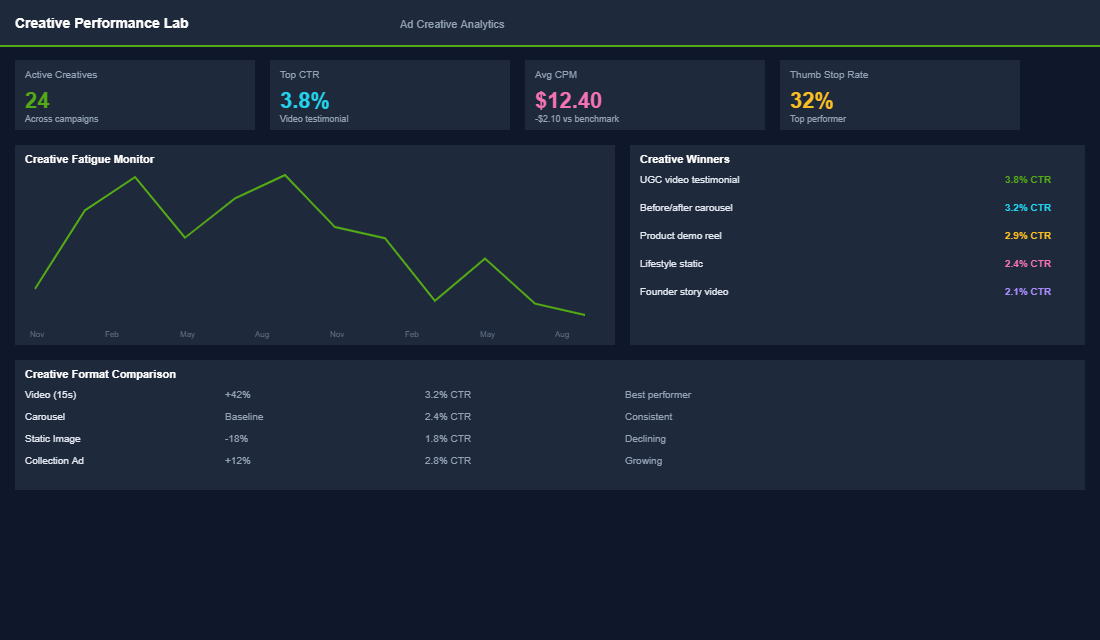
- Track creative fatigue. Monitor your winning creatives weekly. When frequency climbs above 3.0 and CPA increases by 20%+ from its baseline, the creative is fatiguing. Have your next winner ready to replace it.
Build Your Creative Pipeline Now
The brands that consistently scale on Meta are not the ones with the biggest budgets — they are the ones with the best creative testing systems. A structured approach to testing concepts, hooks, and execution details removes the guesswork and gives you a repeatable process for finding ads that convert. Start with the 3-layer framework, dedicate 10-20% of your budget to testing, and commit to launching at least 4-6 new creatives per month.
Inside the eCommerce Circle, creative strategy for Meta Ads is part of our Promotion pillar. We help members build creative testing systems that keep their ad accounts scaling without the constant stress of creative fatigue. If your Meta Ads performance has plateaued and you are not sure what to test next, our coaching can help you break through.
How Much Budget Does Creative Testing Actually Need?
Here is the number most agencies will not give you straight: set aside 10-20% of your total Meta budget purely for testing. If you are spending $10,000 AUD a month, that is $1,000-$2,000 that exists to buy learnings, not immediate ROAS. Founders who skip this end up paying for learnings anyway — they just pay through underperforming campaigns instead of controlled tests.
At the ad set level, give each test cell enough spend to reach a decision. In the Australian market, CPMs typically run $18-$35 AUD depending on your category and the season (expect the top end from October through December). A practical floor is $50-$100 AUD per day per test cell, held for 3-4 days before you call it. Killing an ad after $30 of spend is not testing — it is guessing with extra steps.
And before you set a target CPA for those tests, make sure it is grounded in your real unit economics. Your maximum profitable CPA comes from your contribution margin, not from what a benchmark report says. Our contribution margin audit walks through exactly how to find that number for your store.
The Metrics That Decide Winners (Ignore Everything Else)
Meta gives you dozens of columns. You need five. Everything else is noise that will talk you into keeping losers.
- Hook rate (3-second views ÷ impressions): aim for 25-30%+. Below 20% means your first frame is failing, and nothing downstream can save it.
- Hold rate (ThruPlays ÷ 3-second views): tells you whether the promise in your hook is being kept. A strong hook with a weak hold means the body of your ad is not delivering.
- Unique outbound CTR: healthy Shopify ads sit at 1-1.5%+. High hook rate with low CTR usually means you are entertaining people, not selling to them.
- Cost per unique landing page view: your bridge metric between ad performance and site performance. If this is cheap but sales are absent, your problem is the site, not the creative.
- CPA against your contribution-margin ceiling: the only metric that decides scaling. Everything above is diagnosis; this is the verdict.
Pair these with GA4 and a session-recording tool like Hotjar or Microsoft Clarity so you can see what paid visitors actually do after the click. Roughly 70% of carts are abandoned on the average store, so if your creative is winning but revenue is flat, the leak is usually past the ad. Once traffic lands, A/B testing on your store is the second half of the same discipline.
Build a UGC Pipeline So the Machine Never Starves
The framework above dies without a steady feed of new creative. Winning ads fatigue — for most Shopify stores spending at moderate levels, expect a winning creative to hold for 4-8 weeks before frequency creeps up and CPA follows. That means you need 10-15 new creative variations a month entering Layer 1, and you will not sustain that by shooting everything yourself.
Build a bench of 3-5 UGC creators who know your product. Brief them on hooks, not scripts — give each creator three hook angles and let them deliver in their own voice. Expect to pay $150-$400 AUD per video in the current market. One in ten will be a real winner, and that winner will pay for the other nine many times over. Feed every learning from your testing layers back into next month’s briefs: winning hooks become new angles, and losing concepts get retired before you spend on variations.
Remember that paid traffic is rented attention. The stores that win convert that rented attention into owned channels — capture emails on the way through and let your Klaviyo flows do the compounding while your ads do the introducing.
Want a Second Set of Eyes on Your Ad Account?
If your CPA has been creeping up and you are not sure whether the problem is creative, structure, or your store itself, we look at this every week with Aussie Shopify founders inside eCommerce Circle. Let’s Talk — a 20-minute chat will usually tell you exactly where the leak is.