Pricing is the most powerful lever in your Shopify business, and the one most store owners are afraid to touch. A 1% improvement in pricing drops straight to your bottom line with zero extra cost. Compare that to a 1% improvement in conversion rate, which requires testing, design work, and months of optimisation. Yet most Shopify store owners set their prices once, based on a gut-feel markup, and never revisit them.
What’s in This Article
The fear is understandable. Raise prices and you might lose customers. Drop prices and you might erode your margins. But the reality is that most ecommerce brands are underpriced, not overpriced. They are leaving money on the table because they are pricing based on cost-plus markup instead of perceived value, and those are two very different things.
Here is the pricing framework that helps Shopify stores find their optimal price point, the sweet spot where you maximise revenue without sacrificing conversion. It is not about charging more for the sake of it. It is about understanding what your product is worth to your customer and pricing accordingly.
Why Cost-Plus Pricing Is Holding You Back
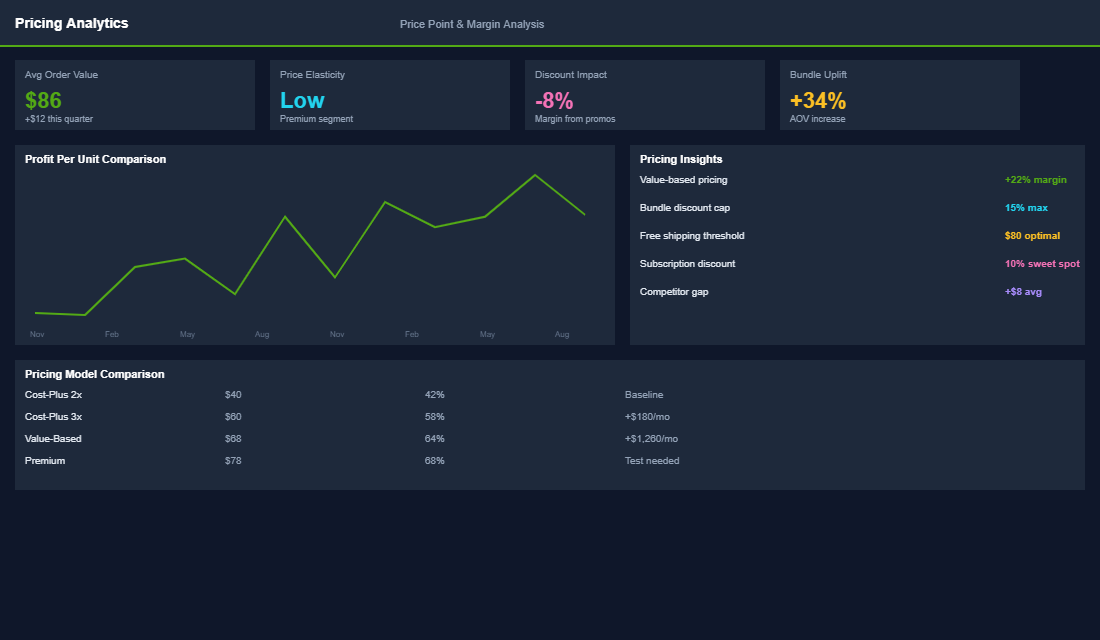
Cost-plus pricing is the default for most Shopify stores: calculate your product cost, add a markup (typically 2-4x), and that is your retail price. It is simple, predictable, and completely ignores the most important factor in pricing, what the customer is willing to pay.
Consider two identical-quality moisturisers. Brand A costs $8 to produce and prices at $32 (4x markup). Brand B costs $10 to produce and prices at $65 (6.5x markup). Brand B has premium packaging, a compelling brand story, clinical trial references, and positions itself as a luxury skincare brand. It sells just as many units as Brand A, but makes 3x the profit per unit. The product cost barely matters. The perceived value determines the price.
This does not mean you should just slap a high price on everything. Value-based pricing requires that you actually deliver and communicate the value that justifies the price. But if you are defaulting to the lowest price because you are afraid of losing sales, you are probably undervaluing your product and your brand.
The Value-Based Pricing Framework
Value-based pricing starts with understanding what your product is worth to your customer, not what it costs you to make. Here is how to determine your optimal price point.
Step 1: Map your competitive landscape. List 5-10 competitors selling similar products. Record their prices, positioning, and perceived quality. This gives you the price range customers are already comfortable with in your category. If competitors sell similar products for $40-$80, that is your category price band.
Step 2: Identify your value differentiators. What makes your product different or better? Unique ingredients, Australian-made, sustainable materials, superior design, better customer experience, stronger brand story, each of these justifies a premium over generic alternatives. List 3-5 genuine differentiators and estimate how much each is worth to your target customer.
Step 3: Test price sensitivity. The simplest way to test pricing is an A/B test on your product page. Show 50% of visitors the current price and 50% a higher price. Measure conversion rate and revenue per visitor (RPV). If RPV is higher at the higher price, even with a slightly lower conversion rate, the higher price is more profitable. Tools like Google Optimize or Shopify’s native A/B testing can run these tests.
Step 4: Survey your customers. Ask existing customers: “If this product were no longer available at [current price], what is the maximum you would pay for a similar product from another brand?” The Van Westendorp Price Sensitivity Meter uses four questions to identify the optimal price range where most customers see the product as neither too cheap nor too expensive.
Psychological Pricing Tactics That Work
Beyond the base price, how you present your pricing dramatically affects perceived value and conversion.
Charm pricing ($49 vs $50). Prices ending in 9 or 7 consistently outperform round numbers for most consumer products. The effect is real: a product priced at $49 sells significantly more than at $50, even though the practical difference is negligible. Use charm pricing for standard products and round pricing for premium or luxury positioning (where $50.00 signals quality more than $49.99).
Anchoring with a higher-priced option. If you sell a product at $60, adding a premium version at $95 makes the $60 option feel like a deal, even if nothing about the $60 product has changed. This is anchoring bias, and it works in every product category. Create a “good-better-best” range and watch the middle option outsell the others.
Bundle pricing for higher AOV. A moisturiser at $45 and a serum at $40 sold separately total $85. Bundle them at $72 (“Save $13!”) and you increase AOV while making each product feel cheaper. Bundles also reduce decision fatigue, instead of choosing between products, the customer gets both. Shopify apps like Bundler or Bold Bundles make this easy to implement.
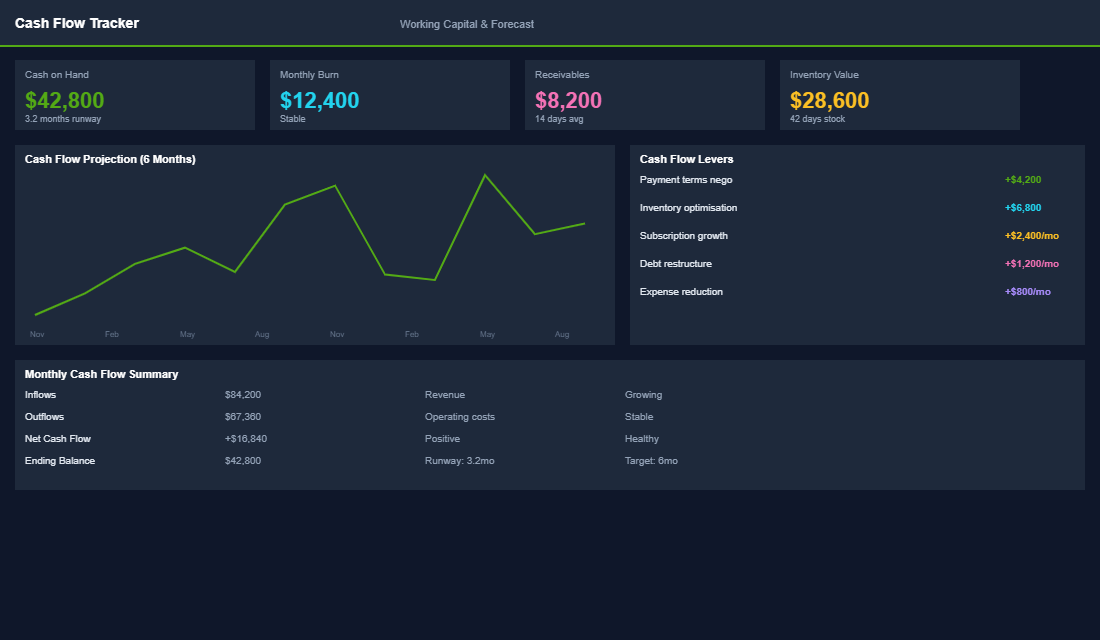
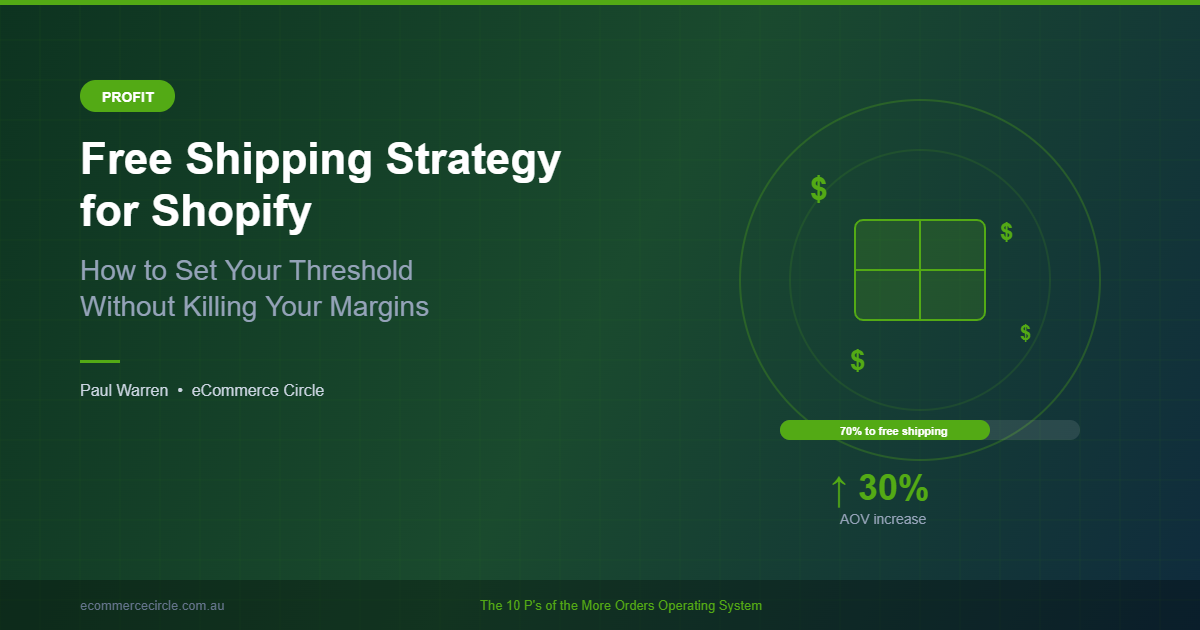
Free shipping thresholds. Setting your free shipping threshold 20-30% above your current AOV nudges customers to add more items. If your AOV is $65, set free shipping at $80-$85 AUD. Most customers will add a small item rather than pay for shipping. This is technically a pricing tactic, you are embedding shipping cost into product margin while creating a perceived benefit.
When and How to Raise Prices
- Raise prices when your conversion rate is healthy. If your product page conversion rate is above 3-4%, your price is likely not the bottleneck. Test a 5-10% increase and monitor RPV. If RPV goes up, you found free money.
- Raise prices alongside value additions. The best time to raise prices is when you are adding value, new packaging, improved formula, better materials, or enhanced customer experience. The price increase feels justified because something tangibly improved.
- Raise prices on your best sellers last. Start with mid-tier products where price sensitivity is lower. Once you have data showing the price increase works, apply it to your hero products.
- Communicate value, not price. If customers complain about a price increase, the issue is not the price, it is that the perceived value has not been communicated clearly enough. Invest in better product photography and descriptions, stronger social proof, and brand storytelling to support the higher price point.
Common Pricing Mistakes That Erode Your Margins
After working with hundreds of Shopify store owners, the same pricing mistakes come up again and again. Recognising them in your own business is the first step to fixing them.
Racing to the bottom on price. When a new competitor enters your market and undercuts your price by 15%, the instinct is to match them. Resist it. Price wars are a race nobody wins. If your competitor is selling at $35 and you are at $45, the answer is not to drop to $35, it is to make the $10 difference feel justified through better imagery, stronger social proof, and a more compelling brand story. Brands that compete on value retain 40-60% of their customers after 12 months. Brands that compete on price retain under 20%.
Ignoring your landed cost when calculating margins. Your product cost is not just the price you pay your supplier. It includes shipping to your warehouse, customs duties (for imports), packaging, and any assembly or labelling. A product that costs $12 from your supplier might have a true landed cost of $18-$22 once you factor everything in. If you are calculating your markup from $12 instead of $22, your margins are 30-40% thinner than you think. Use a tool like our unit economics guide to map your true costs.
Discounting too often and too deeply. Sales events are powerful when used strategically, EOFY, BFCM, and seasonal clearance are all legitimate reasons to discount. But running 20% off every other week trains your customers to never pay full price. Data from Shopify Plus merchants shows that brands running more than six site-wide sales per year see a 12-18% decline in average selling price over 12 months, even on non-sale periods. Your customers learn to wait. Keep deep discounts rare and use smaller incentives (free shipping, gift with purchase) for day-to-day promotions.
Setting one price and forgetting it. Your costs change, your competitors adjust, and your customers’ willingness to pay shifts over time. Review your pricing quarterly at minimum. Pull your Shopify analytics, check your conversion rate by product, and identify SKUs where the conversion rate is suspiciously high (above 5-6%), that often signals you are underpriced and leaving revenue on the table.
Pricing for Subscriptions and Recurring Revenue
If you sell consumable products, skincare, supplements, coffee, pet food, subscription pricing is one of the most powerful levers for increasing customer lifetime value. The key is getting the discount right. Too small and customers will not bother subscribing. Too large and you are giving away margin for no reason.
The sweet spot for most Shopify subscription programs is a 10-15% discount on the subscribe-and-save option. At 10%, you retain most of your margin while giving customers a meaningful incentive. At 15%, you attract more subscribers but need to ensure the increased LTV offsets the margin hit. Anything above 20% is rarely justified unless your margins are exceptionally high.
Subscription customers are worth 2-3x more than one-time buyers over a 12-month period. Even at a 15% discount, a customer who orders monthly for 8 months generates significantly more profit than a one-time buyer at full price. Apps like Recharge, Yotpo Subscriptions, or Loop handle the subscription mechanics on Shopify, and most integrate directly with Klaviyo for subscription-specific email flows.
Using Data to Find Your Optimal Price Point
The best pricing decisions are backed by data, not guesswork. Here is a practical testing framework you can run this month.
Start with your top 5 products by revenue. For each one, pull the last 90 days of data from Shopify: units sold, conversion rate, and revenue per visitor (RPV). RPV is the metric that matters most, it accounts for both price and conversion rate. A product priced at $50 with a 3% conversion rate generates $1.50 RPV. The same product at $60 with a 2.7% conversion rate generates $1.62 RPV. The higher price wins, even though fewer people bought.
Run a simple price test for 2-4 weeks using Shopify’s built-in A/B testing or an app like Intelligems. Test a 10-15% price increase on your top products. Monitor RPV daily, if it holds steady or increases, the higher price is more profitable. If RPV drops significantly (more than 10%), roll back. Most Shopify stores that run this test find at least 2-3 products where a price increase is justified. On a store doing $50K per month, finding 10% more margin on even a few hero products can mean an extra $3,000-$5,000 in monthly profit, with zero additional work.
Price With Confidence
Pricing is not just a number, it is a statement about your brand, your product quality, and your target customer. Brands that price too low attract bargain hunters who have no loyalty. Brands that price based on value attract customers who appreciate quality and are willing to pay for it. Those customers have higher LTV, lower return rates, and are more likely to refer friends. Price for the customer you want, not the customer you are afraid of losing.
Test Your Price Before You Roll It Out Storewide
The fastest way to lose your nerve on pricing is to raise a price across the whole store and then watch the dashboard in a panic. You never learn whether sales moved because of price or because of a hundred other variables. Run a controlled test instead.
- Start with one hero product. Pick a strong seller, lift the price 5 to 10%, and run it for two to three weeks against the same window last month. Watch units, revenue, and contribution margin together, not just units.
- Do the margin maths first. At a 40% gross margin, a 5% price rise can absorb a 10 to 12% drop in units and still leave you ahead on profit. Most founders are stunned by how much volume they can lose and still come out in front.
- Use the right tools. Shopify makes manual price tests easy, and tools like Intelligems and Dexter run true A/B price splits when you want statistical confidence before committing.
The point of a test is to replace fear with evidence. A 1% lift in average price, held across the catalogue, can drop almost entirely to the bottom line, often an 8 to 11% lift in profit for a typical Aussie DTC margin structure. Once one product proves the theory, you roll the playbook out with confidence. To make sure a price rise does not quietly inflate returns, pair it with our guide on cutting return rates without hurting CX.
Inside the eCommerce Circle, pricing strategy is a core part of our Profit pillar. We help members audit their current pricing, run structured price tests, and build pricing frameworks that maximise revenue without sacrificing volume. If you suspect your products are underpriced but are nervous about raising them, let’s talk.