You launched your Shopify store with a handful of products. Now you have 200+ SKUs, three sales channels, a warehouse that is bursting at the seams, and no idea which products are actually making you money versus which ones are quietly draining your cash flow.
What’s in This Article
Scaling from a small Shopify operation to a serious ecommerce business is not about doing more of the same. It is about building the operational backbone that supports growth without breaking. The brands that scale smoothly have systems. The brands that stall have hustle. Here is how to build the systems.
The Operational Growing Pains Most Brands Hit
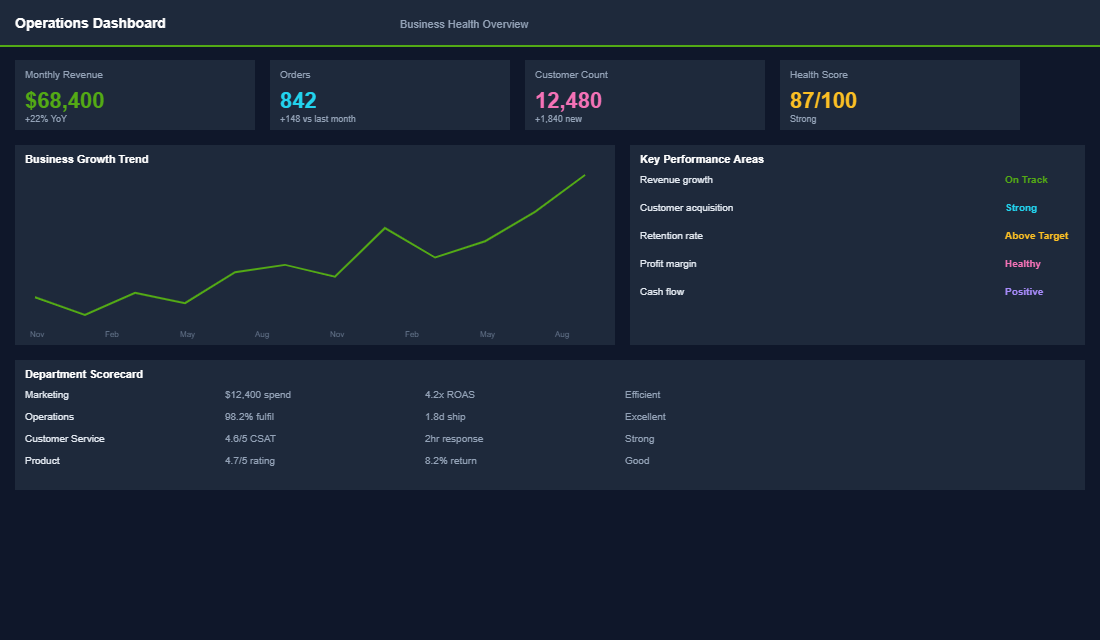
There are predictable breaking points as a Shopify store scales. Understanding them in advance lets you build solutions before they become crises:
$10-30K/month: You are doing everything yourself. Packing orders, running ads, answering customer emails, posting on social. The ceiling is your personal time. Growth stalls because there are not enough hours in the day to do more.
$30-80K/month: You have hired help – maybe a VA, maybe a part-timer – but there are no documented processes. When someone is sick or quits, critical tasks do not get done. Quality becomes inconsistent because everything depends on institutional knowledge in your head.
$80-200K/month: Cash flow becomes the bottleneck. You need to order more inventory to keep up with demand, but the cash from recent sales is tied up in ad spend and operating costs. Without proper financial forecasting, you either run out of stock (losing sales) or overstock (killing cash flow).
$200K+/month: Everything that worked at lower scale starts to crack. Manual processes that were fine at 50 orders per day collapse at 200. Customer service response times blow out. Shipping accuracy drops. The business needs professional operations, not founder hustle.
Building Your Operations Playbook
The solution to every scaling challenge is the same: documented, repeatable systems. Here are the five operational systems every Shopify brand needs to build between $30K and $100K per month:
- Order fulfilment SOP. Document every step from order received to package shipped. Include picking procedures, packing standards, quality checks, and shipping label creation. When this is documented, anyone can fulfil orders at your standard – not just you or your best team member.
- Inventory management system. Set reorder points for every SKU based on average daily sales and lead times (the inventory forecasting playbook covers the maths). Use a tool like Stocky (Shopify’s native inventory management) or an app like Katana to track stock levels and trigger reorder alerts. Never rely on “I think we are running low” as an inventory strategy.
- Customer service playbook. Document responses to the 20 most common customer enquiries: shipping times, return requests, size exchanges, damage claims, order modifications. Use templates in your helpdesk (Gorgias or Zendesk) so responses are consistent and fast. Target sub-4-hour response times – anything longer and you are losing customers.
- Financial reporting rhythm. Review three numbers weekly: revenue, profit margin, and cash in bank. Monthly, review your full P&L including ad spend, COGS, shipping costs, and overheads. If you are not tracking your actual profit (not just revenue), you might be scaling a business that loses money on every order.
- Marketing calendar. Plan promotions, email campaigns, product launches, and content at least 30 days in advance. Reactive marketing – scrambling to send an email because sales are slow this week – always underperforms planned, strategic campaigns.
When and How to Outsource
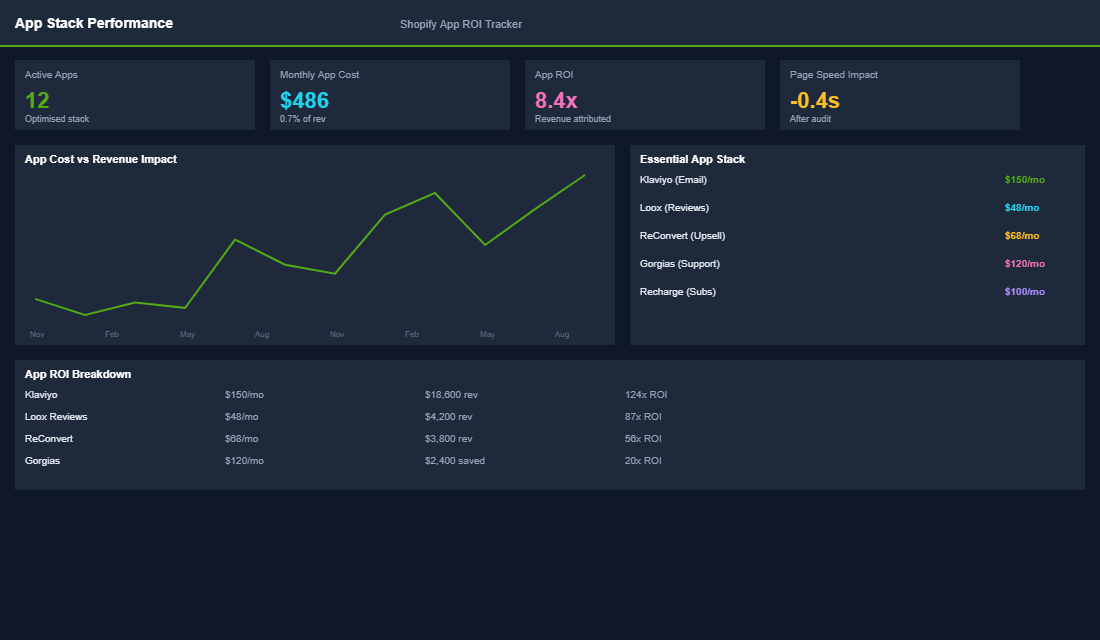
You cannot do everything yourself forever. The question is what to outsource first and when. Here is the typical outsourcing sequence for scaling Shopify brands:
First hire: fulfilment. Whether it is a part-time packer or a 3PL, getting order fulfilment off your plate is the highest-impact first hire. Fulfilment is time-consuming, repetitive, and does not require founder-level decision making. A good 3PL costs $3-6 per order – often cheaper than your own time when you factor in the opportunity cost.
Second hire: customer service. A VA handling customer emails and enquiries frees you to work on growth. Train them using your customer service playbook (you documented it, right?) and review their responses weekly for the first month. Philippines-based VAs typically cost $8-15 AUD per hour and can handle 50-80 tickets per day. Our VA hiring guide covers where to find them and how to onboard them properly.
Third hire: marketing execution. Not strategy – execution. Someone to create social content, schedule emails, and manage ad campaigns based on the strategy you set. This is where a junior marketer or specialist VA shines. Keep strategy in-house until you can afford a senior marketing hire.
Fourth hire: bookkeeper / accountant. Once you are doing $50K+ per month, proper bookkeeping is not optional. A bookkeeper keeps your books clean, manages BAS lodgements, and provides the financial data you need to make smart decisions. Expect $500-1,500 per month depending on transaction volume.
Choosing a 3PL in Australia: The Decision That Locks In Your Unit Economics
Outsourcing fulfilment is the highest-impact hire on the list, which makes the 3PL decision the one to get right the first time. Switching providers mid-year means re-platforming inventory, retraining integrations, and two to four weeks of degraded delivery performance. Choose once, choose well.
- Price the full stack, not the pick fee. Aussie 3PL quotes usually lead with a $2.50 to $4.50 pick-and-pack fee, but the real cost includes receiving ($30 to $60 per pallet), storage ($15 to $40 per pallet per month), cartons, and account fees. Get the all-in cost per order at your current volume. For most brands it lands at $5 to $9 per order once everything is counted.
- Match the warehouse to your customer map. A Melbourne warehouse shipping to a 60% Sydney customer base adds a day to most deliveries. Pull your last 1,000 orders by postcode before you shortlist. If your volume is split east-coast wide, ask about dual-location options once you pass roughly 3,000 orders per month.
- Test the integration before you sign. Native Shopify integration should sync orders, inventory, and tracking automatically. Ask for a sandbox demo with your actual catalogue. SKU mapping errors are the number one cause of month-one chaos.
- Check the cut-off and the SLA in writing. Same-day dispatch for orders before 1pm should be standard. Ask for their measured dispatch accuracy (you want 99.5% or better) and what compensation applies when they miss it.
Volume guide: under about 300 orders per month, a 3PL rarely beats a casual packer and a garage. Between 300 and 1,000, the maths starts favouring a 3PL hard, especially once you price your own hours honestly. Past 1,000 orders per month, in-house fulfilment only wins if you are ready to run a warehouse as a second business.
Cash Flow Management: The Silent Business Killer
Revenue is vanity. Profit is sanity. Cash flow is reality. More ecommerce businesses die from cash flow problems than from lack of sales. Here is how to stay solvent while scaling:
- Forecast your cash needs 90 days out. List all expected expenses (inventory orders, ad spend, software, wages, rent) and expected revenue. If there is a gap, you need to address it now – not when the bank balance hits zero.
- Negotiate supplier payment terms. Moving from net 30 to net 60 gives you an extra month to sell inventory before paying for it. This single change can prevent cash crunches during high-growth periods.
- Use inventory financing strategically. Services like Wayflyer, Clearco, and Shopify Capital offer revenue-based financing for inventory purchases. These can bridge cash flow gaps during peak ordering periods – but only use them if the unit economics are sound.
- Maintain a cash reserve. Keep 2-3 months of fixed operating costs in a separate account. This is your emergency fund. Do not touch it for inventory speculation or aggressive ad scaling – it exists solely to keep the business running if revenue dips unexpectedly.
Technology Stack for Scale
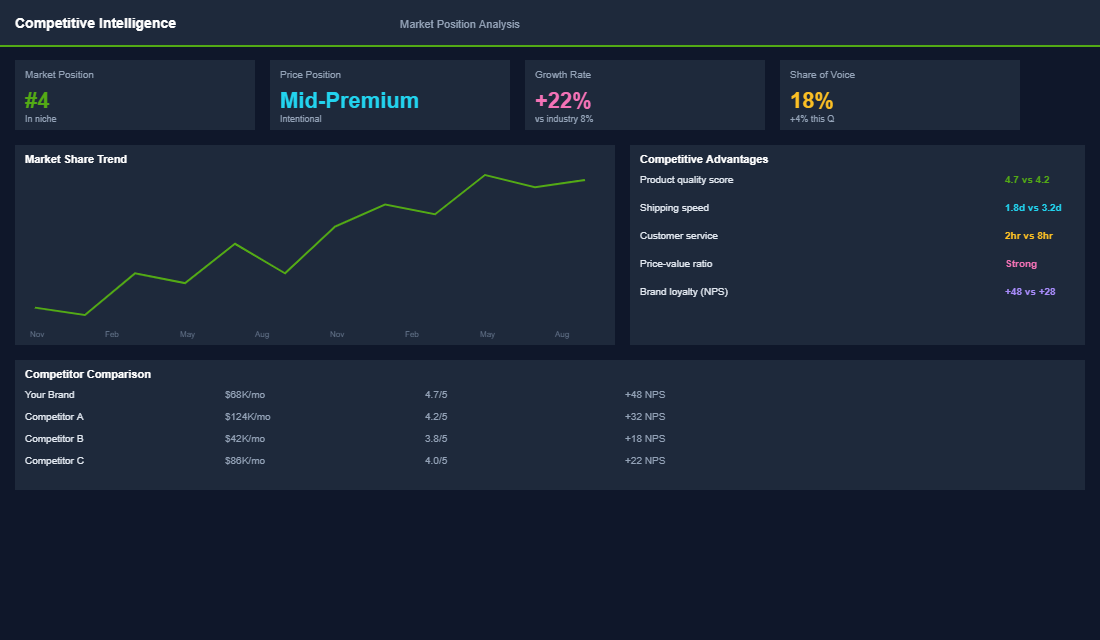
The apps and tools that work at $10K/month often break at $100K/month. Here is the recommended tech stack for serious Shopify operations:
- Email and SMS: Klaviyo (the industry standard for Shopify, handles segmentation, flows, and campaigns at scale)
- Customer service: Gorgias (built for ecommerce, integrates with Shopify orders, automates common responses)
- Reviews: Judge.me or Okendo (automated review collection, photo reviews, product-specific display)
- Loyalty: Smile.io or LoyaltyLion (points, referrals, VIP tiers integrated with Klaviyo)
- Analytics: Triple Whale or Northbeam (cross-channel attribution beyond what GA4 provides)
- Inventory: Katana or Stocky (demand planning, reorder automation, multi-location tracking)
- Accounting: Xero or MYOB (Australian-friendly accounting with Shopify integration)
- Shipping: Starshipit or ShipStation (automate label creation, tracking updates, and carrier selection)
Audit your tech stack quarterly. Remove any app you are not actively using – each unused app adds code to your theme, slows your site, and costs money for no return.
The Compound Effect of Operational Excellence
Operations are not exciting. Nobody posts Instagram Reels about their inventory management system. But operational excellence is what separates businesses that scale to $1M+ from those that plateau at $50K/month and burn the founder out.
One eCommerce Circle member was stuck at $45K/month for 18 months. Revenue would not grow because every hour was consumed by operational tasks – packing orders, answering emails, managing inventory by hand. After implementing SOPs, hiring a 3PL, and bringing on a customer service VA, they freed 25 hours per week. They redirected that time to marketing and product development. Within six months, revenue grew to $92K/month.
The lesson is simple: you cannot grow what you cannot manage. Build the systems first, then pour fuel on the fire.
Your Scaling Action Plan
This week, identify the single operational bottleneck that is consuming most of your time. Document the process for that task in a simple SOP (here is how to write SOPs that stop you being the bottleneck). Then figure out who can take it off your plate – a VA, a 3PL, or an app. That one change will free the time and mental space you need to focus on actual growth.
Inside the eCommerce Circle, operational scaling is woven through our entire framework – from Practice (systems and SOPs) to People (hiring and outsourcing) to Performance (metrics and tracking). We help members build the operational backbone that supports aggressive growth without the chaos.
Revenue gets the headlines. Operations get the results.
Stage-by-Stage Operations Benchmarks (the Numbers That Actually Matter)
If you do not know what good looks like at your stage, you cannot tell whether you are scaling or just getting busier. Here are the operational benchmarks Aussie Shopify stores hit at each revenue stage, drawn from the operating data we see across eCommerce Circle members.
$0 to $50K per month: Order accuracy above 98 percent, ship-to-door under 5 business days, returns rate under 8 percent, and labour cost per order under $4. At this stage you are likely doing it yourself or with one casual. The danger is hero mode – looks like efficiency, is actually a single point of failure.
$50K to $200K per month: Order accuracy 99 percent plus, ship-to-door under 4 business days, returns rate under 6 percent, customer service first-response under 12 hours. This is where systems kick in or kill you. Tools to standardise: Gorgias or Zendesk for support, Shipstation or Starshipit for shipping automation, Cin7 Core or Stockone for inventory once you cross 200 SKUs.
$200K to $1M per month: Order accuracy 99.5 percent plus, ship-to-door under 3 business days for capital cities, returns rate under 5 percent, defect rate under 1 percent, customer service first-response under 4 hours. By this stage you should have a documented SOP for every recurring task and a Monday morning ops huddle reviewing last week’s numbers. Tools that earn their keep: Klaviyo for lifecycle, Triple Whale or Lifetimely for unit economics, Asana or Notion for SOP storage, Loom for training videos.
The Three Operational Failures That Stall Every Scaling Brand
Imagine you run a homewares store at $180K per month and your team has grown to seven. You feel busier than ever but the growth has flatlined for four months. Nine times out of ten, one of these three failures is happening, and we see it on almost every diagnostic call.
Failure one: tribal knowledge. Critical processes live in one person’s head. When they are sick or quit, the wheels come off for two weeks. The fix: every recurring task gets a written SOP plus a Loom video, stored in one location everyone can reach. We aim for new hires to be productive within 5 business days of starting, which is impossible without documented processes. This is the heart of the Practice pillar in the More Orders Operating System.
Failure two: hiring before systemising. Founders bring in a $90K operations hire to fix chaos and end up with a $90K hire who is stuck firefighting because the chaos is the system. The fix: document and stabilise current processes before adding headcount, even if it feels slower. Read our take on building the right People stack for context on hiring sequence.
Failure three: no operational rhythm. There is no weekly review, no monthly close, no quarterly planning. Decisions get made reactively. The fix is brutally simple: 30-minute Monday ops huddle, 60-minute Friday wrap, monthly P&L review on the first Tuesday of the month, quarterly off-site to set the next 90 days. Stores that install this rhythm typically see a 15 to 25 percent productivity lift in the first quarter without adding a single team member, simply because decisions get made faster and friction gets named earlier.
If your operations are dragging the rest of the business down and you are not sure whether the next move is a system, a hire, or a tool change, that is exactly the kind of trade-off we work through with members every week. Let’s talk.