Most Aussie founders make the single biggest revenue decision of their year in a panic, the week before Black Friday. They pick a discount number, write a subject line, blast the whole list, and hope. Then they spend December trying to work out why a record sales weekend somehow left the bank account looking thinner than October.
What’s in This Article
The brands that clear real money over Black Friday Cyber Monday do not treat it as a weekend. They treat it as a project that starts in winter. To put the stakes in context: Shopify merchants turned over US$11.5 billion across the 2024 BFCM weekend, up 24% on the year before, then a record US$14.6 billion in 2025. Closer to home, Australians spent a record $6.7 billion across the four days of the 2024 Black Friday weekend, according to Roy Morgan and the Australian Retailers Association.
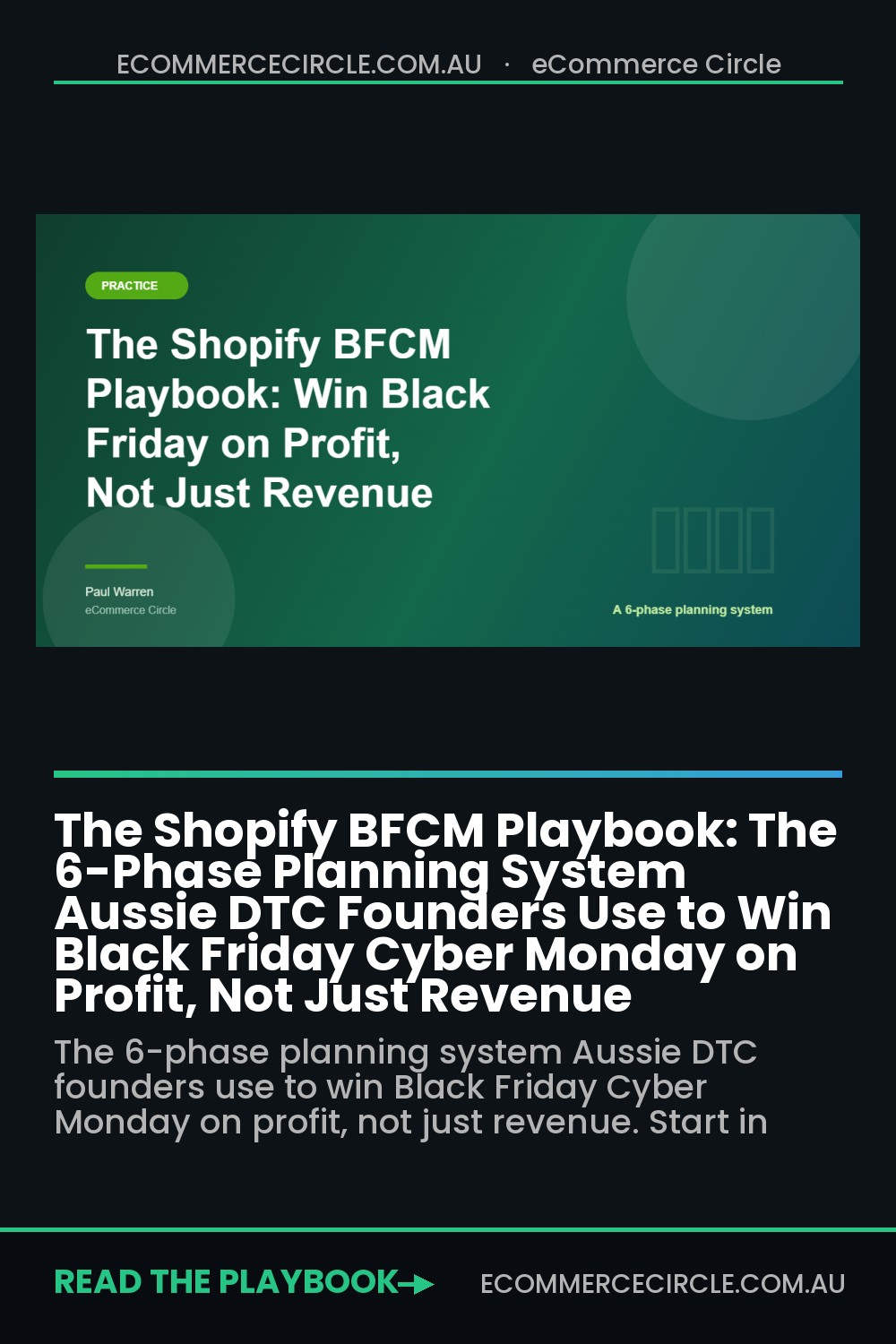
Here is the uncomfortable part. The gap between the brands that bank profit and the brands that just bank revenue is almost never the size of the discount. It is the planning that happened months earlier. This is the 6-phase system we run with members to win BFCM on profit, not just on top-line revenue.
The Six Phases at a Glance
Before we go deep, here is the whole system in one view. Each phase feeds the next, which is why the brands that start in winter are so hard to beat by the time November arrives.
- Set the number. Margin floor and discount ceilings before any offer exists.
- Build the offer architecture. Layered offers that lift AOV instead of one flat sale.
- Grow and warm the list. Bigger, hotter owned audience built through winter.
- Map the calendar. Every send planned and written before November.
- Stress-test the store. Mobile, speed, inventory, and checkout proven under load.
- Protect margin and retain. Turn deal-seekers into second-time buyers.
Phase 1: Set the Number Before You Set the Discount
The first mistake is choosing a discount before you know what a discount actually costs you. The average Black Friday discount across Shopify stores in 2024 was 26.7%. Most founders see that figure, round it to 30%, add free shipping on top, and never run the maths on what is left.
Run it now. If your blended contribution margin is 60% and you discount 30%, you have just handed away half your margin before shipping, payment fees, and pick-and-pack. Add free freight in Australia, where a parcel to Perth can cost you $14, and some of your orders are underwater. You cannot discount your way out of a margin you never had. If you are unsure of your real per-order profit, work through our contribution margin playbook before you touch a single price.
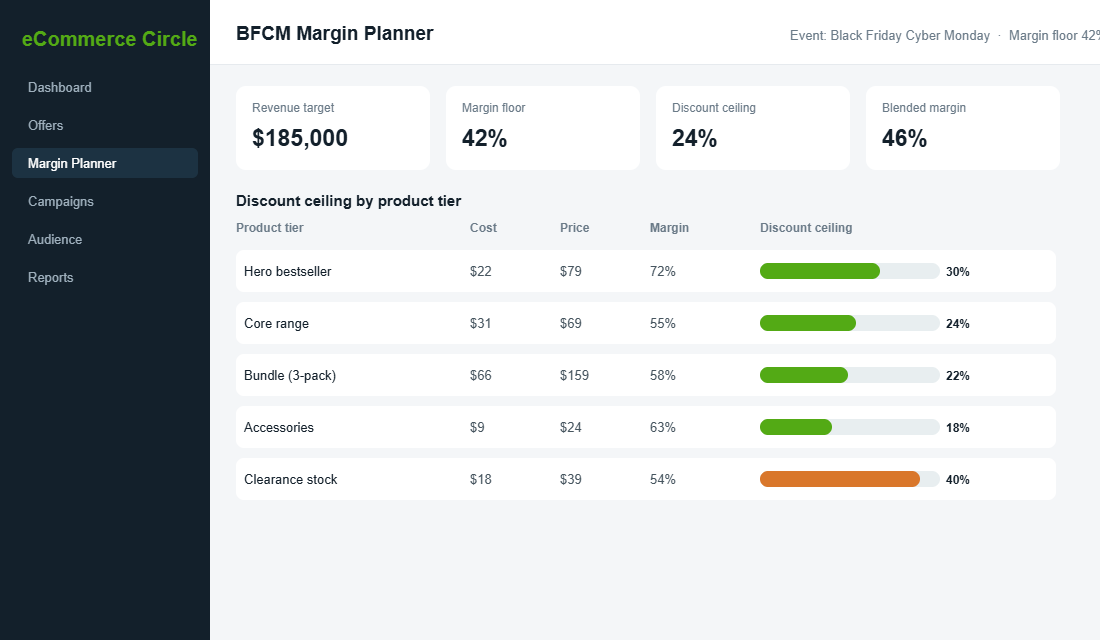
Before you design any offer, lock three numbers:
- Revenue target. A specific dollar figure for the weekend, not “more than last year”.
- Blended margin floor. The lowest average margin you will accept across the whole event after discounts, shipping, and fees.
- Maximum discount per tier. The ceiling on each offer, calculated back from your margin floor, not plucked from what a competitor is shouting about.
When the number comes first, the discount becomes an output of your maths instead of a reaction to everyone else’s email. That single shift is what separates a profitable November from a busy one.
Phase 2: Build the Offer Architecture, Not One Sitewide Sale
A flat “30% off everything” banner is the laziest offer in ecommerce. It trains your best customers to wait, it torches margin on products that did not need discounting, and it gives shoppers no reason to add a second item. The brands holding profit build an offer architecture instead, a set of layered offers that protect margin and lift average order value at the same time.
This works. Despite the discounting, brands held an average order value near $139 over BFCM 2024 while only giving up around $38 per order, because the offers were designed to push basket size up. Your job is to make the discount do more than one thing.
- Spend-and-save tiers. Spend $80 save 15%, spend $150 save 25%. The threshold pulls AOV toward your higher tier instead of letting everyone buy one discounted item.
- Gift with purchase. A free add-on above a spend threshold protects your headline price and moves slow stock without cutting the price tag.
- Bundles. Pre-built kits at a bundle price let you show a saving while keeping blended margin healthy across the set.
- Hero-product doorbuster. One deep deal on a known winner to pull traffic, fenced so it does not bleed into your whole catalogue.
You do not have to win on depth. Melbourne-founded Who Gives A Crap has built a loyal base partly by refusing to join the race to the bottom, leaning on brand and values rather than the biggest percentage off. If your margins are tight, differentiating on the offer structure beats matching a competitor’s discount you cannot afford. For the mechanics of running a sale without training customers to wait, our EOFY sale playbook covers the same discipline applied to the June peak.
One more rule on the offer: fence your hero deal. The doorbuster exists to pull traffic, so it should sit on a known winner with enough margin to survive the cut, not on your whole range. Use a specific product or collection discount rather than a store-wide code, so a single deep offer cannot quietly apply itself to every SKU you sell. That one decision protects more margin than any other choice you make in November.
Phase 3: Grow and Warm the List Through Winter
Your BFCM result in November is mostly decided by the size and warmth of your owned audience in August. Paid traffic gets expensive and competitive in the lead-up, so the cheapest revenue you will make over the weekend comes from people who already know you. Winter is when you build that asset, not the week of the sale.
The numbers back the owned-channel focus. Over BFCM 2024, brands on Klaviyo generated US$3 billion in attributed value across email and SMS, and the merchants who added SMS to email saw a 20% lift in revenue versus the year before. Email and SMS are not the discount channel. They are the channel that turns a list you grew in winter into orders in November.
Use the quiet months to do three things:
- Capture more contacts. Get your email and SMS pop-up converting at 5 to 10% of visitors now, so the list is bigger before traffic spikes. Collect the mobile number, not just the email.
- Warm the domain. Send consistent campaigns through winter so your sender reputation is strong. A cold sending domain that suddenly blasts in November lands in spam exactly when it matters most.
- Segment for the weekend. Tag VIPs, recent buyers, and never-purchased browsers so you can give early access to the right people and avoid hammering everyone with the same message.
Anticipation is a tool here too. Gold Coast brand Hismile is known for building hype well before the sale with teasers and waitlists, so demand is primed the moment the offer goes live. You can run a smaller version of the same play with a “BFCM early access” sign-up list that you grow from September.
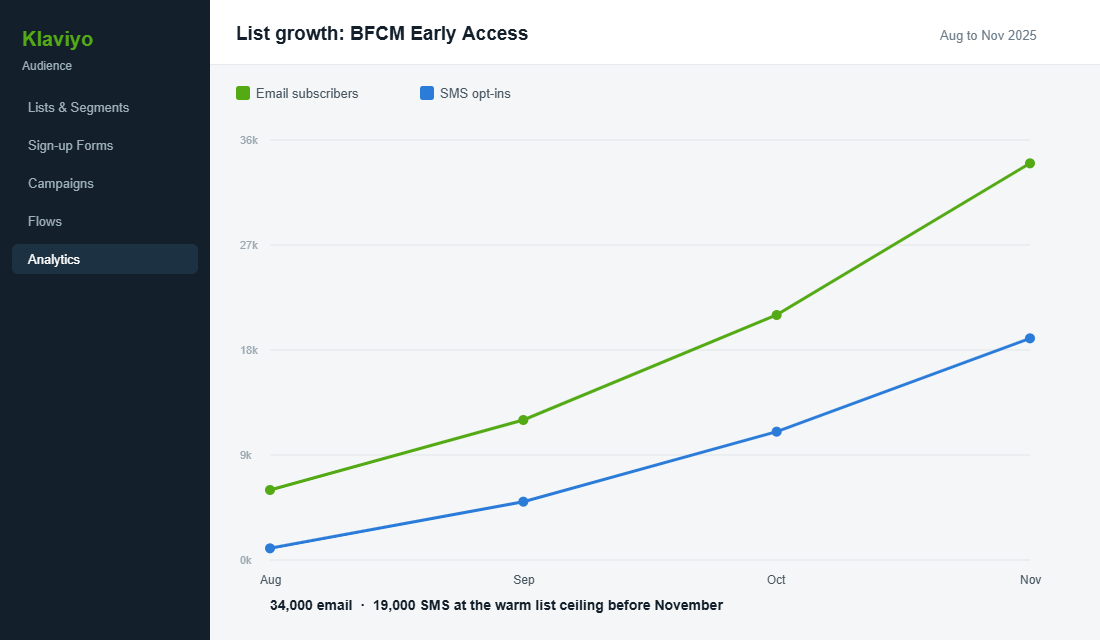
Tool focus: set up a BFCM early-access list in Klaviyo
Klaviyo is the workhorse here because it owns both email and SMS in one place. To stand up an early-access list before September:
- Create the list. In Audience, create a new list called “BFCM Early Access” so these subscribers are easy to target later.
- Build a sign-up form. Use Sign-up Forms to make a teaser pop-up or footer form that promises first access and an extra perk, and subscribe entrants to that list.
- Collect the mobile number. Add an SMS consent field to the form so you capture phone numbers with proper consent, not just emails.
- Set the welcome. Build a short flow that confirms the sign-up and sets the expectation that the best offer lands in their inbox first.
- Warm the segment. Send this list one light campaign a month through winter so the segment stays engaged and your domain reputation climbs before the November rush.
That single list becomes the audience for your Phase 4 early-access send, and it is the cheapest revenue you will make all weekend.
Phase 4: Map the Campaign Calendar Day by Day
BFCM is not one send. It is a sequence, and the brands that plan it as a calendar instead of a single email capture far more of the window. The four official days run Friday through Cyber Monday, but the real selling period now stretches across the whole of Cyber Week, and many Aussie brands open early access the Monday before.
Build the calendar before November and write the emails in advance. A workable structure looks like this:
- Early access (the week before). VIPs and your most engaged segment get first crack. This rewards loyalty and pulls revenue forward before inbox fatigue sets in.
- Black Friday. Full launch to the list, with a clear hero offer. Plan two to three sends across the day, not one.
- The Saturday and Sunday lull. Most brands go quiet. A mid-weekend angle, a restock alert or a category spotlight, captures shoppers competitors have stopped emailing.
- Cyber Monday. A fresh hook and genuine urgency, since this is the highest mobile-conversion day of the lot.
- Last chance and extend. A final-hours send, and a planned one-day extension for non-openers, which routinely adds a meaningful tail without a deeper discount.
Write every send, design every email, and schedule the lot by mid-November. When the weekend arrives, your job should be monitoring and replying, not writing copy at 11pm on Black Friday.
Bake the logistics into the calendar too. Australia Post hits peak volume across Cyber Week, and shoppers care more about arrival dates than ever. Publish your last-dispatch dates clearly, set realistic delivery expectations on the product page and at checkout, and brief whoever packs your orders that the weekend will land like a small tidal wave. A sale that arrives late turns a new customer into a refund and a one-star review.
Phase 5: Stress-Test the Store and the Stack
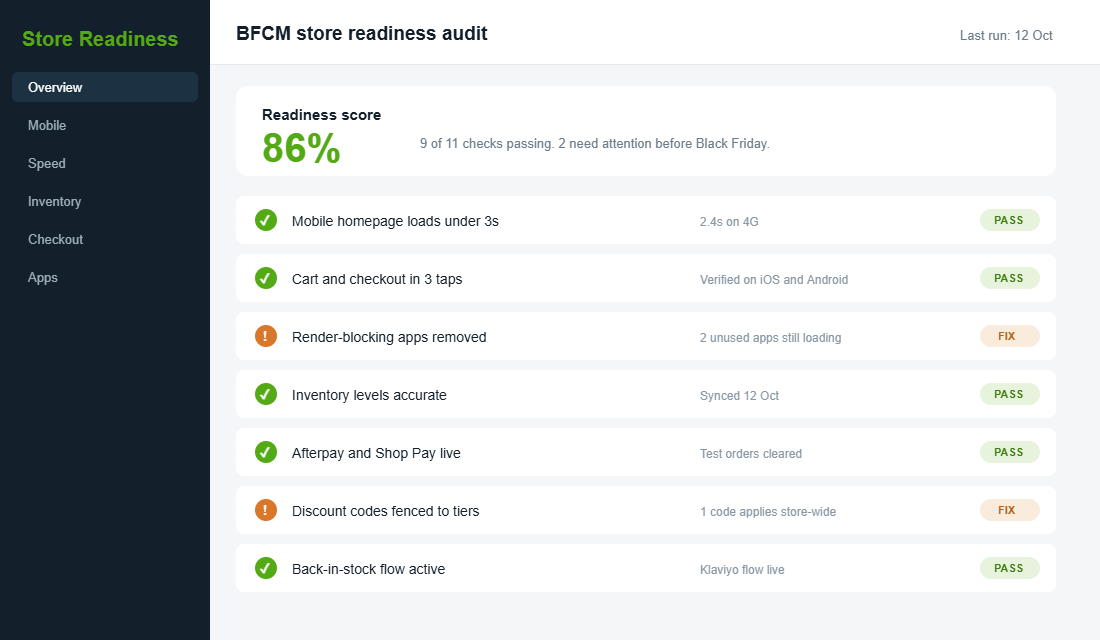
The fastest way to lose money on the biggest traffic day of the year is a store that buckles under it. Over 60% of BFCM 2024 transactions came from mobile, and conversion rates across the weekend climbed to around 11%. That traffic is fragile. Shopify clocked a peak of US$4.6 million in sales per minute in 2024, which means every second of friction on your store is real money walking out.
Run this stress test in October, not on the day:
- Mobile first. Buy something on your own phone. Time how long the homepage takes to load, check the offer is obvious above the fold, and make sure the cart and checkout work in three taps.
- Page speed. Audit and remove render-blocking apps. Every app you installed and forgot is loading scripts on every page for every visitor.
- Inventory truth. Confirm stock levels are accurate and decide what you will do when a hero product sells out mid-weekend. A back-in-stock flow beats a dead product page.
- Checkout and payments. Test every payment method, including Afterpay and Shop Pay, and confirm your discount codes and automatic discounts actually stack the way you intend.
- App stack sanity. Turn off anything you are not using. The pop-up, upsell, and review apps you trust should be the only ones loading.
If a single discount code applies incorrectly to your whole catalogue during peak traffic, you can give away thousands before you notice. Test the offers under real conditions before the weekend, including on a slow mobile connection.
Phase 6: Protect Margin and Keep the Buyers You Just Bought
Most founders count BFCM revenue on the Monday night and call it a win. The brands that actually grow count it again in February, after they see how many of those buyers came back. A discount-led weekend pulls in a flood of deal-seekers, and if none of them buy a second time, you have just bought a pile of one-time customers at your worst margin of the year.
The real win is order two. Plan the retention the same way you plan the sale:
- Post-purchase flow. A welcome and onboarding sequence for every new BFCM buyer that sells the brand, not just the next discount.
- Second-purchase nudge. A timed offer or replenishment reminder four to six weeks out, designed to convert the deal-seeker into a regular.
- Returns readiness. A clear, fast returns process so the spike in volume does not become a January of disputes and angry DMs.
This is where the profit actually lives. Make your money on order two and beyond, when there is no discount attached. Our repeat purchase playbook maps the exact flows that turn a BFCM rush into lifetime customers.
The Margin Maths on a Real Weekend: A Worked Example
Here is Phase 1 and Phase 2 run end to end on a brand you can picture. Say you run a Brisbane homewares store doing $1.2M a year with a 58% gross margin and a $96 AOV. Last year’s BFCM did $118K over the four days on a flat 30% off, and by the time you counted freight and fees you were not sure you had made anything.
Start with the floor. After a 30% discount your gross margin on a $96 order drops to $67.20 of revenue against $40.32 of COGS, which is 40% margin, before you add free shipping (an average of $11.40 across your Australian parcels), Shopify Payments at 1.75% plus 30 cents, and Afterpay on roughly a third of orders at around 4 to 6%. Net contribution lands near $12 an order, about 18% of the discounted revenue. That is your 2025 reality and it explains the thin bank balance.
Now rebuild it with architecture. Set a revenue target of $150K and a blended margin floor of 30% contribution after every cost. Then work back:
- Tier 1: spend $120, save 15%. The threshold is set 25% above last year’s AOV. Contribution per order lands around $35.
- Tier 2: spend $200, save 25%. Pulls the two-item basket. Contribution per order around $48, and freight cost per dollar of revenue almost halves.
- Gift with purchase over $250. A $9 landed accessory replaces a further discount and clears slow stock.
- One fenced doorbuster on your hero candle at 40% off, capped at 300 units, as the traffic magnet.
Model it in a spreadsheet with last year’s order distribution and the same $150K of revenue now produces roughly $46K of contribution instead of $22K. Same traffic, same product, double the money kept. That gap is the whole reason Phase 1 comes before the email copy. If you have not built the per-order profit model yet, the contribution margin playbook gives you the template.
The Paid Media Plan for Cyber Week: Where the Ad Money Goes and When
Phase 4 covers the owned channels. Paid needs its own plan, because Cyber Week is the most expensive auction of the year. Meta CPMs in Australia typically rise 30 to 50% across the fortnight, and cold prospecting that returned a 2.5 MER in October can fall under 1.5 by Black Friday.
The brands that hold profit shift the mix rather than the budget:
- October: front-load prospecting. Spend 60 to 70% of your Cyber Week budget on cold traffic in the four weeks before, while CPMs are normal, and push those visitors to the early-access list from Phase 3. You are buying the audience cheaply and selling to it later.
- Cyber Week: 70% warm, 30% cold. Retargeting site visitors, email openers, and engaged social audiences from the last 90 days. Warm audiences convert 3 to 5 times better than cold during the sale and cost far less per purchase.
- Set a daily MER floor, not a daily budget. Decide in advance that any ad set under a 2.0 MER on the trailing 48 hours gets paused, whatever the platform ROAS claims. Our MER playbook explains why that blended number is the only one to trust during a peak.
- Creative is written in October too. Three hooks for the hero offer, a tier explainer, and a last-chance version, all approved before November.
Then run the whole thing on a slow mobile connection the week before. Traffic, offers, codes, checkout, and the SMS send all tested together, which is the seven-part dry run in our peak season dress rehearsal. Fixing a broken discount code on 12 November costs you an hour. Fixing it at 9pm on Black Friday costs you the weekend.
How the Six Phases Compound
None of these phases is clever on its own. The power is in the order. The margin number you set in Phase 1 defines the offers you can afford in Phase 2. The list you grow in Phase 3 is the audience your calendar speaks to in Phase 4. The store you harden in Phase 5 protects every dollar the first four phases worked to create. And the retention you build in Phase 6 is what turns a single weekend into a customer base.
Skip the winter work and you are left doing what most stores do: picking a panic discount in November and hoping volume covers the margin you forgot to protect. Do the phases in sequence and the weekend itself becomes the easy part. The hard work was already done while your competitors were waiting for the calendar to tell them it was time.
Your BFCM Planning Timeline
Here is the whole system as a timeline you can put on the wall. Australian winter is your planning season, not your downtime.
- July to August (Phase 1 and 2). Lock your revenue target, margin floor, and discount ceilings. Design the offer architecture.
- September (Phase 3). Turn up list growth, fix the pop-up, start warming the sending domain, and open an early-access waitlist.
- October (Phase 4 and 5). Write and schedule the full campaign calendar. Run the store and stack stress test.
- Early November (final checks). Build segments, load every email and SMS, and test all discount codes under load.
- BFCM weekend (execute). Monitor, restock alerts, reply fast. No copywriting on the day.
- December to January (Phase 6). Run the post-purchase and second-purchase flows. Handle returns cleanly. Count the real win.
Inside eCommerce Circle, BFCM planning is one of the core pillars we work on with every member, because it touches margin, list, store, and retention all at once. If you want a second opinion on your plan before the winter window closes, let’s talk.