Most Aussie founders treat November as one event. They block out the last week of the month, build a Black Friday offer, order stock against it, and then act surprised when the first half of the month goes flat and their Meta costs double on the 27th alongside every other brand in the country.
What’s in This Article
November is not one peak. It is two. The first one opens on 12 November when Click Frenzy Main Event goes live, and it lands sixteen days before Black Friday with a fraction of the auction pressure.
The money is real. Australians spent a record 82.6 billion dollars online in 2025, up 14 percent year on year, and roughly 24 percent of all retail spend now happens online according to the Australia Post eCommerce Report 2026. The Australian Retailers Association and Roy Morgan put the Black Friday to Cyber Monday weekend on its own at 6.8 billion dollars, with about six million Australians taking part.
That is the number everyone chases. What most brands miss is the two week runway sitting in front of it, where a properly built offer buys customers cheaper, clears the stock you do not want to carry into December, and hands you a warm list to sell to again at the end of the month.
Click Frenzy is not a second discount. It is the first bite. Here is how we plan it with members running between 40k and 500k a month.
Why 12 November Matters More Than Most Aussie Founders Think
Click Frenzy Main Event runs 12 to 15 November 2026. It started in 2012 as Australia’s homegrown answer to Cyber Monday and is now owned by Gabby and Hezi Leibovich, the pair behind Catch.com.au, Scoopon and Menulog. The event aggregates deals from hundreds of retailers into one destination, then pushes shoppers out to individual stores to check out.
The line-up is broad. Recent events have included The Iconic, David Jones, Myer, Bing Lee, The Good Guys, Shaver Shop, Platypus, Emma Sleep and Aussie direct-to-consumer brands like Musclenation. That mix matters, because it tells you the audience is not only chasing 65 inch televisions. Fashion, beauty, supplements, homewares and sporting goods all convert.
Power Retail reported participating retailers averaging revenue uplifts of 177 percent and 169 percent across the first two days of a Click Frenzy Mayhem event. Treat those figures as a ceiling rather than a forecast, because they are self-reported by brands that showed up with a real offer. But the direction is not in dispute.
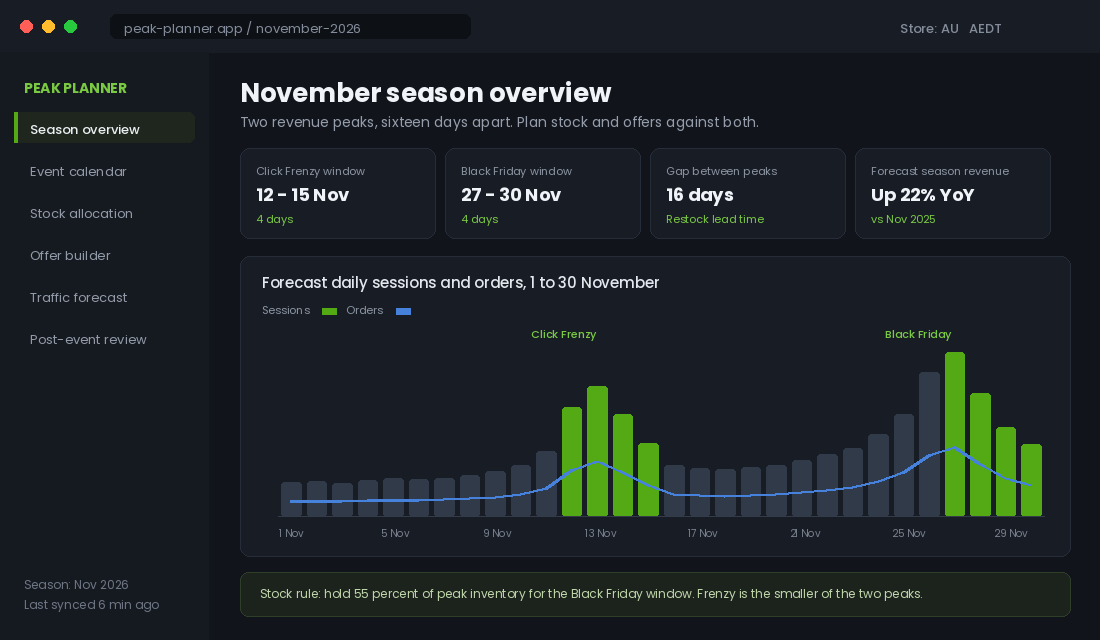
There are three structural reasons the date deserves a plan of its own, not a leftover offer.
- Auction pressure is lower. Meta and Google CPMs in Australia climb hard from about 20 November. In the second week of the month you are still buying attention at close to normal rates while intent is already lifting.
- Shoppers are in research mode. Deloitte expects Australians to spend 14 percent more across November and December than the year prior. A lot of that money gets shortlisted in mid November and spent later. Getting into the consideration set early is worth as much as the sale.
- Your discount does not need to be as deep. Big-box retailers commonly run 20 to 50 percent off in the Black Friday window. In the Frenzy window, a smart threshold or bundle offer holds its own against a sitewide percentage, because the comparison set is thinner.
The other quiet advantage is behavioural. Australian households now buy from an average of 16 different brands a year, and that number keeps climbing. Click Frenzy is one of the few moments where a shopper actively goes looking for brands they have never bought from. That is a discovery channel, not just a discount channel.
The Four Question Filter: Should You Be In It At All
Not every store should run Click Frenzy. Plenty of brands would make more money doing nothing on 12 November and putting the effort into Black Friday. Run these four questions honestly before you commit a dollar.
- Is your blended gross margin above 55 percent? Below that, a 30 percent offer plus freight plus acquisition cost leaves almost nothing. You either need a threshold offer instead of a discount, or you sit this one out.
- Can you hold stock back for Black Friday? If your best sellers will run out by 16 November, you have not created a peak. You have moved one forward and given up the higher-traffic window.
- Do you have at least a few thousand engaged email subscribers? Frenzy rewards brands that can drive their own traffic. If your list is small or cold, your only lever is paid, and paid alone rarely covers a discounted order.
- Will your store hold at four to six times normal traffic? A four day event compresses a month of sessions. If your mobile largest contentful paint is already over three seconds on a normal Tuesday, fix that before you invite a crowd.
Four yes answers means go. Three means go with a narrower offer on a subset of products. Two or fewer means skip it, put the hours into your peak season dress rehearsal instead, and come back next year with the margin to play.
One more consideration. Click Frenzy sells participation packages to retailers, and the listing fee is a real cost that needs to sit in your model alongside the discount. The organisers have run free entry promotions before, including free participation for the first 500 retailers at a recent end of financial year event, so it is worth asking about current terms rather than assuming a rate card. Whatever you pay, treat it as a media cost and hold it to the same return standard as a Meta campaign.
Build the Offer Backwards From Contribution, Not From the Discount
Here is where most brands lose the event. They decide on a headline number first, usually because a competitor ran it last year, then work out afterwards whether it made money. Do it the other way around.
Start with contribution per order. Take your average order value, subtract cost of goods, subtract pick, pack and freight, then subtract your blended acquisition cost. Whatever is left is the money the offer actually generates. Now model each candidate offer against that same line.
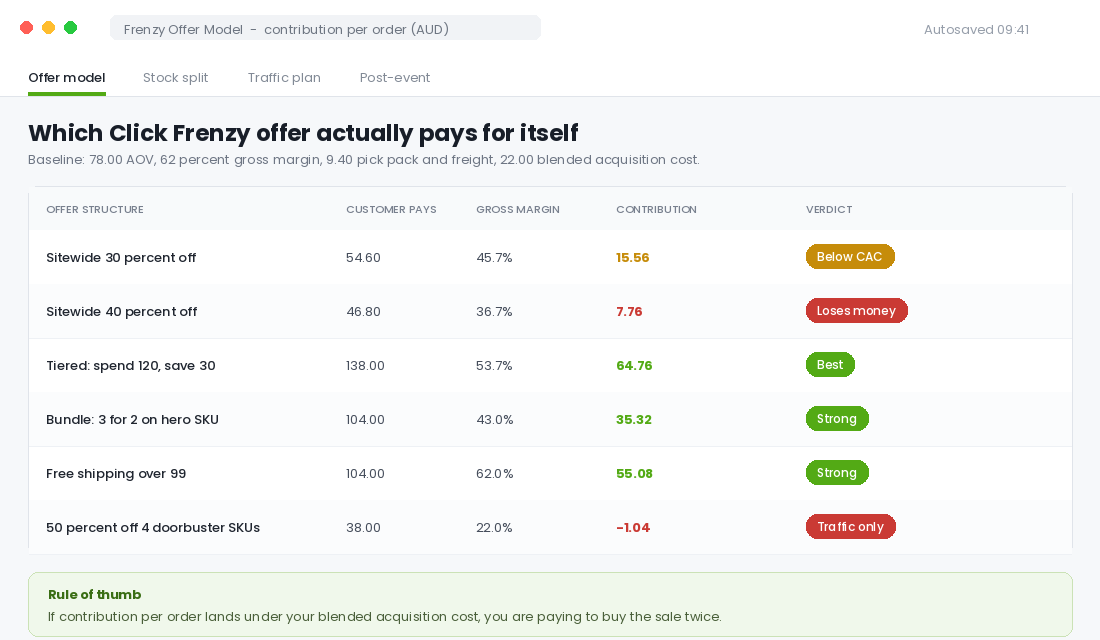
Run the numbers on a store with a 78 dollar average order value, 62 percent gross margin, 9.40 in pick, pack and freight, and a blended acquisition cost of 22 dollars. A sitewide 30 percent off drops contribution to 15.56 per order, which is below what it cost to acquire the customer. A sitewide 40 percent leaves 7.76 and quietly loses money once you add the event listing fee. A tiered offer of spend 120 and save 30 pulls the basket up and leaves 64.76.
Same brand, same four days, wildly different outcomes. Three offer shapes tend to hold up in the Frenzy window:
- Tiered spend thresholds. Spend 120 and save 30, spend 200 and save 60. The customer chooses to grow the basket, so you buy the discount with volume rather than giving it away on a single unit sale.
- Bundles built on your hero product. Three for two, or a curated set at a price that is impossible to reverse engineer. Bundles hide the unit price, protect your everyday pricing and shift more units per pick.
- A free shipping threshold set above your current average order value. The cheapest offer you own. Set the bar at 30 to 35 percent above your average order value and you lift the basket without touching gross margin at all.
The shape that consistently fails is the deep doorbuster on a handful of lines with nothing behind it. It brings traffic, sells at or below break even, and trains a cohort of shoppers to wait for the next markdown. If you use one, put it behind a threshold so the doorbuster is the reason they land and the threshold is the reason the order is profitable. We go deeper on this in the discount discipline framework.
Split Your Stock Before You Split Your Attention
This is the decision that separates a good November from a frustrating one. You have finite stock and two peaks sixteen days apart. Most Australian suppliers cannot restock a hero SKU inside that window, and anything coming by sea certainly cannot.
The default allocation we use is 55 percent of peak inventory held for the Black Friday window, 30 percent released to Click Frenzy and 15 percent kept in reserve for December gifting. Black Friday gets the larger share for one reason: businesses expect around 35 percent of their entire November and December sales to land in that four day window. That is where the volume is, so that is where the stock goes.
Then apply the allocation by SKU tier rather than across the board:
- Hero SKUs. Cap the units available to the Frenzy offer. Use Shopify’s inventory locations or a dedicated collection to enforce a hard limit rather than trusting yourself to watch the dashboard at 11pm.
- Ageing stock, more than 120 days on hand. Give it to Click Frenzy without hesitation. Cash back in the business before Christmas is worth more than the margin you are protecting on stock that is not moving.
- New season lines. Keep them out of both events if you can. Discounting a product in its first 60 days sets a reference price you will fight for a year.
- Bundle components. Check the component stock, not the bundle stock. A three for two on your hero SKU consumes inventory three times faster than the order count suggests.
The 16 day gap is also your only realistic restock window for anything held locally or by a domestic 3PL. Get purchase orders in now, with delivery dated to land no later than 24 November. That gives you three days of buffer before Black Friday and keeps a late shipment from becoming a cancelled campaign.
The Build: Setting Up a Four Day Event in Shopify
You do not need an app for this. Shopify Flow is free on every plan from Basic upward, and combined with scheduled automatic discounts it will start and stop a timed event without you being awake. Here is the exact build.
- Step 1. Create the event collection. Products, then Collections, then Create collection. Make it automated with the condition Product tag is equal to frenzy26. Now adding a product to the sale is a tag edit, not a manual collection reshuffle.
- Step 2. Tag your allocated SKUs. Use the bulk editor from the products list. Tag only the lines your stock split approved.
- Step 3. Build the automatic discount. Discounts, then Create discount, then Amount off order. Set the minimum purchase amount to your threshold, set the discount value, then set the active dates to start 12 November at 7pm AEDT and end 16 November at 11.59pm. Automatic discounts apply in the cart with no code, which removes the single biggest source of mobile checkout drop-off during a sale.
- Step 4. Add the second tier. Shopify will stack discount tiers if you create them as separate automatic order discounts with different minimum spends. Test both tiers in a draft order before you go live.
- Step 5. Build the Flow. In Shopify Flow, create a workflow with a Scheduled Time trigger. Add an action to add the tag frenzy-live to products in the collection at start, and a second scheduled workflow to remove it at the end. Your theme can then read that tag to show and hide the sale badge without you touching code mid event.
- Step 6. Add a low stock guard. A second Flow with the Inventory Quantity Changed trigger, a condition of inventory less than your Black Friday reserve, and an action that removes the frenzy26 tag. That is the automation that protects your Black Friday stock while you sleep.
- Step 7. Build the landing page. One URL, live and indexed by 5 November, with a countdown, the offer explained in a single sentence, and an email capture for early access. Click Frenzy traffic lands on whatever URL you submit, so make it a page you control, not your homepage.
- Step 8. Create the Klaviyo segment. Anyone who visits that landing page before 12 November goes into a segment called Frenzy Waitlist. That segment is your highest converting audience on day one and your best Black Friday retargeting pool two weeks later.
If you are on Shopify Plus, Launchpad does steps 3 through 6 in one interface and will also swap theme assets on a schedule. If you are not on Plus, the Flow build above gets you 90 percent of the way for nothing.
Your Email and SMS Sequence for a 96 Hour Window
Paid traffic will not carry a four day event on its own at a discounted average order value. Owned channels have to do the heavy lifting, and they need to run on a tighter schedule than you would use for a normal campaign.
Seven sends, mapped to the window:
- 5 November, email one. Early access invitation. No discount detail, just the date and the promise that subscribers go first. Drives sign-ups to the landing page and builds the Frenzy Waitlist segment.
- 10 November, email two. The offer reveal to your list only. Tell them exactly what the mechanic is. Ambiguity kills conversion during a sale window because shoppers will not spend 40 seconds working out whether your deal is good.
- 12 November 6pm, SMS one. Early access opens one hour before the public event. Short, one link, no emoji required. This single send often produces the highest revenue per recipient of the whole month.
- 12 November 8pm, email three. Doors open, sent to the full engaged 90 day segment.
- 13 November, email four. Category or bestseller focus. Not a resend of the same creative with a new subject line. Show different products.
- 15 November midday, email five. Last day, plus a genuine stock status. If a hero line has sold through, say so. Real scarcity outperforms invented scarcity and does not put you on the wrong side of Australian Consumer Law.
- 15 November 7pm, SMS two. Five hours left, to openers and clickers only. Do not blast your whole list twice by SMS in four days.
Suppress anyone who has already purchased in the event. Nothing burns goodwill faster than a customer who bought on Thursday getting a last chance message on Sunday. In Klaviyo that is an exclusion on the Placed Order metric within the last four days, and it takes 30 seconds to set up.
One more thing that matters in Australia specifically. Every commercial message needs a functional unsubscribe and accurate sender identification under the Spam Act, and consent needs to be real. A sale window is exactly when tired teams start importing lists they should not be mailing. Do not be that brand in November.
Make Sure the Site Survives the Spike
A four day event compresses a normal month of traffic. Shopify itself will hold up. Your theme, your apps and your third party scripts are the risk.
Work through this list by 5 November, then stop touching the site:
- Run a code freeze from 8 November. No theme edits, no new apps, no font swaps. Every serious outage we have seen in a peak window traces back to a change made inside the fortnight before it.
- Audit your app scripts. Open the theme’s rendered source and count third party tags. Most stores carry two or three from apps they uninstalled months ago. Removing those is usually worth several hundred milliseconds on mobile.
- Target a mobile largest contentful paint under 2.5 seconds. Test your landing page and your top three product pages on a throttled 4G connection, not on your office wi-fi.
- Compress the sale creative. Peak banners are the single most common cause of a slow landing page. Serve WebP, size it for mobile first, and never ship a 1.4MB hero image to a phone.
- Test the full checkout on a real device. Add to cart, apply the threshold, pay with Shop Pay, PayPal and a card. Then do it again as a returning customer with a saved address.
- Check your shipping cutoffs and rates. If your free shipping threshold changes for the event, confirm the shipping profile actually reflects it. A mismatch here costs you money on every single order.
Also brief whoever handles customer service. Four day events generate a spike in pre-purchase questions about delivery timing, and a two hour reply time in a sale window converts. A 24 hour reply time does not.
Measure Incrementality, Not Revenue
Every brand reports their event revenue. Very few work out how much of it they would have earned anyway. That gap is the difference between a strategy and a habit.
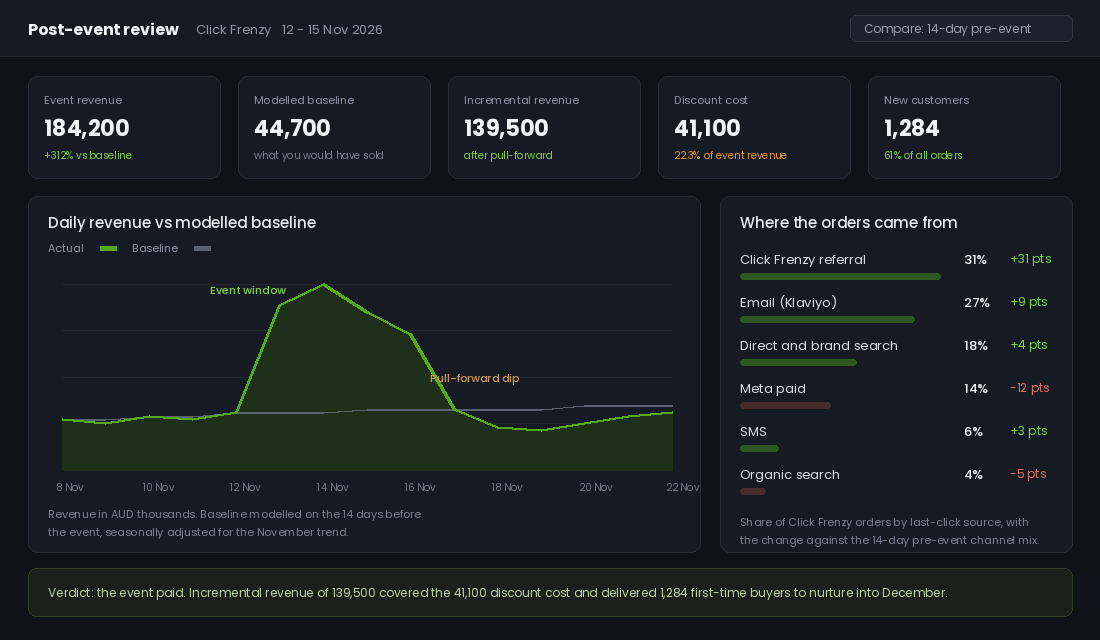
Build the review the week after, using five numbers:
- Modelled baseline. Average daily revenue for the 14 days before the event, adjusted upward for the normal November trend. Multiply by four. That is what you would have sold with no event at all.
- Pull-forward. Compare the seven days after the event against the same modelled baseline. If sales sit 25 percent below, subtract that shortfall from your event result. That revenue was borrowed, not created.
- Incremental revenue. Event revenue, minus baseline, minus pull-forward. This is the honest top line.
- Total discount and event cost. Discount value given, plus the Click Frenzy listing fee, plus incremental ad spend. Express it as a percentage of event revenue. Under 25 percent is healthy for a threshold-led offer.
- New customer count and their second order rate. Track the cohort separately for 90 days. A first-time buyer acquired in November who never returns is a very expensive way to hit a revenue number.
Also check your channel mix against the pre-event fortnight. If Click Frenzy referral traffic delivered 30 percent of orders while your Meta share dropped, that is not a problem, that is the event working. If referral traffic delivered 4 percent, your listing did not earn its fee and you renegotiate or skip it next year.
How the Two Peaks Compound
Here is where it all connects, and it is the part almost nobody plans for.
Click Frenzy on its own is a decent four day sale. Run in isolation, you take the revenue, absorb the pull-forward dip and start Black Friday from a standing position with slightly less stock. That is roughly break even as a strategy.
Run as the front half of a system, it changes shape entirely. The 1,200 first-time buyers you acquired on 13 November are a warm, high-intent audience on 27 November. They have your delivery experience, your packaging and your product in hand. Around three in four Australian shoppers say a good delivery experience makes them shop online more, so the unboxing that lands on 17 November is doing sales work for the second peak.
That gives you four assets going into Black Friday that your competitors do not have:
- A fresh buyer list to build lookalike and retargeting audiences from while CPMs are still climbing rather than peaked.
- Live creative data. You know which hooks, images and offers converted, tested with real money, two weeks before the expensive window.
- Proven site performance under four to six times normal load, so Black Friday is a known quantity instead of a hope.
- Cleaner stock. The ageing lines are gone, so your Black Friday merchandising leads with product you actually want to sell.
Then it keeps compounding into December. Your Frenzy cohort gets a post-purchase flow, a replenishment or cross-sell prompt, and a Christmas gifting campaign. Only 44 percent of Australian retailers participate in Black Friday at all, so the brands that treat the whole of November as one connected campaign are competing against a field that mostly turns up for four days and hopes. That is the same thinking behind the November double peak approach we run with members.
Your Click Frenzy Countdown Checklist
Copy this into your project tool and work backwards from 12 November.
- Ten weeks out. Run the four question filter. Decide in or out. Contact Click Frenzy about participation and current terms.
- Eight weeks out. Build the contribution model. Choose the offer shape. Lock the stock split across Frenzy, Black Friday and December.
- Six weeks out. Place restock purchase orders dated to land by 24 November. Confirm 3PL capacity and cutoffs for the peak.
- Four weeks out. Build the landing page and publish it. Set up the automatic discounts and both Shopify Flow workflows. Draft all seven sends.
- Two weeks out. Run the site audit. Compress creative. Test checkout end to end on a real phone. Brief customer service on the offer and delivery promises.
- One week out. Code freeze from 8 November. Send early access email one. Warm your sending domain with a normal campaign if you have been quiet.
- Event days. Watch stock hourly against the reserve, not revenue. Reply to service messages inside two hours. Change nothing on the theme.
- Seven days after. Build the incrementality review. Segment the new cohort. Load them into the Black Friday audience and the December gifting flow.
Click Frenzy will not make your year on its own. But treated as the opening move of a six week November and December campaign rather than a standalone discount, it is one of the cheapest customer acquisition windows on the Australian calendar. The brands that plan it in September are the ones still talking about it in January.
Inside eCommerce Circle, peak season planning is one of the core pillars we work on with every member, and the stock split is usually where the biggest money sits. If you want a second opinion on your November plan, let’s talk.