Your best seller sold out on your own site in the third week of November last year. Not because you underbought. Because four hundred units were sitting on a marketplace listing earning you eighteen dollars a unit while your own site was turning buyers away at fifty four.
What’s in This Article
That is not an inventory problem. That is an allocation problem, and almost no Aussie Shopify brand has a written rule for it. You add a wholesale account, an Amazon listing, a pop-up, and Shopify keeps showing you one number. Every channel drinks from the same pool, first come first served. That is not a strategy. That is a queue.
The cost is bigger than most founders think. IHL Group put the global bill for inventory distortion (stockouts plus overstocks) at roughly US 1.73 trillion in 2025, about 6.5 per cent of retail sales, and Asia Pacific carries US 642 billion of that, the largest share of any region. When you do run out, 43 per cent of shoppers simply buy from a competitor instead. They do not wait for your restock email.
This playbook is the six-step system for deciding, in advance, which channel gets which units. It takes about half a day to build and it is the single highest-leverage thing you can do between now and peak.
Why One Pool of Stock Breaks the Moment You Add a Second Channel
Single-channel brands do not need allocation rules. You have stock, people buy it, you reorder. The moment a second channel exists, every unit has an opportunity cost, and the channel that sells fastest is almost never the channel that pays best.
Marketplaces make this worse because they are structurally good at speed and structurally bad at margin. Amazon now has 8.8 million active shoppers in Australia and its shopper penetration has climbed from 52 per cent in 2023 to 60 per cent heading into 2026, while eBay has slid from 62 per cent to 51 per cent over the same window. A listing on a platform that big will clear stock quickly. It will also take a referral fee, a fulfilment fee, and often an ad spend before you see a cent.
Wholesale has the opposite shape. Half the gross margin, but no acquisition cost, no returns handling in most cases, and a buyer who reorders on a six to twelve week cadence. We covered the economics of that channel in the Shopify wholesale channel playbook. The point here is not which channel wins. It is that they are different businesses sharing one warehouse, and you need to decide the split on purpose.
Australian out-of-stock rates are already worse than the global average. Measured availability sits around 9 per cent out of stock globally and has been recorded as high as 15 per cent in Australian retail. Add three channels pulling from one pool during a peak week and that number climbs fast.
Step 1: Build the Channel Contribution Table
You cannot allocate what you have not costed. Before you split a single unit, build a table that shows what one unit of your hero SKU actually earns you in each channel after everything that channel takes.
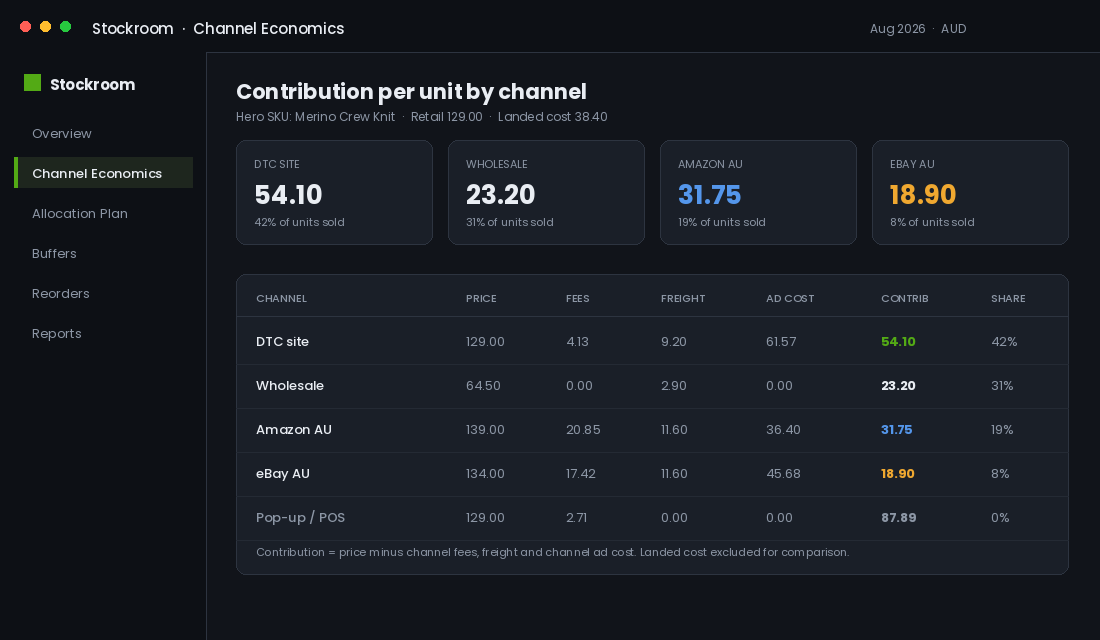
For each channel, subtract from the selling price: platform or referral fees, payment fees, pick and pack, freight to the customer or to the retailer, and the ad spend attributable to that channel. Leave landed cost out for now so you are comparing channels, not products.
- DTC site. Highest price, highest ad cost. Contribution is whatever survives your blended acquisition cost.
- Wholesale. Roughly half price, near zero acquisition cost, freight in bulk. Lower percentage, often solid dollars.
- Amazon AU. Referral fee plus fulfilment plus sponsored product spend. Model it at your real advertising cost of sale, not the one you wish you had.
- eBay AU or other marketplaces. Usually the thinnest line. Worth knowing before peak, not during it.
- POS, markets and pop-ups. Almost no fees and no freight. Frequently your best contribution per unit and the channel most founders forget to allocate to.
Do this for your top ten SKUs by units, not all of them. Those ten will cover the majority of your volume and every allocation fight you are going to have. If you have not built your buying plan yet, run this alongside the open to buy playbook so the two numbers agree.
The output you want is one sentence per SKU: for the Merino Crew Knit, a unit sold on the DTC site is worth about 2.9 times a unit sold on eBay. That ratio is your allocation logic for the rest of this process.
Step 2: Set the Allocation Ratio Before Peak, Not During It
Peak in Australia is no longer a single weekend. Black Friday and Cyber Monday 2025 were forecast by the Australian Retailers Association and Roy Morgan at 6.8 billion dollars, and the actual result came in near 9 billion, up 22 per cent year on year, with online making up about 33.7 per cent of transactions. Demand is compressing into a nine week window from late October, and inside that window you will not have time to think.
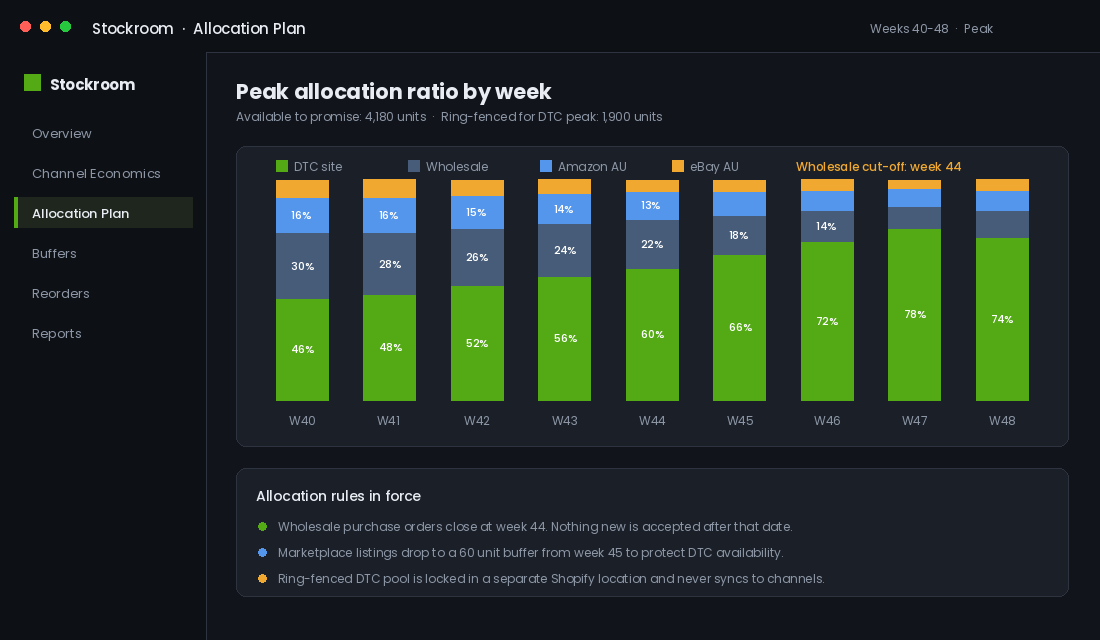
So write the ratio down now, week by week, and shift it deliberately toward your highest-contribution channel as the peak approaches. A simple version that works for most Aussie DTC brands:
- Weeks 40 to 43 (early October to late October). Wholesale gets its largest share. Retail buyers are placing Christmas orders now and they need lead time. This is also when marketplace volume is cheap to service.
- Week 44. Wholesale purchase orders close. Nothing new is accepted after this date. Tell every stockist in writing four weeks before the cut-off.
- Weeks 45 to 47. Marketplace listings drop to a small holding buffer. DTC share climbs above 70 per cent because that is where the contribution is and where your ad spend is pointed.
- Week 48 onward. Post-BFCM, marketplaces come back up to absorb residual demand and clear anything that did not move on site.
The exact percentages matter less than the fact that they exist and everyone knows them. The failure mode is not a wrong ratio. It is having no ratio, so whoever shouts loudest on the Tuesday of Black Friday week gets the stock.
Aussie brands that run this well tend to be the ones with real retail distribution. Koala, Who Gives A Crap and Modibodi all built DTC first then layered retail and wholesale on top, and none of them can afford to let a marketplace listing eat the stock a national retailer is expecting. Same discipline applies at 80k a month as at 80 million.
Step 3: Ring-Fence Stock With Buffers and Locations, Not Good Intentions
A ratio in a spreadsheet does nothing. The stock has to be physically or logically separated so a channel cannot take units it was not allocated.
Shopify gives you two mechanisms and you should use both.
- Locations. Create a location that only your online store publishes to. Wholesale and marketplace channels are not connected to it. The units sitting there are invisible to every other channel.
- Channel buffers. Hold back a fixed quantity per channel so a marketplace never sees your true available count. If you have 1,200 units and you allocate 200 to Amazon, Amazon is told you have 200.
How to set this up with Cin7 Core in about an hour
If you are running more than two channels, a spreadsheet will fail you inside a week. Cin7 Core is the tool most Australian brands in this bracket land on because it handles Shopify, Amazon, eBay and wholesale purchase orders in one place and supports buffers at both product and channel level.
- Install Cin7 Core from the Shopify App Store and connect it to your Shopify store as the source of truth for stock on hand.
- In Cin7 Core, go to Integrations, select your Shopify connection, and set the stock sync mode so Cin7 pushes availability to Shopify rather than the other way around.
- Under the Shopify integration settings, set a buffer inventory value. You can apply a buffer to an individual product or to every product on a sales channel.
- Repeat for each marketplace connection. Give each channel its own buffer that matches the allocation ratio you wrote in step two.
- Create a Shopify location named something obvious such as DTC Peak Reserve and do not connect it to any sales channel other than the online store.
- Set a reorder point and a safety stock level per SKU so the system flags a channel before it runs dry rather than after.
Whatever tool you use, the test is the same. Can a marketplace order physically take a unit you promised to your own site? If the answer is yes, you have not ring-fenced anything.
Step 4: Protect the Metrics That Can Close a Channel
There is an asymmetry most founders miss. Running out on your own site costs you a sale. Running out on a marketplace can cost you the channel.
Amazon requires seller-fulfilled accounts to keep the pre-fulfilment cancel rate under 2.5 per cent on a rolling seven day window. Breach it and Amazon can deactivate your seller-fulfilled offers. That is not a warning email, it is your listings going dark in the week that matters most. The same logic applies to fill rate with a wholesale account: miss a retailer twice and you are not on next season’s buy.
So the allocation rule is not simply give everything to the highest contribution channel. It is:
- Never oversell a marketplace. Better to show 40 units and sell 40 than show 400 and cancel 30.
- Never miss a confirmed wholesale purchase order. Those units are committed the day the order is accepted, so treat them as sold, not as available.
- Let your own site be the channel that absorbs the shortfall. You control the messaging, you can offer a pre-order or a back-in-stock capture, and no algorithm punishes you for it.
The other reason to keep marketplace exposure modest: channels disappear. Catch, a marketplace plenty of Australian brands relied on, ceased trading in January 2025. Any channel you cannot control is a rental, not an asset. Our Amazon Australia playbook goes deeper on treating it as a supplementary channel rather than a foundation.
Step 5: Run a Weekly Reallocation Review With Three Numbers
Allocation is not a one-off decision. Demand moves, and the plan you wrote in October will be wrong by the second week of November. The fix is a fifteen minute review every Monday with the same three numbers per SKU per channel.
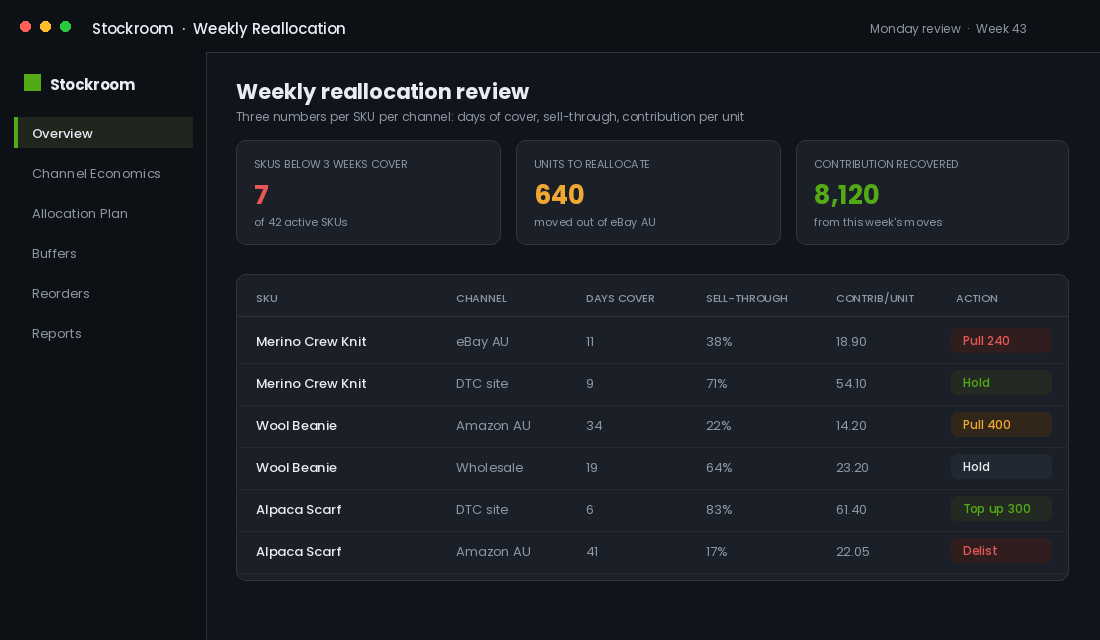
- Days of cover. Units on hand in that channel divided by the daily run rate. Under fourteen days going into peak means top up. Over thirty days means pull.
- Sell-through rate. Percentage of allocated units sold. A channel sitting under 25 per cent sell-through with three weeks to peak is holding stock hostage.
- Contribution per unit. Straight from your step one table. This breaks ties when two channels both look healthy.
Then one decision per row, and only four options: pull, hold, top up, delist. No discussion, no committee. The person who owns inventory makes the call and the team executes it that day.
Track one number at the top of the review: contribution recovered. Every time you move 240 units from an eighteen dollar channel to a fifty four dollar channel, that is 8,600 dollars of contribution you would otherwise have handed away. Showing that figure weekly is what makes the meeting survive past the second week.
Step 6: Write Your Sell-Out Sequence Before You Need It
Assume you will run out of your hero SKU. Most brands with real demand do. The question is which channel goes dark first and in what order, and that decision should be made in October when you are calm, not on the Saturday of Black Friday weekend when you are not.
A sensible default sequence, lowest contribution first:
- eBay and secondary marketplaces go to zero. Deactivate the listing rather than letting it sit at zero, so you are not damaging your search position with a dead offer.
- Amazon drops to a minimal buffer and stays there. Keep the listing live with a small quantity so you retain ranking and reviews, and lift the price if demand justifies it.
- Wholesale is capped at confirmed orders only. No new purchase orders accepted, and every stockist gets a dated email so they can plan.
- DTC site switches to pre-order with a firm dispatch date, or to a back-in-stock capture with a waitlist offer attached.
- Only then do you consider substituting the next best SKU into your paid campaigns and email flows.
Write this sequence into a one page document, put the actual dates and thresholds in it, and give it to whoever runs your warehouse and whoever runs your ads. The value is not the plan. It is that nobody has to make a judgement call at 9pm on a Friday.
The One Page Allocation Framework You Can Steal
Copy this into a doc today and fill it in for your top ten SKUs. It is the entire system on one page.
- Line 1. Contribution per unit by channel. DTC, wholesale, each marketplace, POS. One row per channel.
- Line 2. Allocation ratio by week. Nine rows, weeks 40 to 48, percentages that add to 100.
- Line 3. Hard cut-off dates. Wholesale purchase order close, marketplace buffer reduction, DTC reserve lock.
- Line 4. Buffer quantity per channel. The number each channel is allowed to see.
- Line 5. Weekly review triggers. Under 14 days cover means top up. Over 30 days cover means pull. Under 25 per cent sell-through means pull.
- Line 6. Sell-out sequence. The order channels go dark, with the person responsible named against each step.
- Line 7. Owner and review time. One name, one recurring fifteen minute slot, every Monday from week 40.
Seven lines. Half a day to build. If you already have a demand forecast, most of the inputs are sitting in it, and the BFCM inventory planning playbook covers the forecast side in detail.
Why This Compounds Well Beyond Peak
The obvious win is that you stop selling fifty four dollar units for eighteen. On a brand doing 4,000 units through peak with a third of them mis-allocated, that gap alone is worth tens of thousands of dollars of contribution.
The second win is quieter and larger. Once you know contribution per unit by channel, every other decision gets easier. Which channel deserves more ad budget. Which stockist is actually worth servicing. Whether that marketplace listing has earned its place in the business at all. Australians spent 82.6 billion dollars online in 2025, up 14 per cent, and online is now about 24 per cent of all retail spend. There is plenty of demand. The brands that win the next three years are the ones who choose which demand they serve, rather than serving whatever arrives first.
The third win is that peak stops being frightening. You are not making decisions under pressure with incomplete information, because you made them in October and wrote them down. That is the whole game.
Inside eCommerce Circle, stock allocation across channels is one of the calls we pressure-test with members every peak season. If you want a second opinion on yours before October, let us talk.