Open your product page on a phone and read it as if you have never used the product, never heard of the brand, and are buying it for your sister-in-law who mentioned it once in March.
What’s in This Article
Almost nothing on that page is written for you. The copy assumes you know what the product does. The reviews assume you care about performance. The size guide assumes you know the measurements. The delivery text says ships in 1 to 3 business days, which is useless when the only question that matters is whether it lands before the 24th.
That reader is your gift buyer, and in the Australian peak window they are a very large share of your traffic. The Australian Retailers Association and Roy Morgan put Christmas gift spending at around 12 billion dollars, with roughly 68% of Australian adults, about 15.9 million people, planning to buy gifts and spending an average of 757 dollars each. Most Shopify stores treat all of that demand as if it came from the person who will actually open the box. That is the mistake this playbook fixes.
Your Store Is Built for the User. In Peak, Half Your Traffic Is Not the User
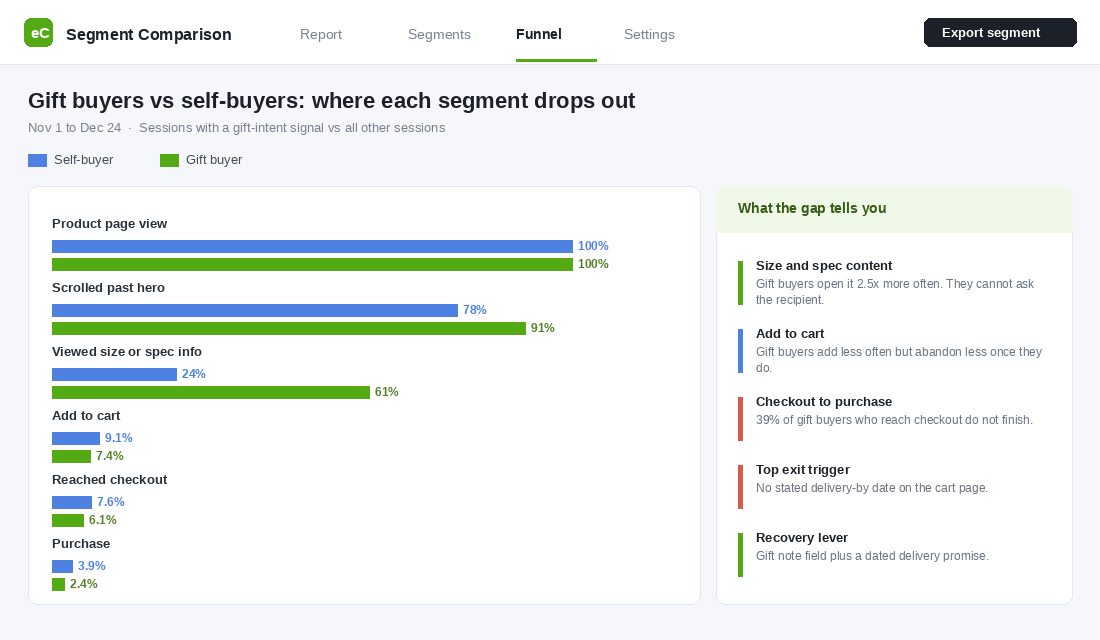
A gift buyer and a self-buyer look identical in Google Analytics. Same device, same source, same landing page. But they behave completely differently, and they fail for completely different reasons.
A self-buyer has already decided they want the thing. Their questions are about price, timing and trust. A gift buyer has decided they want to give something, and has not yet decided what. Their questions are about suitability, safety and delivery certainty. They are shopping a category, not a product.
That difference shows up in three specific ways on Shopify:
- They browse wider and buy shallower. Gift buyers touch two to three times as many collection pages before adding to cart, because they are comparing across categories rather than within one.
- They read the boring content. Size guides, ingredient lists, care instructions, warranty terms. The pages your self-buyers skip are the pages that decide the gift sale.
- They abandon on logistics, not price. A self-buyer who is not sure about delivery will risk it. A gift buyer will not, because a late gift is worse than no gift.
The other reason this matters is returns. The National Retail Federation’s 2025 returns research puts the average ecommerce return rate at 19.3%, and holiday-period returns run above the baseline at 17.9% versus 16.5%, driven largely by gifts that were the wrong size, colour or fit. Every gift order you win with a vague product page comes back to you in January as a refund and a support ticket.
Layer 1: Measure What Share of Your Revenue Is Already Gift-Driven
You cannot optimise for a segment you have never counted. Before you change a single line of copy, build a gift signal in Shopify. Four data sources give you a reliable picture, and none of them require an app to start.
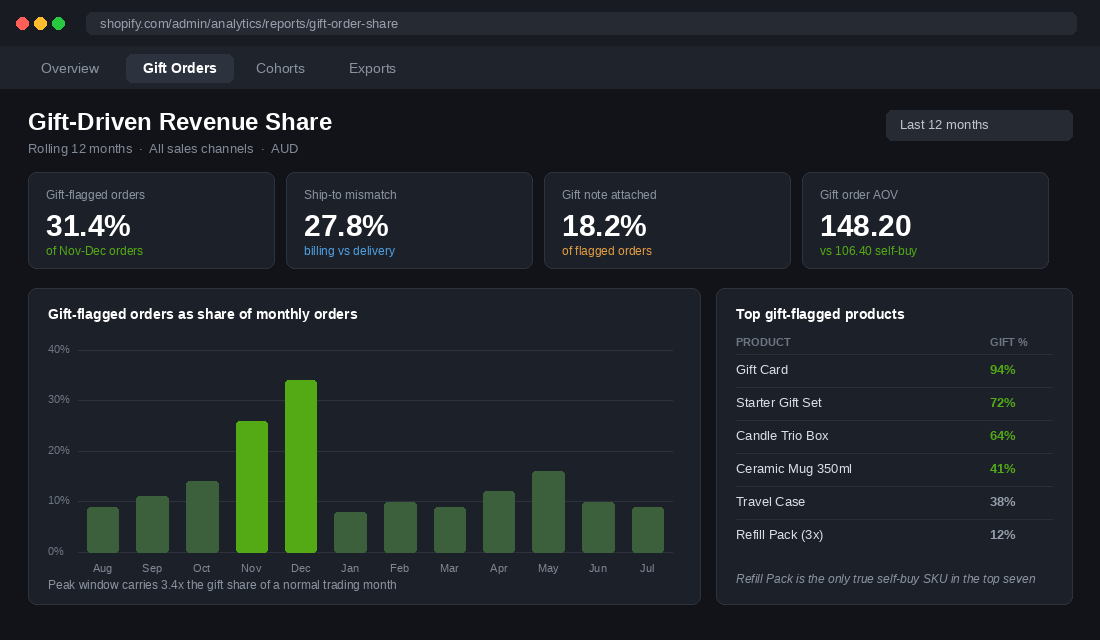
- Address mismatch. Export orders for last November and December and flag every order where the shipping name or shipping address differs from the billing name or address. This is your strongest single signal. In most consumer brands it lands somewhere between 15% and 30% of peak orders.
- Gift note or order note usage. If you already have a note field, count how often it contains a name, a message or the word gift. If you do not have one, that is a gap you will close in Layer 5.
- Single-unit, first-time orders in the peak window. A new customer buying one item at full price in late November behaves very differently from a returning customer restocking.
- Post-purchase survey. Add one question at the thank-you page: Is this a gift? with a yes or no. It takes ten seconds to answer and gives you a clean number you can trend year on year.
Then split the product catalogue. Run the same gift flag across SKUs and you will find that your revenue is not evenly gifted. Gift cards, sets and boxed items sit above 60%. Refills, consumables and multi-packs sit under 15%. That split tells you exactly which products deserve gift merchandising and which should be left alone for the people who already know your brand.
Write the number down. If gift-flagged orders are under 10% of peak revenue, this is a nice-to-have. If they are over 25%, this is the highest-impact work you can do between now and November, and it is worth more than another round of ad creative.
Layer 2: Build the Gift Buyer Avatar (It Is Not Your Customer Avatar)
Your customer avatar describes the person who uses the product. Your gift buyer avatar describes someone standing next to them, holding a wallet, with far less information and far more anxiety.
The gift buyer has four fears, and every one of them is addressable on a Shopify store:
- Fear of getting it wrong. Wrong size, wrong colour, wrong flavour, wrong allergy. This fear is why size and spec content converts gift traffic and bores everyone else.
- Fear of looking cheap. The gift buyer is buying a signal about the relationship, not a product. Presentation, packaging and perceived value carry more weight than unit economics.
- Fear of it not arriving. A product that arrives on 27 December has failed completely, even though it arrived.
- Fear of the awkward exchange. If the recipient needs to swap it, the buyer does not want to be involved and does not want the recipient to see the price.
Get this avatar out of your head and onto paper. The fastest way is to interview five people who bought from you as a gift last December. Ask what they nearly bought instead, what they checked before ordering, and what they were unsure about at checkout. If you have run structured research before, this is the same discipline applied to a segment you have probably never spoken to. Our corporate gifting playbook covers the business-to-business version of the same buyer, where the gap between buyer and recipient is even wider.
One useful reframe: the gift buyer is not a lower-quality customer. They spend more. In the ARA and Roy Morgan data, Australians aged 35 to 49 are the biggest gift spenders at around 853 dollars each. And they arrive with a deadline, which is the single best conversion accelerant there is, provided you give them a date they can trust.
Layer 3: Merchandise by Price Band, Recipient and Occasion
Your navigation is almost certainly organised by product type. Candles, diffusers, refills. That is a self-buyer taxonomy. It assumes the shopper knows what they want.
A gift buyer does not think in product types. They think in three axes: how much am I spending, who is it for, and what is the occasion. Build collections along those axes and you remove the hardest step of the gift journey, which is narrowing an entire catalogue down to a shortlist.
T2 Tea does this well on their Australian store. Their gift navigation splits into shop by price, gift ideas, gifts for her, and gift packs, with price bands like gifts under 35 dollars sitting as their own collection. A shopper who has decided to spend about 30 dollars on a colleague can land, filter and buy without ever reading a product description. Bed Threads runs the same principle through dedicated gift guide landing pages rather than relying on the standard collection structure.
Here is how to build it in Shopify without a developer:
- Create automated collections by price band. Use collection conditions on price, with bands that match your catalogue. Three to four bands is plenty. Under 50, 50 to 100, 100 to 200, over 200.
- Create manual collections by recipient. Gifts for him, gifts for her, gifts for kids, gifts for the person who has everything. Manual is correct here because the curation is the value.
- Tag every gift-suitable product. A single tag such as
giftlets you exclude refills and consumables from every gift collection with one condition. - Add a Gifts entry to the top-level menu. Not buried under Shop. Top level, from late October through to the delivery cut-off.
- Sort gift collections by best seller, not by newest. Social proof is the shortcut a gift buyer uses when they have no product knowledge.
Two rules that stop this going wrong. Do not create a gift collection with fewer than six products, because a thin collection reads as a dead brand. And do not let a gift collection show out-of-stock items, because for a gift buyer with a deadline, an out-of-stock hero product ends the session.
Layer 4: Rewrite the Product Page for Someone Who Has Never Held It
You do not need a second product page. You need four blocks added to the one you have, positioned so a gift buyer finds them without scrolling past the buy button.
The four blocks that decide the gift sale
- A one-line suitability statement. Directly under the title. Something like Suits anyone who drinks black tea. Caffeine free option available. This answers the buyer’s first question before they have to hunt for it.
- Sizing or spec confidence. If the product has a size, the guide must be inline, not behind a modal that opens a PDF. Add a plain-English fallback such as Not sure on size? Every order includes a free exchange. Our size guide playbook covers how to build this properly.
- What it looks like when it arrives. One photo of the product in its packaging as the recipient will see it. This is the single most under-used image slot in Australian ecommerce. The gift buyer is buying the unboxing moment, and you are showing them a white-background product shot.
- A dated delivery promise. Not ships in 1 to 3 days. A date. Order by 3pm today for delivery by Friday 19 December.
On reviews, add a filter or a pinned selection for reviews that mention gifting. A review that says bought this for my mum and she loved it does more work on a gift buyer than five reviews about product performance. If your review app supports keyword filtering, pin the gift reviews to the top from November onwards.
And handle the price question. Gift buyers frequently want the recipient not to see what was paid. State clearly on the product page that no invoice or pricing is included in the parcel. That one sentence removes a real objection that almost nobody addresses.
Layer 5: Make the Cart Carry the Delivery Promise
This is where most Australian stores lose the gift order, and it is almost always a logistics communication failure rather than a price problem.
Australia Post delivered close to 103 million parcels across November and December, and their published cut-offs are recommendations, not guarantees. Domestic Parcel Post cut-offs typically land around 19 to 22 December depending on whether the parcel is intrastate or interstate, Express runs to about 23 December, and Western Australia and the Northern Territory cut off much earlier, around 13 to 16 December. If your store shows the same generic shipping message to a shopper in Perth on 17 December as it does to a shopper in Melbourne, you are setting up a failure.
Four changes, in order of impact:
- Put a live delivery-by date in the cart drawer. Calculated from postcode where possible, from a conservative national estimate where not. A date beats a range every time.
- Add a gift note field before checkout, not inside it. Checkout extensibility limits what you can add at the checkout step. A note field in the cart drawer is easier to build and easier to find.
- Offer a gift receipt toggle. One checkbox. It signals that you understand what is being bought and it removes the price-visibility objection.
- Show the cut-off countdown from mid-November. A simple banner with the last order date for standard and express, updated by state. Real urgency, not invented urgency.
The tool: Giftship, and how to set it up
If you want gift options without custom theme work, Giftship is the most complete option on the Shopify App Store for Australian stores. It handles gift notes, gift wrapping, delivery date pickers, multi-address shipping and product-level gift options in one app. Setup takes about an hour:
- Install Giftship and connect it to your live theme, not a duplicate. Most of its blocks install as theme app extensions, so they will not break on a theme update.
- Create your first block set: a gift note text field plus a gift wrap product, and scope it to the cart drawer rather than the product page so it appears once rather than per item.
- Set a character limit on the gift note, around 200 characters, and add helper text telling the buyer the note is printed on a card and no invoice is included.
- Turn on the delivery date picker and configure blackout dates for public holidays and your own warehouse closure days. Set the last selectable date to your Express cut-off, not your Parcel Post cut-off.
- Create a gift wrap product priced at cost plus a small margin, mark it as not requiring shipping, and exclude it from all discount codes so it does not get given away in a peak promotion.
- Test one full order end to end, including the packing slip, and confirm the gift note prints and the price does not.
If you would rather stay native, the minimum viable version is a line-item property on the cart form for the gift note, a Shopify Flow rule that tags any order containing that property as gift, and a manual delivery-date banner. It is less elegant but it costs nothing and it gets you the data from Layer 1.
Do not forget gift cards in this layer. They are the highest gift-intent product you sell, they carry no shipping risk, and they are the correct answer for the buyer who lands on your store on 22 December. Our gift card playbook covers how to merchandise them properly rather than hiding them in the footer.
Layer 6: Capture the Recipient, Not Just the Buyer
This is the layer almost nobody builds, and it is where the compounding happens.
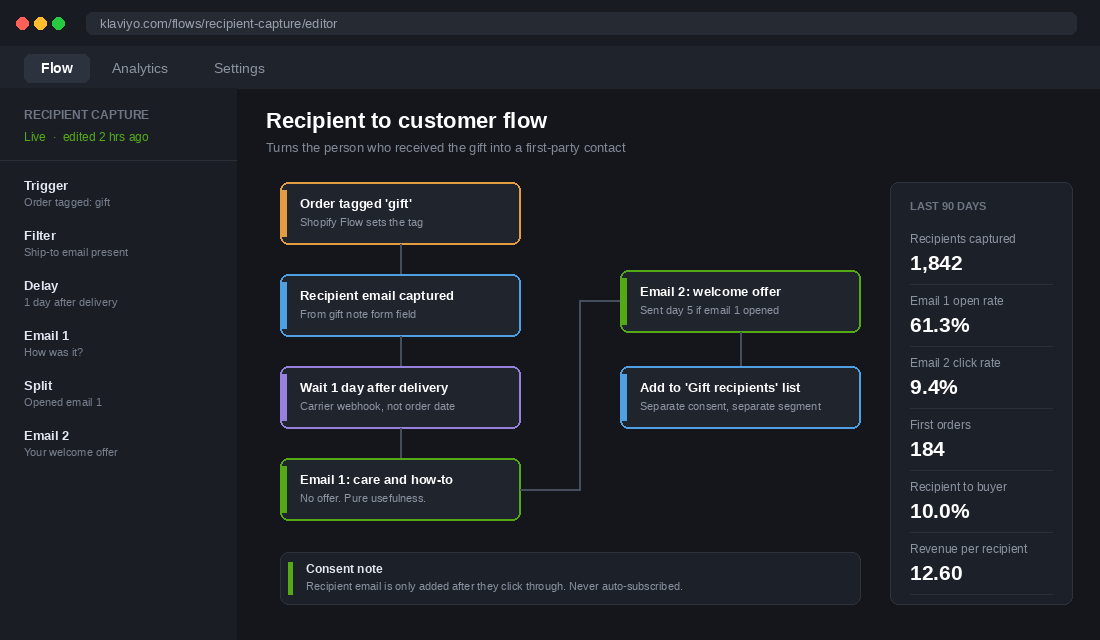
Every gift order creates two people: a buyer you now have on your list, and a recipient you know nothing about. That recipient has your product in their hands, has formed an opinion about your brand, and has never been contacted by you. Bain and Company’s work, widely cited through Harvard Business Review, puts the cost of acquiring a new customer at five to twenty five times the cost of retaining one. The gift recipient is the cheapest new customer available to you, and they are sitting in your order data doing nothing.
Build the capture properly and ethically:
- Ask for the recipient’s email in the gift note flow, framed as a service. Want us to email them care instructions when it arrives? Optional. Roughly one in four buyers will provide it when it is framed as helpful rather than promotional.
- Trigger from delivery, not from order. Use the carrier webhook or your tracking app to fire the flow one day after delivery confirmation. Emailing a recipient before the gift is opened ruins the surprise and burns the relationship.
- Send a useful first email with no offer. Care instructions, how to use it, what pairs with it. This is the email that earns the right to send a second.
- Send the welcome offer on day five, only to openers. A modest first-order incentive. Treat this as a separate list with separate consent, not as an addition to your main marketing list.
- Never auto-subscribe. Under Australian spam rules and basic decency, the recipient did not opt in. Add them to your marketing list only after they click through and subscribe themselves.
A well-built recipient flow converts somewhere around 8% to 12% of captured recipients into first-time buyers within ninety days. On a store doing 2,000 gift orders in peak with a 25% email capture rate, that is roughly 500 recipients and 40 to 60 new customers you would otherwise never have met, at zero media cost.
The Gift Buyer Audit: Run This Before November
Print this. Work through it once in September and once again in the first week of November.
- Measurement. You know what percentage of last peak’s orders had a shipping and billing mismatch, and which five SKUs carry the highest gift share.
- Avatar. You have spoken to at least five gift buyers from last year and written down what they nearly bought instead.
- Navigation. Gifts sits at the top level of your menu, with at least one price-band collection and one recipient collection, each holding six or more in-stock products.
- Product page. Every gift-tagged product has a suitability line, inline sizing or spec detail, a packaging photo, and a stated exchange policy.
- Price discretion. The product page states in plain words that no invoice or pricing is included in the parcel.
- Cart. A delivery-by date appears in the cart drawer, and a gift note field with a character limit appears before checkout.
- Cut-offs. State-specific cut-off dates are published on the site by mid-November, with earlier dates flagged for Western Australia and the Northern Territory.
- Gift cards. Merchandised in the Gifts collection and in the main menu, not only in the footer.
- Recipient capture. An optional recipient email field exists, the flow triggers on delivery confirmation, and the first email carries no offer.
- Returns. Your exchange window extends past mid-January so a gift bought in November is still exchangeable when it is opened.
That last point catches more Australian brands than any other. A thirty-day return window on a gift bought on 20 November expires on 20 December, four days before the recipient opens it. Extend the window for orders placed between 1 November and 24 December and say so on the product page. It costs you almost nothing and it removes a genuine reason not to buy.
Why the Six Layers Compound
Run any one of these layers alone and you will get a small lift. Run them together and they multiply, because each one removes a different failure point in the same journey.
The gift navigation gets a buyer to a shortlist who would otherwise have bounced from your homepage. The suitability line and the packaging photo convert that shortlist into an add to cart. The delivery-by date and the gift note convert the cart into an order. The gift receipt and the extended exchange window stop that order coming back in January as a refund. And the recipient flow turns the whole thing into an acquisition channel that costs you nothing per new customer.
Put numbers on it for your own store. If gift-flagged orders are 25% of peak revenue and you lift gift conversion by 20% while cutting gift returns by a third, you have added roughly 5% to peak revenue and protected another two to three points of margin that would have leaked out in January. That is a better return than most founders get from another 20% on their Meta budget, and unlike ad spend, it stays built. The same gift architecture works for Mother’s Day, Father’s Day and every birthday in between. Peak season is simply when the volume makes it obvious. Our peak offer architecture playbook covers how to layer promotions on top of it without wrecking your margin.
The mindset shift is small but total. Stop assuming the person reading your product page will ever use the product. Start writing for the person who has to decide, with incomplete information and a hard deadline, whether this is the right thing to hand to someone they care about.
Inside eCommerce Circle, understanding who is actually buying is one of the core pillars we work on with every member. If you want a second opinion on how much of your revenue is gift-driven and what it would take to serve that buyer properly, let’s talk.