Your product is good. Your ads work when they run. Your email list is warm. And yet the moment you turn the spend off, sales fall off a cliff and you are back to buying every order twice.
What’s in This Article
Most Aussie founders respond to that by tightening the funnel. Better creative, tighter targeting, a new landing page. Useful work, but it treats the problem as a conversion problem when it is usually a memory problem. Your brand is not losing the sale at checkout. It is losing it three days earlier, in the two seconds where a buyer thinks about the category and your name does not turn up.
The Australia Post eCommerce Report 2026 puts a number on how crowded that moment has become. Aussie households now buy from an average of 16 different brands a year, and that figure has been climbing for a decade. Meanwhile the average online basket has shrunk to 96 dollars while total online spend hit 82.6 billion dollars, up 14 percent. More brands, smaller baskets, same buyer. Being remembered in more buying situations is now the growth lever, and category entry points are how you engineer it.
What a Category Entry Point Actually Is
A category entry point, or CEP, is the situation that sends someone into your category in the first place. Not a demographic. Not a persona. A moment with a trigger attached.
“Women 25 to 44 who care about clean beauty” is a persona. “My skin feels tight after a long shift and I want something before bed” is a category entry point. One tells you who to target on Meta. The other tells you what to say, what to photograph, what collection to build, and which email to send in week three.
The concept comes out of the Ehrenberg-Bass Institute in Adelaide, where Byron Sharp and Jenni Romaniuk have spent years measuring how buyers actually retrieve brands from memory. Their term for the outcome is mental availability: how likely your brand is to come to mind in a buying situation. A meta-analysis across more than 100 tracked brands found a correlation of 0.83 between mental market share and actual sales. That is about as strong as marketing research gets.
The strategic point is not to own one situation deeply. It is to be linked to as many relevant situations as possible. A brand attached to one occasion has one door. A brand attached to twelve has twelve.
Step 1: Harvest Situations From Buyers, Not From a Whiteboard
The mistake here is predictable. Founders sit down with the team, brainstorm twenty occasions, and end up with a list that describes their own habits rather than the market’s. You cannot invent CEPs. You collect them.
Four sources, all of which you already have access to this week:
- Customer interviews. Fifteen to twenty five conversations, twenty minutes each. One question does most of the work: “Take me back to the moment you decided you needed this. Where were you and what had just happened?” Shut up and let them talk. This is the same discipline behind jobs to be done research, pointed at retrieval rather than product design.
- Post-purchase survey free text. Add one open field: “What was happening that made you go looking?” Even a five percent response rate on 800 orders a month gives you 40 situations, in the buyer’s own words, every month.
- Your own site search log. Shopify records every internal query. Occasion language shows up here raw and unfiltered: “gift for mum”, “travel size”, “for camping”, “something for a teenager”.
- Google Search Console. Filter queries by “for”, “when”, “before”, “after” and “best … for”. Those five filters surface hundreds of situation-shaped queries you are already getting impressions for and almost certainly not answering.
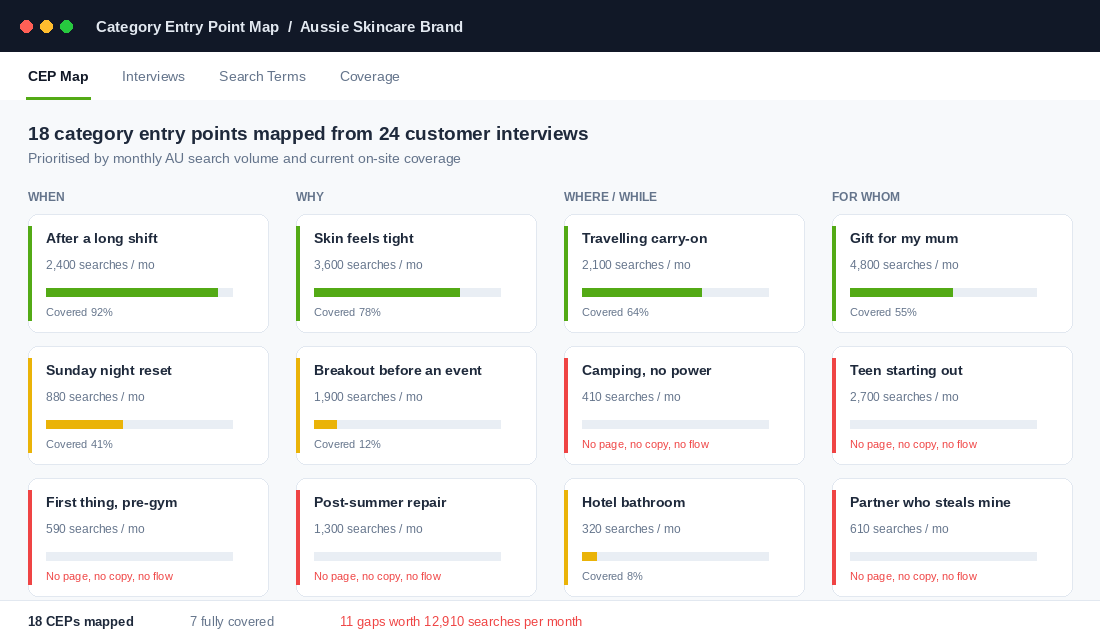
Capture every situation verbatim in a spreadsheet. Do not tidy the language yet. “Skin feels tight” is worth more than “hydration need” because it is what buyers type and what they think.
Step 2: Sort Everything Through the Seven Ws
Raw interview notes are messy. Romaniuk’s framework gives you a sorting grid that stops you from collecting forty versions of the same occasion while missing three whole categories.
- Why. The motive. Skin feels tight. Ran out. Want to look sharp at a wedding.
- When. Time of day, day of week, season. Sunday night reset. First thing before the gym. Start of summer.
- Where. Physical context. In the car. At the beach. Hotel bathroom. Hot desk at the office.
- While. The concurrent activity. While travelling. While camping. While studying for exams.
- With or for whom. Social context. Gift for my mum. Shared with a partner. Something for a teenager starting out.
- With what. The complementary product or ritual. With my coffee. Under makeup. Over a base layer.
- How feeling. The emotional state. Feeling flat. Feeling organised. Feeling like treating myself after a hard week.
Sort every verbatim into one of the seven. Merge duplicates. Ehrenberg-Bass research suggests that roughly 20 CEPs tend to matter most in a given category, so if you land somewhere between 15 and 25 after merging, you are in the right territory. If one W column is empty, that is not a sign the column does not apply. It is a sign your research skipped it.
Bellroy, the Aussie carry brand out of Bells Beach and Fitzroy, is a clean example of the sorted version showing up in the storefront. Their navigation is not organised by material or by product type alone. It is organised by situation: travel, everyday carry, tech, work. A buyer who is packing for a trip and a buyer who is sorting out their daily pockets land in different places, both of which speak their language.
Step 3: Score Each Occasion Before You Build Anything
Twenty CEPs is a two year roadmap if you treat them all equally. You will not. Score each one out of five on three axes and rank by the total.
- Size. How many buyers hit this situation, and how often? Use monthly AU search volume as your proxy, plus how many times it came up in interviews. A CEP mentioned by 11 of 24 interviewees is a big one regardless of what a keyword tool says.
- Fit. Can your product genuinely serve this occasion better than the obvious alternative? Attaching yourself to a situation you serve poorly generates trial and then returns.
- Contest. How strongly is a competitor already linked to it? A crowded CEP is expensive. An unclaimed one with real volume is where the compounding lives.
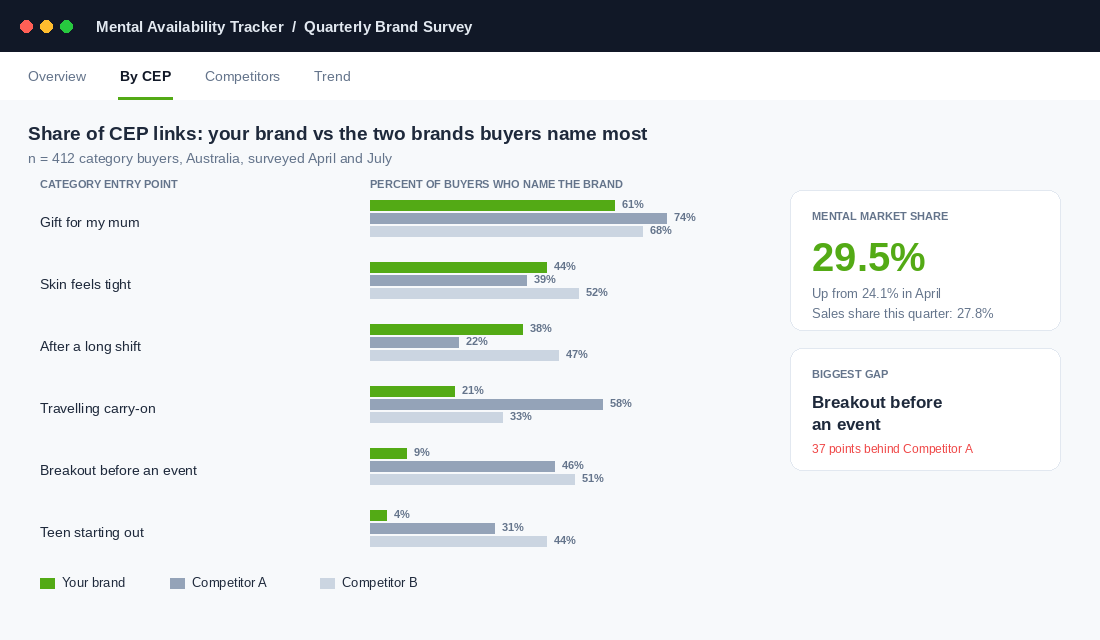
Then apply one filter that matters more than the scores. Ask which occasions are currently served by a competitor rather than by nobody. Ehrenberg-Bass research on buyer behaviour, sometimes described as the 60/20 law, found that the top 20 percent of a brand’s buyers account for around half of purchases while the lightest half of buyers contribute roughly 20 percent. Growth comes disproportionately from light and non-buyers, and light buyers are exactly the people who only think of you in one or two situations. Every CEP you add is a new entry ramp for someone who does not currently think of you at all.
Pick your top five. Ignore the rest until those five are properly built.
Step 4: Give Every Priority CEP a Home on the Site
This is where most CEP work dies. The founder finishes the research, feels smarter, and changes nothing on the storefront. A CEP only earns its keep when a buyer arriving in that situation lands somewhere that reflects it back to them.
Each of your top five needs four assets:
- A landing surface. Usually a Shopify collection with a proper handle and an intro paragraph written in occasion language. “Travel and carry-on” beats “50ml range”. Build these the same way you would any other ranking page, using the structure in the collection page SEO playbook. These pages compound in organic search precisely because they match how people phrase the situation.
- A photograph of the situation. Not a product on white. The product in the moment: on a hotel bathroom bench, in a carry-on, in a gift box on a kitchen table. Buyers recognise the situation before they read a word.
- A proof block. Two or three reviews filtered to that occasion. Most review apps let you tag or filter by keyword. A review that says “took it to Bali and it survived the flight” does more for the travel CEP than fifty generic five star ratings.
- An entry offer that suits the moment. Gift CEPs want gift wrapping and a gift note field. Travel CEPs want a bundled minis kit. Replenishment CEPs want a subscription or a reminder flow.
Who Gives A Crap, the Melbourne toilet paper brand, is the cleanest local example of an occasion built into product architecture. “I am about to run out” is a CEP, and their entire subscription and bulk box structure exists to occupy it. Separately, they merchandise gift boxes hard through November and December, occupying a second, completely different situation with the same product.
Step 5: Make Your Store Speak the Occasion Back
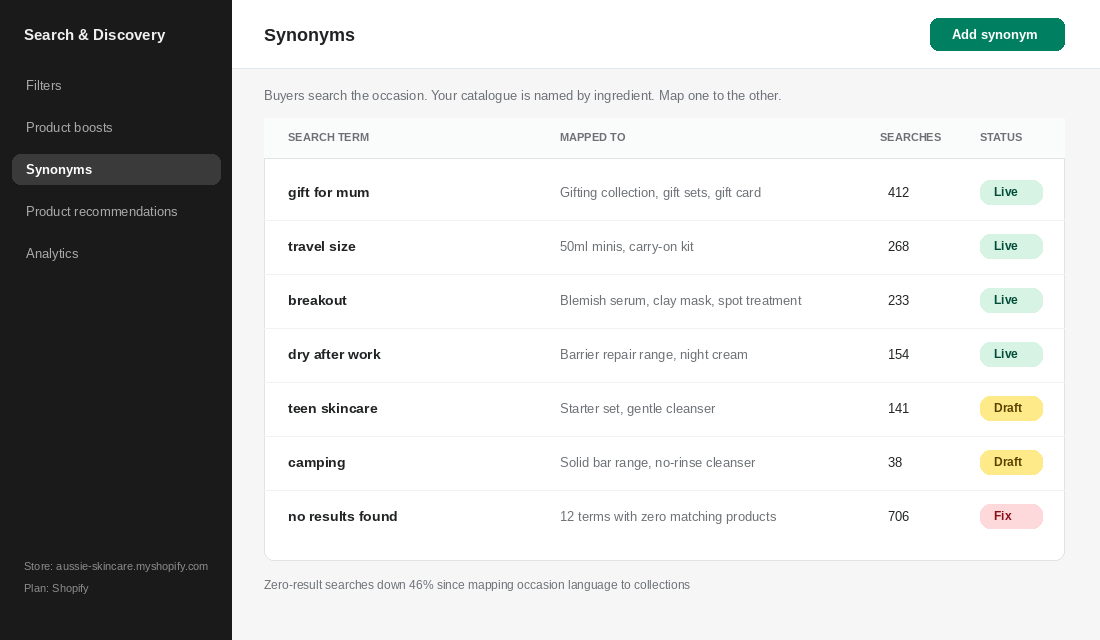
Your catalogue is almost certainly named the way you think about your products: by ingredient, by material, by SKU family. Buyers arrive naming the situation. That mismatch shows up as zero-result searches, which are among the highest intent and highest bounce moments on your entire site.
The fix is free and sits inside Shopify. Search & Discovery is a first-party Shopify app, no monthly cost, and it takes about 45 minutes to set up properly.
- Install it. Shopify App Store, search “Search & Discovery”, install to your store. It adds a Search & Discovery item under Apps in admin.
- Pull your zero-result queries first. In Shopify admin go to Analytics, then Reports, then “Top online store searches with no results”. Export the last 90 days. This is your gap list.
- Add synonyms. In the app, open Synonyms, then Add synonym. Map each occasion phrase to the product words in your catalogue. “Gift for mum” maps to your gifting collection, gift sets and gift card. “Travel size” maps to 50ml, minis and carry-on. One synonym group per CEP phrase, plus the obvious misspellings.
- Set product boosts. Open Product boosts and pin the two or three products that best serve each priority occasion to the top of results for that term.
- Add occasion filters. Under Filters, create a filter from a product metafield such as “best for” with values like travel, gifting, sensitive, teen. Now the situation is browsable, not just searchable.
Do this properly and internal search stops being a dead end. Search users convert at multiples of browse-only visitors on most stores, which is why the full mechanics are worth reading in the Shopify site search playbook. Occasion synonyms are the single biggest win inside it.
Step 6: Rotate CEPs Through Your Creative and Flows
Owning a CEP on-site is half the job. The other half is planting the link before the buyer needs it, which means your ads, your emails and your organic content all need to rotate through occasions rather than repeating one message.
Practically, this changes three things:
- Creative briefs get written by occasion, not by product. Instead of “three new hero product ads”, brief “one ad per CEP for the top five”, each opening on the situation in the first two seconds. This also solves creative fatigue, because five genuinely different situations produce five genuinely different hooks rather than five colour variations.
- Your welcome and post-purchase flows introduce occasions in sequence. Email two is the primary use case. Email four is the gifting occasion. Email six is the travel occasion. You are not selling harder, you are widening the number of doors that lead back to you.
- Your content calendar maps one to one against the CEP list. Every priority occasion gets an article, a set of organic social posts and a section on the relevant collection page. This matters more now that six in ten Australians use AI in some form, because assistants answer situation-shaped questions by reading situation-shaped pages.
One discipline holds all of it together. Whatever assets you rotate, keep your distinctive brand elements identical across every occasion. Same colour, same logo lockup, same voice, same product hero treatment. The situation changes. The brand cues never do. Without that consistency you build memory for the occasion and hand the sale to whoever the buyer does remember.
How to Tell If It Is Working
CEP work is a twelve month play measured in quarters, so you need a measure that moves before revenue does.
Run a short survey to 300 to 400 category buyers each quarter. For each of your priority CEPs, ask which brands come to mind for that situation, unprompted. Count the percentage naming you. That number, averaged across your CEP list, is your mental market share, and it should climb before your sales share does.
Three supporting metrics you already have:
- Zero-result search rate. Should fall sharply within a month of the synonym work. Anything above two percent of total searches is leaking revenue.
- Non-brand organic entries by occasion page. Track sessions and conversions for each CEP collection separately in GA4. These are the pages that keep working when the ad account is off.
- Purchase reason spread. From your post-purchase survey. If 70 percent of orders trace back to one occasion, you are a one-door brand and you have found your ceiling.
Why This Compounds When Everything Else Plateaus
Here is the part worth sitting with. Paid acquisition resets every month. You buy attention, you convert some of it, and next month you start at zero and pay again. CEP work does the opposite. Every occasion you attach yourself to stays attached, and it keeps producing demand you did not pay for that month.
Look at what the six steps produce together. Research gives you the real language buyers use. The sorting grid stops you clustering around one situation. Scoring puts your build effort where volume and winnability overlap. Collections, photography and proof turn each occasion into a page that ranks and converts. Synonyms and filters make sure buyers who arrive with occasion language find the right shelf. Creative rotation plants the link before the need appears.
Now run the arithmetic on a store doing 100 orders a week from three effective occasions. Add two more properly built occasions with comparable volume and you are not chasing a two percent conversion lift. You are adding entry ramps, each of which brings its own organic traffic, its own email segment, its own review corpus and its own repeat cycle. That is why brands that look boringly consistent from the outside keep growing while sharper looking competitors stall.
The Tool Stack That Makes CEP Work Repeatable
You do not need new software to map category entry points. You need to point the tools you already pay for at the right question.
Harvesting occasions. A post-purchase survey is the cheapest CEP research you will ever run. One question on the Shopify thank-you page — “What was happening in your life that made you look for this?” — collected across 100 orders will give you more usable occasions than a month of keyword tools. Fairing and Enquire both plug straight into Shopify checkout. Expect a 15 to 30 per cent response rate on a single-question survey, so 400 orders gets you comfortably past the 60 to 100 responses you need before patterns are trustworthy.
Sizing them. Google Search Console is your free demand meter. Filter queries by the occasion language your customers actually used, not the category nouns you assume. Export 16 months of query data, tag each query to an occasion, and you have volume ranking without paying for a keyword tool. If you want seasonality on top, Google Trends comparing your occasion terms across a 5-year window will show you whether an occasion is growing, flat or dying.
Building the homes. Shopify’s native Search & Discovery app handles occasion synonyms and filters at no cost. For occasion landing pages that need to rank, a metaobject-driven template beats a hand-built page every time because you can spin up occasion 12 as fast as occasion 2. Set the template once, then each new CEP page is a data entry job, not a build.
Measuring recall. This is the one most founders skip. Run a 6-question unprompted recall survey through your email list twice a year — “When you think about [occasion], which brands come to mind?” — and track your share of first mentions. A brand doing this well moves from roughly 8 to 12 per cent unprompted recall on a priority occasion to 20 per cent plus over 18 months. That number moves slower than your ad account, and it is worth far more.
What This Looks Like on a Real Aussie Store
Imagine you run a mid-size Australian homewares brand doing about $2.4M a year on Shopify. Your paid account has plateaued, your ROAS has drifted from 3.1 to 2.2 over eighteen months, and every new campaign feels like it is fighting the last one for the same buyers.
You run the survey. 340 orders, 71 responses. The occasions that come back are not “I needed a new vase.” They are: moving into a first rental, a housewarming gift for a colleague, restyling before selling the house, and setting up a spare room for visiting parents. Four occasions, none of which appear anywhere in your collection structure.
You score them. Housewarming gifts wins on volume and margin — gift buyers do not price-compare the way self-buyers do, and average order value on gift orders runs 30 to 45 per cent higher. Pre-sale styling is smaller but almost uncontested, because none of your competitors have written a word about it.
You give both a home: a housewarming collection with a price-banded filter and a gift note option, and a styling-to-sell guide that maps rooms to products. You add the occasion language to your search synonyms so “housewarming” and “new place” both land somewhere useful instead of on a zero-results page. You rotate one occasion into your creative each month rather than running the same product carousel forever.
Nine months later the housewarming collection is doing 11 per cent of total revenue at a blended cost of acquisition roughly 25 per cent below your site average, because a chunk of that traffic now arrives via search and direct rather than paid. Nothing about the products changed. What changed is that you got thought of at the moment the need appeared, instead of bidding for attention after someone else had already been remembered.
That is the whole game. If you want to go deeper on the demand side of this, the customer avatar framework pairs directly with CEP mapping — avatars tell you who, category entry points tell you when. And once the occasions are live on site, run a conversion funnel audit on those new pages so you are not sending hard-won occasion traffic into a leaky experience.
Your CEP Worksheet: Build This in One Afternoon
One tab, eight columns, and it becomes the source document for your next two quarters of marketing.
- Occasion, in the buyer’s words. Verbatim from interviews or search logs. Never cleaned up.
- W category. Why, when, where, while, with or for whom, with what, or how feeling.
- Mentions. How many of your interviews raised it.
- Monthly AU search volume. For the main phrase and its two closest variants.
- Score out of 15. Size plus fit plus contest, each out of five.
- Current coverage. Do you have a collection, imagery, proof and an offer? Mark each yes or no.
- Owner and due date. One name, one date. Unassigned CEPs never get built.
- Mental market share. Percentage of surveyed buyers naming you for this occasion, updated each quarter.
Sort by column five, take the top five, and give yourself a quarter to build all four assets for each. Do not start a sixth until the first five have a page, a photo, proof and an offer live on the site.
Inside eCommerce Circle, mapping category entry points is one of the first things we work through with every member, because it makes the rest of the marketing plan obvious. If you want a second opinion on yours, let’s talk.