Pull up your Shopify orders report, filter by shipping postcode, and look at how many orders went somewhere that is not Sydney, Melbourne, Brisbane, Perth or Adelaide. For most Aussie DTC brands we work with, that number lands between 25 and 35 percent of orders. Then look at how much of your ad spend, your delivery promise, your free shipping threshold and your returns policy was designed with those customers in mind. Usually the answer is none of it.
What’s in This Article
That is the blind spot. More than 10 million Australians live outside the eight capital cities. In 2025 they spent roughly a quarter of the $82.6 billion Australians put through online checkouts, and their online purchase volume is growing faster than metro. The single busiest delivery postcode in the country last year was not in a capital city. It was 4350, Toowoomba, followed by Mackay. Yet most Shopify stores still run a metro-only playbook: a “2 to 4 day” delivery promise that is a lie in Dubbo, a flat surcharge that fires at checkout for anyone past the city limits, and Meta targeting radiused around the founder’s own suburb.
The brands winning this segment treat regional Australia as a customer avatar with its own economics, not as a shipping problem. This playbook is the 5-part system we use inside eCommerce Circle to do exactly that: map where your regional revenue already is, fix the delivery promise, price shipping by zone instead of by fear, remove the fit and returns friction that kills regional conversion, and then keep the most loyal customers you will ever acquire.
Why Regional Australia Is the Segment Your Competitors Are Ignoring
Start with the numbers, because they are not what most founders expect. Australia Post’s 2026 eCommerce Report puts total online spend for 2025 at $82.6 billion, up 14 percent year on year. Capital city households accounted for $61.9 billion of that. Inner regional areas alone added $13.8 billion, and outer regional and remote households sit on top of that again. Call it one dollar in four.
The growth story is even more lopsided. In the September 2025 quarter, Australia Post recorded regional online purchases up 4.2 percent year on year while metro grew just 0.7 percent. Regional centres like Toowoomba, Mackay and Gladstone posted some of the strongest gains in the country.
Two structural forces are behind this. First, people are moving. Capital cities lost a net 29,800 residents to regional areas in the December 2025 quarter, with capital-to-regional movers outnumbering the reverse by 31 percent, according to the Delivering Regional Australia report compiled for Team Global Express. The Sunshine Coast, Geelong and the Newcastle-Hunter corridor are the big magnets. These are people with city incomes, city expectations and no David Jones down the road.
Second, regional shoppers are not buying online for convenience. They are buying online because it is often the only practical option. When the last fashion retailer in a town of 8,000 closes, that spend does not disappear. It moves to whichever brand makes the experience feel safe. That is why the report describes regional consumers as intentional and loyal, with strong brand retention once trust is established. It also found that Australians aged over 70 grew online spend 7.7 percent last year, the fastest of any age group, and that demographic is heavily concentrated outside the capitals.
So you have a segment that is a quarter of the market, growing faster than metro, with fewer local alternatives and higher loyalty. And almost every competitor is treating it as an afterthought. Here is how to stop doing that.
Part 1: Map Your Regional Revenue Before You Change Anything
You cannot build a strategy for a customer you have not measured. The first job is to find out how much of your business is already regional, what those orders look like, and where they cluster. This takes about an hour in Shopify and a spreadsheet, and it changes the whole conversation.
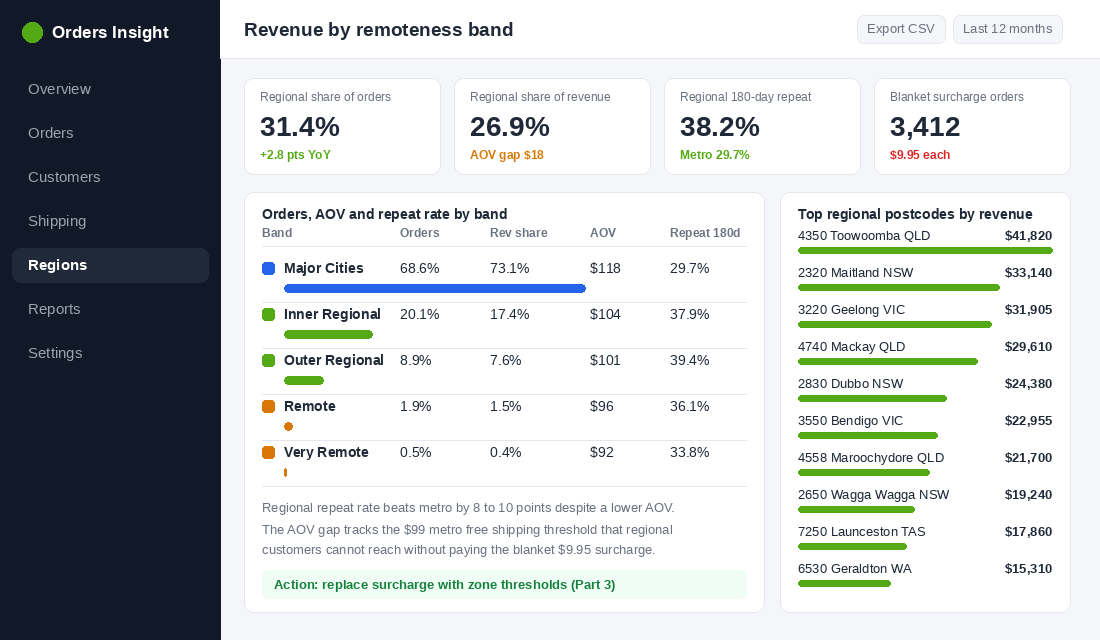
Export the last 12 months of orders from Shopify with shipping postcode, order value, discount, shipping charged, and customer ID. Then classify every postcode using the ABS Remoteness Structure, which sorts all of Australia into five bands: Major Cities, Inner Regional, Outer Regional, Remote and Very Remote. The ABS publishes the postcode-to-remoteness mapping for free, and a VLOOKUP does the rest.
Now build one table with a row per remoteness band and these columns:
- Share of orders and share of revenue. If regional is 30 percent of orders but 22 percent of revenue, your AOV is lower out there and you need to ask why. Usually it is a free shipping threshold they cannot reach or a surcharge that makes them trim the basket.
- Average order value by band. Regional AOV is often higher once shipping friction is removed, because customers consolidate purchases when a parcel is an event rather than a daily occurrence.
- Repeat purchase rate at 90 and 180 days. This is the number that surprises founders. Regional repeat rates frequently beat metro by 5 to 15 percentage points because the alternatives are thinner.
- Shipping charged versus shipping cost. Pull your carrier invoices and match them. This tells you whether you are losing money on regional parcels or simply assuming you are.
- Return rate by band. Regional returns are typically lower in volume but slower and more painful for the customer. You need both numbers.
Then go one level deeper and rank your top 20 regional postcodes by revenue. Almost every brand finds three to five regional centres that outperform inner suburbs of Melbourne. Those postcodes become your test markets for everything that follows in this playbook. If you already run the post-purchase survey we recommend, add one question for regional customers: “What was the hardest part of ordering from us?” The answers will write your next three fixes for you.
Part 2: Fix the Delivery Promise for the People You Are Actually Shipping To
Delivery is now a conversion issue, not a warehouse issue. Metapack’s 2025 outlook found 76.6 percent of consumers would switch brands after a poor delivery experience. Australia Post’s own survey data shows 69 percent of shoppers want a choice of delivery options at checkout and 26 percent expect same or next day when something is urgent. Regional shoppers have all of those expectations, and they have learned the hard way that most stores do not honour them.
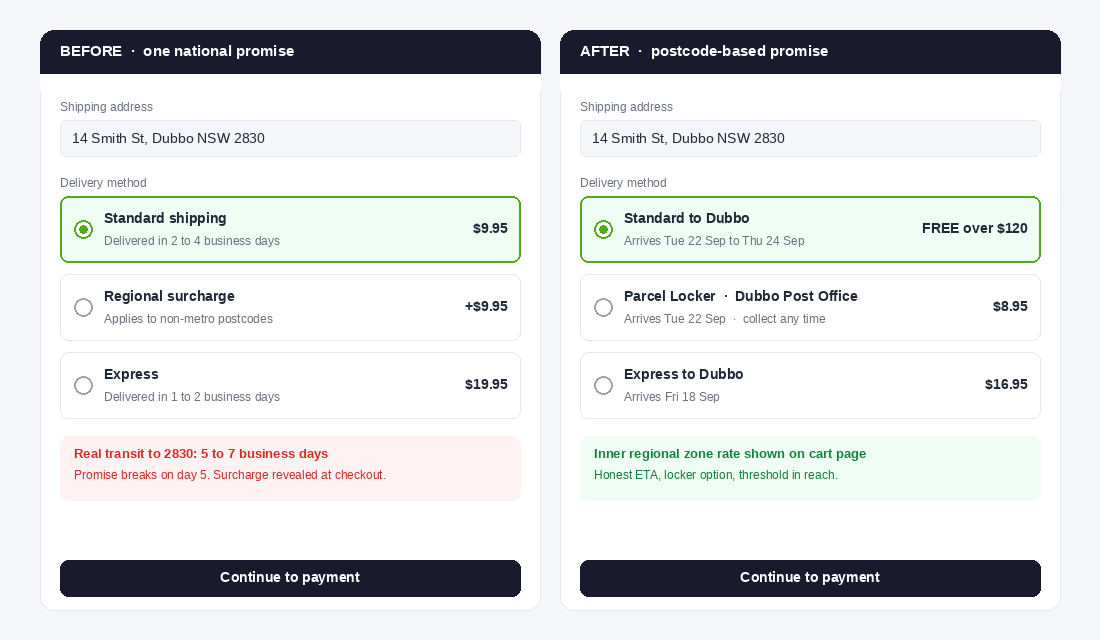
The most common failure is a single, national delivery estimate. “Delivered in 2 to 4 business days” is accurate for Parramatta and fiction for Port Lincoln, where a standard parcel can take 3 to 6 business days and transit can exceed metro benchmarks by two to five days on some lanes. When a regional customer sees a promise they know to be false, one of two things happens. Either they do not trust the rest of your page, or they order, the parcel arrives on day seven, and they never come back. Both cost you the customer.
Here is the fix, in order:
- Show delivery estimates by postcode, not nationally. Shopify’s checkout can display carrier-calculated dates, and apps like Starshipit and Shippit pull live Australia Post and courier transit times per postcode. If you cannot do live estimates, publish an honest zone table on your shipping page: metro, inner regional, outer regional, remote. Founders worry this will hurt conversion. In practice, an honest 5 to 7 day estimate outconverts a broken 2 to 4 day promise because the customer stops second-guessing you.
- Offer Parcel Locker and Parcel Collect at checkout. Australia Post runs more than 1,500 Parcel Lockers, and in regional towns they are often the most reliable delivery point available, because home delivery beyond town limits is increasingly being routed to hubs and agencies anyway. Customers get two business days to collect from a locker before it moves to the Post Office for another ten. One thing to check right now: Australia Post is changing the delivery address format for Parcel Lockers and Parcel Collect from 1 September 2026, so any saved addresses or address validation rules in your checkout need to accept the new format or you will start seeing failed deliveries you cannot explain.
- Send proactive tracking that assumes the longer lane. Regional customers check tracking more, not less. Set your shipping confirmation to say “Your order is on its way to Wagga. Regional deliveries usually land in 4 to 6 business days” instead of a generic “Shipped!” A second message when the parcel reaches the destination facility cuts “where is my order” tickets by a third in our members’ stores.
- Design for the failed delivery. Regional addresses are more likely to be rural numbering, roadside mailboxes or properties where a courier will not attempt delivery. Add an optional “delivery instructions” field, make the phone number mandatory, and read our failed delivery playbook for the recovery flow when a parcel bounces.
Birdsnest, the fashion brand run out of the old Woolworths building in Cooma, has built one of Australia’s most loyal online customer bases by getting this right for a regional audience. Founded by Jane Cay in 2004, it now employs more than 150 locals and serves women across the country and overseas with a Cooma-based team on live chat, phone and email, and a handwritten note in every parcel. That is not a gimmick. It is a deliberate answer to the question every regional shopper asks before they hit buy: “Will these people look after me if something goes wrong?”
Part 3: Price Shipping by Zone, Not by Fear
Most regional surcharges are not based on cost. They are based on anxiety. The founder got one $48 invoice for a parcel to Broome three years ago and has been charging every non-metro customer an extra $9.95 ever since. Meanwhile the Team Global Express report found 48 percent of shoppers abandon a cart over unexpected extra costs, and cart abandonment exceeds 40 percent on orders under $100 when a surcharge appears at checkout. You are losing far more in abandoned orders than you ever lost on that Broome parcel.
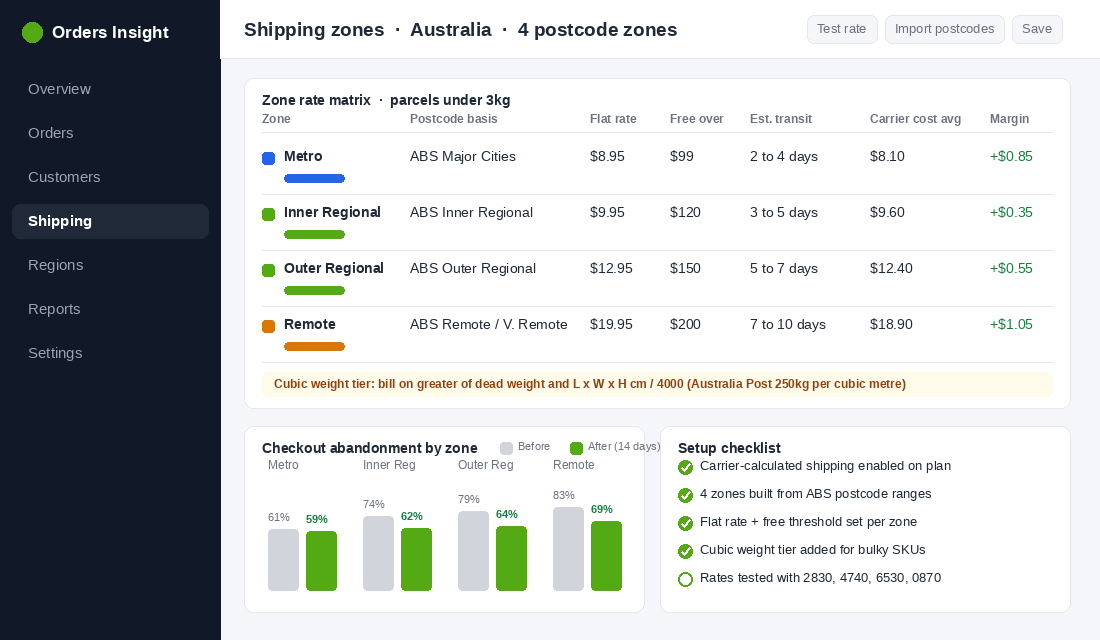
The fix is to replace one national rate and one blanket surcharge with a proper zone matrix. Shopify’s native shipping zones only split Australia by state, which is useless for this, because Cairns and Brisbane are the same state and very different lanes. You need postcode-level zones, which means one of two paths:
- Carrier-calculated rates. Connect Australia Post via Shopify’s carrier service (Advanced Shopify or the carrier-calculated add-on) or through Starshipit or Shippit, and let the live rate flow into checkout. Simple, accurate, but it exposes the customer to the raw cost, which is a poor experience for small orders.
- Postcode-based flat zones. Use an app such as Postcode Shipping or Calcurates to define four zones by postcode range (metro, inner regional, outer regional, remote) with your own flat rates and thresholds per zone. This is the approach we recommend for most brands under $10 million, because you control the story the customer sees.
Setting up Postcode Shipping takes about an hour:
- Step 1. Install the app from the Shopify App Store and enable it as a carrier service in Settings, then Shipping and delivery. It requires carrier-calculated shipping to be active on your plan, which Shopify enables free on annual billing or as a paid add-on on monthly plans.
- Step 2. Build four zones using postcode ranges. The ABS remoteness mapping from Part 1 gives you the list. Do not try to be precise to the town. Ranges are fine.
- Step 3. Set a flat rate and a free shipping threshold for each zone. A typical starting matrix for a parcel under 3kg is $8.95 metro free over $99, $9.95 inner regional free over $120, $12.95 outer regional free over $150, and $19.95 remote free over $200. Tune it against your carrier invoices, not your gut.
- Step 4. Add a weight or cubic tier so bulky items step up cleanly instead of blowing out. Australia Post bills on the greater of dead weight and cubic weight at 250 kilograms per cubic metre, so a large light parcel to Mount Isa can cost triple what the scales suggest.
- Step 5. Test with a real regional postcode in checkout before you switch it on for everyone. Then watch checkout abandonment by zone for two weeks.
The thresholds matter more than the flat rates. Regional customers will happily add a second item to hit free shipping, because a second parcel next month is a much bigger pain for them than for someone in Fitzroy. Ringers Western, the country workwear brand that started as a sketch on a Weet-Bix box on a Kimberley cattle station and now has more than 400,000 customers, runs free shipping over $150 nationally and lets the basket do the work. Our free shipping threshold playbook walks through the margin maths if you want to set yours per zone.
One more rule: never let the surcharge appear for the first time on the payment page. If a zone costs more, show it on the product page or cart with a postcode estimator. The customer who learns about the $12.95 while browsing will still buy. The one who discovers it after entering their card details will not.
Part 4: Remove the Fit and Returns Friction That Kills Regional Conversion
Sizing confidence is worth more than a discount
Online fashion in Australia hit $11.6 billion in 2025 with return rates around 30 percent, and sizing and fit drive close to half of those returns. For a metro customer a return means a five-minute walk to the Post Office. For a regional customer it can mean a 40-minute drive, a fortnight without the money, and a replacement that takes another week to arrive. So they do something rational: they do not order unless they are confident, and they do not reorder if they were wrong once.
That makes fit content a conversion lever specifically for this segment. Put model height and size worn on every product. Add a “true to size, runs small, runs large” indicator built from your own returns data. Show the garment on three body shapes, not one. If you sell footwear, publish a printable sizing guide. If you sell furniture or bulky goods, publish the carton dimensions, because the customer needs to know whether it fits through a farmhouse door and whether it will fit in the ute if it goes to a depot.
Make the return feel as easy as the purchase
Your returns policy should explicitly address distance. Extend the return window to 45 or 60 days for regional postcodes, because a 30-day window from dispatch can be half gone before the parcel even lands. Offer a printable prepaid label and a Parcel Locker or Post Office drop as the default. Where the margin supports it, offer an instant exchange: ship the replacement as soon as the return is scanned at the Post Office, not when it reaches your warehouse. The regional customer who gets the right size in ten days instead of three weeks tells everyone in town.
Write copy that sounds like you have been past Gundagai
Regional customers can smell a Surry Hills brand pretending. You do not need to put a kelpie in every photo. You do need to reflect their actual context: harsher sun, colder mornings, longer drives, product that has to last because replacing it is a hassle. If your reviews mention durability, put those front and centre. If you have customers in Dubbo, Bendigo or Mackay, photograph one of them and say where they are. Buy From The Bush, which started as an Instagram page in 2019 and facilitated more than $10 million in sales for regional businesses within two years, proved that Australians respond hard to authentic regional identity. One seller went from 75 pre-Christmas orders to 350 after a single feature. The audience is there. The tone has to be right.
Part 5: Keep Them, Because Regional Loyalty Is the Real Prize
Acquisition costs in metro Australia keep climbing because every DTC brand is bidding on the same five million people. Regional customers are cheaper to reach and, once won, harder to lose. The Delivering Regional Australia report describes older regional consumers as motivated by reliability rather than price promotions, with loyalty that is hard to displace once established. In a market where 72 percent of shoppers say a better deal has made them switch brands, that stability is worth building a program around.
- Segment regional customers in Klaviyo. Create a segment from shipping postcode using the same remoteness bands. Send them a different post-purchase flow: longer delivery reassurance, a returns explainer, and a “stock up” reminder timed to the average gap between their orders, which is usually longer than metro.
- Bundle for the parcel event. Regional customers consolidate. Build bundles and “add to your parcel” offers that make one order cover two months, and price them so the free shipping threshold is obviously in reach.
- Recruit regional ambassadors. A schoolteacher in Orange with 1,800 followers will outperform a Sydney micro-influencer for this audience every time. Give them product and a code, not a brief.
- Turn up in person once a year. A stand at the Toowoomba Carnival of Flowers, the Ekka, the Henty Field Days or a regional show does two things: it sells product, and it produces a year of authentic content. Our pop-up retail playbook covers the maths.
- Measure loyalty by band, not by average. Track 180-day repeat rate and 12-month LTV for each remoteness band. When regional LTV is 20 percent above metro, which it often is, you have a business case for spending more to acquire regional customers, and a reason to point Meta targeting at Newcastle, Geelong and the Sunshine Coast instead of Bondi.
The Compound Effect: How the Five Parts Work Together
None of these parts is dramatic on its own. Together they change the unit economics of a quarter of your market. Here is what it looks like for a brand doing $2 million a year with 30 percent regional orders.
The revenue map shows regional AOV running $18 below metro and a blanket $9.95 surcharge sitting on every one of those orders. Replacing the surcharge with zone thresholds lifts regional checkout conversion by two points and pushes AOV up as customers add items to hit the threshold. That is roughly $90,000 of recovered revenue before you touch a single ad. An honest, postcode-based delivery promise and proactive tracking cut support tickets and cut the “never came back after a slow first order” churn. Fit content and a distance-aware returns policy lift the regional repeat rate. And because regional customers are cheaper to acquire and stickier to keep, every extra dollar of Meta budget aimed at Geelong or Mackay returns more than the same dollar aimed at inner Sydney.
The compounding part is trust. The regional shopper who had a good first experience with your brand does not have four other stores to try next month. They have you. Get the delivery promise, the pricing and the returns right and you are not just winning an order. You are winning the category in that postcode.
The Regional Australia Checklist
Use this as your 30-day sprint. Tick each item off in order.
- Map. Export 12 months of orders, classify postcodes by ABS remoteness band, build the share, AOV, repeat rate, shipping margin and returns table. Rank your top 20 regional postcodes.
- Promise. Replace the national delivery estimate with postcode or zone estimates. Add Parcel Locker and Parcel Collect at checkout. Check your address validation accepts the new Australia Post locker address format from 1 September 2026. Rewrite the shipping confirmation email for regional lanes.
- Price. Build four postcode zones with flat rates and free shipping thresholds. Add a cubic weight tier. Show shipping costs before the payment page. Remove any blanket surcharge that is not backed by your carrier invoices.
- Product. Add size worn, fit indicators and carton dimensions. Extend the returns window for regional postcodes. Offer instant exchange on scan. Feature real regional customers in your content.
- Patrons. Build a regional segment in Klaviyo with its own flows. Launch two “stock up” bundles. Recruit three regional ambassadors. Book one regional show for the next 12 months. Report repeat rate and LTV by remoteness band every month.
Inside eCommerce Circle, understanding who your customers really are is one of the core pillars we work on with every member, and regional Australia is the avatar most brands have never written down. If you want to see exactly where your store is being capped, take the free More Orders Scorecard. It takes two minutes and shows you which of the 10 P’s to fix first.