You posted the role three weeks ago. Ninety-one people applied. You skimmed the pile late on a Sunday, picked six that “felt right”, had a chat with four of them, and hired the one you enjoyed talking to most. Eleven weeks later they are still asking you which report to pull, your Meta account is drifting, and you are quietly doing the job you hired them to do.
What’s in This Article
That is not a people problem. That is a process problem. In Australia, a bad hire typically costs between 30% and 150% of the employee’s first-year salary once you count recruitment, training, lost output and the replacement round, and somewhere between 15% and 30% of new hires leave or are separated inside the first 12 months. For a $95,000 ecommerce manager, the low end of that range is about $28,500 of pure waste. The high end buys a very good year of paid media.
The founders who get hiring right are not better judges of character. They just refuse to judge character. They score evidence instead, against a document written before the first CV lands. This is the six-stage hiring scorecard system, built for an Aussie Shopify store between $40k and $500k a month, where there is no talent team and no recruiter, just you and a calendar that is already full.
Why Gut Feel Is the Most Expensive Tool in Your Hiring Kit
Decades of selection research land on the same uncomfortable conclusion. The classic Schmidt and Hunter meta-analysis, updated by Schmidt, Oh and Shaffer in 2016, puts the predictive validity of a structured interview at roughly 0.51 against later job performance, compared with about 0.38 for the unstructured chat most of us default to. Pair a structured interview or a work sample with a general ability measure and the composite validity climbs to around 0.63.
Translate that out of academic language. Your unstructured coffee chat is better than a coin toss, but not by as much as your confidence suggests. Adding structure to the exact same conversation, with the same questions in the same order, lifts your accuracy by roughly a third for zero extra dollars.
The market is not making this easier either. SEEK data shows applications per job ad sitting at record highs, up 5.5% year on year, while ad volumes are down 5.8%. More applicants per role sounds like a gift. In practice it means the founder doing the sorting is the bottleneck, and volume makes gut feel worse, not better, because you start optimising for whoever reads well at 10pm.
Atlassian, the biggest software company this country has produced, solved this with process rather than instinct. Every interviewer submits structured written feedback that forms a candidate packet reviewed by an independent hiring committee, and a separate values interview is run by someone outside the hiring team entirely. You are not Atlassian. You do not need a committee. You do need their discipline in a version that fits on two pages.
Stage 1: Write the Scorecard Before You Write the Ad
Most job ads are a list of duties. Duties tell you nothing about whether someone succeeded. A scorecard replaces duties with outcomes, and outcomes are scoreable.
Open a single document and write four things before you touch SEEK.
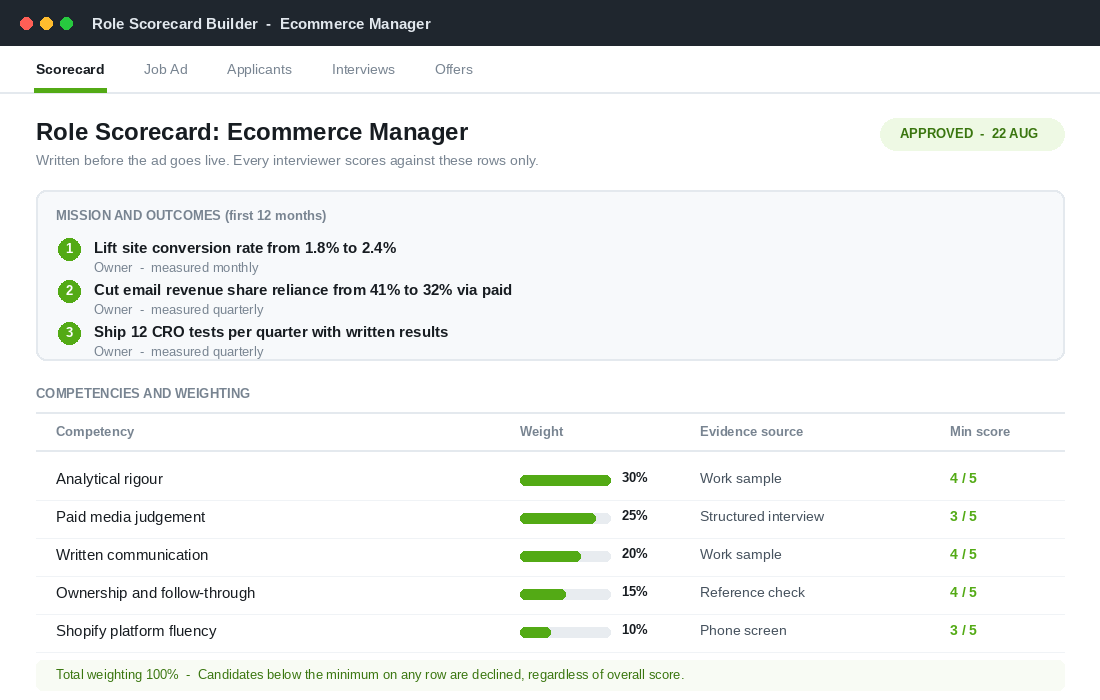
- The mission in one sentence. “Own site conversion and email revenue so the founder never opens Klaviyo again.” If you cannot write it in one sentence, you do not know what you are hiring.
- Three to five outcomes with numbers and dates. “Lift site conversion from 1.8% to 2.4% by June.” “Ship 12 CRO tests per quarter with written results.” Vague outcomes produce vague hires.
- Five weighted competencies. Analytical rigour 30%, paid media judgement 25%, written communication 20%, ownership 15%, Shopify fluency 10%. The weights force you to admit what actually matters.
- A minimum score per competency. A candidate who scores 2 out of 5 on analytical rigour is declined even if their total is high. Averages hide the exact weakness that will cost you in month four.
Then map each competency to the stage that will produce evidence for it. Writing is proved by the work sample, not by asking “are you a strong writer?”. Ownership is proved by a reference, not by a candidate telling you they are self-motivated. If a competency has no evidence source, either find one or cut it from the scorecard.
One rule keeps this honest. The scorecard is locked before the first application arrives. If you edit it mid-process, you are almost always reshaping the role around a candidate you have fallen for, which is the exact failure mode this whole system exists to prevent.
Stage 2: The CV Filter That Cuts 400 Applicants to 60 in an Hour
With applications per ad at record highs, expect 100 to 400 for a decent ecommerce role in Melbourne or Sydney. Reading them properly is impossible. Filtering them mechanically is not.
Build three knockout questions into the application form itself and let them do the sorting. Good ones for a Shopify role look like this:
- A number question. “What was the conversion rate of the last store you worked on, and how did you measure it?” People who have not owned a metric cannot answer this without waffling.
- A tool question. “Name the three apps you would remove from a bloated Shopify stack first, and why.” Fluency shows up in specificity. Anyone naming Klaviyo, Rebuy or Triple Whale with a real reason has touched the stack.
- A 100-word written answer. “Describe a campaign that failed and what you changed after.” This single field kills more weak applicants than the CV ever will, and it gives you a writing sample before you have spoken to anyone.
Score each answer 0, 1 or 2 and only read the CVs of candidates who total 4 or more. You will move 400 to roughly 60 in about an hour, and every cut is defensible because it is tied to the scorecard rather than to a gap year or a font choice.
Resist the urge to keep a “maybe” pile. Maybes are how a clean process turns into eight rounds of second-guessing three weeks later.
Stage 3: The 20-Minute Phone Screen With One Script
The phone screen exists to answer four questions and nothing else. Keep it to 20 minutes, run it the same way every time, and take notes in the same template.
- What are you looking for in your next role? Listen for whether their answer matches the role you actually have, not the one you wish you had.
- Walk me through your last two roles and why you left each. Two minutes each, no more. You are listening for pattern, not for storytelling.
- What are your salary expectations? Ask it at minute 15, not at the offer. Discovering a $30,000 gap after four rounds is a self-inflicted wound.
- What is your notice period and availability? Strong candidates move fast and hold multiple processes. Knowing their timeline lets you compress yours.
Score the phone screen against only the competencies it can actually test, usually platform fluency and communication. Everything else waits. The temptation to make a hiring decision on a good phone call is enormous and it is exactly how founders end up with someone charming who cannot build a report.
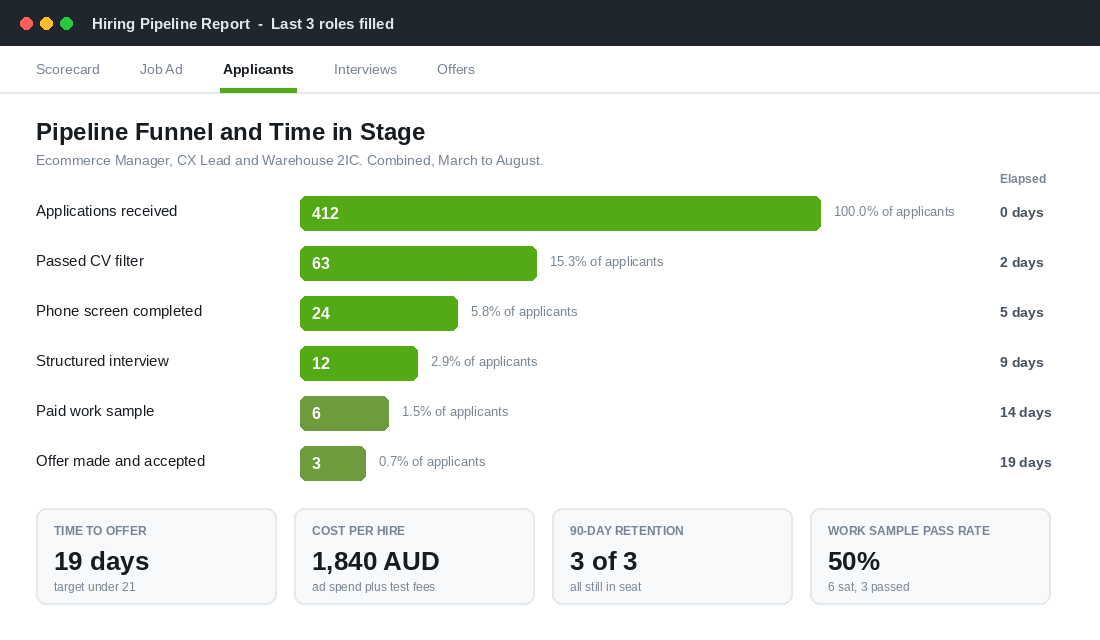
Aim to run 24 phone screens for every 3 hires. That ratio sounds brutal until you price the alternative.
Stage 4: The Structured Interview Where Everyone Asks the Same Questions
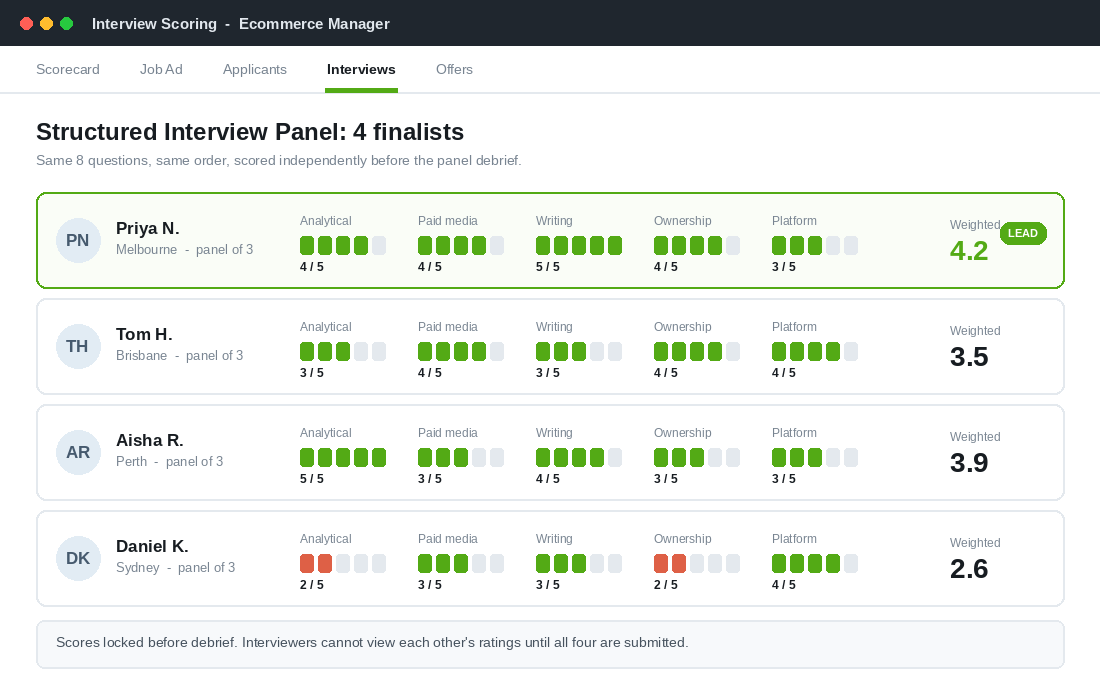
This is where the 0.51 lives. A structured interview means the same questions, in the same order, for every candidate, scored independently before anyone discusses anyone.
Write eight behavioural questions, mapped two per competency, and phrase them in the past tense. “Tell me about a time you found a conversion problem nobody else had spotted. What did you look at first?” beats “How would you approach conversion optimisation?” every single time, because hypotheticals reward people who are good at hypotheticals.
For each answer, chase the specifics until you hit real detail: what the number was before, what they changed, what happened, and what they would do differently. People who did the work have this detail sitting right there. People who watched someone else do the work run out of road inside 90 seconds.
Two mechanics matter more than the questions themselves.
- Score before you talk. Every interviewer submits their 1 to 5 ratings and written evidence before the group discusses. Without this, the first person to speak anchors everyone else and you get one opinion wearing three costumes.
- Write evidence, not adjectives. “Scored 4: rebuilt a GA4 funnel to find a 22% drop at the shipping step, then tested three fixes” is evidence. “Scored 4: really switched on” is a feeling with a number attached.
If you are a solo founder with no panel, borrow one. Your accountant, your 3PL account manager, a founder mate in a non-competing category. One outside scorer on one competency is enough to break your own bias, and it costs you a coffee.
Stage 5: The Paid Work Sample That Ends the Guessing
Work samples sit at the top of the validity table for a simple reason. Watching someone do a small version of the job beats listening to them describe doing the job.
Design the task to take 90 minutes to two hours, no more, and make it a real slice of the role. Some that work well for Aussie Shopify teams:
- Ecommerce manager. Here is 90 days of anonymised GA4 and Shopify data. Find the three biggest conversion leaks and write a one-page plan with the order you would fix them in.
- CX lead. Here are eight real support tickets with names removed. Reply to four of them and write two sentences on the process change each one suggests.
- Paid media. Here is an ad account screenshot and the target contribution number. Tell us what you would turn off this week and what you would build next.
- Warehouse 2IC. Here is a pick error rate by SKU and a floor plan. Where would you move stock and why?
Pay for it. Always. From 1 July 2026 the National Minimum Wage is $26.44 an hour, with the casual rate at $33.05 including loading, so a two-hour task at a fair professional rate is a couple of hundred dollars at most. Paying does three things: it removes any question about unpaid work, it lifts completion rates from strong candidates who have options, and it signals that you value people’s time before they have signed anything.
Score the work sample blind where you can. Strip the names, score against the scorecard rows, then match the scores back to the people. Expect roughly half your finalists to fail it. That failure rate is the entire point, because every one of those failures used to become a hire.
Stage 6: References, the Offer, and the 90-Day Proof Window
Reference calls are usually theatre. Three questions turn them back into evidence.
- “What was their single biggest measurable result while you worked together?” Silence here is data.
- “On a scale of 1 to 10, how likely are you to hire them again, and what would need to be true for it to be a 10?” The second half is where the honesty lives.
- “What kind of manager gets the best out of them?” This is the question that tells you whether you personally can manage this person, which is the variable most founders never test.
Then make the offer quickly. Strong candidates in this market are usually running two or three processes at once, and the founder who takes nine days to decide loses to the one who takes two. Put the scorecard outcomes into the offer letter itself, so the first 90 days measure the same things you hired against. If you want the structure for that first quarter, our 30-60-90 day onboarding playbook maps it out week by week, and the performance review and 1:1 scorecard system keeps the same language running through year one.
The Tool Stack: Set This Up in an Afternoon
You do not need enterprise recruitment software. You need somewhere to hold applications and somewhere to hold scores.
Employment Hero’s Hiring Essentials plan is the pragmatic Australian option: it is free at the entry tier, paid HR plans start around $8 per employee per month, and it handles job posting, applicant tracking, screening questions and interview scheduling in one place. Setting it up takes about 40 minutes.
- Create the role and paste your scorecard outcomes into the description. Not duties. Outcomes. The ad and the scorecard should say the same thing.
- Add your three knockout questions as required application fields, including the 100-word written answer. This is the step most people skip and it is the one that saves the hour.
- Build your pipeline stages to match the six stages here: Applied, CV filter, Phone screen, Structured interview, Work sample, Offer. Rename the defaults so nobody invents a stage mid-process.
- Create one Google Sheet per role for scoring, with competencies as rows and interviewers as columns, and protect each interviewer’s column so scores stay independent until the debrief.
- Set a weekly 30-minute hiring block in your calendar and do all screening in it. Hiring done in the gaps takes six weeks. Hiring done in a block takes three.
Who Gives A Crap, one of the fastest growing ecommerce businesses to come out of Australia, now runs a public applicant tracking board for a remote-first team of 200-plus across hubs in Australia, the Philippines, China, the US, the UK and Europe. They did not start there. They started with structure at 10 people, which is the only reason 200 was ever possible.
How the Six Stages Compound
Any one of these stages on its own is a marginal improvement. Run together, they multiply, because each stage tests something the previous one could not.
The scorecard makes the ad honest, which changes who applies. The knockout questions kill the volume problem before it reaches you. The phone screen removes the salary and timing mismatches that waste your best hours. The structured interview strips out the charisma premium. The work sample catches the people who interview brilliantly and execute poorly, which is the single most expensive category of hire in ecommerce. The reference call tells you how to manage the person you are about to sign.
The compounding shows up in three numbers. Time to offer drops, because there are no undefined stages to stall in. Cost per hire drops, because you are not re-running the process in eight months. And 90-day retention climbs, which matters most, given Robert Half’s Australian research puts even a conservative bad-hire cost at 15% to 21% of salary before you count the morale damage and the founder hours spent covering the gap.
There is a second-order effect that nobody mentions. Once your hiring is structured, your management gets structured, because the competencies you hired against become the language of your 1:1s. Founders who fix hiring almost always report that their existing team got better too, which is a strange and very welcome side effect.
Your Hiring Scorecard Checklist
Copy this into a doc and run it for the next role you open.
- Before the ad: mission in one sentence, 3 to 5 numbered outcomes, 5 weighted competencies totalling 100%, a minimum score per competency, and an evidence source mapped to each row.
- In the ad: three knockout questions including one 100-word written answer, a stated salary range, and the six stages listed so candidates know the runway.
- CV filter: score knockouts 0 to 2, read CVs only for totals of 4 or more, no maybe pile.
- Phone screen: 20 minutes, four fixed questions, salary asked by minute 15, scored on two competencies only.
- Structured interview: eight behavioural questions in fixed order, scores submitted before discussion, written evidence not adjectives, at least one scorer who is not you.
- Work sample: 90 minutes to two hours, real slice of the job, paid at a fair professional rate, scored blind against the scorecard.
- References and offer: three sharp questions, decision within 48 hours of the final stage, scorecard outcomes written into the offer and the first 90 days.
- After the hire: record time to offer, cost per hire and 90-day retention, then review the scorecard against what actually mattered in month three.
The first time you run this it will feel like overkill for a $75,000 role. Run it once and compare the hire to your last three. The difference is not subtle, and it is not luck.
If you are still working out which role to open first, start with the first hire order that most Aussie DTC founders should follow before you build the scorecard, because hiring the right person for the wrong role is still a bad hire.
Inside eCommerce Circle, hiring is one of the core pillars we work on with every member, because the ceiling on most Shopify businesses is not traffic, it is the team. If you want a second opinion on the role you are about to open, let’s talk.