The resignation never arrives on the day it happens. It arrives about ninety days earlier, in a Slack message that went unanswered, a project handed to someone else, a pay conversation you kept meaning to have.
What’s in This Article
Most Aussie Shopify founders find out last. Gallup’s research is blunt about it: 45% of people who leave voluntarily say no manager or leader had spoken to them about their job satisfaction, performance or future in the three months before they walked. Not one conversation. And 42% say their manager or their company could have done something to stop them going.
That is the whole game. Retention is not a perk problem or a ping pong table problem. It is a noticing problem. And in a nine person DTC team where one person owns your entire email channel, not noticing is expensive in a way it never is at a company of 400.
This is the system we run with founders inside eCommerce Circle. Five observable signals, a half hour conversation that beats every exit interview you will ever run, and a scorecard you review once a quarter. None of it requires an HR department. All of it requires you to look.
What Losing Someone You Wanted to Keep Actually Costs
SEEK surveyed more than 950 Australian small and medium businesses and put the cost of one wrong hire at roughly 16,000 dollars. Across the SME sector that adds up to about 7.3 billion dollars a year. Broader Australian benchmarks put a bad permanent hire somewhere between 30% and 150% of first year salary, scaling with seniority: 30 to 50% for support roles, 50 to 100% for mid level specialists, 100 to 150% for senior hires.
Those numbers are usually quoted about hiring the wrong person. They apply just as hard to losing the right one, because you pay the same bill twice. You pay to replace, and you pay for the months where nobody owns the work.
Here is the part founders underprice. Managing the fallout absorbs 4 to 8 hours a week of the owner’s time. If your Meta media buyer resigns in October, you are not just recruiting. You are personally running the ad account through Black Friday. That is the real cost, and it does not show up in any line item.
The macro picture is actually in your favour right now. The ABS put job mobility at 7.2% in the year to February 2026, down from 7.7% the year before, with just over 1.0 million Australians changing employer. People are moving less. But Australian turnover still sat at 13.5% in the June quarter 2026, and retail trade runs hotter than almost every other industry at around 15.5%. Roughly 40% of retail and hospitality businesses report turnover above 20%.
Translation for a team of nine: on industry average you lose one to two people a year. The question is not whether it happens. The question is whether you get to choose which one.
The Five Signals That Show Up Before a Resignation Does
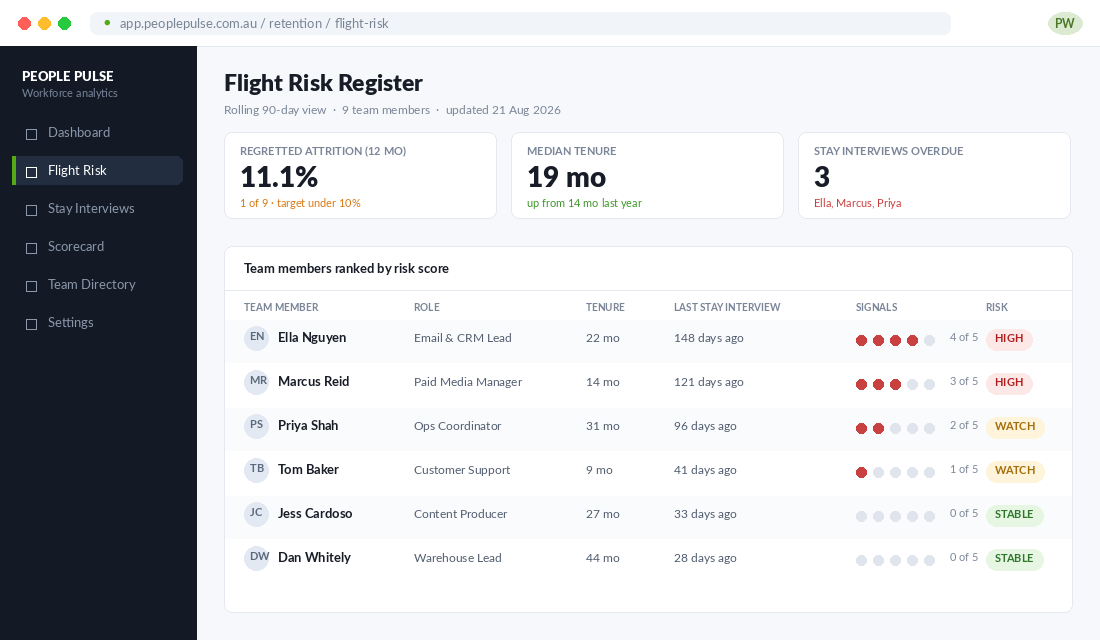
Regretted attrition almost never comes out of nowhere. It comes out of a pattern you were too busy to read. These are the five signals that reliably precede a resignation in a small ecommerce team, and every one of them is observable without a survey tool.
- Signal 1: Discretionary effort stops. Not performance. Effort. They still hit the deadline, but they stopped suggesting the thing nobody asked for. The Slack message that used to say “I noticed our returns page has a broken link” stopped arriving about six weeks ago.
- Signal 2: Meeting posture changes. Camera off in a team of nine. Arriving on the dot and leaving on the dot. Answering only what they are directly asked. In a small remote team this is loud, and it is usually the first thing a founder dismisses as “they are just heads down”.
- Signal 3: The learning stopped. Ask yourself when this person last learned something new in your business. If the honest answer is more than six months, you have a problem. The ABS found 24.6% of people who left their job said they wanted a better job or just wanted a change. Change is what they could not get from you.
- Signal 4: They stopped asking about the future. People who intend to stay ask about next quarter, about the new channel, about who is getting hired. People who have decided stop asking, because the answer no longer concerns them.
- Signal 5: Availability quietly narrows. More medical appointments. More Tuesday afternoons off. Nothing you could ever question, and nothing you should. But interviews happen during business hours, and the pattern is the pattern.
One signal is noise. Two is a conversation. Three or more with someone you would fight to keep is a same week priority, not a next quarter one.
Log this. Not in your head, in a sheet, updated on the first Monday of every month. Name, role, tenure in months, date of last real one on one, signal count, and a rating of stable, watch or high. It takes twenty minutes and it is the single most valuable twenty minutes in your people calendar.
The Stay Interview Beats Every Exit Interview You Will Ever Run
Exit interviews are archaeology. You are asking someone who has already accepted another offer to explain a decision they made months ago, and they will be polite about it because they want the reference. The information arrives too late to be worth anything.
A stay interview asks the same questions while you can still act on the answers. Adoption has jumped roughly 40% in recent years, and organisations running them properly report turnover reductions of up to 20%. It is a thirty minute conversation, run by whoever the person reports to, scheduled every quarter, and it is not a performance review. Do not merge the two.
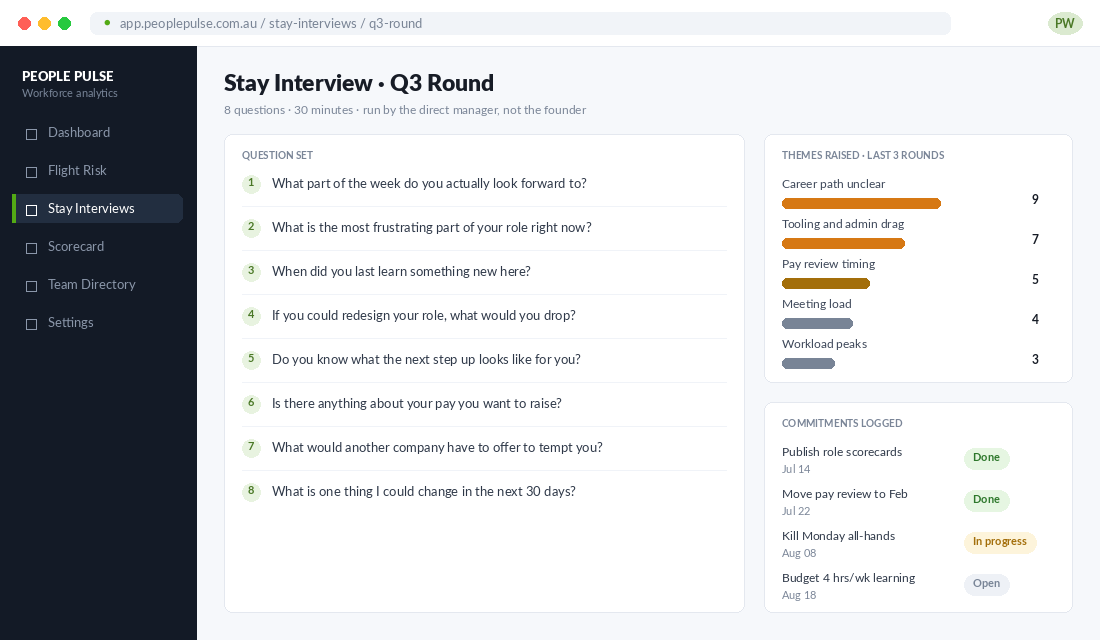
Here is the eight question script. Use it as a guide, not a checklist to read aloud.
- What part of the week do you actually look forward to?
- What is the most frustrating part of your role right now?
- When did you last learn something new here?
- If you could redesign your role, what would you drop?
- Do you know what the next step up looks like for you?
- Is there anything about your pay you want to raise?
- What would another company have to offer to tempt you?
- What is one thing I could change in the next 30 days?
Question six terrifies founders. Ask it anyway. If someone is unhappy about pay, they are already having that conversation with somebody, and you would rather it be you. Our full breakdown of how to structure that side of it sits in the Shopify Compensation Playbook.
Question eight is the one that makes the whole thing work. It forces a commitment out of you, in writing, with a date. A stay interview where nothing changes is worse than no stay interview at all, because you have now proven that speaking up achieves nothing.
The rule we give founders: never leave a stay interview without one thing you have committed to change in 30 days, and never let that commitment die quietly.
Track the themes across rounds. When three of your nine people independently say the same thing about career path or admin drag, that is not nine separate conversations. That is one structural problem you can fix once.
The Four Levers That Hold People, and Which One Matters at Your Size
When someone is wobbling, founders reach for money first because money is the fastest lever to pull. It is also the weakest one, and the most expensive to get wrong. There are four levers. Rank them properly.
Lever 1: The Manager
This is the biggest one and it is almost always you. Close to half of people who leave a small business cite conflict or disconnection with their manager. In a nine person team you are the manager, whether you have accepted the job title or not. If you have not had a real one on one with someone in eight weeks, you are not managing them, you are just paying them. The cadence side of this is covered in the Shopify Performance Review Playbook.
Lever 2: Mastery
People stay where they are getting better. Younger workers are the most mobile group in the country, with 12.0% of 15 to 24 year olds changing employer in the year to February 2026 against 4.9% of those aged 45 to 64. Your paid media coordinator is 24 and every agency in Australia is hiring. The counter is not a bonus. It is four hours a week of protected learning time, a conference ticket, a course budget, and giving them the channel test they have been asking to run.
Lever 3: Mobility
A nine person team has no ladder, so build a lattice instead. Write down what the next version of each role looks like, with the specific capabilities required and a rough timeline. Not a promise of promotion, a definition of progress. “No clear next step” is one of the most common exit reasons in small teams and it is one of the cheapest to fix, because scope, ownership and title cost a lot less than salary.
Lever 4: Money
Pay does not buy loyalty, but underpay definitely buys resignations. Set a fixed annual review date and tell people when it is, so nobody has to ask. Benchmark against actual current SEEK listings for the same role in the same city, not against what you paid two years ago. The rule of thumb: money is a hygiene lever, not a retention lever. Get it right and it stops being a reason to leave. It rarely becomes a reason to stay.
Two Australian brands worth studying here, both of which put employer practice under external scrutiny rather than leaving it to vibes. Melbourne’s Who Gives A Crap holds a B Corp score of 125.5 against a global median of 50.9, with employer impact one of the key drivers of that score, and has taken Best For The World four times. Victoria’s Bellroy scores 96.9 on the same assessment. You do not have to chase certification. But the B Impact worker questions (fair wages, career development, worker feedback channels, benefits) make a genuinely useful free audit of your own people setup, and you can score yourself against them in an afternoon.
Build the Retention Scorecard You Review Every Quarter
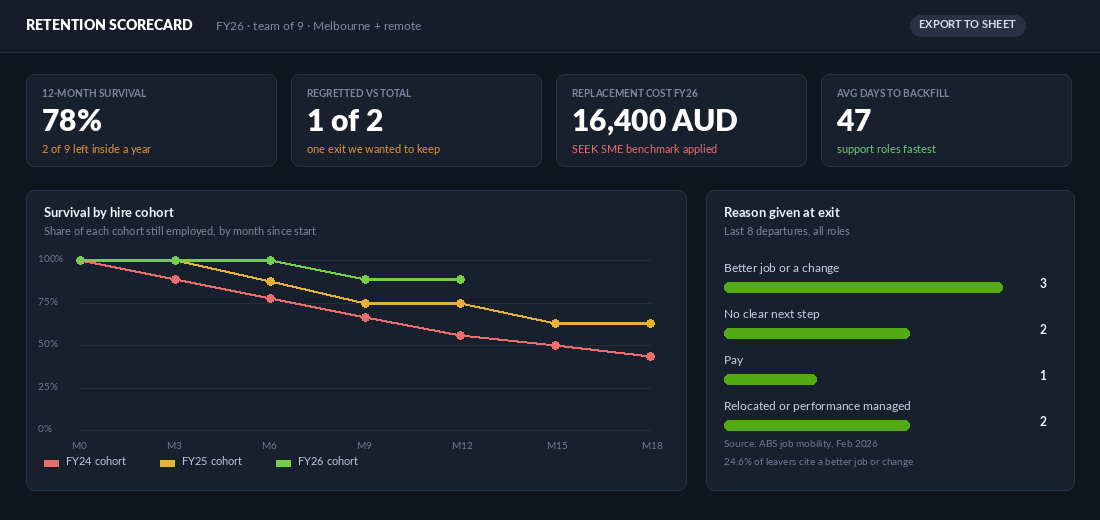
What gets measured gets managed, and almost no founder under 50 staff measures retention at all. Four numbers, reviewed quarterly, alongside your P and L.
- Regretted attrition rate. Of everyone who left in the last twelve months, how many did you want to keep? This is the only turnover number that matters. Losing a mis-hire is a win. Losing your CRM lead is not. Target under 10%.
- Twelve month survival by cohort. Of the people who started in FY25, what share are still here? Plot it by month since start. If the curve falls off a cliff between month three and month nine, you have an onboarding problem, not a retention problem.
- Median tenure by role. Support and paid media almost always sit lowest. Knowing which role burns out fastest tells you where to spend your systems effort.
- Days to backfill. How long from resignation to a productive replacement. This is the number that converts retention into dollars, because every one of those days is either unowned work or your own time.
Add one qualitative column: reason given at exit, in their words, recorded within 48 hours. After eight departures you will have a pattern, and the pattern is almost never what you assumed it was.
How to Set This Up in Employment Hero This Week
You can run all of this in a spreadsheet, and plenty of founders should. But once you pass six or seven people, the admin starts to slip and the review dates get missed. Employment Hero is the Sydney built option most Aussie DTC teams land on, covering HR, payroll and performance in one place across more than 350,000 businesses and 2 million users, and it is already built for the move to per payday super from 1 July 2026.
Here is the setup that turns this article into a running system. Budget about ninety minutes.
- Load the team and lock the dates. Import every employee with their exact start date. Tenure in months is the input for half of what follows, so get it right at the source rather than guessing later.
- Create a recurring “Stay Interview” performance cycle. Under Performance, set up a review cycle on a quarterly cadence and paste the eight questions in as the manager form. Name it something other than “review” so nobody walks in braced for a rating.
- Turn on continuous feedback and 1:1s. Set the one on one cadence to fortnightly at minimum. The system will chase you when one is missed, which is the actual point of paying for software.
- Build a custom field called Flight Risk. Three values: stable, watch, high. Update it on the first Monday of the month off the back of the five signals. Only you and any direct manager should see it.
- Set a fixed annual remuneration review date for everyone. Same month, every year. Put it in the platform so it triggers without you remembering, and tell the team when it is.
- Enable the pulse survey monthly, not quarterly. Three questions is plenty. Monthly gives you a trend line, quarterly gives you a photograph.
- Export to your scorecard on the last Friday of the quarter. Pull tenure, exits and reasons, drop them into the four number scorecard, and review it in the same session you review your numbers.
If you are on a different stack, the same seven steps map onto Bamboo, Lattice or Deel with different menu names. The tool matters far less than the calendar entries. A stay interview that is not scheduled does not happen.
When Someone Resigns Anyway: The First 48 Hours
Sometimes you do everything right and they still go. Partner gets a job in Brisbane. Someone offers them a role you genuinely cannot match. That is not failure, that is a business with good people in it.
Three rules for the first 48 hours. First, be careful with counter offers. A counter offer that only moves money almost always fails, because money was rarely the real reason, and you have now taught the whole team that the way to get a raise is to interview elsewhere. If you counter, counter on scope and role, and only for someone in your top tier.
Second, capture the knowledge before you capture the feelings. Every password, supplier contact, ad account structure, Klaviyo flow logic and half finished project needs to be documented in week one of the notice period, not week four. Notice periods get emotionally awkward and productivity falls off; front load the handover.
Third, run a real exit conversation about a fortnight after they finish, not on the last day. People are far more honest once they are gone and the reference anxiety has faded. We have mapped the full sequence in the 5-phase departure playbook, including how to protect the channel they owned.
Why Retention Compounds Faster Than Recruitment
Here is where the pieces click together. Each lever on its own looks like soft management. Stacked, they behave like a compounding asset.
A person in month 24 is not twice as productive as a person in month 12. They are considerably more than that, because they carry the context that never made it into a document: which supplier actually ships on time, why that discount code was retired, what happened last Boxing Day. That context is the difference between a team that executes and a team that relearns.
Run the maths on a team of nine. Cutting regretted attrition from two people a year to one saves you roughly 16,000 dollars in direct replacement cost, plus 47 days of unowned work, plus somewhere between 200 and 400 hours of your own time across the recruit, onboard and cover cycle. At any sensible valuation of a founder’s hour, that is the highest return activity in your business that quarter, and it did not require a single dollar of ad spend.
Then it compounds again. Longer tenure means better onboarding for the next hire, because someone other than you can run it. Better onboarding lifts twelve month survival. Higher survival means fewer roles open at once, which means you can be picky, which means better hires. Three years of this and you have a team that runs Black Friday without you in the ad account at 11pm.
Start this week. Open a sheet, write down all nine names, add tenure and the date of your last real conversation with each of them, and rate the five signals honestly. Whoever comes out on top of that list gets thirty minutes in your calendar before Friday. That is the entire first move.
Inside eCommerce Circle, keeping the right people is one of the core pillars we work on with every member, because a team that stays is the cheapest growth lever most founders never pull. If you want a second opinion on yours, let’s talk.